Hickory
I have never made hickory syrup. I’ve never tasted it either.
Same disclosure as birch and black walnut, and for the same reason: I run maple — sugar and red, buckets on spiles, a turkey fryer in the yard, fifty to two hundred taps in Michigan, and I sell the jars at a store and a farmers market. Everything below is research.
But I need to tell you something up front, because it reorganizes this entire page and it’s the reason hickory is the strangest entry in this whole section:
Hickory syrup is not made from sap. There is no tapping. There is no boiling down. It is an extract made from toasted bark, mixed into sugar syrup — and the sugar is cane sugar you bought at the store.
Every source agrees. The two best-known commercial producers, the independent recipe writers, the food press — I found no dissent anywhere. This isn’t a contested claim I’m adjudicating. It’s just the fact, and it’s oddly hard to find stated plainly, because “hickory syrup” sits on the shelf next to maple in a bottle that looks exactly like maple’s.
So hickory doesn’t belong on a tree-syrup page at all, structurally. It has more in common with the vanilla syrup at a coffee shop than with anything I make in February. The tree contributes flavor. It contributes zero sweetness.
And yet it earns its spot, cheerfully, for two reasons. First, because if you’re a maple person reading a list of “trees you can tap,” hickory is on that list and it shouldn’t be — and somebody should tell you. Second, because once you get past the disappointment, what’s actually going on here is genuinely interesting, and it’s the only entry in this section that needs no season, no taps, and no evaporator.
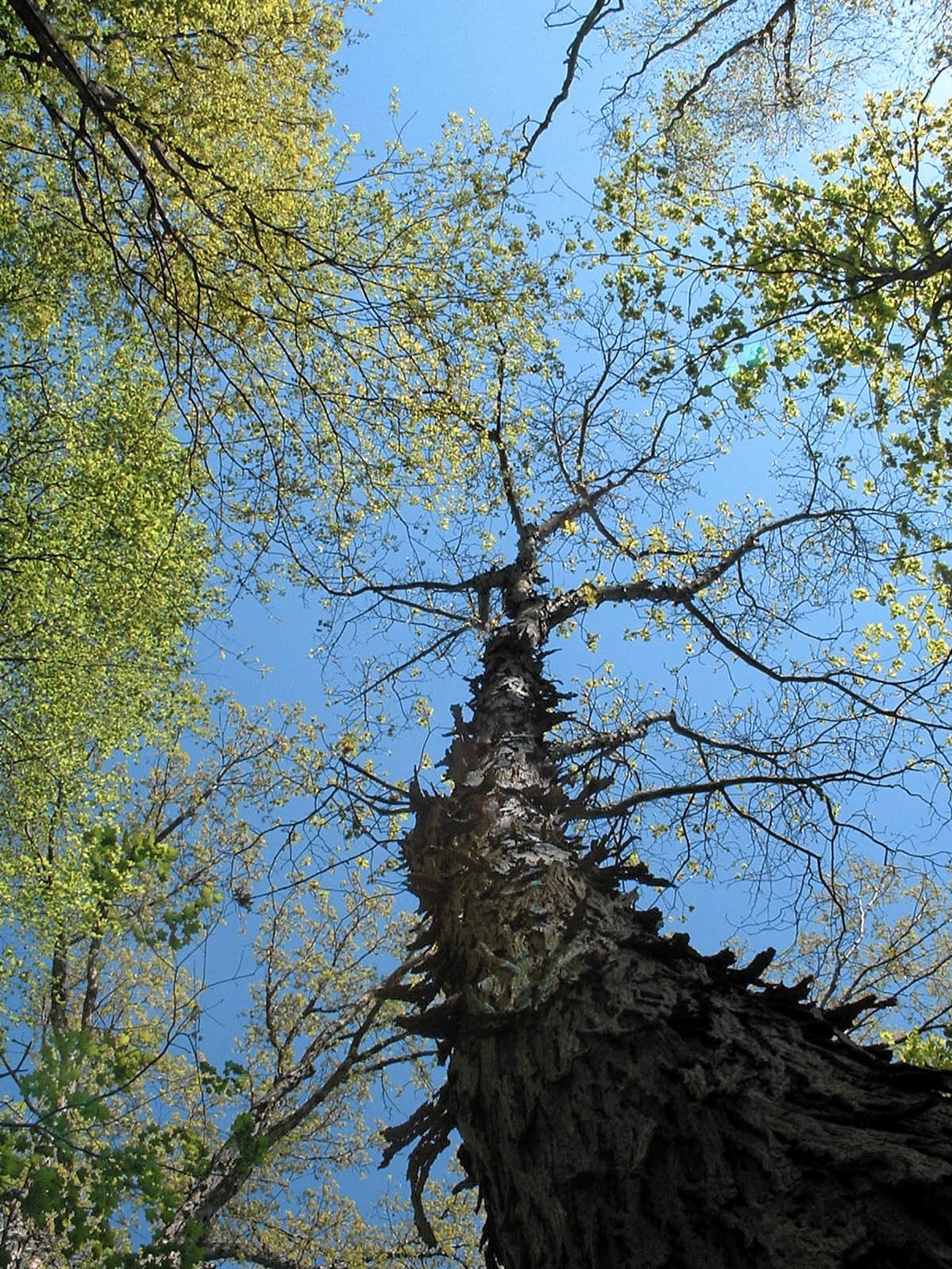
The claim that shouldn’t be there: “you can tap hickory”
Let’s kill this one first, because it’s the obvious question and you deserve a clean answer.
Hickory shows up on the standard “trees you can tap for syrup” listicles, right alongside maple, birch, walnut, and sycamore. You’ve seen those lists. I’ve read a dozen of them.
But I could not find a single extension source, university source, or research program documenting hickory sap being tapped, measured for Brix, or boiled to syrup. Not one.
Not a bulletin. Not a trial. Not a hobbyist with a hydrometer and a blog post. Every hickory syrup you can buy is bark. No exceptions found, anywhere.
And here’s the part that convinced me. The serious non-maple sap research — the programs actually doing this work, the UNH agricultural experiment station and the SARE-funded projects — study birch, beech, sycamore, walnut, and hophornbeam. Hickory is absent from the sap research entirely. Not “studied and rejected.” Just absent. Nobody with a vacuum pump and a grant has apparently ever thought hickory was worth pointing one at.
That absence is itself informative. These are people whose entire job is finding the next tappable species, and hickory — a common, large, well-known nut tree that’s already famous for its flavor — isn’t in their notebooks.
So what happened? My read: listicle inertia. Somebody wrote a list of trees, somebody put “hickory syrup” on it because hickory syrup demonstrably exists in a bottle, and the list got copied down a chain of blogs that were each citing the last one. Nobody stopped to notice that the bottle wasn’t sap. The species name propagated; the mechanism never did.
But let me be precise about what I’m claiming, because there’s a version of this that overreaches.
I am not telling you hickory sap can’t flow, or that a hickory can’t be tapped. I found no source testing it and rejecting it — I found no source testing it at all. Those are different findings and I’m not going to blur them.
The honest position is undocumented, not disproven. If somebody out there is producing sap-based hickory syrup, it isn’t written down anywhere I could find. That’s the defensible sentence, and it’s the one I’ll stand behind.
What it actually is: bark tea and a bag of sugar
The process is consistent across every source, and it’s simple enough that you could do it this afternoon:
- Harvest shagbark bark. (There’s a real disagreement about which bark — that’s the next section.)
- Scrub it clean.
- Toast or roast it over open flame.
- Simmer it in water for about an hour, making what’s honestly just a bark tea.
- Strain, then combine with sugar and cook to density.
Step three is the whole trick, and I want to underline it, because a maple audience will read right past it.
The smoke doesn’t come from the tree. It comes from the fire.
That character everybody describes — the smoky, toasted, campfire-adjacent thing — is a process artifact. You made it. It’s in the roasting step. A raw, untoasted shagbark plate simmered in water is not going to give you that. This is Maillard and pyrolysis on a piece of bark, and then you drink the water it soaked in.
That’s a strange inversion for anybody who sugars. In maple, my whole job is to not screw up what the tree already made. The sweetness, the character, the season-long shift from delicate to robust — that’s the tree’s work and my pan is just a way of removing water from it politely. Here the tree hands you a flavoring agent and you build the entire rest of the product around it.
Falling Bark Farm — the best-documented producer — uses turbinado sugar and a hydrometer to test density and sweetness, and says everything is done by hand. A representative home ratio is one cup of sugar per one cup of strained bark tea.
⚠ That ratio is a hobby-blog figure, not a standard, and I want to flag why that matters more than it sounds. There is no standard. Maple is a regulated category — there’s a legal density, a grading system, defined language about what you may and may not put in the jar. Hickory syrup is regulated by nothing. Every producer is picking their own sugar, their own ratio, their own density, and calling the result “hickory syrup.” Two bottles from two producers aren’t the same product in the way two jars of Grade A Amber are.
There’s a yield figure floating around — roughly six cups of syrup from a pound of bark — but it’s a hobby-source number and I’d treat it as illustrative rather than a spec. It’s the kind of figure that gets repeated because it’s the only one anybody wrote down.
⚠ The sourcing problem — and it’s the whole page
Here’s where I have to stop and be blunt with you, because this is the honest spine of this page the same way juglone is the spine of the walnut one.
Nearly every substantive claim about hickory syrup traces to vendor marketing or a hobby blog. There is essentially no independent research behind any of it.
Not the yields. Not the “few producers in the world” superlative. Not the sustainability claims. And not — this is the big one — “no harm is done to the tree.”
That line is everywhere, and it is a producer’s claim about the producer’s own product. It is not a studied finding. Nobody from a forestry school checked. I went looking specifically for an extension-service or forestry-research source on hickory bark harvest — anything at all on what taking bark does to these trees — and found zero. Not thin evidence. Not conflicting evidence. None.
Now, I want to be fair here, because “vendor said it” isn’t the same as “vendor lied.” The no-harm claim is plausible on its face. Falling Bark Farm sources bark that’s already on the ground, and some of it from the timber industry, where the log has already been harvested and the bark has no value to anyone. That’s genuinely waste material. Picking up a bark plate off the forest floor is about as harmless an act of foraging as exists. I believe it.
But believing it and it being established are different things, and you’re entitled to know which one you’re standing on.
The reason I’m making a point of this: the bark-not-sap headline is solid — everybody agrees, and it’s a verifiable fact about a product you can buy and look at. That solidity has a way of lending credibility to everything printed next to it. Don’t let it. The headline is well established; almost nothing else on the label is.
Compare the neighbors for a second. Walnut has peer-reviewed compositional analysis and Cornell trials. Hickory has a handful of small producers describing their own process, a few bloggers who tried it, and some warm local press. That doesn’t make it less interesting to me — an honest “nobody has actually studied this” is a better read than borrowed authority. But it’s a different kind of page, and pretending otherwise would be the exact thing this section exists to not do.
The bark: which bark, and off what
Here’s the one place the sources genuinely disagree, and once you lay them side by side the disagreement mostly dissolves.
| Position | Source | What they say |
|---|---|---|
| Fallen bark only | Producers | ”Collected after it has fallen to the ground. No harm is done to the tree.” Also from already-harvested timber logs. |
| Detached but hanging | Hobby blog | ”Break off the hanging pieces. Don’t disturb the attachment point.” |
| From the living tree | Forager | ”From a living tree” — they “have lots of shaggy bark to spare” — but “you shouldn’t harvest heavily from a single tree”; heavy harvest “could leave the tree vulnerable to pests and molds.” |
These look contradictory. I don’t think they are, and the resolution is in the species itself.
Shagbark hickory sheds its bark. That’s the defining trait — it’s the whole name. The tree grows long plates that curl away at the top and bottom and eventually let go. So the real question isn’t “living tree or not,” it’s how loose is the piece in your hand:
- (a) Plates already on the ground — the tree is done with them. Nobody objects.
- (b) Loose plates hanging but still attached — the tree is in the process of being done with them. Broadly agreed to be fine.
- (c) Prying off sound, attached bark — this is what every source warns against, including the one that says “from a living tree.”
So the actual rule, and it’s unanimous once you see it: never strip bark that isn’t already loose, and never girdle. Stripping attached bark from any tree risks cambium damage and opens a door for pests and fungus. That’s true of every tree, not just this one.
One more thing that argues for restraint regardless of what any vendor says: shagbark hickory is very slow-growing. It takes something like forty to eighty years to produce nuts. As one source puts it — and this is the line that stuck with me — if you injure these trees, you’re leaving a mark that will last generations.
That reframes it nicely. Even absent any research, the conservative practice costs you nothing. Fallen bark is free, it’s abundant under a shagbark, and it’s the only category nobody argues about. Take the stuff on the ground. There’s no upside to the pry bar.
Flavor — and the one honest note I can offer
I haven’t tasted it, so everything here is somebody else’s palate. Given the sourcing section above, take the vendor descriptions for exactly what they are.
- “Slightly smoky and earthy with a hint of molasses”, with a “golden-brown color and thick, slow-pour consistency” — producer.
- “Notes of vanilla and a bit of toasted nuttiness” — hobby blog.
- “A unique blend of sweet, toasted, and smoky flavors” — vendor copy, and it reads like it.
The descriptions converge on smoky, toasted, nutty, with molasses and vanilla depth, which is at least consistent. But three of those four are people selling bottles, and I’d rather hand you the counterweight than the consensus. A forager who’s made it calls it “smoky, sweet” and, candidly, “more of a ‘poor man’s maple syrup.’”
That’s the most useful sentence I found about the flavor, precisely because nobody’s getting paid for it.
Here’s the one thing I can offer from my own hands, and I want to be careful not to oversell it. I don’t know what hickory syrup tastes like. But I do know what hickory tastes like.
I keep five-gallon buckets of wood chunks I cut up myself, and hickory is one of them — see smoking woods for how I actually use it. It’s the sound of “barbecue” for most of the South: strong, bold, bacon-y, with a slightly sweet edge, and powerful enough to turn bitter if you overdo it. I cut it with apple constantly for exactly that reason.
And the syrup process is toasting hickory over flame. That’s step three. So I’ll say this much: when the producers describe smoky and sweet-edged, that’s the direction hickory goes when you put fire to it, and I’ve smelled it a hundred times over a smoker. That’s not a tasting note and I’m not dressing it up as one. It’s just the one place where this page touches something I actually know.
Uses: you can reportedly use it anywhere you’d use maple — pancakes, coffee, tea. But the smoky, savory lean makes it a natural for glazes, BBQ, pork, cocktails, and vinaigrettes, and it’s been used in beer. These are real documented uses, but they’re scattered and anecdotal rather than any kind of established practice. If I made it, the glaze is where I’d start, because that’s where a smoke note is an asset rather than a surprise.
Who makes it, and what it costs
It’s a genuinely tiny world. A handful of small producers, concentrated in Indiana and Virginia, sold through farmers markets, regional general stores, and specialty mercantile.
- Falling Bark Farm (Joyce and Travis Miller), Clarke County, Virginia — roughly 3,000 gallons a year, described in the food press as “two of just a few hickory syrup producers in the world today.” ⚠ That superlative is press framing, not a census.
- Hickoryworks, Brown County, Indiana — a two-person operation, sold in 8 oz bottles, described locally as the nation’s first factory turning fallen shagbark bark into syrup. Same caveat on the superlative: that’s local press being generous.
There are a couple of other names floating around that I couldn’t independently verify, so I’m leaving them off.
On price: I’m not going to give you one. The only figure I could find is roughly fifteen years old, which makes it worse than useless — it’s a number that would look authoritative while being wrong. Current retail listings I tried either didn’t render a price or couldn’t be verified. If you need a number, go look at a live listing yourself. I’d rather leave a hole than fill it with something stale.
What I can tell you confidently: this is a craft, regional product, sold the way I sell maple — at farmers markets, as an interesting value-added thing on a folding table. That part I recognize.
The Michigan angle — and the genuinely good idea
Shagbark hickory grows here. Hickories reach the northern limit of their range in southern Michigan, and the Lower Peninsula has four species: pignut, shagbark, shellbark, and bitternut. The DNR lists shagbark as a Michigan tree, and “oak-hickory” is a recognized Michigan forest type, common through the southern Lower Peninsula.
Which means if you’re a southern-Michigan sugarmaker, you may already have shagbark on the property. Possibly in the same woodlot as the maples. Quite possibly a tree you walk past in the dark forty times a February without a thought.
And now the part that makes me actually sit up, which follows directly from the headline:
Hickory needs no tapping, no sap season, and no evaporator.
Read that as somebody with a finite number of Februaries. This is the exact opposite of the walnut problem — walnut wants my attention during the best weeks of my only season, and that’s what stops me. Hickory wants none of my February at all.
Bark is on the ground year-round. You could gather it in October. You could toast it in July. There is no run to catch, no freeze–thaw to pray for, no night drive to check buckets. It’s an off-season, zero-infrastructure product made from a tree I already own and a bag of sugar.
That’s the honest pitch, and it’s the best one in this section — if you can get past the thing that stops me:
It isn’t syrup. It’s a flavored sugar syrup, and I’d have to say so on the label.
I sell maple to people at a folding table. The entire proposition is that the jar contains one ingredient and a tree made it. Putting a bottle next to it that’s mostly cane sugar I bought at Meijer — even a good bottle, even an honest one — is a conversation I’d have to have every single Saturday, with every single customer, forever. And I’d have to have it, because not having it is the lie.
Where I land
Hickory is the odd one out and I’m glad it’s here.
It’s the only entry in this section that isn’t tree syrup, and finding that out is worth the price of admission on its own — especially if you came in off a listicle that told you to go tap one. Don’t. Nobody’s tapping hickory, and as far as I can tell nobody ever has, at least not on paper.
What’s left, once you accept what it actually is, is a legitimately clever product: a slow-growing tree that throws away its own bark, a fire, an hour of simmering, and a bag of turbinado. No season. No capital. No four-hour nights. For somebody who wants a woodlot product without a sugaring operation, this is the easiest thing in this entire section by an enormous margin — and unlike birch or walnut, you could try it this weekend for the cost of the sugar.
What stops me is that I’d be selling sugar with a story on it, next to jars that are just tree. That’s a me problem, not a hickory problem. If I ever make it, it goes on the glaze shelf and not the pancake shelf, and this page gets rewritten by somebody who’s tasted it.
And I’d want you to leave with the sourcing, more than the syrup. Everything confident you’ll read about hickory syrup’s sustainability, its yields, and its place in the world comes from people with a bottle to move. They may well be right. Nobody has checked. That’s not an accusation — it’s just the shape of the evidence, and it’s the most honest thing on this page.
For the tree I actually run, see maple. For hickory as the thing I genuinely know it as — a bucket of chunks next to the smoker — see smoking woods. For the species that asks for the one thing I can’t spare, see black walnut.
Comments (0)