The Wider World
I run buckets on sugar and red maples in Michigan, boil on a turkey fryer, and sell what I make at a store and a farmers market. Everything on this site so far has been written from inside that world — the freeze–thaw, forty gallons in and one out, the six-week window that opens when it wants to. If you’ve read the maple pages, you know the shape of my year.
Here’s why this page exists: that year is not how most of the sweetened world works. I’ve been to every state and more than thirty countries, and the most useful thing travel ever did was demolish the assumption that the way I do a thing is the way the thing is done. This page is that, applied to trees. I’ve tapped none of the trees below — I’d rather be the guy who says “I read this carefully” than the guy who implies he was there. What I can do is read the research honestly and point at the part that reframed the whole subject for me. That part is the last section.
Gorosoe — the maple Korea refuses to boil
Gorosoe (고로쇠) is Acer pictum subsp. mono. It’s a maple — not a “maple-like” tree, a genuine Acer, same genus as the sugar maple in my woods and as boxelder. It grows across the mountains of South Korea, runs on the same freeze–thaw physics I rely on, and Korean producers take it to market by the tonne.
And they almost never boil it. They drink it. By the glass. By the gallon.
When I first read that I assumed the sap must be too thin to bother boiling. That’s the intuitive explanation — a North American’s explanation. It’s wrong, and the numbers say so.
The sugar content is the punchline
Gorosoe sap runs 2–3 °Brix. Korean agricultural press converges on about 3 Brix, one source pinning sucrose at 2.7%. Well-corroborated; I’d call it solid.
Now look at your own sap. Sugar maple runs around 2%. Gorosoe is not a low-sugar sap — it’s in the same range as the tree I tap. Rule of 86 on 2–3 Brix gives roughly 29:1 to 43:1. My ratio. Korea is sitting on sap that would boil about as efficiently as anything in Vermont, and chooses not to.
Korean sources say so plainly: sap is 2–3 Brix, syrup standard is 66–67 Brix, therefore a large amount would be needed — stated not as a lament but as an explanation of why syrup isn’t the point. They’re not failing to make syrup. They’re declining to.
One correction, because it’s the kind of error that propagates. Smithsonian called gorosoe “low in sugar—about 40 gallons to make a gallon of syrup.” That refutes itself: 40:1 is the sugar maple ratio. Somebody wrote “40 gallons” and reached for “low in sugar” as the obvious gloss, because in the culture that sentence was written for, 40:1 sounds like a lot of work.
Same genus, same chemistry, same physics, opposite verdict. That’s not agronomy. That’s culture.
Flavor, season, method
Straight from the tree, Smithsonian’s first-person note is “nearly indistinguishable from water” — faint sweetness, mineral finish. Which tracks; 2–3 Brix is barely sweet. If you’ve drunk raw sap out of your own bucket on a cold morning, you know it already. Korean tasting language reaches for 달보드레한 맛 — dalbodeurae, a soft, mellow sweetness. Sweetness moves over the season and was never meant to be syrupy.
Season: mid-January to late March, peaking late February to mid-March, tied to 경칩 (Gyeongchip, “Awakening of Insects,” ~March 5) — the ten days either side are considered the year’s best for taste and composition. It needs a day–night swing of 4–5 °C, which is my freeze–thaw in different units. Two-month window, then a month of tree recovery. Korean press notes the start creeping earlier every year; Michigan sugarmakers won’t need that explained.
Method: drill 1–3 cm deep about a meter up, insert a hose, collect. Increasingly a 연결식 — hoses from many trees manifolded to one point, which the Korea Forest Service recommends as lower-damage and more hygienic. Read that again. Korea adopted tubing for the same reasons we did.
Then the regulation, my favorite hard fact here. The Korea Forest Service’s 「수액의 채취 및 관리지침」 — Sap Harvesting and Management Guidelines — specifies 1–3 holes per tree scaled to diameter, hole diameter fixed at 8 mm, and no tapping trees under 10 cm DBH. A national government writing down a taphole diameter. Hang onto that; it comes back.
Where, and the festivals
The heartland is Gwangyang Baegunsan (광양 백운산), Jeollanam-do: five townships, 18 villages, 447 farm households, 1,686 hectares, over 900 tonnes a year, and Korea’s first geographical indication for gorosoe, 2008. Also GI-registered: Inje, Ulleungdo, Deogyusan. Production runs at Jirisan, Geoje, Hadong, Sancheong, and Unjangsan/Jinan; nine Jeollanam-do counties produce commercially. A geographical indication for sap — the appellation is on the liquid as it leaves the tree, not on anything we’d call a product.
- Jirisan Sancheong Gorosoe Mineral Water Festival (지리산 산청 고로쇠 약수제) — 19th edition, Feb 28, 2026, Sancheong County. There is a sap-drinking contest.
- Gwangyang Baegunsan Gorosoe Yaksuje (백운산 고로쇠 약수제) — 43rd edition, running since the early 1980s, and not a fair at all: a 제례, a traditional rite for community wellbeing and a good harvest.
- Jinan Gowon Unjangsan Gorosoe Festival — mid-March.
I’ve been to plenty of maple festivals. We have pancakes and a sugarhouse tour. Korea has a rite and a drinking contest.
How it’s consumed — the part that got me
Smithsonian reports as much as five gallons in a single sitting. The Korea Times frames it as gallons drunk as a detox after winter.
The setting is a sap-sucking picnic: groups sit in heated ondol rooms, play cards, and deliberately eat salty snacks — dried fish, dried pollock — to make themselves thirsty so they can drink more. Multiply attested, and the image I can’t shake. It’s a party whose organizing logic is engineering your own thirst. Korean sources also describe sipping it between bites of grilled meat or mountain vegetables (산나물), and a porridge with dried pollock (북어). It sells in 20-liter containers and UV-sterilized retail packs. The belief is it must be drunk fresh — no preservative, live microbes, it turns fast.
Two pictures. In Michigan I take forty gallons and spend a day and a lot of propane making one gallon of concentrate that keeps for years. In Jeollanam-do friends sit in a warm room eating salted fish so they can drink five gallons of the same liquid before it spoils. Same tree. Same sap. Opposite ideas about what the tree is for. Neither is a degraded version of the other.
The name, and a monk — folklore, and I’m labeling it
The name is generally explained as an erosion of 골리수 (骨利水 / 骨利樹), “bone-benefiting water” or “tree good for the bones,” worn down to 고로쇠. Consistent across sources, but I found nothing philological proving it — call it a well-attested folk etymology.
The story: Doseon (도선), a 9th-century Silla-dynasty monk, meditated under a maple for months; when he attained enlightenment his legs had stiffened and wouldn’t carry him, so he drank the tree’s sap and they limbered up.
That is folklore, and I’d ask you not to see it repeated as fact. But don’t dismiss it — it’s load-bearing folklore. It’s the story producers, county tourism boards, and newspapers tell, and it’s the stated origin of the name. A story doesn’t have to be true to do real work. The claim that the practice is “thousands of years old” is unsourced; leave it alone.
Health claims versus facts
Sourced fact: the sap is genuinely mineral-rich — calcium, potassium, magnesium, zinc, manganese, amino acids. A Korean figure puts it at 20–30× the calcium and potassium of bottled spring water; that’s industry-adjacent and not independently verified, so hold it loosely.
The claims: bone health and osteoporosis prevention, digestion, blood-sugar stabilization, anti-inflammatory effects, ulcers, hypertension, hangovers.
The status: Smithsonian states the health claims haven’t been proven.
The minerals are real, the claims are beliefs, the efficacy is unproven — all three at once. I sell syrup. I know exactly how tempting it is to let a health halo do your marketing, and what it costs the reader.
Syrup: essentially nil, but not zero
For completeness: Korean patent KR101134089B1, “Syrup process using acer mono max liquid and mountain-grown ginseng,” exists. Someone has worked on it. It’s a novelty, not an industry. The one market figure I have is the Korea Forest Service’s 2014 statistic: about ₩16.1 billion (161억 원), more than doubled over the prior decade. That’s real, and twelve years old. I looked for a current one and didn’t find it, so I’m giving you the old one labeled as old.
Japan tapped the same tree — itaya-kaede (板屋楓), sap 1–5% sucrose, season early February to late April, with a modern revival at Maple Base, Chichibu, Saitama framed as forestry renewal. Thinner sourcing; treat as documented-but-light. China: same subspecies (五角枫, wǔjiǎofēng), and I found no documented tapping or sap-drinking tradition. That’s not “none exists” — it’s “I don’t know,” and I’m not inventing one to round out a paragraph.
Butternut — yes, you can. No, don’t.
Butternut (Juglans cinerea) is a walnut relative — near neighbor of the tree on the black walnut page. Its sap has high sugar content and can be boiled down into a rich syrup. On chemistry alone it belongs on any list of trees worth tapping.
Don’t tap it.
Butternut canker (Ophiognomonia clavigignenti-juglandacearum) produces bark cankers that multiply and kill the tree. It arrived in the US around the beginning of the 20th century, apparently on imported Japanese walnut nursery stock. Since the 1980s, butternut numbers have fallen 58% and volume 44% across the US range — peer-reviewed, solid.
Here’s the mechanism, and why this isn’t sentimentality: a taphole is a bark wound, and bark wounds are how this fungus gets in. You’re not being asked to feel bad for a tree. You’re being told that the act of tapping opens the exact door the pathogen uses, on a species already more than half gone.
Being precise on confidence: the “probably inadvisable” call reasons from canker biology rather than from a study that tested tapping butternut — I found no extension source addressing it directly. So the decline and the mechanism are solid; the recommendation is inference from them. It’s inference I’d bet a woodlot on. When a species has lost 58% of its stems to a bark-wound pathogen, “let’s drill holes in the survivors and see” isn’t an experiment, it’s a shrug. Let it stand. Some individuals show resistance, and the species’ future runs through those. Boil something else.
Ironwood — a small story about how tree lore travels
This one is barely about a tree. It’s about how claims move, and it’ll make you a better reader of everything else here, including me.
Ironwood / hophornbeam (Ostrya virginiana) arrived with two flatly contradictory findings attached. One: nobody taps it, no evidence anywhere. The other: sure they do, and a producer sells the syrup. Both asserted confidently. Both were half right.
Half one: it IS tapped, and syrup IS documented. “No evidence anywhere” is wrong. The Crooked Chimney, of Lee, New Hampshire, has a dedicated hophornbeam page with firsthand detail: that you can harvest sap and make syrup from Ostrya spp.; that the sap has very little sucrose and lots of fructose and glucose, so don’t process it too long or too hot; that syrup made without reverse osmosis tastes like toffee or caramel. The author tapped American hophornbeam with vacuum, and notes others get decent sap without it. On tree health he’s candid — very little is known, so keep it conservative: low temperatures, plastic and stainless only, since these are birch relatives.
And the fact that would make any sugarmaker sit up: sap flows in hophornbeams after maple sugaring season is over. After. A tree that runs when your evaporator has just gone cold is a completely different proposition from one competing for the same three weeks of labor.
Half two: “they sell it” is eleven years stale. Their own homepage says they’re sold out of all their syrup, and that they went on hiatus after the 2015 syruping season so David could pursue a graduate degree. They ran about six years and now point customers elsewhere. So the correct present-tense sentence isn’t a New Hampshire producer sells hophornbeam syrup. It’s a New Hampshire producer documented making it, and stopped in 2015.
And the third piece — the claim that got checked and didn’t survive. One finding asserted that UVM’s Proctor Maple Research Center contradicts the premise. That could not be substantiated. A search of Proctor’s material turned up nothing addressing hophornbeam, ironwood, or non-maple tapping at all — their guidance is maple-specific. There is no Proctor statement saying hophornbeam can’t be tapped. There’s just silence, and somewhere along the line somebody read the silence as a denial, wrote it down as one, and then it was a citation.
That’s the story. Not because ironwood matters much — the evidence base is one small hobby producer plus adjacent university research, which is thin, and nobody has ever measured its Brix — but because one small species puts the entire failure mode of tree-syrup lore on display. A real thing gets reported. The report goes stale and nobody updates it. An absence of evidence gets transcribed as evidence of absence. And both get repeated confidently by people who never looked. Same machinery that produced the 60:1 boxelder figure and the 40:1 sycamore figure, both of which fall apart the moment somebody measures.
When someone says a tree can’t be tapped, ask who measured. When someone says a producer sells it, ask what year. Costs about four minutes.
Palm — the part that reframes everything
Here’s the one.
Everything so far has been temperate tree tapping. Drill the trunk, wait for frost, collect a thin liquid for a few weeks a year, boil most of it away. That’s the craft I practice and mostly what this site is about.
And it is a minority tradition. It always has been.
Palm sap sweetens far more of the world than maple ever has. Not “also sweetens.” Far more. Across South and Southeast Asia, West Africa, and North Africa, palm sap has been the everyday sugar for millions of people for thousands of years — and it’s a fundamentally different operation from mine in every dimension that matters.
| Temperate tapping (maple, birch, gorosoe) | Palm tapping | |
|---|---|---|
| Tissue | Xylem — sap from inside the trunk | Phloem — from a cut inflorescence (flower stalk) |
| Mechanism | Freeze–thaw pressure cycling | Turgor/phloem pressure; wound response — no temperature dependence |
| What you cut | A hole in the trunk | The tree’s own flower, sacrificed before it fruits |
| Season | ~4–6 weeks, once a year, weather-gated | Months to nearly year-round |
| Frequency | Passive drip over a season | 1–2× per day, every day |
| Sugar | 2–3% | 10–25% — five to ten times richer |
| Ratio | ~40:1 | ~10:1 |
| Labor | Walk the bush | Climb a 10–20 m palm, twice a day, every day |
| Spoilage | Days | Hours — ferments spontaneously |
| The tree | Lives, tapped for a century | Lives, but never sets that fruit |
Read down that right-hand column. You are not tapping a palm’s sap in the maple sense at all. You are cutting off the flower and drinking what it would have fed the fruit. The chemistry, the calendar, the labor, and the economics all follow from that. A palm tapper’s year has no season. It has a shift.
That’s the reframe. The real division here isn’t temperate versus tropical, or maple versus everything-else. It’s xylem versus inflorescence. Drill the trunk and wait for frost — or kill the flower and drink the inheritance, every single day. Maple is one branch of that split, the smaller one, and I spent years assuming it was the center of the map because it’s the part I live on.
One honest complication: the Phoenix date palms of Bengal are tapped by incising the trunk below the crown — closer to my model than the inflorescence model. Palm tapping isn’t monolithic.
The species
Palmyra / doub palm — Borassus flabellifer, official tree of Tamil Nadu. You tap the spadix, and here’s the part that sounds invented: the inflorescence must be bound, beaten, then sliced for five to eight consecutive days before it will run — wooden mallets for the female, tongs for the male. You have to beat the flower into yielding. Yield 2.7–7.5 kg per tree per day at an average 13.3 °Brix, collected twice daily to outrun airborne yeasts, over a five-to-six-month season (Jan–May, Cambodian dry season). Unfertilized: 10–27 tonnes of sugar per hectare per year — an FAO figure, and staggering next to a sugarbush. Fresh, it’s neera / padaneer (Tamil), thaati kallu (Telugu) — cool, sugary, refreshing; pots lime-coated to inhibit fermentation. Boiled, the jaggery is karupatti / panai vellam — three to five hours to a golden-brown syrup with a strong caramel aroma. Udangudi, Tamil Nadu is the famous origin, and the local verdict is that it beats cane jaggery: clearer, better aroma.
Sugar palm — Arenga pinnata, gula aren in Indonesia. One inflorescence gives ~5 L a day, tappable one to two months, two to four inflorescences at once per tree. Sugar 15–25% — the richest of the group, though sources split between 15–20% and 20–25%, so take the range not the point. Boiled over wood fire into something rich, smoky, deep amber — and the smoke is a feature, from open wood-fired vats. Sold as syrup, molded blocks, or gula semut, crystalline “ant sugar.”
Coconut — Cocos nucifera. Inflorescence stalk cut in the afternoon, cleaned and beaten for quality, bamboo tube attached, collected next morning. Sugar 10–20%. Basis of the modern “coconut sugar” aisle — a much newer thing than the practice it’s built on. Nipa — Nypa fruticans, a mangrove palm, is tapped at the stalk and its syrup is documented; I couldn’t retrieve the detail, so that’s all I’ll claim.
Date palms — Phoenix sylvestris and P. dactylifera. The distinction matters: P. sylvestris is the Bengal jaggery palm — the nolen gur tree — not the fruiting date palm. P. dactylifera in Tunisia and North Africa runs ~18.6% TSS, sucrose 186.8 g/L against glucose 13.0 and fructose 1.2 — overwhelmingly sucrose, like maple. Season March–June, up to 500 L per tree per season (female ~190 L, male ~140 L). Fresh, that sap is legmi. P. sylvestris carries 11.72–12.50% total sugar in January–February.
Five hundred liters a season, off one tree. I run buckets.
Nolen gur — a winter that can’t be faked
নলেন গুড় — nolen gur, also notun gur, means NEW jaggery. Not a type. A time. It’s the first, freshest tapping of the season, and the whole culture is organized around firstness. Bengalis talk about first-of-season nolen gur the way Burgundy drinkers talk about a vintage.
And it’s hard-gated by cold. The season runs late November to February, and the reason is microbial: cool, dry air lets the sap flow pure and sweet, and if the temperature rises, bacteria ferment it sour and unusable. Nolen gur is a winter-only product and cannot be faked in warm months. I find that genuinely moving. I’d assumed seasonality was the temperate world’s peculiar burden — that you had a sugar season because you had winter. Bengal has one too. It’s just enforced by bacteria instead of frost.
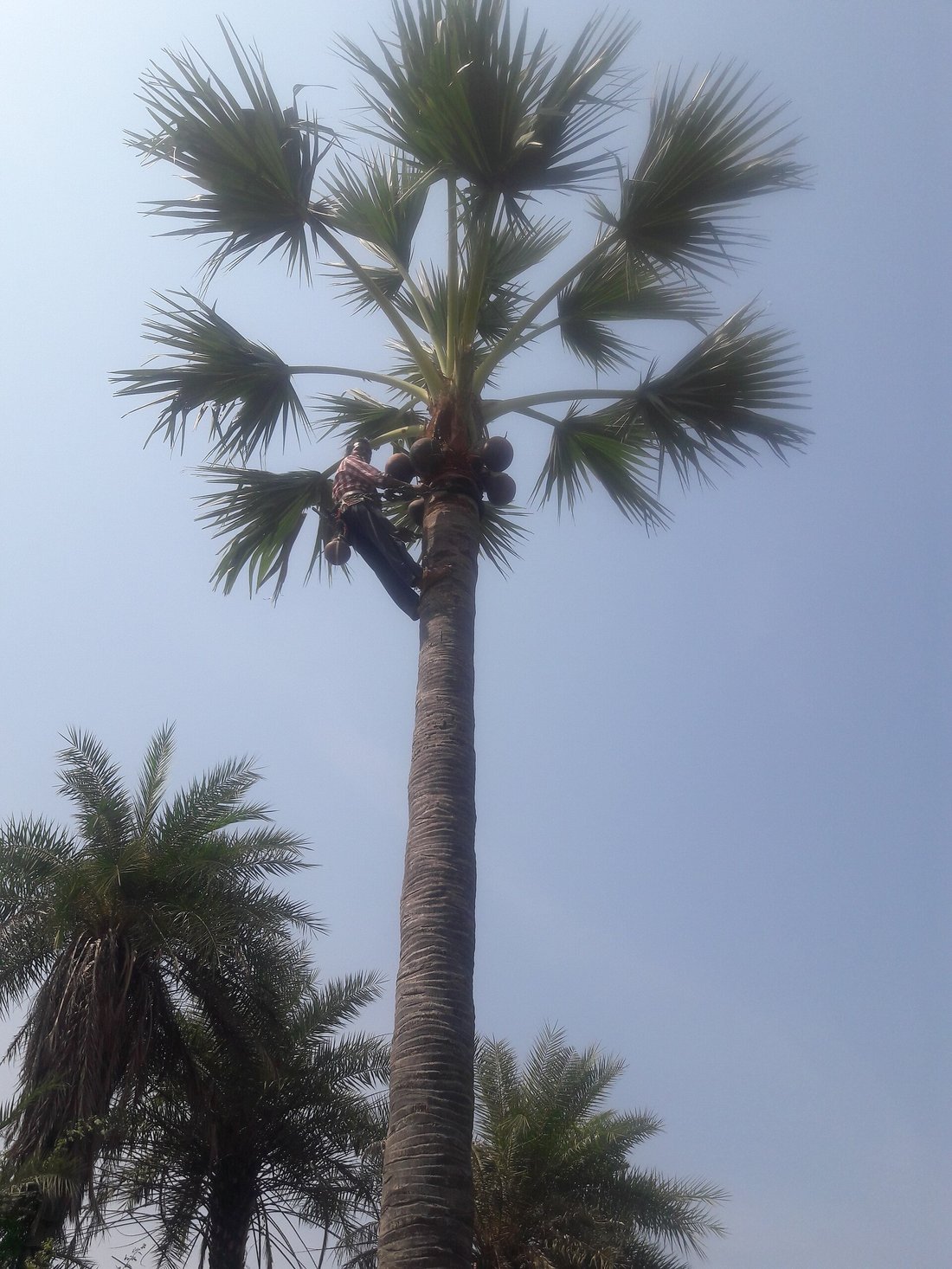
The tappers are the শিউলি — shiuli (also gachhi), migrant specialists whose families relocate to other villages for the season. They lease trees at ₹5,000–7,000 each for the months, meaning they carry the crop risk personally. They start at 4:30 in the morning to collect before sunrise. The method: in the afternoon, slice the bark below the crown, insert a wooden tube — a nalen, very likely the true root of nolen — hang an earthen pot, collect overnight, retrieve at dawn.
Then জিরন — jiron: tap two days, rest the tree two days. A codified rest cycle against over-tapping.
Look at that next to the Korea Forest Service’s 8 mm holes and three-hole maximum and 10 cm minimum. Next to gorosoe’s month of recovery. Next to the tapping chart I follow in Michigan. Every one of these cultures independently invented restraint rules. Nobody coordinated. Nobody had to be told twice. Different centuries, continents, trees — same conclusion: the tree has a limit, and you’d better find it before you’re standing in a dead orchard.
Yield is only 2–3 L per tree per day, and it must be boiled within hours — filtered, poured into wide earthen or iron cauldrons on mud stoves, boiled six-plus hours. The quoted ratio is about 10 L of sap to 1 kg of jaggery, widely repeated and consistent with ~12% sugar, though I couldn’t trace it to a primary source — ballpark, not spec. Forms: ঝোলা গুড় — jhola gur, liquid and pourable; পাটালি গুড় — patali gur, solid cones and blocks; and nolen, the fresh grade, the prize. In 2024, liquid ran ~₹120/kg and solid ~₹330/kg.
The history is older and more industrial than I expected. Roughly a 4,000-year tradition; nolen gur is named in ancient Sanskrit texts; and the first mechanized factory opened in 1837 near Bardhaman, West Bengal — India’s first industrialized palm sugar production. Jessore district alone produced 1,709,960 maunds in 1900–01, some 63,000 tonnes. One district, one year — around the time North American maple was still largely a farm sideline. Read that again and tell me which tradition is the marginal one.
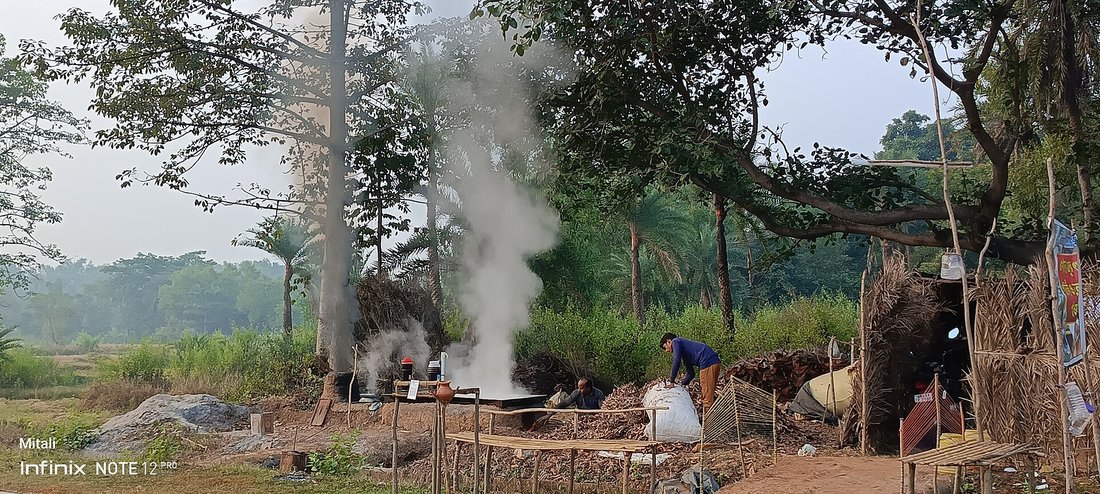
What it tastes like, and why it isn’t maple
Nolen gur: smoky, deeply caramel, faintly salty-mineral, with a date-like resinous edge, markedly less one-dimensional than cane sugar. “Warm, glossy, aromatic.” “Winter’s liquid gold.” Gula aren: rich, smoky, deep amber — the wood fire. Palmyra karupatti: clear, pleasant aroma, strong caramel, locally reckoned superior to cane jaggery.
And the structural reason it can’t taste like my syrup — the best piece of food science on this page:
Maple’s aromatics come from thermal Maillard and vanillin development in a near-pure sucrose solution. That’s my whole flavor story. Sap goes in nearly flavorless; the heat builds the taste. The tree gives me sugar; the evaporator gives me maple.
Palm’s aromatics come from wood smoke, open-pan caramelization, and the sap’s own minerals and organic acids. Three sources, not one. Which is why palm sugar is savory-adjacent in a way maple never is. Not a difference in quality or care — a difference in what’s in the pan and what’s under it.
You can feel it in the use. Nolen gur is the flavor of Bengali winter: rosogolla and sandesh (nolen gur sandesh is the seasonal grail), pithe rice cakes, payesh, poured over luchi, spooned onto plain yogurt for mishti doi. It “imparts a characteristic nuttiness.” More broadly, palm sugar runs through Thai and Indonesian curries and sambals, kaya, es cendol, Vietnamese caramel braises — wherever you want salt plus sweet plus smoke. I put maple on pancakes and think of it as a sweetener with personality. Palm sugar is doing a different job. It’s a seasoning.
And neera / padaneer — fresh sap, drunk chilled as a morning beverage — is the direct analogue of gorosoe. Two hemispheres, two unrelated trees, both landing on: drink it cold, drink it fresh, don’t boil it.
Toddy — the fork in the morning
This has no maple analogue at all.
Palm sap ferments spontaneously and fast. The wild yeasts and lactic acid bacteria are already there — on the flower, in the pot, in the air. Within hours, sweet neera becomes alcoholic toddy (kallu). From there, arrack (distilled), or vinegar.
So the tapper’s core problem is a race. Now re-read every palm practice above: twice-daily collection, lime-coated pots, boiling within hours, a six-hour cook starting the same morning. Every single palm sugar practice is an anti-fermentation measure. It isn’t a set of techniques with a safety footnote — the anti-fermentation is the technique.
Sweet palm sugar and palm wine are the same liquid at different hours of the same morning. That fork — sugar or booze — is decided before lunch, and often by which pays better that week. I have nothing like it. My sap spoils in days if I’m careless; that’s a nuisance. It does not turn into a different product with a different market while I walk back to the truck. Also: legmi (Tunisia), palm wine (West Africa), tuba, bahalina.
Nipah virus — the thing you must know about raw date palm sap
Leaving this out would be dishonest. Overplaying it would be too. So: plainly, then stop.
Raw date palm sap consumption is strongly linked to Nipah virus infection, primarily in Bangladesh. Fruit bats (Pteropus) drink from the collection pots overnight and contaminate the sap with saliva or urine. Fresh raw sap is the main transmission route, and the case fatality rate is high.
Two things go with that. First, there’s an intervention and it works: “bamboo skirts” over the tap and pot cut bat contact from 83% to 2%. A cheap, local, physical fix to a lethal problem, and it deserves more attention than the scary headline. Second — and this gets lost — boiled gur is safe. Heat kills the virus. The danger is specific to the fresh raw sap tradition, not to jaggery, not to nolen gur, not to anything that’s been through the cauldron.
There’s an asymmetry worth sitting with. Korea has a fresh-raw-sap drinking culture too — that’s the whole gorosoe story — and it carries no equivalent hazard, because there are no Pteropus bats in the picture. Two cultures do the same sensible thing, drink the sap fresh, and one runs into an ecology that turns it lethal. That’s not a difference in wisdom or hygiene. It’s an accident of which mammals share your trees.
The labor, and why it’s disappearing
Tappers climb 10 to 20 meters, often twice a day, every day, for months, on notched trunks or rope loops, without fall protection. Palmyra and date palm climbing carries a real, documented injury and fatality rate.
And nolen gur is vanishing — not from agronomy. The trees work, the chemistry works, and people will pay ₹330 a kilo. It’s vanishing because young people won’t do this work, because palms are being cut for land, and because warming winters shorten the cold window that keeps the sap from souring. The scarcity is a labor and climate story, not an agronomy one. I walk to my buckets. The difference between my craft and theirs isn’t skill or tradition — it’s that mine doesn’t require anybody to climb a sixty-foot tree twice a day in the dark.
What I take away
I came in with the map I inherited: maple at the center, everything else arranged around it by how closely it resembles maple. Boxelder is almost maple. Sycamore is maple but worse. That’s the frame nearly every tree-syrup page on the internet is written inside — including, until I did this reading, mine.
The frame is wrong. Maple is the parochial one. A narrow, cold-weather, six-week practice on one genus in one corner of one continent, elevated to the default because that corner writes a lot of the food internet. Palm sap has sweetened more people, for more of the year, for more centuries, than maple ever has. Gorosoe is the same genus as my tree, and Korea drinks it by the gallon and thinks boiling it is beside the point.
That’s why this page is last in the section rather than first. You have to have the maple picture firmly in your head before it’s worth taking apart.
What survives the taking-apart is the encouraging part: the restraint rules. Korea’s 8 mm holes and three-tap maximum. Bengal’s jiron, two on, two off. Gorosoe’s month of recovery. My own chart from the extension service. Nobody coordinated. Every one of these cultures, different tree, different century, different tools, reached the same conclusion: the tree has a limit, find it, stay inside it. That’s not maple wisdom or Korean wisdom or Bengali wisdom. That’s what happens when people depend on a tree long enough to notice. And butternut is the same lesson pointed the other way — good sap, high sugar, and you should leave it entirely alone, because the thing you’d do to it is precisely what’s killing it. Sometimes the restraint rule is don’t.
If you got here from the maple pages, read them once more with this in your head. Nothing in them is wrong. But they’re a local dialect, not the language — and I say that as someone who’s spent a lot of cold mornings speaking it, and expects to spend a lot more.
Comments (0)