Tasting & Using It
I sell my syrup. A store carries it, and I stand behind a table at a farmers market with it, and that means I have had the same conversation a few hundred times. Someone picks up a bottle of the dark stuff, turns it over, squints, and puts it back down for the light one. “I want the good one,” they say.
Here’s the thing I have to say gently, every single time: they’re both the good one. Dark maple syrup is not leftover, not overcooked, not second-rate, and not what didn’t sell. It is a different moment in the spring, captured. And once you understand why it’s dark — which is a genuinely great piece of chemistry — you stop thinking of the grades as a quality ladder and start thinking of them the way you think about olive oil or coffee roasts. Different tools. Different jobs.
So this page is the conversation I’d have with you at the table, if the line behind you weren’t so long.
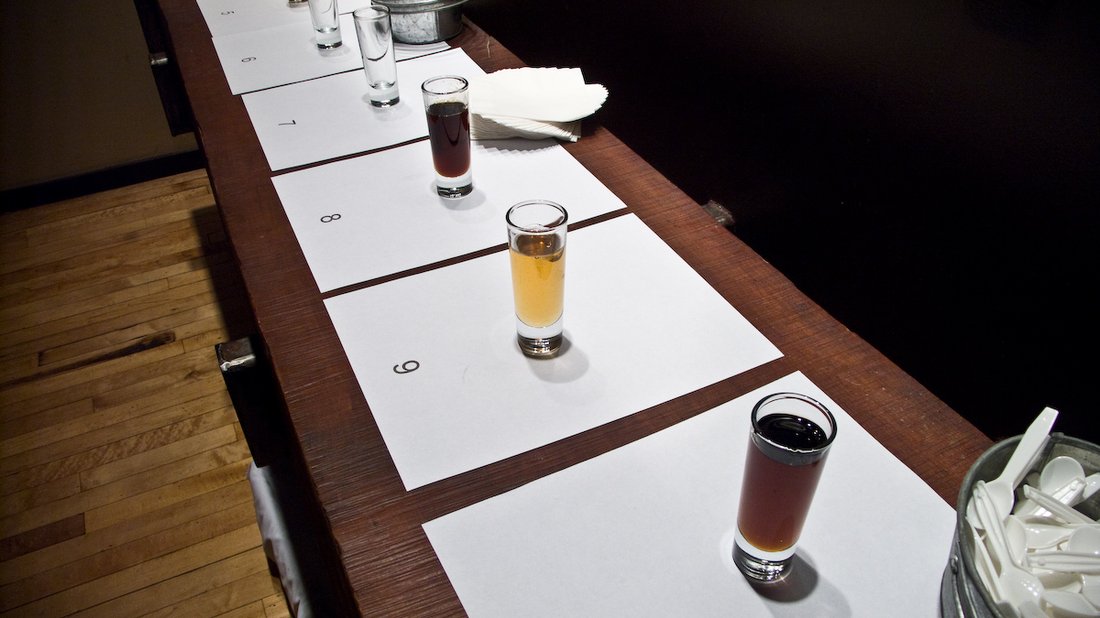
That’s the gradient. Not better to worse — earlier to later.
The grades, and what they actually mean
Since March 2, 2015, the US and Canada have used one shared system. Before that we had a mess — Vermont called things one name, the federal standard called them another, Maine’s statute used a third — and 2015 swept it into four classes, each with a color band and a flavor descriptor:
| Grade | Descriptor | Light transmittance |
|---|---|---|
| Grade A Golden | delicate taste | 75.0 %Tc and up |
| Grade A Amber | rich taste | 50.0 – 74.9 %Tc |
| Grade A Dark | robust taste | 25.0 – 49.9 %Tc |
| Grade A Very Dark | strong taste | below 25.0 %Tc |
%Tc is light transmittance — literally, how much light gets through the syrup, measured on a spectrophotometer. Golden lets three-quarters of the light through. Very Dark lets less than a quarter. That’s all the number is. It is a measurement of color and nothing else, and the flavor descriptor rides along with it because in maple, color and intensity track each other almost perfectly.
The single most important thing the 2015 rule did was delete “U.S. Grade B for Reprocessing.” That word — reprocessing — was doing enormous damage. It implied the dark stuff was a defect that needed fixing. It wasn’t. Darker syrup that’s clean and free of off-flavors is now simply Grade A Dark or Grade A Very Dark. Nothing was taken off the shelf. The insult was taken off the label.
I still get asked for Grade B by name. People miss it, and they mean it as a compliment — the in-the-know shoppers had figured out years ago that “B” tasted more like maple than “A” did, and they felt clever about it. They were right. They were just fighting a label that was lying to them.
Mapping it to the old system
If you’ve got an old jug in the cupboard, or an old recipe calling for a grade that no longer exists, here’s the honest crosswalk. I’m using Maine’s statute (Title 7 §892-A) for the old numbers, because Maine happens to carry both systems in one law — which means it pins the exact old cutoffs that marketing pages never bother to.
| Old grade | Old %Tc band | Becomes |
|---|---|---|
| Grade A Light Amber (Vermont’s “Fancy”) | 75.0 and up | Golden — identical band |
| Grade A Medium Amber | 74.9 – 60.5 | Amber |
| Grade A Dark Amber | 60.4 – 44.0 | straddles Amber and Dark |
| Grade A Extra Dark Amber (“Grade B”) | 43.9 – 27.0 | Dark, or Very Dark at the bottom |
| Commercial | below 27.0 | Very Dark if clean; Processing if not |
Look at the top line: ≥75.0 %Tc is the one boundary that survived 2015 untouched. Old Light Amber and new Golden are the same syrup, same band, new name. Every other line moved to round numbers — 50.0, 25.0 — and that’s where the tidy story breaks. Old Dark Amber straddles the new Amber/Dark boundary. A jug of Dark Amber could land on either side today depending on where in its band it fell. So if anyone hands you a clean one-to-one conversion chart below Golden, they made it up. There isn’t one.
There’s also a fifth class you’ll never see on a shelf: Processing Grade. It can be any color and any light transmittance, it’s allowed to carry off flavors and odors, and by rule it must be packed in containers of five gallons or twenty litres and up. It’s the industrial stream — the stuff destined to be an ingredient in something else. If you’re buying a bottle at a market, you’re not looking at it.
Why dark is dark (this is the good part)
Here’s the folk explanation, and it’s wrong: dark syrup was boiled longer, or boiled harder, or made by someone careless.
Here’s what actually happens. And I love this, because it means every bottle of syrup is a readout of the weather.
Start with the raw material. Sap is 2–3% sugar. Syrup is about 66%. It takes roughly forty litres of sap to make one litre of syrup — which is the whole brutal economics of this hobby in one sentence, and why I spend my Michigan Marches watching a turkey fryer boil off water that used to be a tree’s winter savings.
Now the key fact: maple flavor is made, not found. Raw sap does not taste like maple. It tastes like faintly sweet water — genuinely underwhelming the first time you taste it, and every sugarmaker remembers that letdown. All of it, the entire flavor, is created in the boil, principally by the Maillard reaction: amino acids reacting with reducing sugars under heat. The same reaction that browns a steak and toasts a crust is the one that makes maple taste like maple. More than 250 compounds beyond plain sucrose have been identified in syrup — carbonyls, phenolics, 27 different pyrazines, alcohols, acids, furans.
Including, and this delights me every time: vanillin. The vanilla molecule. It’s genuinely in there, and the boil makes it. That’s a real, sourced reason maple reads as warm and vanilla-adjacent on the tongue rather than just sweet.
So why does the syrup get darker as the season goes?
- Microbes multiply in the sap as spring warms. Populations climb steadily across the harvest.
- Those microbes split sucrose into fructose and glucose — which are reducing sugars, and reducing sugars are exactly what the Maillard reaction eats.
- More reducing sugar in the pan → more Maillard in the same boil → darker, stronger syrup.
That’s it. Darkness is a symptom of the sap’s chemistry, not of your boiling. Two sugarmakers running identical rigs on identical fires in the same week will both make dark syrup in April and both make golden syrup in March, because the trees are the variable, not the fire.
The season’s amino acid profile shifts too — glutamic acid and histidine decline, methionine and asparagine climb — and that shift produces off-flavor precursors. Which brings me to the honest footnote on all of this: the late season is a gradient toward defect, not infinitely toward better. Don’t over-romanticize Very Dark. Push far enough past it and you get buddy syrup, which ends everyone’s season.
Buddy, and a disagreement worth knowing about
When the tree starts pushing buds, the sap changes and it carries into the syrup. Buddy syrup signals the end of sugaring, full stop.
What it tastes like is genuinely contested, and I’d rather show you the disagreement than pretend it away. Vermont’s state grader describes buddy as chocolaty — “almost a tootsie roll” flavor, going toward bitter chocolate when it’s strong. The chemistry literature describes it as cabbage-like, driven by dimethyl disulfide, formed when yeasts work on sulfur-containing amino acids. Chocolate and cabbage are not the same descriptor. Nobody I’ve read has reconciled them — maybe it’s concentration-dependent, maybe grading tradition and chemistry just use different vocabularies for the same molecule. Both descriptions come from people who know far more than I do. I’m not going to pick.
Worth knowing: in Maine, “buddy” is a legal term — the statute names it explicitly as a disqualifier.
One more myth to kill: quebecol
You’ll see it written that quebecol is “the maple flavor molecule.” It isn’t, and the claim falls apart on inspection.
Quebecol is not present in raw sap at all. It’s formed during the transformation of sap into syrup — it’s a product of the boil, same as the flavor is. What it’s actually good for is authentication: it’s a distinctive phenolic marker, uncommon in syrups from other plants, and it’s how you can tell real maple from an imitation. Its contribution to taste is not established in anything I’ve read.
So the honest version: quebecol is a molecule that exists only because you boiled the sap. It’s a chemical signature of the process — a fingerprint, not a flavor.
How I actually use them
Here’s the working rule I give people at the table, and it’s simpler than the grade chart makes it look:
Use Golden where maple is the point and nothing competes. Use Dark and Very Dark where it has to survive butter, flour, heat, or bacon.
Golden (delicate) is early season, and it’s fragile. Over vanilla ice cream, in tea, on a plain yogurt, drizzled on something that has no other business being loud. Put Golden in a batch of cookies and you have thrown your money in the oven — the flour and the butter will eat it alive and you’ll taste nothing but sweet. Some people find Golden too delicate, and that’s a fair reaction, not a failure of palate.
Amber (rich) is mid-season and it is the maple flavor most people have in their heads. It’s the classic. If you buy one bottle a year and put it on pancakes, buy this one. It’s also what bulk buyers reach for, for exactly that reason.
Dark (robust) is the cooking grade and my personal workhorse. Anywhere heat and fat are involved, this is the one. Glazes, marinades, baked goods, anything on a grill.
Very Dark (strong) is where maple stops being a background note and starts being an ingredient with opinions. Barbecue sauce. Baked beans. Anything that also contains chilies or smoke or mustard and needs a sweetener that can be heard over them.
Beyond pancakes
Maple’s real trick is that it’s not just sugar-in-liquid-form — it’s sugar plus acid plus several hundred aromatic compounds, which means it behaves like a seasoning in places plain sugar can’t go.
The pairings that reliably work: bacon, mustard, apples, root vegetables, aged cheddar, coffee, lemon, balsamic vinegar, chili flakes. Look at that list for a second — it’s mostly savory and mostly sharp. That’s the tell. Maple doesn’t want another sweet thing next to it. It wants something to push against.
- Glazing proteins. This is the highest-leverage use of syrup in a home kitchen. The sugars brown, the syrup’s own acidity does a little tenderizing at the surface, and the aromatics stick around. Pork and salmon are the obvious ones; bacon is barely even a suggestion at that point. Brush late, not early — sugar burns.
- Roasted vegetables. Carrots, parsnips, squash, Brussels sprouts. A little syrup, a little mustard or vinegar, hot oven. The maple and the char are doing the same chemistry from two directions.
- Dressings. Syrup instead of honey, with balsamic or lemon. It emulsifies more willingly than honey and doesn’t seize when it’s cold.
- Cocktails. Syrup is a bartender’s dream because it’s already a syrup — no simple syrup to cook, no undissolved sugar in the bottom of the shaker. It dissolves cold, which granulated sugar simply will not do. Anywhere a recipe says “simple syrup,” you can say maple instead and find out what happens. With whiskey it’s not even a question.
- Coffee. Sweeten with Dark and you’ll never look at a flavored syrup pump again.
- Caramelized nuts, and popcorn. Both work, both are dangerous to have in the house.
- Oatmeal, which needs no explanation.
Sugar on snow
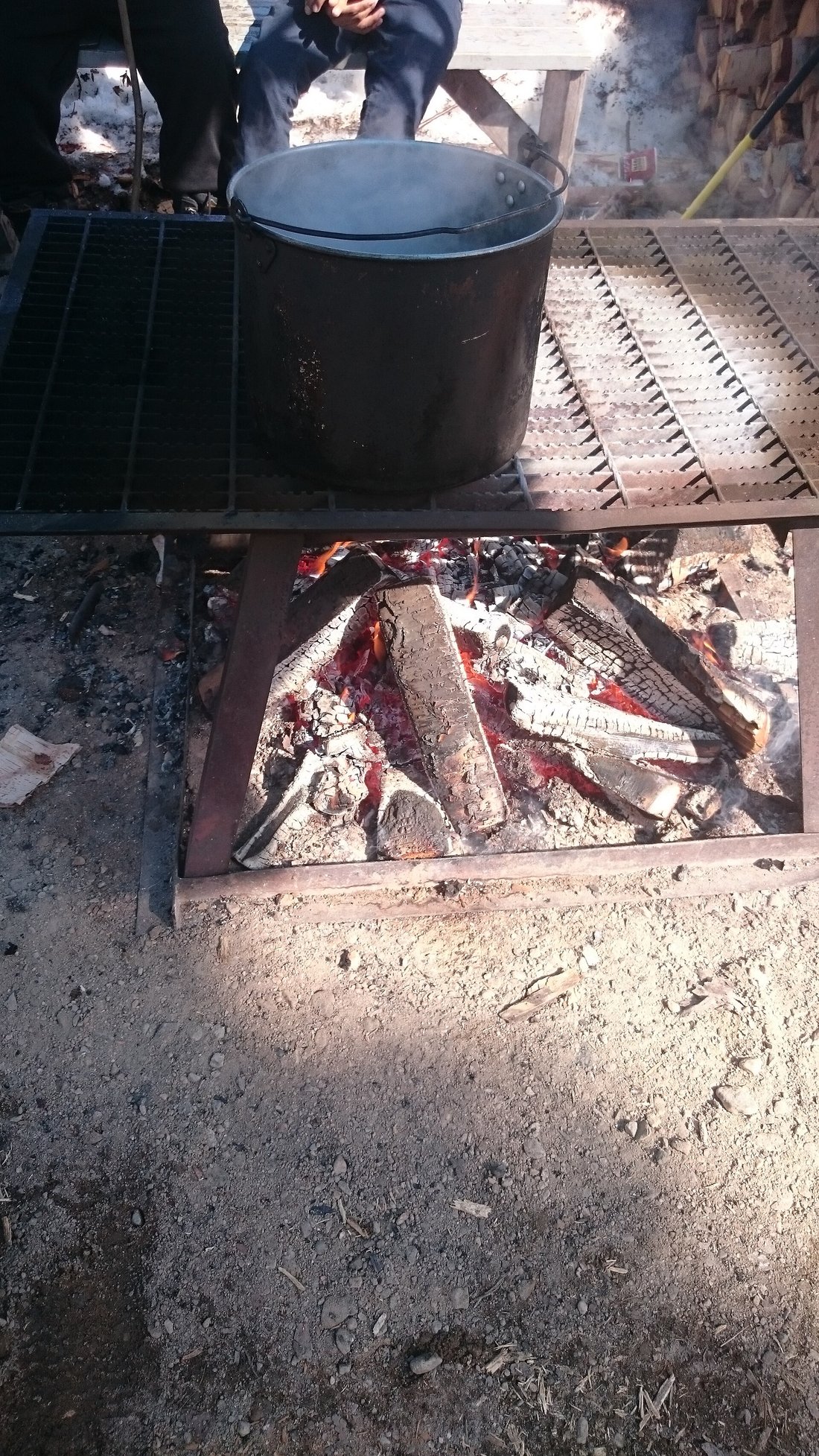
And then there’s the one that isn’t cooking at all, it’s a rite of spring: sugar on snow. You boil syrup past syrup — past the finishing point, up toward candy — and pour ribbons of it onto clean packed snow. It seizes on contact into taffy you pick up with a fork and wind into your mouth. Traditionally it’s served with a pickle and a plain doughnut, and if that sounds insane it’s because you haven’t had it: the sugar rush is so absolute that a sour pickle is genuinely the correct engineering solution.
In Michigan we still have snow in March, which is the entire reason this tradition exists where it does. You need a syrup season and a snowpack at the same time. That’s a narrow band of the world, and we live in it.
Baking with it — the substitution math
This is the question I get most after the grade question, and the internet’s answer is a mess, so let’s do it properly.
The clean answer first: granulated maple sugar substitutes 1:1 for white sugar with no adjustments at all. No math, no compensation, no fiddling. And I love that this is the clean answer, because granulated sugar was the original product — the Indigenous nations of the Great Lakes made sugar, not syrup, for exactly the reasons that make it convenient now. It stores, it travels, it measures. Liquid syrup as the default form is a later, market-driven idea.
But most of us have syrup. So:
The working rule, from the Vermont Maple Sugar Makers’ Association:
- ¾ cup maple syrup per 1 cup of white sugar
- Reduce the other liquids by 2–4 tablespoons
- Add ¼–½ tsp baking soda — unless the recipe already has something acidic in it like buttermilk or sour cream
- Drop the oven temperature by 25°F
Now, why. And this matters, because you’ll find sources that say substitute 1:1, and here’s the thing — they’re not wrong either. They’re just optimizing something different.
By sugar mass, 1:1 is genuinely correct. A cup of maple syrup carries about 214 g of sugar; a cup of white sugar is about 210 g. Nearly identical. If your only question is “how sweet will this be,” swap them straight across and you’re fine.
By recipe behavior, ¾:1 is safer — because that cup of syrup is also carrying about 105 g of water, call it a third of a cup. So a 1:1 swap doesn’t just match the sugar; it quietly dumps a third of a cup of extra liquid into your batter. In a cake that’s the difference between crumb and pudding. The ¾ cup + reduce-the-liquid approach is the mass-balanced version dressed up as a kitchen rule.
(There’s a third framing floating around that says replace 1:1 and then pull 3.7 oz / 105 g of liquid per cup of sugar replaced. That’s the same arithmetic, stated honestly. Take whichever version your brain likes.)
The baking soda is there because syrup is mildly acidic and the soda neutralizes it so your lift survives. I’ll flag that as guidance rather than settled mechanism — it’s an inference from the VMSMA’s own conditional, and it works, but I haven’t seen it spelled out in a primary source.
The 25°F drop is the one people skip and then get mad about. Maple’s sugars brown fast — it’s the Maillard reaction again, and this time it’s working against you. Bake maple goods at the recipe’s original temperature and the outside will be well past golden before the middle is done.
And use Dark or Very Dark for all of this. Golden in a cookie is a donation.
Storage — how to not ruin what you just paid for
Unopened, pure maple syrup is astonishingly shelf-stable. There is no meaningful “best by” date on it, because it’s a single-ingredient sweetener at a sugar concentration that most organisms simply cannot live in. That’s not a preservative talking, that’s osmotic pressure.
Then you open it, and the clock starts. Breaking the seal introduces air and mold spores. The sugar concentration still holds them back — but the surface of syrup is where trace water accumulates, and that thin film is a place mold can get a foothold. Note that mold grows on the surface, not through the syrup. The syrup’s interior is chemically hostile; the top of it is merely inconvenient.
So: refrigerate after opening. That’s the one thing every source agrees on without argument. Fridge for what you’ll use day to day; freezer for bulk. Repacking a big container into mason jars for the freezer works beautifully, and it’s what I do.
Syrup doesn’t freeze solid at household freezer temperatures — the sugar concentration depresses the freezing point far below what your freezer can reach. It just gets thick and slow and pours like cold honey. It’ll keep in there indefinitely.
Shelf-life numbers vary depending on what question is being asked. One extension source says up to 2 years unopened in a cool dark place and about a year refrigerated after opening; another says a properly bottled syrup is stable indefinitely. Both are true — “indefinitely” is about microbial stability, “2 years” is about quality. And if it’s in a metal can, the rule is much shorter: pack only what you’ll use in three months, because longer storage picks up a metallic off-flavor and sometimes a greenish tinge.
Crystallization is not spoilage
Sugar crystals in the bottom of the jar, or a hard sheet on the surface — that’s crystallization, and it’s a density issue, not a safety issue. It means the syrup is at or above saturation and sugar is coming out of solution. It’s over-dense, not gone bad. (It’s also, technically, a grading fault — Grade A has to be free of sugar crystals — but that’s about what I can sell, not what you can eat.)
I’ll be straight with you about the fix: I couldn’t pin a properly sourced remedy. Gentle warming and a splash of water is the common kitchen advice and I’ve heard it a hundred times, but I’m not going to present folk wisdom as sourced fact on a page where I’ve spent this much time telling you what the internet gets wrong. The crystals are safe. Eat around them, or warm the jar and see.
Don’t confuse crystallization with sugar sand. Gritty sediment that was always there is niter — mostly calcium malate and fines that came out of solution when the syrup cooled. That’s a filtration issue from my end of the process, not yours. They look similar in the jar and have absolutely nothing to do with each other.
Mold — and I’m going to be honest about the uncertainty
Here’s where I have to break character and tell you the ground isn’t solid.
The old advice, standard for decades and still repeated at every kitchen table in the north: skim the mold off, boil the syrup for a few minutes, carry on.
The current advice is: throw it out. The Vermont Maple Sugar Makers’ Association says it about as plainly as it can be said — “If you ever see mold in your syrup, toss it.” Cornell’s maple program says the old skim-and-reheat practice “may be risky,” particularly given how much more we know now about foodborne illness. The reasoning you’ll see attached to this is that molds can produce mycotoxins that boiling doesn’t destroy — so killing the organism doesn’t undo what it left behind.
But I want to be square with you: I could not settle this one. The research behind that mycotoxin claim traces back through secondary sources, not to a primary study I could read. And other sources still say reheating to 180°F makes it safe. They contradict each other flatly, and this is a food-safety question, which is precisely the kind of question where “probably fine” is not an acceptable answer.
So I’m going to default to the cautious side and tell you to discard it, and tell you why I’m doing that rather than pretend the science is settled. The two organizations that most want you to keep buying maple syrup — Vermont’s trade association and Cornell’s maple program — both tell you to throw it away. When the people with the strongest possible incentive to say “it’s fine” say “toss it,” I listen.
Refrigerate it after you open it and this never comes up.
The takeaway
If you take one thing off this page, take this: grade is not quality, it’s timing. Golden is early March. Very Dark is the end of the run. Each one is the honest product of a particular week’s weather working on a particular tree, translated into sugar by a fire. There is no better one. There’s only the one that fits what you’re about to make.
Come by the table and taste all four next to each other. It takes thirty seconds and it settles the argument permanently — nobody who’s tasted them side by side ever asks me for “the good one” again. They ask for the one they liked.
Comments (0)