Maple
This is my tree. Everything else in this section — birch, walnut, sycamore, the odd curiosities — I write about as an interested outsider looking over the fence. Maple I actually run. Sugar maple and red maple, buckets on spiles, a turkey fryer in the yard, here in Michigan. Somewhere in the fifty-to-two-hundred tap range depending on the year and how many neighbors say yes. It is not a big operation. It’s big enough to be work, and small enough that I still know most of the trees by sight.
I sell what I make — a little at a store, a little at a farmers market — which changes things more than you’d think. The moment somebody hands you money for a jar, you stop being a guy with a hobby and start caring about consistency, about filtering properly, about what your syrup tastes like in August and not just on the morning you bottled it. Next season I’m putting up a sugar shack, which will finally get the steam out of my face and the boil out of the weather.
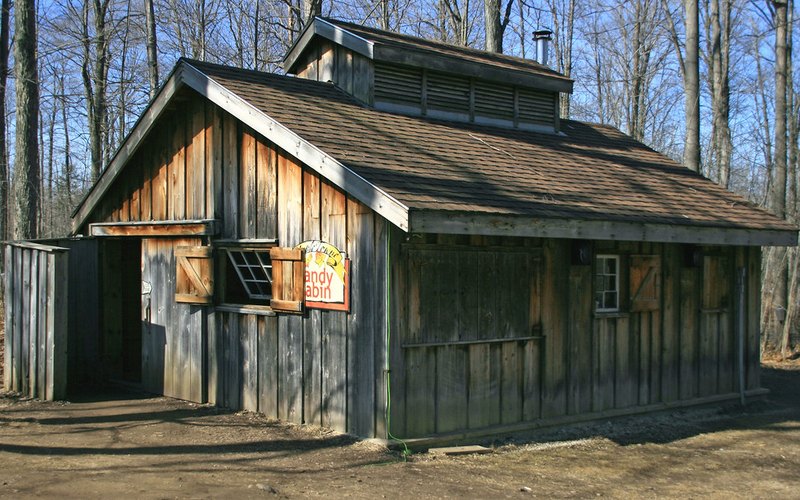
So this page is the tree itself: what it is, which maples are worth your time, and — the part that most writing on this subject gets flat wrong for anyone standing in Michigan — when it actually runs here. For the mechanics of drilling and hanging, go to tapping. For what happens in the pot, go to the science. For what to do with the jar afterward, go to using it. This page is about the tree.
Michigan is a maple state, and almost nobody knows it
Ask an American where maple syrup comes from and you’ll get Vermont, then maybe Canada, and that’s the list. Michigan doesn’t come up. Michigan should come up.
Michigan is fifth in the country — about 680,000 taps producing roughly 203,000 gallons in the 2025 USDA figures. Fifth. Out of a national crop of about 5.8 million gallons on 16.8 million taps. We’re a real maple state and we’ve been quietly a real maple state for a long time. (The exact ordering of the four states above us is genuinely messy depending on whether you’re counting gallons or taps and which year you grabbed — but Michigan at or about fifth by production is solid.)
Now here’s the number that actually keeps me up at night, in a good way. Only about one percent of Michigan’s maple forest is tapped. One percent. Michigan State’s own framing is that we rank fifth despite tapping essentially none of what we’ve got. Sugar maple grows throughout the state and covers something on the order of five million acres. The USDA Forest Service’s Silvics of North America — the federal reference on the species — lists the greatest commercial volumes of sugar maple as being in “Michigan, New York, Maine, Wisconsin, and Pennsylvania.” Michigan is listed first. Michigan Tech’s forestry people go further and call the Upper Peninsula “probably the most favorable growing area in the United States” for sugar maple.
Sit with that. We have arguably the best sugar maple ground in the country, we tap one percent of it, and we still finish fifth. There is more room to grow here than in any of the states above us, and most of that room is in woodlots owned by people who have never thought about it. That’s not a marketing line — it’s the actual shape of the opportunity, and it’s why a fifty-tap operation in Michigan doesn’t feel like a novelty. It feels like an early one.
The season moves north — this is the whole thing
If you take one fact from this page, take this one, because it’s the fact that every Vermont-written article will quietly hand you wrong.
Michigan doesn’t have a maple season. It has a wave.
The state runs roughly from 41.7°N at the Ohio line to about 47.5°N up at the Keweenaw — around six degrees of latitude. The season starts at the bottom and walks north. MSU Extension puts it plainly: the season starts in the southern Lower Peninsula in mid- to late February and proceeds northward until it reaches the Upper Peninsula after eight to ten weeks.
Eight to ten weeks. That’s the spread across one state.
- Southern Lower Peninsula — mid- to late February. Southern producers are usually tapping in late February.
- Northern Lower Peninsula — March. MSU treats March as “the heart of the season” and doesn’t give the NLP its own tidy bracket, so I won’t invent one; call it early-to-mid March and watch your own thermometer.
- Upper Peninsula — weeks behind the south. By mid- to late March nearly all UP producers are collecting and boiling, and the run carries into April.
The best independent check on that isn’t prose at all — it’s money and reputation. The Michigan Maple Syrup Association staggers its Maple Weekend open houses by region, and those dates are set by producers who need to be reliably in season when the public shows up. Southern Lower Michigan gets March 21–22. Northern Lower gets March 28–29. Upper Michigan gets April 11–12. That’s a three-week spread in the association’s own calendar, set by people with skin in the game.
Read that UP date again: April 11–12. In Vermont an April run is the sad tail end of things. In the Upper Peninsula it’s the open house. If you’re working off a New England schedule you will tap late in southern Michigan and comically early in the UP.
Four to six weeks on the calendar, ten to twenty days that matter
The other thing the calendar lies about. MSU says the season “generally lasts only four to six weeks in the early spring while the trees are dormant,” and that’s true as far as it goes. But a four-to-six-week window is not four-to-six weeks of sap.
You need the freeze-thaw cycle: below freezing at night, above freezing during the day. Not warm. Not cold. Both, in alternation, in the same twenty-four hours. Nights in the 20s and 30s, days in the 40s to low 50s is the working shape of a good day. When the weather goes flat — a stretch that never freezes, or a stretch that never thaws — the trees just stop, and you stand around looking at empty buckets.
One Michigan producer’s framing that matches my experience: many seasons only produce ten to twenty good sap-flow days even though the calendar window looks much bigger. That’s field experience rather than research, so hold it loosely, but it lines up with MSU’s own description of the season as a handful of small windows called sap runs.
The practical consequence is a planning one, and it’s why I’m building a shack. Size your boil to the runs, not to the calendar. If a hundred taps hand you their whole year’s sap across a dozen days, then a dozen days is your evaporator’s actual job. A turkey fryer will do it — I’m proof — but it does it by turning those dozen days into a dozen very long nights standing in the yard.
And the mechanism behind the freeze-thaw isn’t what most people think it is. It is not root pressure pushing sap up to the buds — that’s the story everybody repeats and it’s wrong. It’s freeze-thaw stem pressure, gas and ice doing physics inside the wood. I took that apart properly over on the science, including why birch genuinely does run on root pressure and maple doesn’t. It’s the best fact in the craft and it deserves its own page rather than a paragraph here.
One honest gap while we’re here. People will tell you the Great Lakes moderate our freeze-thaw cycle and give Michigan a better rhythm than inland states. It’s a lovely idea. The lakes obviously moderate our climate generally — that part isn’t in question. But I went looking for a single Michigan source that connects lake moderation to sap production specifically, and I couldn’t find one. Not MSU, not the DNR, nobody. So I’m not going to tell you it’s true. It might be. Nobody has shown it.
Sugar maple and red maple — I run both
I tap sugar maple (Acer saccharum) and red maple (Acer rubrum). Both make syrup. They are not interchangeable, and understanding the difference is most of what separates a good season from a confusing one.
Sugar maple is the target. It’s the flagship of the northern hardwood forest — the company it keeps in Michigan is basswood, beech, yellow birch, white ash, hemlock, white pine — and it grows throughout the state. It’s the species every piece of maple literature is implicitly about. When somebody says sap averages about 2% sugar, they mean sugar maple. When they say roughly forty gallons of sap to a gallon of syrup, they mean sugar maple. If you have sugar maples, tap sugar maples.
Red maple is common, native, and completely legitimate. It’s less dominant than sugar maple across Michigan but it’s everywhere, and it turns up on the wetter ground — Michigan Tech describes it as often found on swampier sites with elm, ash, and cottonwood, though it also holds fine on drier uplands. That distribution alone means a lot of us have red maples whether or not we have a nice sugar bush.
Two real differences drive everything:
- Sugar content. Sugar maple is the sweeter tree, and sweeter sap is straightforwardly less boiling for the same jar. Red maple runs thinner, so your ratio goes the wrong way and your firewood pile goes with it.
- Timing — this is the bigger one. Red maple buds earlier, and budding is what ends your season. Dormancy release is the thing that produces true “buddy” syrup, with its off sulfur character, and it’s a defect you cannot boil your way out of. So red maple gives you a shorter window on the back end. It’ll quit on you before your sugar maples do.
Which is exactly why I run both, and why it doesn’t feel like a compromise. The red maples are part of the woods I have. They contribute early and mid-season and then I pull them before they turn on me, and the sugar maples carry the tail. What I don’t do is treat them as the same tree and get surprised in the last week.
Black maple (Acer nigrum) deserves a mention because it’s a genuinely Michigan answer that a Vermont guide will skip entirely. MSU Extension’s own Michigan Fresh bulletin says maple syrup is “typically harvested from sugar maple and black maple trees” — it’s often treated as a subspecies or variety of sugar maple, and it occurs mainly in southern Michigan. If you’re down there, it’s a real second species, not a curiosity.
Silver maple and boxelder round out what’s actually available, especially in southern-LP bottomlands and around old homesteads. Both are tappable. Silver maple is native to Michigan but scarce in the UP. Boxelder is native and weedy — genuinely considered a nuisance in fallow fields and ditches — and it’s reported to have lower sugar content with a more sorghum-like syrup, though that comes from a light source and I’d treat it as a starting expectation rather than a fact. Neither is the tree you plant. Both are trees you might already have.
What a tree needs to be before you touch it
MSU’s rule is the one I use, and I like it because it’s stated in circumference, which is what you can actually put a tape around: a maple needs to be about forty years old and at least 32 inches in circumference at four and a half feet off the ground before you tap it. That’s about 10.2 inches of diameter.
The DNR’s published guidance lines up with that — ten inches minimum, one tap in trees 12–18”, two taps at 19–25”, three above 25” — though I’ll flag that I couldn’t load the DNR page directly to verify it (see below), so read it from them rather than from me.
For fifty to two hundred taps you’re looking at roughly fifty to two hundred tappable maples, fewer if you’re lucky enough to have a stand full of nineteen-inch-plus trees. It’s not many acres. It’s more trees than most single backyards hold.
Everything else about how — bit size, depth, spout choice, why the modern advice has drifted shallower and smaller — lives on the tapping page. I’d just say here that a forty-year-old tree is a long-term relationship. Drill accordingly.
You cannot tap Michigan state land
This one matters, because the natural move for anybody short on trees is to look at all that public forest and start doing math.
Don’t. Everything I could find says sap collection is not permitted on Michigan state land, and that the DNR does not issue permits for it. The legal logic is that tapping counts as damaging vegetation — the state land rules prohibit cutting, peeling, damaging, destroying, or removing a tree without written permission from the director. The DNR’s own suggested alternative is to tap backyard trees.
Now the honest caveat, and I want to be blunt about it: every michigan.gov page I tried to read on this returned an error and refused to load. Every one. So what I’m telling you rests on search extracts of DNR pages rather than on the DNR pages themselves. The sources are consistent with each other, and I have no reason to doubt the answer — but this is the single most consequential thing on this page and the least directly verified. Call your local DNR office, or open the page in a browser yourself, before you act on it. That’s the DNR’s own recommendation for any specific circumstance, and it’s mine.
(There’s real nuance around tribal treaty-reserved gathering rights on certain ceded lands. That applies to tribal members, and it is not a route for the general public.)
So if you need trees, the route is the one every small Michigan operation already takes: private agreements. Neighbors with mature maples who are delighted to trade a jar for access. It is how this scales here. Some municipalities run their own tapping programs too — Birmingham has one — so it’s worth canvassing locally; each has its own rules.
The threats worth knowing about
Asian longhorned beetle. This is the one that should scare Michigan. Maples are about 25% of our forest volume — 35% in the Upper Peninsula — and MSU calls sugar maple arguably the most financially valuable tree species in the state for forest products, syrup included. The beetle doesn’t simply kill a tree; it mechanically weakens it, raising breakage risk and rendering it unsuitable for forest products. MSU’s own judgment is that ALB in Michigan could exceed the emerald ash borer disaster — because maple is both a preferred host and vastly more abundant than ash ever was. EAB has run something like $15 billion nationwide.
The good news, with a caveat: ALB has not been found in Michigan. The caveat is that the source I have for that is from 2015, and a decade-old “not yet found” is not proof of today. The state still runs active reporting campaigns, which suggests it remains absent-but-watched. Verify the current status before you take my word for it.
Two things worth internalizing anyway. First, most exotic infestations are found by ordinary people, not experts — the detection system is us. Second, before you report anything, learn the white-spotted pine sawyer, a native beetle that gets mistaken for ALB constantly. MSU has a side-by-side. Know the look-alike first.
Climate. The picture for Michigan is genuinely mixed, and I’d rather give you mixed than tidy. Sugar maple’s range is projected to contract northward — by 2071 the modeling has it holding in Minnesota–Michigan and Pennsylvania–Maine and losing ground to the south. Michigan is inside the surviving range. In range terms we’re a relative winner.
But that’s not the same as our maples being fine. A University of Michigan study found Michigan’s sugar maples get some benefit from environmental nitrogen compounds, but that those gains won’t fully offset the added stress of a drier future climate. And the broader research suggests sap flow declines and gets more variable near a species’ southern range limit while improving at the northern limit — which, in a state six degrees tall, cuts both ways inside Michigan. Southern LP is the stressed end. The UP is the favored end.
That’s not theoretical. It’s already legible in the numbers: between 2002 and 2022, UP taps rose about 70% versus 58% statewide, and UP producers rose 94% versus 68% statewide. The industry is walking north, the same way the season does.
There’s also a genuinely Michigan research asset here worth knowing about: the Michigan Gradient Study, established in 1987, with sites spanning the north–south run of northern hardwood forest from the west-central Lower Peninsula to the northwestern UP. Nearly forty years of data on exactly this question, in exactly this state.
And the thing that already happened. A March 2025 ice storm did widespread damage to trees and tap systems across northern Michigan. The MMSA stood up an Ice Storm Relief Fund for affected producers. Statewide production still rose over 2024 — the state absorbed it — but “the state absorbed it” is cold comfort to the producer whose woods came down. That’s the business. You are farming a forty-year crop that the weather can rearrange in a night.
What a Michigan year actually gives you
About three-tenths of a gallon of syrup per tap. Michigan’s 2025 yield was 0.298 gal/tap; 2024 was 0.308. So a hundred taps is roughly thirty gallons in an average year. That’s the real-world number, averaged across every operation in the state — buckets and tubing, gravity and vacuum, good woods and bad. It’s a better planning figure than any ratio, because it’s what actually happened.
You’ll see 40:1 quoted everywhere as though it were a law of nature. It isn’t. It’s a consequence — of your sap’s sugar content, run through the Jones Rule of 86. Sweeter sap, less boiling. Thinner sap, more. It’s arithmetic, and I walk through it on the science rather than re-deriving it here.
One more thing that isn’t established, and I want to say so plainly rather than let you assume it: there is no data comparing Michigan sap sugar content to Vermont’s or New York’s. None that I could find. If somebody tells you Michigan sap is sweeter — or thinner — they’re making it up. The general figure is 1–4% sugar, with sugar maple around 2%, and that’s a general figure, not a Michigan one.
Whatever you get, keep it cold and boil it fast. Sap needs to stay at 40°F or below until it hits the pot. Above 50°F microbes multiply rapidly and you’re racing them. This is where buckets earn their reputation honestly: they’re simple and inspectable and cheap, but that sap sits out in the sun in an open woods. Sap is like milk. It sours.
The people worth knowing
Two names, and they’re the real ones for Michigan.
The Michigan Maple Syrup Association — 150+ members, 150,000+ taps, 50,000+ gallons between them. That’s the number that made me join: the membership is sized like serious hobbyists and small commercial producers, not industrial operations. These are people with my problems. They keep a spreadsheet of 150+ Michigan sugarbush locations and an interactive producer map, which is the fastest way to find a mentor or a used evaporator within driving distance. Winter meeting is in Mt. Pleasant in January; the Fall Tour moves around. And the staggered Maple Weekends are, as I said, the best public documentation of how this state’s season actually behaves.
MSU Extension is the other. Their bulletins are the Michigan-specific literature — E2617 on production, E3251 (Michigan Fresh: Maple Syrup), E2332 (Identifying Trees of Michigan, revised recently and the current reference), E2693 on the longhorned beetle. They run a “Getting Started with Maple Syrup Production” webinar, and MSU’s forestry department operates a working sugarbush at the Fred Russ Forest in Decatur — around 2,000 sugar maples over 70 acres, with ten acres deliberately left untapped as a comparison. The Tollgate Farm center in Novi runs a hands-on sugarbush program from late February through March, which is itself a nice corroboration of southern-LP timing.
One honest note on MSU: they don’t have a maple program on the scale of UW–Madison Extension’s, which is the best-developed one nearby and far more climatically relevant to Michigan than anything out of Vermont or Maine. Where MSU is silent, I read Wisconsin. That’s a judgment call, not a sourced recommendation, but it’s the one I make.
And a supplier, since somebody always asks: Sugar Bush Supplies Co. in Mason is the one MSU Extension names.
Where I’m at
Fifty to two hundred taps. Sugar and red maple. Galvanized buckets on spiles, because they work, because they need no layout planning, and because on flat ground with trees scattered across a couple of properties they’re genuinely the right answer and not a compromise. A turkey fryer, which is not the right answer, which is why there’s a shack going up.
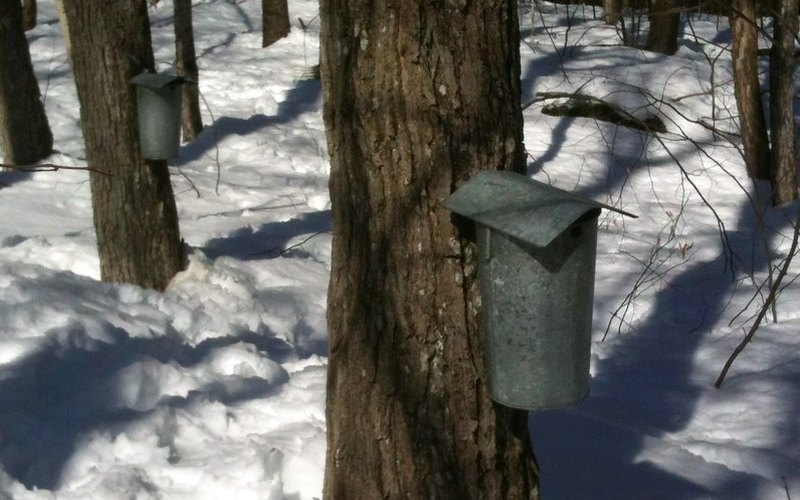
What I keep coming back to is that one percent. Michigan finishes fifth in the country having barely started. There’s a wave that crosses this state over ten weeks every spring, from the Ohio line to the Keweenaw, and almost all of it runs through woods where nobody’s paying attention. Every February the trees do the same physics whether or not anyone hangs a bucket.
Hang the bucket.
For the drilling and hanging, see tapping. For why any of it works, see the science. For what to do with the jar, see using it.
Comments (0)