Alaska
Ask why the sausage in every Anchorage cart says reindeer and not caribou, and you’ll get a romantic answer about Arctic tradition.
The real answer is a statute.
Reindeer and caribou are the same animal. The sausage is blended with pork and beef. And it says reindeer because wild caribou cannot legally be sold to you.
Three facts, all documented, and together they demolish the gift-shop version and replace it with something considerably more interesting. I ate reindeer sausage in Alaska. Here’s what it actually is.
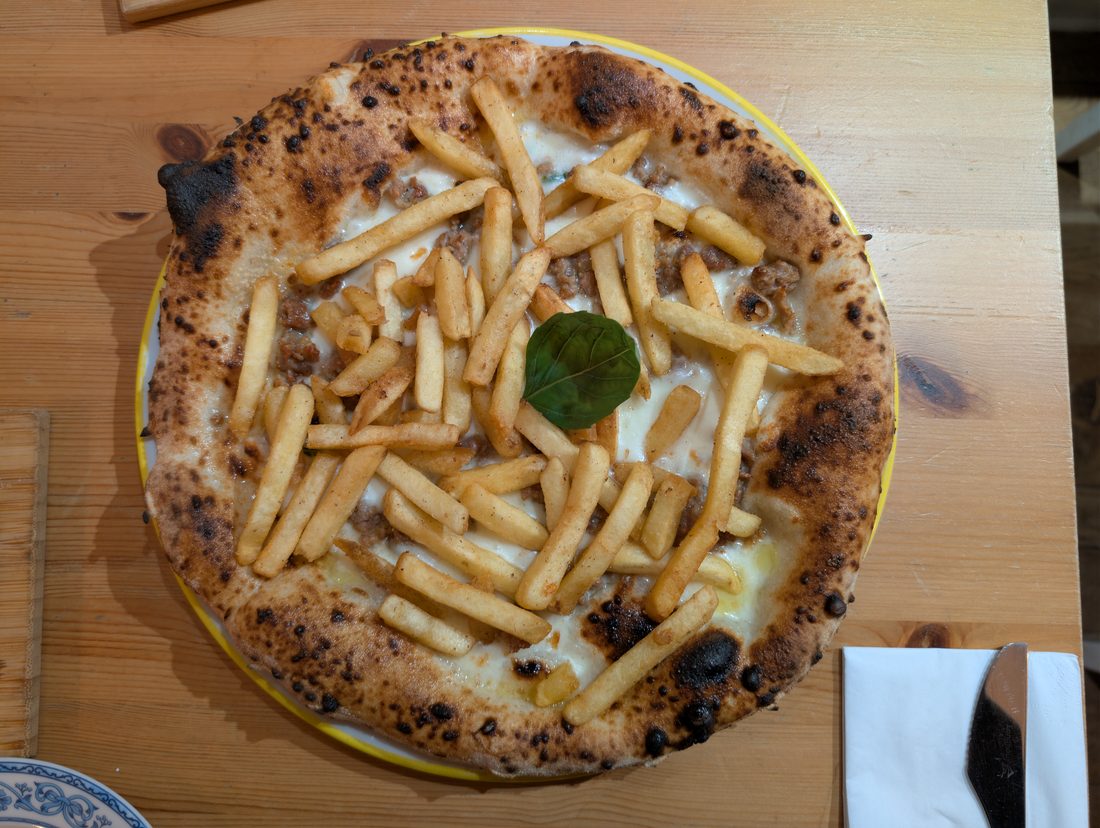
Reindeer sausage — blended with pork and beef, because lean Rangifer needs the fat. And it says reindeer rather than caribou for a legal reason, not a culinary one.
Fact one: same species
Reindeer and caribou are the same species: Rangifer tarandus.
The difference is domestication, not biology. “Reindeer” = the domesticated, herded animal. “Caribou” = the wild one. Alaska’s reindeer are descendants of Siberian domestic stock — which is a whole story of its own, below.
So the question “is reindeer sausage really caribou?” has a slightly annoying answer: it’s the same animal, farmed. Not a substitute for caribou. Not a lesser version. The same species, standing on the other side of a fence.
Fact two: it’s a blend, and that’s not a shortcut
The sausage is not pure reindeer.
Indian Valley Meats — “one of the largest processors of game meat in North America,” family-owned in Indian, Alaska, operating since 1976 — lists its Hot and Spicy Summer Sausage with Reindeer as made with reindeer, beef, and pork. Its Alaskan-Siberian Sausage with caribou is caribou, beef, and pork.
This is typical, and I want to defend it, because I grind sausage and I know what’s going on here.
Rangifer is extremely lean. A pure-lean sausage is dry and crumbly — it has nothing to carry flavour, nothing to hold moisture, nothing to emulsify. Pork fat is a technical necessity, not an adulteration. Anyone selling you “100% reindeer sausage” is either lying or has made something you don’t want to eat. The blend isn’t the compromise. The blend is the recipe.
Fact three: the legal kicker nobody writes
Here’s the part almost nobody puts in print, and it’s the best fact on this page:
Wild caribou cannot be legally sold commercially in Alaska. They’re wild game under Alaska’s subsistence hunting regulations. Reindeer — being domesticated livestock — can be raised and sold.
That is why the sausage in every Anchorage cart and grocery store is reindeer. It isn’t a marketing preference. It isn’t a romantic choice about the Arctic. It’s the only version of that animal that is legal to sell you.
The same rule is why you can buy reindeer sausage but not moose sausage in an Alaskan supermarket, which is the detail that makes the whole thing click. Moose is everywhere in Alaska. Everyone eats it. You cannot buy it, because you can’t commercially sell wild game.
(Caribou-labelled products from a custom processor typically come from a hunter’s own animal processed for their own use, or from Canadian or imported stock. ⚠ Whether Indian Valley Meats’ caribou products specifically come from Alaskan wild caribou is unresolved — given the commercial-sale prohibition they’re likely custom-processed or imported, but that’s my inference and I’m not going to assert it.)
The honest summary line, then: Alaskan reindeer sausage is farmed reindeer — the same species as caribou, domesticated — blended with pork and beef for fat, and it’s reindeer rather than caribou because selling wild caribou is illegal.
Nobody’s hiding this. It’s just less charming than the alternative, so it doesn’t get written.
⚠ Herding is not ancient Native tradition. It’s an 1892 intervention.
This is where I have to be careful, and where being careful produces a better story rather than a hedged one.
Reindeer are not native to Alaska. They were imported from Siberia.
- Sheldon Jackson — Presbyterian minister, missionary, and Alaska’s General Agent of Education — sailed repeatedly to Siberia and in 1892 imported 171 reindeer.
- The reason was famine, and the famine was man-made. By the late 1880s there were reports of starving Alaska Native populations in western Alaska, because the commercial whaling industry had decimated the marine mammals they depended on, and caribou were scarce. Reindeer were an attempted replacement food system for one that outside industry had destroyed.
- Chukchi (Siberian) herders came with that first shipment as instructors. Sámi herders were brought later to teach Iñupiat and other Alaska Native communities to herd.
- The industry grew to over 600,000 animals by the 1930s.
- The Reindeer Industry Act of 1937 — passed by Congress, signed by FDR on 1 September 1937 — prohibited non-Native ownership of reindeer herds in Alaska. The intent was to secure a self-sustaining Alaska Native industry. Only Alaska Natives can hold reindeer grazing permits under it to this day. The Act’s context includes a genuine fight over control of the industry between Alaska Natives and non-Native newcomers.
So let me say the three things that follow, plainly:
Do not write “reindeer have always been part of Alaska Native culture.” Herding was introduced in 1892 by a missionary, taught by Chukchi and Sámi instructors, in response to a famine caused by commercial whaling. That’s a hundred and thirty years, not time immemorial, and the specificity is the point.
Do not imply reindeer replaced or represent traditional subsistence. Subsistence hunting of wild caribou is the older and living practice, and it is legally and culturally distinct from reindeer herding. They are two different things that happen to involve the same species. Conflating them erases the one that was already there.
Do note the 1937 Act, because it’s genuinely unusual: by federal law, the Alaskan reindeer industry is an Alaska Native industry. There aren’t many statutes that read like that.
And one more, which is about how you write rather than what you write. Alaska Native foods are not “exotic,” “primitive,” or “surprising,” and none of them are a “delicacy.” Reindeer sausage sold in Anchorage is a commercial product and writing a recipe for it is fine — that’s what this page does. Writing a recipe for, say, akutaq, and presenting it as a quaint curiosity for a hobby site, is a different act entirely, and I’m not doing it. If in doubt, write about what’s sold, not what’s sacred.
That line’s not squeamishness. It’s the same rule I apply everywhere: don’t claim what isn’t yours.
Cooking it
Reindeer Sausage Breakfast Skillet.
The thing to know before you start: reindeer sausage is sold fully cooked and smoked. Most Indian Valley Meats products are shelf stable and ready to eat, requiring no refrigeration. You are reheating and caramelising it, not cooking it through. Treat it like a raw sausage and you’ll drive out the fat and the moisture and wonder why it’s leathery.
The skillet:
- Boil the potatoes 10–12 min until just tender. Drain and dry them. Wet potatoes steam instead of browning.
- Sear the sausage in a dry cast-iron skillet over medium-high, 4–5 min, until the edges caramelise and the fat renders. Remove. Dry pan — it brings its own fat.
- Oil, then potatoes cut-side down, 6–8 min undisturbed. Undisturbed is the instruction. Stop poking it.
- Onion and pepper, 5 min. Return the sausage.
- Make wells; crack an egg into each. Cover, 4–5 min, set whites and runny yolks. (Or into a 190 °C / 375 °F oven for 5–6 min.)
Lingonberry or wild blueberry preserve on the side is worth it — the sweet-tart against smoked game fat is the traditional Nordic pairing, and it carries over here honestly, via the Sámi herding link. That’s not me reaching for a Scandinavian flourish. The Sámi were literally brought to Alaska to teach this. The pairing came over with the herders.
Fresh seafood at breakfast
This is Alaska’s genuine breakfast advantage and it needs no embellishment at all: this is a place where the fish at breakfast can be a few hours out of the water. That’s a real difference. It doesn’t require adjectives.
Smoked salmon — the distinction that matters is hot-smoked (“kippered”) vs cold-smoked (lox-style). Hot-smoked is cooked, flaky, and the Alaskan default. If you’re picturing translucent lox sheets, that’s the other thing.
Salmon scramble, and one instruction carries it: fold the salmon, cream cheese and herbs in OFF the heat. Residual heat is enough, and it keeps the cream cheese in distinct pockets instead of dissolving into a homogenous smear. No salt — the smoked salmon carries it. On toasted sourdough.
Which is a fair pointer to the other Alaskan thread I’m not going to duplicate here: Alaskan sourdough is real history — Gold Rush-era starters, and “sourdough” as the term for an old-timer, someone who overwintered. I run a starter. That belongs in breads, not here.
For the extravagant version: crab Benedict, king or Dungeness. The hollandaise is the only difficult thing on that plate, and it’s difficult in a narrow, specific way — hold it at 60 °C / 140 °F maximum. Above about 70 °C it scrambles; below about 50 °C it separates. That’s the whole window. Poach the eggs at 82 °C / 180 °F — a bare shiver, no rolling bubbles — with a splash of white vinegar, cracking each egg into a ramekin first.
Wild berries — get the botany right
| Berry | Species | Notes |
|---|---|---|
| Salmonberry | Rubus spectabilis | Amber-to-red, raspberry-like aggregate. Not salmon-flavoured — the name likely refers to the colour (salmon-roe orange) of the ripe fruit. Coastal, very juicy, low sugar, highly perishable — hours, not days. |
| Cloudberry | Rubus chamaemorus | Amber, low-growing bog plant. Called “aqpik” or “low-bush salmonberry” in parts of Alaska. |
| Wild blueberry | Vaccinium uliginosum (bog blueberry), V. alaskaense | Smaller, more intense and more acidic than commercial highbush. Not the same fruit as a supermarket blueberry. |
| Lingonberry / lowbush cranberry | Vaccinium vitis-idaea | Tart. The preserve of choice with game. |
⚠ The name trap, and it’s a real one: “salmonberry” in Alaska may mean cloudberry (Rubus chamaemorus), NOT Rubus spectabilis. Two different plants with overlapping common names. If someone hands you salmonberry jam in Alaska, you don’t actually know which berry is in it until you ask.
⚠ Foraging safety. Alaska has genuinely dangerous lookalikes — baneberry (Actaea rubra) is toxic and can be fatal. Positively identify it or don’t eat it. I’m not writing a breezy foraging passage, because a breezy foraging passage is how people get hurt.
Wild berry compote: simmer 8–12 minutes with sugar and lemon, crushing lightly against the pan, until it just coats a spoon. Adjust the sugar hard — wild berries vary enormously and the recipe’s quarter-cup is a starting guess, not a measurement. And do not overcook. Wild berries lose their perfume fast; you want it barely thickened and still tasting raw. It’ll set further as it cools. Over sourdough pancakes.
The thread
Every good fact on this page is one somebody replaced with a nicer story.
The sausage is a blend because lean meat makes bad sausage. It’s reindeer because caribou is illegal to sell. The herds exist because a missionary imported 171 animals in 1892 to feed people whose food supply commercial whaling had destroyed — and the industry is Native-only because Congress said so in 1937.
None of that is a quaint Arctic tradition. All of it is documented. The documented version is better, and it’s better precisely because it has consequences and named people and a date and a law, instead of a vibe.
Sources & further reading
- Indian Valley Meats — the ingredient lists: reindeer, beef, and pork. Family-owned in Indian, Alaska since 1976.
- Alaska Department of Fish and Game, Subsistence FAQ — why wild caribou can’t be sold to you.
- University of Alaska Fairbanks, “History of Reindeer in Alaska” — Sheldon Jackson, the 171 animals, the Chukchi and Sámi instructors.
- Wikipedia, Reindeer Act — the 1937 Act and the non-Native ownership prohibition.
- BLM, Reindeer Grazing in Alaska — the grazing permits.
- HistoryNet, “There Was Much Money to Be Made in Reindeer Herding” — the fight over control of the industry.
- Atlas Obscura, “The Rise and Fall of Alaska’s ‘Reindeer King’” — Carl Lomen.
- National Park Service, “Reindeer to the Rescue”.
Comments (0)