tomato-toast
title: “Tomato Toast, and My Great-Grandmother’s Table”
Some of my food comes from restaurants and travel. This comes from one woman: my great-grandmother, who was a Seventh-day Adventist vegetarian, and whose table my dad grew up at and handed down to me. Two dishes in particular are hers — and when I finally went to write them down, I found they weren’t family quirks at all. They’re a documented American foodway, and the documents lead straight back to Michigan.
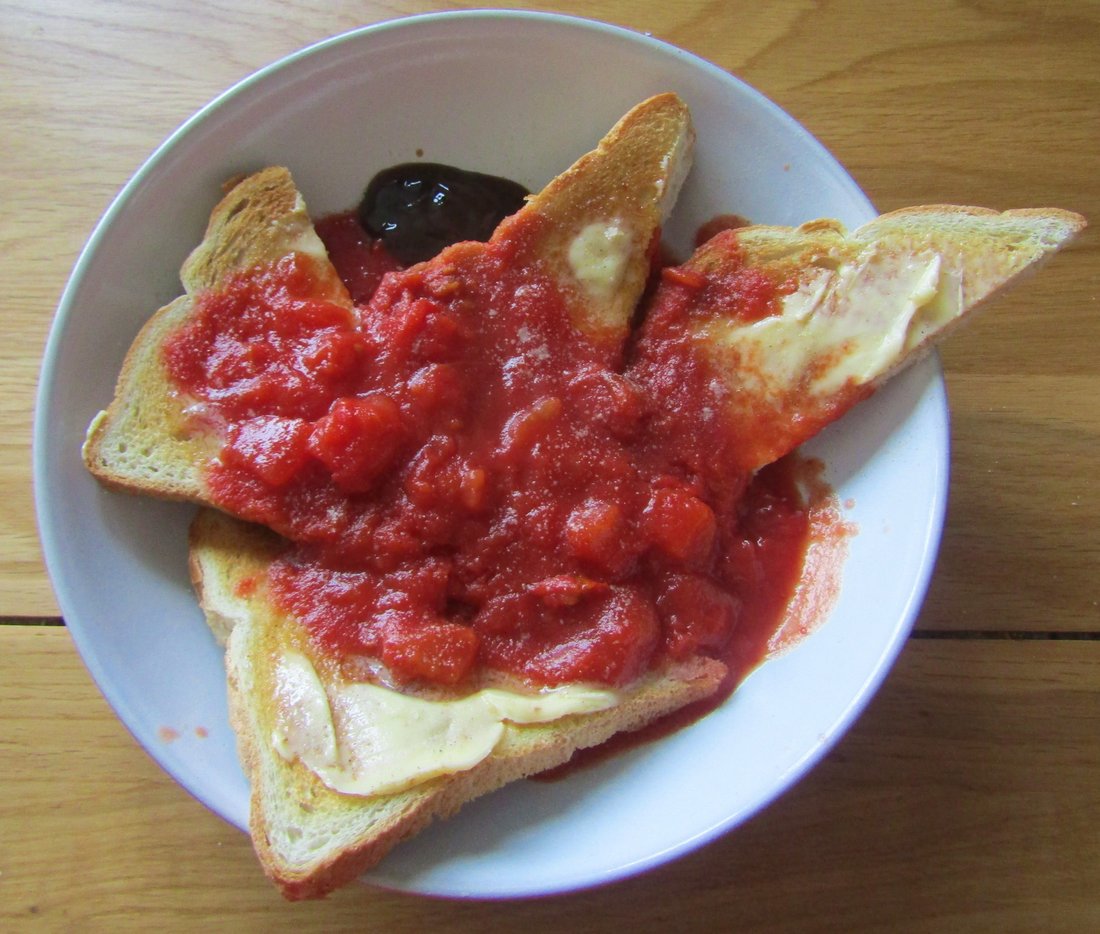
Tomato toast in its plainest form: toast in a bowl, hot canned tomatoes poured over. Mine gets parmesan and pepper; this one’s dressed the British way, with a dab of brown sauce. Same idea, and it costs almost nothing.
Tomato toast
Here’s the dish, exactly as I make it: toast a slice of bread and set it in a bowl. Warm home-canned diced tomatoes — nothing in the jar but tomatoes and salt — in a pot on the stove, then scoop the hot tomatoes over the toast. Top with parmesan and a little pepper. That’s the whole thing. Deeply comforting, nearly free, and I never get tired of it.
I assumed it was a family invention. It isn’t. “Tomato Toast” is a printed recipe in the flagship Seventh-day Adventist cookbook — Mrs. E. E. (Ella Eaton) Kellogg’s Science in the Kitchen (1892), from the Battle Creek Sanitarium, whose cooking school she ran. Her version:
“TOMATO TOAST.—Moisten slices of zwieback in hot cream, and serve with a dressing prepared by heating a pint of strained stewed tomato to boiling, and thickening with a tablespoonful of corn starch or flour rubbed smooth in a little cold water. Season with salt and a half cupful of hot cream.”
Zwieback instead of plain toast, cream instead of parmesan — but it’s unmistakably the same dish: bread, in a bowl, under hot stewed tomatoes. My family’s parmesan-and-pepper finish is a later addition, and I can even prove it’s not original, because Ella Kellogg disapproved of pepper and seasonings like it. Somewhere between her kitchen and mine, somebody put cheese and pepper on it. I’m glad they did.
And here’s the part that stopped me. On a printed Sanitarium breakfast menu, “Tomato Toast” sits directly above “Corn Bread.” Both of the dishes I inherited from my great-grandmother appear as a pair, on the same breakfast bill of fare, in the canonical Adventist cookbook. They came down to me together because they traveled together.
The other one: cornbread and milk
The second dish is the johnny cake I eat in a bowl — hot cornbread, sugar, cold milk. Same cookbook, nearly verbatim, under “Corn Meal Cubes”: leftover cornmeal mush cut into cubes, “turn over them a quantity of hot milk or cream… let them stand until thoroughly heated through.” Grain and milk in a bowl. The Cornmeal page has the whole story of how I eat it; I mention it here only to say it’s the same source and the same table.
Why a vegetarian household ate exactly this
The Adventist health message begins in Michigan, which is a satisfying thing for a Michigander to be able to say. Ellen G. White, the church’s co-founder, had her landmark health-reform vision on June 6, 1863, in Otsego, Michigan, and from there vegetarianism became the Adventist practice — a strong recommendation for the sake of health, never a test of membership. The church built the Western Health Reform Institute in Battle Creek in 1866; it became John Harvey Kellogg’s Battle Creek Sanitarium, and the entire American breakfast-cereal industry — corn flakes and all — grew out of that institution’s need for palatable, meatless breakfast food. (No, Kellogg did not coin “the most important meal of the day.” That’s an 1878 newspaper joke, and I’m not going to launder it here either.)
Once you know the household was meatless and ran on a big breakfast and a midday dinner — with no heavy supper — these dishes stop looking like thrift-by-accident and start looking like a system:
- Grain and milk stand in for meat. Cornbread-and-milk and tomato-toast-with-cream are both grain + dairy, which together carry more complete protein than either does alone — and Ella Kellogg argued in print that the grains stood up to beefsteak. (Careful: nobody in 1890 was counting amino acids. The period logic was simply grains and milk replace meat, and the cookbook says exactly that.)
- Home canning drives the tomato dish. Warmed put-up tomatoes over toast is a way to eat the summer garden in January.
- Nothing gets wasted. Stale bread becomes toast; leftover mush becomes cubes; the rind of the watermelon becomes a pickle.
The one that breaks the pattern (honestly)
That last one — the pickled watermelon rind we ate a lot of — I want to be straight about, because it’s the exception that keeps me honest. Ella Kellogg’s cookbook flatly condemns pickling: she calls vinegar preserving “eminently unhygienic” and lists “pickles” among the marks of a bad dinner. So the watermelon rind is not an Adventist dish my great-grandmother kept because of the health message — it’s an older Southern-and-American thrift habit she kept despite it. Two of her dishes sit squarely inside the doctrine; one sits pointedly outside it. I’d rather tell you that than pretend the whole table was one tidy thing.
The part I was asked to look into
I grew up with a family understanding that there was Native American somewhere in our history, and that some of what we ate might trace back there. I went and looked, and the honest answer turns out to be worth more than the romantic one.
The real connection is specific: my dad’s stepfather was Native — a full-blooded Native man, and a grandfather to us. That’s a true relationship and I’m glad of it. But a stepfather is not a bloodline, and I don’t know his tribe — which means it isn’t something I can responsibly turn into a claim about where our food comes from. (That’s the rule rather than the exception, honestly: an enormous number of American families carry an unverified Native-ancestry story, and even where the ancestry is real, tribal membership is citizenship in a sovereign nation — law, community, and rolls — not a DNA percentage. A test can’t confer it.)
Here’s the thing, though: the food case is real without needing the ancestry at all. Anyone eating cornbread, hominy, succotash, or maple in this country is eating documented Indigenous foodways, full stop — those entered the American kitchen through four centuries of cultural transmission, not through anyone’s grandmother. That inheritance is public and enormous and worth naming plainly. What isn’t Native is the specific stuff I got: cornbread-and-milk and tomato toast are Adventist-and-Southern, and the watermelon rind pickle — even though Native nations grew watermelon within decades of contact — is a European technique on an African fruit, with no record of any nation pickling the rind. The corn itself is the Native gift. What my family did with it in the kitchen was something else.
So: a real Native grandfather by marriage, and a food history that stands on documented ground rather than on him. Both of those are true at once, and I’d rather hold both than flatten either.
Back to the rest of my favorites.
Sources & further reading
- Mrs. E. E. (Ella Eaton) Kellogg, Science in the Kitchen (1892) — “Tomato Toast,” “Corn Meal Cubes,” the Sanitarium bills of fare, and the condemnation of pickles and condiments. Project Gutenberg #12238.
- Ellen G. White’s health-reform vision, 6 June 1863, Otsego, Michigan, and Adventist vegetarianism as recommendation rather than test of fellowship — Ministry Magazine; the White Estate.
- Battle Creek Sanitarium and John Harvey Kellogg — the Adventist origin of American breakfast cereal.
- On unverified Native ancestry and tribal citizenship — Gregory D. Smithers on Cherokee descent; Kim TallBear, Native American DNA; and the Cherokee Nation’s own citizenship FAQ (DNA and genealogy sites are explicitly not proof of membership).
- The watermelon and rind-pickle history is worked out in full on the Pickling page.
Comments (0)