Jamaica, Barbados & Key West
Jamaica’s national dish is a West African fruit cooked with a North Atlantic preservation commodity, and both of them are on the island because of slavery. That’s not a provocation. That’s the ingredient list.
I ate breakfast in all three of these places. Every one of them has a story attached that turns out to be told backwards — the direction of a voyage, the identity of a cake, the century of a machine. The corrections are the reason this page exists.
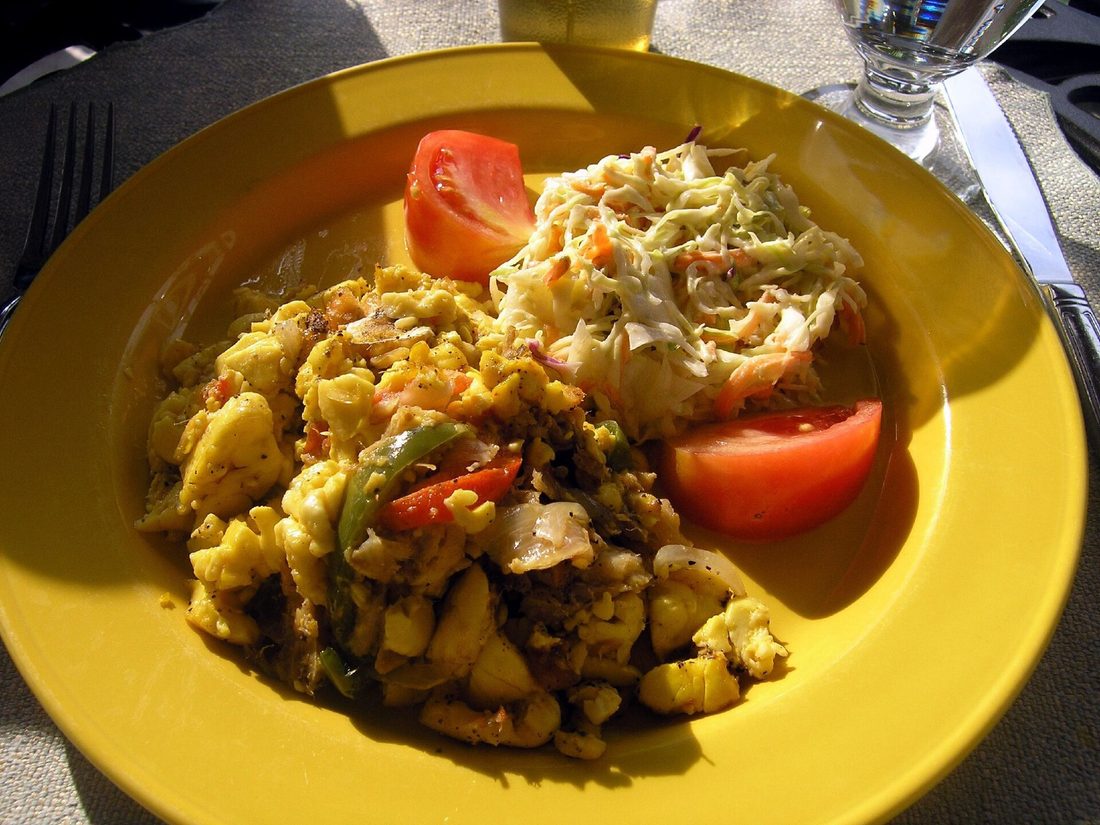
Ackee and saltfish. The ackee came from West Africa on slave ships; Bligh took it the other way, to Kew, and got the binomial for it.
Jamaica
🔴 Bligh is reversed. He took ackee out.
The story you’ve heard: Captain Bligh — Bounty Bligh, who genuinely did bring breadfruit to the Caribbean, which is why the story is sticky — brought ackee to Jamaica.
Backwards.
- Ackee came from West Africa, carried on slave ships, dated variously before 1725 (from Ghana) and 1778.
- Bligh took the fruit FROM Jamaica TO the Royal Botanic Gardens at Kew in 1793, introducing it to European science.
- The botanical name Blighia sapida honours him for the scientific description — for showing it to Europe — not for bringing it to the island.
He got the binomial. The enslaved made the actual voyage. They brought the fruit, they knew what to do with it, and the plant carries the name of the man who carried it in the opposite direction and wrote it down.
The etymology closes the case, and it’s well-supported: ackee derives from “ankye” / akee, from the Twi language of Ghana — also linked to Akan / Akyem. The name is African, and it arrived with African people. No European naming event required.
And the other half of the dish is a colonial-economy artifact with no ambiguity at all: West Indian sugar planters imported salted cod as cheap protein to feed enslaved Africans. Saveur’s headline on this is the right one — “Jamaica’s National Dish Is an Immigrant to Its Own Shores.”
⚠ Ackee safety — this part is not optional
Unripe ackee contains hypoglycin A, which causes Jamaican vomiting sickness and can be fatal.
The fruit must be allowed to open naturally on the tree before harvest. It must never be forced open. The pink/red membrane and the black seeds must be completely removed — they are toxic.
Canned ackee — the only form legally importable to the US — is already processed and safe, and it’s what my recipe specifies and what yours should too. I’m not going to write breezy fresh-ackee handling instructions for people who will be sourcing it from a can anyway.
Making ackee and saltfish
Two steps carry the dish, and both are about restraint.
Desalting is the step people botch. Soak the cod in cold water overnight, 12–24 hours, changing the water three or four times. Or boil 20 minutes, drain, taste, and repeat if it’s still aggressive. Taste before you proceed. Over-salted ackee and saltfish is unfixable — you cannot dilute your way out of it once the ackee is in.
Then: add the ackee last, and fold — do not stir. Ackee is as fragile as scrambled egg and turns to mush if you work it. Two to three minutes, just to heat through. And do not add salt until you have tasted the finished pan. You just spent a day taking salt out of a fish; don’t put it back on reflex.
Serve with fried plantains, festival, boiled green banana, fried dumplings.
🔴 The johnny cake collision
Two completely different foods share one name, and this trips up everyone including people who’ve eaten both.
| New England johnnycake | Jamaican johnny cake | |
|---|---|---|
| Grain | Cornmeal (Rhode Island: flint corn, whitecap) | Wheat flour |
| Method | Griddled / baked — a batter bread | Deep-fried |
| Form | Flat cake / pancake | Puffed fried dumpling |
| Leavening | Little to none | Baking powder |
| Also called | journey cake, hoecake, shawnee cake, spider cornbread | fried dumpling |
The umbrella term genuinely spans the coast — Wikipedia describes johnnycake as prepared “from Newfoundland to Jamaica” — but that’s a fact about the word, not about the food. The Caribbean version is a fried wheat-flour dumpling. The New England version is a cornmeal batter bread. They share four syllables and nothing else.
The name travelled. The food did not.
Which came first is unambiguous: the cornmeal one. Johnnycake originates with the Indigenous people of North America; cornmeal flatbread predates European contact. The Jamaican fried-dough dish is a later Caribbean development using imported wheat flour, which reached the island through colonial trade. So the name is older on the cornmeal dish, and the Jamaican dish borrowed the name and changed everything else about it.
There’s a bonus correction sitting inside this one, and it’s a beauty — the “journey cake” etymology is folk etymology, refuted by its own dates. “Johnny cake” is attested 1739. “Journey cake” only from 1775. The supposed origin postdates its supposed derivative by thirty-six years. The full autopsy is on the cornmeal page.
Festival, and the temperature that kills it
Festival is the sweet, elongated fried cornmeal-and-flour dumpling that partners ackee and saltfish and fried fish. Flour, fine cornmeal, sugar, baking powder, a little nutmeg or cinnamon, cold butter rubbed in, mixed to a firm, non-sticky dough — firmer than biscuit dough — rested 15–20 minutes and rolled into tapered 10 cm logs.
Fry at 170 °C / 340 °F — lower than you’d guess. Five to seven minutes total, turning.
That temperature is the whole recipe. There’s sugar in the dough, and at higher heat the sugar browns the outside while the centre stays raw. You pull out something that looks perfect and is a paste inside. That’s the classic festival failure and it is 100% a thermometer problem.
Same rule for the Jamaican johnny cake / fried dumpling: 170 °C, 4–5 minutes a side, golden and puffed. Split and eat hot with the ackee, or with callaloo, or with butter.
The plantains
Same absolute ripeness rule as everywhere else on this site: black-skinned, or don’t bother. Yellow is not ripe.
Jamaican breakfast plantain differs from the Guatemalan treatment in three specific ways, and they’re all deliberate: sliced thinner (1 cm) and on a longer diagonal, fried a shade darker, and served unsweetened and unadorned against the salt of the cod. No crema. No cheese. The plate’s dairy component isn’t there, so the plantain has to do its work against fish instead of against cream. Different job, different cut.
The green-plantain version is a different food entirely: Tostones — starchy, savoury, twice-fried.
Barbados
Get the terms right — this is the whole game
Bajan breakfast vocabulary is precise, and the internet gets it wrong constantly. Four terms:
- Salt bread = the roll. A fresh Bajan roll, crusty outside, soft and fluffy inside. ⚠ It does not taste salty. It actually reads slightly sweet. The name is a historical artifact, not a description. It is bread. It is not a sandwich.
- Cutter = the sandwich. Any sandwich made on salt bread. Ham cutter, cheese cutter, fish cutter. A cutter is not specifically a fish sandwich — that’s the mistake.
- Fish cutter = the famous one. Breaded and fried flying fish on salt bread with Bajan pepper sauce. Also made with marlin, billfish, kingfish, tuna or mahi-mahi — the “steak fish” versions are common and not lesser.
- “Bread and two” = two Bajan fish cakes in a salt bread roll. The “two” is literally the count of fish cakes. This is the breakfast item — cheap, fast, everyday morning food.
So the distinction that matters: “bread and two” is fish cakes — salt cod fritters. The fish cutter is a fillet of fried flying fish. Both sit on salt bread. Both are cutters in the generic sense. They are not the same sandwich, and only one of them is breakfast.
⚠ NOT FOUND: the first attestation of “bread and two.” The term and the practice are thoroughly documented as current. I found no dated origin — nobody has written down when the phrase started. It has the feel of something that was always just what you said, which is exactly the kind of thing that never gets recorded. If someone has an early citation, I’d like it.
The fish cakes
Bajan Fish Cakes. Desalt the cod the same way as the Jamaican dish — overnight with three or four water changes, or the boil-and-taste method — and then three things decide the result:
It’s a batter, not a dough. Thick — the consistency of very stiff pancake batter. It should drop reluctantly from a spoon. If you can roll it, you’ve made something else.
Plenty of baking powder. The sources say it plainly: “plenty of baking powder to make them rise nice and fluffy.” Two teaspoons to a cup of flour. This is a fritter and it needs the lift.
Drop them craggy, not neat. Heaped tablespoons, rough and irregular. The irregular surface is what crisps. A tidy sphere gives you a smooth exterior and less of the thing you’re eating them for. Fry 3–4 minutes at 175 °C / 350 °F, drain on a rack, and serve hot — fish cakes are miserable cold, and that’s not a preference, it’s a texture fact.
Rest the batter 20–30 minutes before frying: the baking powder starts working and the herbs bleed into it.
To make “bread and two”: split a salt bread roll. Two fish cakes. A slick of Bajan pepper sauce. That’s the sandwich. Optionally cheese and mustard, or lettuce and tomato — the standard cutter accompaniments.
The bread and the sauce
Cuban Bread is on the Key West half of this page, but the Bajan salt bread is its own thing: bread flour, yeast, sugar, salt, a bit of shortening or lard rubbed in, kneaded to a windowpane, shaped into short ovals/torpedoes, and baked at 200 °C / 400 °F for 18–22 minutes. Steam the oven for the first five minutes — a tray of boiling water on the floor. That’s what builds the crackly crust against the soft interior, and it’s the same physics as any hearth loaf. See the breads section if you want that argued properly.
Bajan pepper sauce deserves a note because it’s structurally different from most Caribbean hot sauces: it is mustard-based. A cup of yellow mustard is the defining ingredient, with Scotch bonnets, onion, garlic, vinegar, and turmeric for colour and earthiness. That’s what makes it Bajan rather than generic.
⚠ Gloves. Scotch bonnets run 100,000–350,000 SHU. Don’t touch your face. Ventilate — blending hot chiles aerosolises capsaicin, and you will find out what that means in your own kitchen otherwise.
And rest it at least a week in the fridge before you use it. On day one it is harsh and disjointed and you will think you made it wrong. You didn’t. It integrates. It keeps six months-plus — the vinegar and mustard do the preserving.
Key West
🔴 The café cubano anachronism
Here’s a sentence you’ll find repeated across the internet, including on coffee blogs that should know better:
“Café cubano emerged in the early 19th century as espresso machines grew widespread across the island.”
This is impossible. Not “disputed.” Not “probably too early.” Impossible, and the timeline is short enough to print in full:
| Year | What happened |
|---|---|
| 1884 | Angelo Moriondo, Turin — the first known patent for a steam coffee machine. A bulk brewer for the Turin General Exposition, running about 1.5 bar. No crema. |
| 1901 | Luigi Bezzera patents the machine that forces hot water through grounds under pressure. Cements the word “espresso” (“pressed out”). Introduces the portafilter and multiple brew heads. |
| 1938 / 1945 / 1948 | Achille Gaggia’s spring-piston lever machine — patented, rationalised, then in production — raises pressure from ~1.5–2 bar to 8–10 bar, producing crema, which Gaggia marketed as “caffè creme.” |
So: there were no espresso machines anywhere on earth in the early 19th century, and no crema-producing machines until 1948. Sweetened, crema-topped café cubano in its modern form is mid-20th century at the earliest.
What is defensible — and this is the distinction the bad sentence collapses: coffee was introduced to Cuba in 1748 and was culturally significant by the mid-19th century. Cuban coffee drinking is old. Café cubano as an espresso preparation is a 20th-century form. Those are two different claims and merging them is how you end up asserting that Cubans in 1820 were pulling shots.
And the technique itself proves the point. Café cubano is not “espresso with sugar stirred in.” The espumita — the pale tan foam — is made by whipping natural brown sugar with the first and strongest drops of the extraction, 60–90 seconds, into a thick paste, before the rest of the coffee goes in. The sugar is aerated into the crema at the start. That mechanically requires a pressurised machine producing concentrated first drops. The dish itself is evidence against its own origin story.
The related forms are worth knowing: colada (a large shot with tiny plastic demitasses, meant to be shared around a workplace — a social object as much as a drink), cortadito (espresso cut with steamed milk), and café con leche.
The full espresso history argument lives on the coffee pages.
Café con leche, and the dunk
Brew it strong — espresso, or a moka pot with Bustelo, Pilón or La Llave, which are the culturally correct brands and are dark and fine-ground.
⚠ Do not tamp a moka basket. Fill it level and unpacked. A tamped moka builds dangerous pressure and channels. Cold water in the base, to just below the valve. Medium-low heat.
Scald the milk to 65–70 °C / 150–160 °F — hot and steaming, not boiled. Boiled milk develops a skin and a cooked flavour, and the whole drink tastes of it. Roughly 1:3 coffee to milk, though that’s household preference and plenty of people pour to taste at the table.
Serve with buttered, toasted Cuban bread (tostada cubana) — pressed flat on a plancha, cut into halves, for dunking directly into the cup. The dunk is not optional. It’s the form. That’s what the bread is cut that way for.
Cuban bread is from Tampa, and its first commercial baker was Sicilian
⚠ Handle the Key West / Tampa question honestly, because it’s easy to let a Key West section quietly annex Tampa’s history.
Pan cubano is a Tampa/Florida creation, not an import from Cuba. It “originated in the immigrant communities of Tampa, Florida.”
- The first commercial US bakery producing it was most likely La Joven Francesca, founded by the Sicilian-born Francisco Ferlita in 1896 in Ybor City — a Cuban-Spanish-Italian community. Sit with that: Cuban bread’s first commercial baker in America was Sicilian.
- La Segunda Central Bakery in Ybor City is the surviving institution — its Cuban bread tradition ran 105-plus years as of the Tampa Bay Times’ 2020 telling.
Key West’s claim is real but it’s a different claim. Key West’s Cuban community is older than Ybor’s — Cuban cigar makers were there from the 1860s, before Ybor City was founded in 1885 — and Key West’s strongest claims are on the Cuban sandwich and on the cafecito/café con leche culture. Those are genuine. The documented commercial bread history is Tampa’s. Both things are true and neither needs to eat the other.
What makes it technically distinct from a baguette: fat. Cuban bread contains a small amount — lard or vegetable shortening — where a true French baguette is a lean dough: flour, water, salt, yeast, nothing else. That fat gives the tender shreddy crumb and a crust that shatters rather than tears, which is exactly why it presses flat into a Cuban sandwich instead of turning to leather.
⚠ Currency note, because “Cuban bread is made with lard” is now only partly true: “lard used to be a mainstay in the process, but these days more bakeries such as La Segunda are using animal and vegetable shortening.” Say traditionally lard; today often shortening. Historically true, presently drifting.
⚠ The palmetto frond: four stories, no answer
Bakers lay a fresh palmetto leaf lengthwise across the top of the loaf before baking. It scores the characteristic seam down the loaf’s spine.
The practice is real and documented. The why collapses into folklore, and there are at least four live explanations:
- Moisture retention — the frond holds moisture in during the bake.
- An oven timer — bakers working uneven ovens would “watch for a scorched leaf to see when it was time to rotate the loaves.” (Genuinely clever, and my favourite, which is exactly why I don’t trust myself on it.)
- Texture — “some believe it gives it that texture on top.”
- Just the seam — it’s simply what makes the signature groove.
Historian Gary Mormino — the leading scholar of Tampa’s Latin community — is quoted saying “I’ve heard people almost come to fisticuffs” over the debated story.
When the field’s own historian describes the origin as a subject of near-fistfights, there is no documented answer. The practice is fact. The reason is contested folklore with at least four candidates and no winner. I’m not picking one.
Also newsworthy: the tradition is at risk. The Tampa Bay Times reported in 2022 on pressure from supply, labour and food code. A practice nobody can explain may end before anyone settles what it was for.
The sandwich
Cuban Bread, and then the Key West breakfast built on it: butter the cut faces generously, soft-scramble two eggs over low heat and pull them while glossy (they finish in the press), and layer cheese on the bottom face — it acts as a moisture barrier — then eggs, ham if you want it, cheese on top.
Press on a plancha or under a heavy skillet weighted with a foil-wrapped brick. 200 °C / 390 °F, 3–4 minutes a side, until the bread is compressed to about a third of its height, the crust is deep golden, and the cheese has run.
⚠ No ridged panini grill. A Cuban press is flat. Grill marks are wrong — they’re a different machine’s signature on someone else’s sandwich.
Cut on a sharp diagonal. Café con leche alongside.
The thread
Three places, three reversals. Ackee sailed out of Jamaica, not into it. Johnny cake is two foods wearing one name, and the name belongs to the other one. Café cubano couldn’t have existed in the century it’s assigned to, and the espumita proves it.
And underneath all of it, the ledger: saltfish fed enslaved people, ackee arrived on slave ships, Cuban bread was baked by Sicilians for Cubans in Florida. The breakfast table is a record of who moved what, and why, and under what compulsion. Plainly stated, without sentimentality and without grievance-tourism — the facts don’t need help.
Next: Venezuela & Uruguay — where a 1954 patent, an inventor who died a year too early, and a sandwich named after an ingredient it doesn’t contain are all waiting.
Sources & further reading
- Wikipedia, Ackee and saltfish — the West African origin, the dating, and the Bligh correction.
- Saveur, “Jamaica’s National Dish Is an Immigrant to Its Own Shores” — the best framing written on this.
- Our History UK, on ackee and saltfish.
- Wikipedia, Johnnycake — the 1739/1775 attestations and the “Newfoundland to Jamaica” range.
- Etymonline, johnny-cake.
- What’s Cooking America, Johnnycakes.
- Sandwich Tribunal, “Sandwiches of Barbados: Cutters, Bread-And-Two” — unusually careful on the terminology, and the best source on this page for Barbados.
- Barbados.org, Cutters and Fish Cakes.
- Wikipedia, Cuban bread — Ybor City, Ferlita, 1896.
- Tampa Bay Times, “Tampa tradition of baking Cuban bread with palm leaves at risk” (2022) — the Mormino quote and the four explanations.
- Tampa Bay Times, “How La Segunda’s Cuban bread became a 105-year-old Ybor City tradition” (2020).
- La Segunda Bakery, “Our Story”.
- Wikipedia, Cuban espresso — colada, cortadito, the espumita.
- Britannica, Cafe Cubano — coffee reaching Cuba in 1748.
- Smithsonian, “The Long History of the Espresso Machine” — Moriondo, Bezzera, Gaggia.
- Barista Hustle, “Who really invented the first espresso machine?”.
- A Sassy Spoon, café con leche — the tostada and the dunk.
Comments (0)