Japan & China
Both of the dishes on this page are, in the strictest sense, the same dish twice: wheat, cooked by a professional, handed to you in the street or over a counter, eaten standing up on the way to somewhere else. One is steamed, one is griddled. One is a Chinese food the Japanese adopted and made their own; the other is a Chinese food that never left, and got a fake origin story bolted onto it anyway.
I ate nikuman in Japan and jianbing in China.
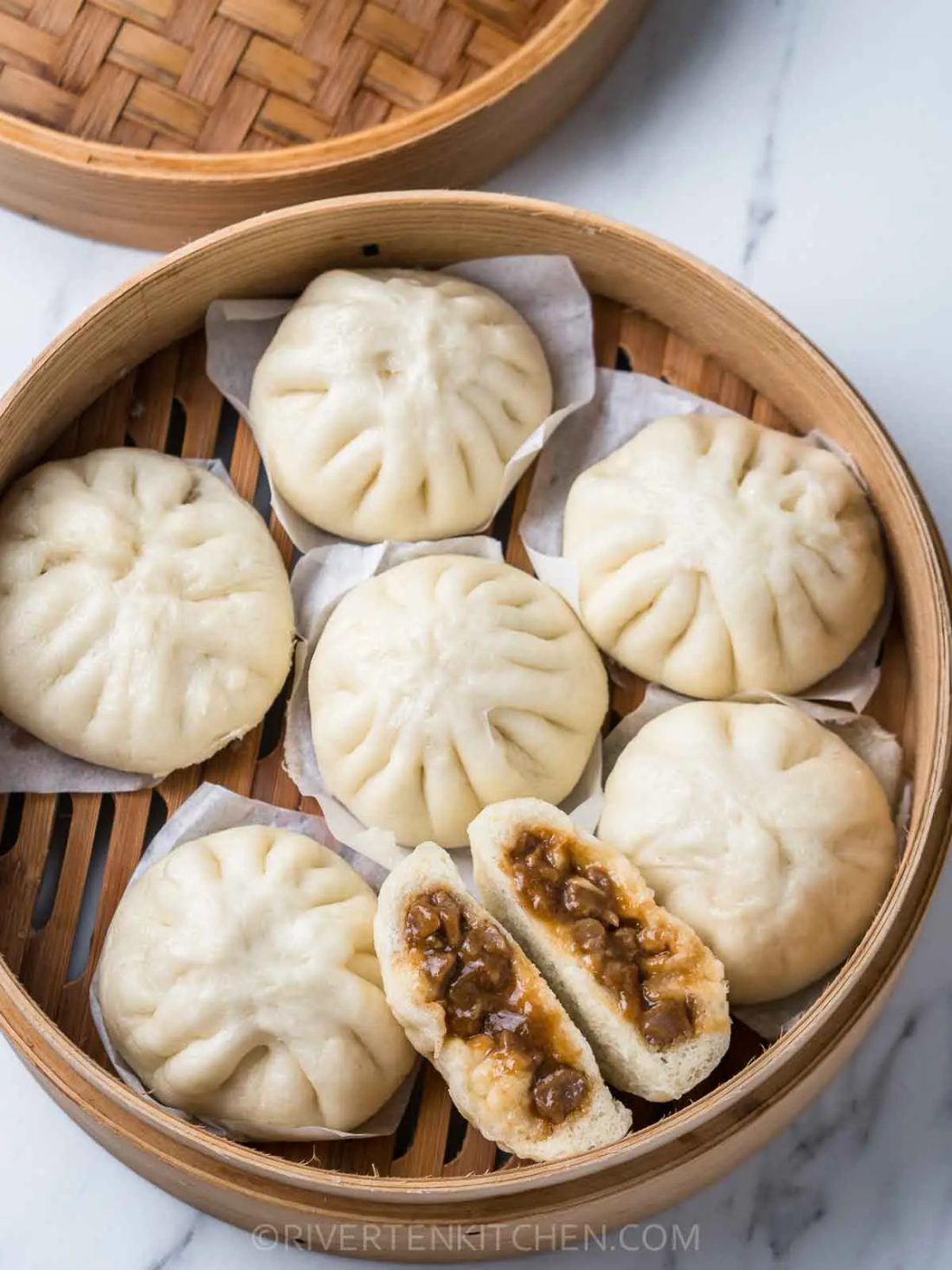
Nikuman. A Chinese bun, adapted in Japan, sold from a heated cabinet by the register — and Kobe was selling them twelve years before the shop that gets the credit.
Japan — Nikuman (肉まん)
It’s a Chinese bun. Say so first.
A nikuman is a steamed wheat bun with a seasoned pork filling. It is not a Japanese invention. It descends from baozi (包子), and Japan has never been coy about this: the category term for the whole family is 中華まん (chūkaman) — literally “Chinese bun.” The name announces the import every time somebody says it.
A vocabulary note that tells you something real about Japan: in Kansai the same object is called 豚まん (butaman) — pork bun — because in western Japan the character 肉 (“meat”) defaults to beef. Call it a nikuman in Osaka and you’ve technically ordered something else. The regional meat default is baked into the word.
The transmission, in the correct order
The popular account collapses two separate events into one, and gets the credit wrong. Here they are apart:
1915 — Kobe, Nankinmachi. Rōshōki (老祥記). Founder Sō Shōki (曹松琪), from Ningbo in Zhejiang, opened what is described as Japan’s first dedicated pork-bun shop in Kobe’s Chinatown in Taishō 4 (1915). He based it on 天津包子 (Tianjin baozi), adapted it to Japanese palates with a soy-sauce seasoning, and coined the name 豚饅頭 (butamanjū) — which is where “butaman” comes from. The shop is still open.
⚠ Japanese Wikipedia is honest about the limit of this claim, and I’ll reproduce the caution rather than launder it: whether Rōshōki’s 1915 bun is identical to the modern Japanese chūkaman is not certain (「現在の日本の中華まんと同一かどうかは定かではない」). It got there first. Whether “there” is the same place is a separate question.
1927 — Tokyo, Shinjuku. Nakamuraya (中村屋). Per Nakamuraya’s own corporate history, founders Sōma Aizō (相馬愛蔵) and his wife Kokkō (黒光) travelled to China and tasted baozi for the first time. They found the Chinese preparation oily and heavy, and concluded a lighter version would sell at home. Aizō hired Chinese craftsmen to learn the technique, struggled considerably with the dough, and launched in 1927 (Shōwa 2) under the gloriously immodest name 「天下一品支那饅頭」 — “Finest-in-the-Land Chinese Bun” — at 6 sen for the meat-filled and 4 sen for the sweet bean.
⚠ The date of that China trip is contested. Nakamuraya’s own site says 1925; Japanese Wikipedia says 1914. I’m going with the company’s account because it’s the company’s history, but the conflict is real and I’m not going to pretend it away.
So here’s the honest summary. Before this, chūkaman was available essentially only in Chinatowns and a handful of Chinese restaurants, bought mostly by Chinese immigrants. Rōshōki (1915) got there first. Nakamuraya (1927) is what put it in front of the general Japanese public.
“Nakamuraya invented nikuman” is wrong. “Nakamuraya popularized nikuman” is right. The gap between those two sentences is twelve years and a different city.
Why the dough tastes wrong to Chinese eaters (and that’s the point)
Japanese nikuman dough is mildly sweet and milky. Chinese baozi dough is plain. That difference is not a drift or an error — it is the Nakamuraya adaptation, the deliberate lightening Aizō set out to do in 1927, still sitting in the dough a century later. If you’ve eaten both and thought the Japanese one tasted faintly of dessert, you were tasting a business decision from the Shōwa era.
The konbini cabinet is a genuine institution
This is the part that isn’t hype. Convenience stores began selling steamed buns in the 1970s, as konbini themselves spread across Japan. The chain credited with starting it is Sun Avery, now Daily Yamazaki.
Then Imuraya (井村屋) blew the category open:
| Year | Product | Why it matters |
|---|---|---|
| 1977 | カレーまん (curry man) | A major hit — and the trigger for the whole diversified chūkaman category |
| 1979 | ピザまん (pizza man) | Proof the format would carry anything |
The steamed-bun cabinet by the register, appearing around October and running through winter, is a real seasonal marker in Japan — the food equivalent of the leaves turning. And the scale is not small: 55,713 konbini in Japan as of end-2023, ¥11.6 trillion in combined annual sales.
⚠ NOT FOUND: unit-sales figures for konbini nikuman in the 1960s–70s. Every version of this story wants a number there. I don’t have one, so there isn’t one.
RECIPE — Nikuman (makes 20 small buns)
Dough
- 300 g all-purpose flour
- 20 g sugar
- ½ tsp kosher salt
- 1 tsp baking powder
- 1 tsp instant yeast
- 1 Tbsp neutral oil
- 160–180 ml lukewarm water
Filling
- 340 g ground pork
- 180 g green cabbage (about 4 leaves), finely chopped
- 1 tsp kosher salt, to purge the cabbage
- 2 dried shiitake, rehydrated in ½ cup water, finely chopped
- 1 scallion, minced
- 1½ tsp grated ginger, juice and all
- 1 tsp sugar
- 1 Tbsp sake
- 1 Tbsp soy sauce
- 1 Tbsp toasted sesame oil
- 1 Tbsp potato starch or cornstarch
- Black pepper
Method
- Whisk the dry dough ingredients. Add oil and water; knead to a smooth, soft dough. Cover and rise somewhere warm 30–60 min, until doubled.
- Salt the chopped cabbage, rest 5 min, then squeeze the water out hard. This is the difference between a juicy bun and a soggy one. Be more brutal than feels reasonable.
- Mix all filling ingredients until slightly sticky. Chill while the dough rises.
- Punch down; divide into 20. Rest 10 min under a towel.
- Roll each into a ~10 cm round, thicker in the center than at the edge — the center carries the filling’s weight, the edge has to pleat.
- Fill, pleat, twist closed. Set each on a square of parchment.
- Final proof 20 min.
- Steam over high heat: 10 min (small) / 13 min (medium) / 15 min (large). Wrap the lid in a towel so condensate doesn’t drip and pit the surface.
Two technique notes worth having:
- Why both yeast AND baking powder? Yeast gives flavor and structure; baking powder adds extra lift in the steamer’s short, wet heat. It’s the standard Japanese approach, and it’s why nikuman is fluffier than most baozi. It isn’t belt-and-braces — it’s doing two different jobs.
- The dough is deliberately sweet and pale. That’s the Nakamuraya lineage, not a mistake. If yours comes out looking like a Chinese bun, you’ve made a Chinese bun.
Related and already in my collection: Buns, Steamed, with Mushroom Filling — same technology, different lineage. Worth making back-to-back with the nikuman to feel the dough difference.
→ Full recipe: Nikuman
China — Jianbing (煎饼)
What it is
A savory street crêpe cooked to order on a round griddle. Batter goes down and gets spread thin with a wooden T-shaped scraper (刮子); an egg is cracked on and smeared flat across the surface; sesame and scallion get scattered; it’s flipped, painted with sauces, loaded with a crisp cracker, then folded into a handheld packet and cut in half.
Breakfast. Eaten walking. The entire construction takes about ninety seconds and is one of the most efficient pieces of street cookery on earth.
⚠ The Zhuge Liang legend is folklore. I’m saying it plainly.
The story you’ll read everywhere: during the Three Kingdoms period, Chancellor Zhuge Liang’s army lost its woks. He ordered the cooks to mix wheat flour with water and cook the batter on shields over the fire. Morale restored, battle won, jianbing invented.
It is not documented history. Every source carrying it introduces it with “according to legend” (「传说」). No primary text is ever cited. Not one.
And it’s internally incoherent, which is the part that should bother you more than the missing citation. The same articles say “2,000 years old” and “Three Kingdoms (AD 220–280)” in the same breath. Those differ by about two centuries. Zhuge Liang died in AD 234. The story can’t keep its own arithmetic straight, which is what happens when nobody is checking because nobody ever had a source to check against.
What is defensible, and it doesn’t need a chancellor: jianbing sits in northern China’s very old bing (饼) tradition — a broad category of griddled flour flatbreads — and griddle cookery in the region is genuinely ancient, with archaeological griddle implements turning up across multiple dynasties. But that’s a tradition, not an invention event. Traditions don’t have birthdays, and the desire to give them one is exactly what manufactures a Zhuge Liang.
The actual earliest documentation: jianbing guozi being served in Tianjin, recorded in the newspaper 《大公报》(Ta Kung Pao), 20 November 1933. That’s it. That’s the paper trail. It is much less romantic and much more real.
The two styles — the actual regional story
| Shandong | Tianjin (jianbing guozi 煎饼果子) | |
|---|---|---|
| Batter | Coarse grains — corn, sorghum, millet | Mung bean flour |
| Texture | Crisper, harder (low gluten from coarse grain) | Softer (mung bean has little gluten) |
| Crisp element | báocuì (薄脆) — a thin fried cracker | Youtiao (油条) — the fried dough stick |
| Served with | Scallions, meat soup | — |
Traditional jianbing originated in Shandong and flourished in Tianjin; the Tianjin version is a transformation of the Shandong one, and the mung-bean batter is the Tianjin signature.
The word guozi in jianbing guozi literally refers to the youtiao inside. Which sets up a real, live argument: Tianjin purists will tell you that a jianbing guozi made with báocuì instead of youtiao is not a jianbing guozi at all. They have a point — the name is naming the youtiao. I have no dog in that fight and I’m not going to pretend the dispute is settled just to make the recipe below tidier.
RECIPE — Jianbing (makes 4)
Batter
- 100 g mung bean flour
- 60 g all-purpose flour (low protein)
- 40 g millet flour (optional — use it for a Shandong lean)
- 400–450 ml water
- ½ tsp salt
Whisk to the consistency of thin cream. It must pour and spread, not mound. Rest 30 min, then re-whisk. ⚠ Mung bean flour settles — stir it before every single crêpe or your last one will be water and your first will be paste.
Báocuì (the crisp cracker)
- 150 g all-purpose flour, ½ tsp salt, ~75 ml water
Knead to a stiff, pasta-like dough. Rest 30 min. Roll very thin, cut into ~12 cm squares, prick all over, and deep-fry at 180 °C / 355 °F for 30–45 sec per side until pale gold and rigid.
Shortcut that actually works: deep-fry wonton wrappers. I’m not going to be precious about it.
Sauces
- Sweet bean: 3 Tbsp tianmianjiang (甜面酱) thinned with 1 Tbsp water + 1 tsp sugar
- Chili: 2 Tbsp chili-garlic paste, thinned
- Fermented bean curd (optional, traditional): 1 cube red furu mashed with 1 Tbsp water
Per crêpe
- 1 egg; 1 tsp white sesame seeds; 1 Tbsp chopped scallion; chopped cilantro; 1 sheet báocuì; optional pickled mustard stem (榨菜)
Method
- Heat a large flat pan or crêpe griddle over medium, lightly oiled and wiped almost dry. ⚠ Too hot and the batter sets before you can spread it. This is the #1 home failure and it is counterintuitive, because everything about the street version looks like it’s cooking fast.
- Ladle ~120 ml into the center. Spread immediately in a circular sweep with a T-scraper — a flat-bottomed offset spatula or a small wooden spreader works. Aim for ~25 cm.
- When the surface is just set (~30 sec), crack an egg straight on top and smear it flat across the crêpe with the scraper.
- Scatter sesame and scallion; press gently so they stick.
- When the underside releases (~1 min), flip.
- Brush with sweet bean sauce, then chili to taste. Add cilantro and pickle.
- Lay the báocuì across the center. Fold both sides in over it, then fold the ends in. Press. Cut in half.
- Eat immediately — the crisp starts dying within a minute. That’s not a flaw. It’s why this is street food and not restaurant food: the dish has a lifespan of about sixty seconds and the only way to serve it is to hand it to someone who’s already walking.
→ Full recipe: Jianbing
The through-line
Two Chinese breakfasts. One crossed a sea, got sweeter, and became so Japanese that it’s sold in 55,000 convenience stores — while still being called, out loud, a Chinese bun. The other stayed home and had a 3rd-century general retroactively assigned to it by people who wanted it to be older and more heroic than a 1933 newspaper clipping.
Food doesn’t need an origin myth. It needs somebody who can cook it. Both of these have that.
More on the wider argument at Why breakfast?, and the rest of the world’s morning food is indexed at Breakfast Favorites. If you want the opposite of a street crêpe — a plate that takes an hour and never moves — that’s the Irish breakfast.
Sources & further reading
Japan — nikuman
- Nakamuraya official product history (中華まん│商品の歴史│新宿中村屋) — the primary claim: 1927, 天下一品支那饅頭, 6 sen.
- 老祥記 official site and 老祥記の軌跡 — the 1915 Kobe claim, from the shop that’s still making them.
- 神戸っ子 — 老祥記 vol.1「豚饅」の発祥は神戸にあり
- ja.wikipedia — 中華まん — Imuraya 1977/1979, the butaman naming, and the honest 1915-vs-1927 caution.
- Just One Cookbook — Nikuman — the basis of the recipe above.
- Tokyo Weekender — a history of Japanese convenience stores
China — jianbing
- Wikipedia — Jianbing
- Wikipedia — Jianbing guozi — the 1933 Ta Kung Pao attestation, which is the whole documentary record.
- Sandwich Tribunal — From Kongming to Tianjin: Jian Bing — explicitly notes the Zhuge Liang tale is tradition, not record; also the báocuì method.
- The World of Chinese — The Bing Dynasty
- China Daily — The bing dynasty
Comments (0)