Vietnam
Here’s the thing Westerners get wrong before they’ve even sat down: phở is breakfast.
Not a dinner. Not a rainy-Sunday thing. In Vietnam it’s a morning food, and the American habit of eating it at 8 p.m. is the deviation — ours, not theirs. Same for bánh mì, same for cơm tấm. All three of the dishes on this page are genuinely what people eat before work.
I ate all three in Vietnam.
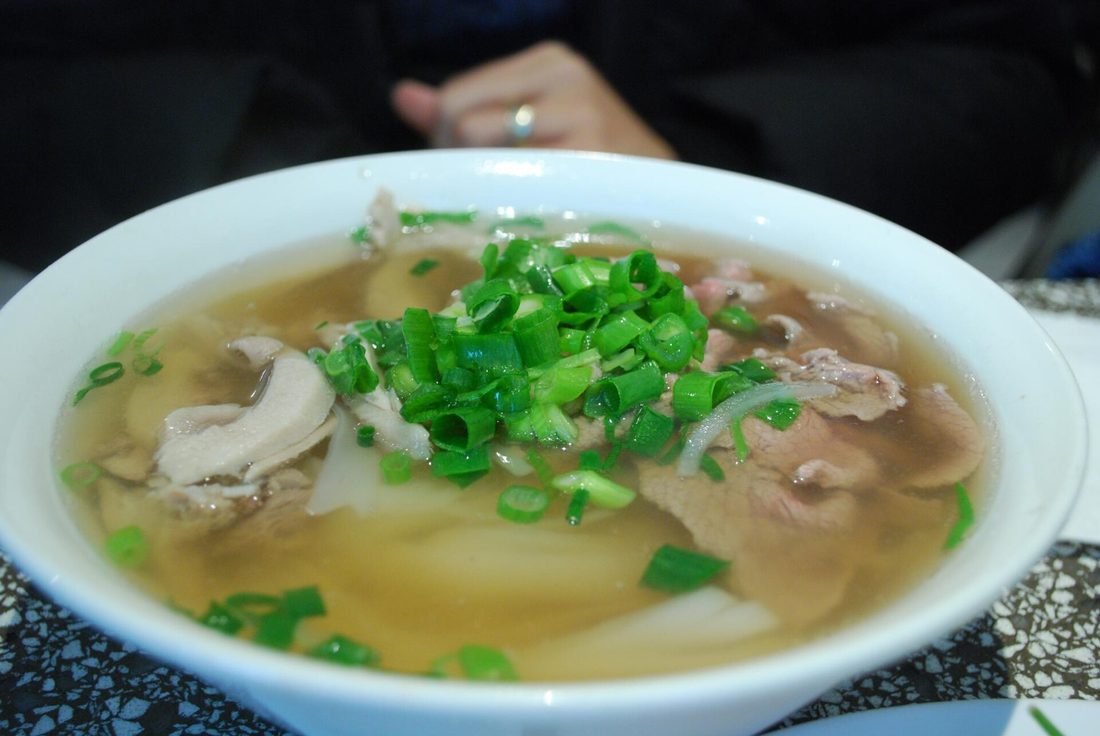
Phở — and yes, breakfast. Where it came from is a genuine scholarly dispute, and I’m not going to pretend to settle it.
Phở bò — and a fight that hasn’t been settled
⚠ This one is different from the rest of this section. Most of the origin stories I’m debunking across these pages are folklore — copy-pasted, uncited, often self-contradicting. The phở argument is not that. It’s a genuine, live, unresolved dispute between serious people who have read the sources and disagree. I’m going to lay out both sides and I’m not going to pick a winner, because the people who know most about it haven’t either.
The timeline both camps mostly accept
| Date | Event |
|---|---|
| 1907 | Georges Dumoutier’s extensive account of Vietnamese cuisine omits phở entirely — strong negative evidence that it barely existed yet |
| 1907 | The word appears in a short story |
| 1908–1910 | Henri Oger’s illustrated survey of Hanoi shows phở vendors (per Andrea Nguyen) |
| 1913 | Nguyễn Công Hoan recalls street vendors selling phở |
| ~1900–1907 | Modern phở emerges — in Nam Định Province, per that camp |
| 1925 | A skilled cook from Vân Cù village opens a storefront in Hanoi; Nam Định-style shops seed their reputation |
| ~1930/1931 | First dictionary definition |
| 1930 | Phở widely available across Hanoi |
| 1935 | Earliest English-language reference, in Recipes of All Nations |
| 1954 | Partition. Over a million refugees move north→south. Phở, previously uncommon in the south, takes off — and picks up the garnish plate |
That Dumoutier omission is the most useful single fact on the table. A thorough survey of Vietnamese food in 1907 that doesn’t mention phở tells you something no positive claim can: it wasn’t there yet, or it was too new and too marginal to notice. Whatever happened, happened right around then.
Theory A — the French pot-au-feu
Who says so: Gustave Hue (1937) equated cháo phở with pot-au-feu — “pot on the fire” — and Western sources have been repeating it ever since.
The argument: the French ate beef; the Vietnamese traditionally ate pork and chicken. French demand created a beef-slaughter industry where none had existed. A variant has French soldiers asking vendors for “feu.”
The strongest version — and this is Andrea Nguyen’s framing, who is sympathetic to this part of it: the French, occupying Vietnam officially from the 1880s to 1954, slaughtered cows — animals the Vietnamese used as draft animals, not food — to get their steaks. The leftover bones and scraps were salvaged and sold by a handful of Hanoi butchers. Street vendors then adapted an existing soup, xáo trâu (water buffalo noodle soup), swapping beef for buffalo and flat noodles for round vermicelli.
Read that carefully, because it’s the honest version and it’s better than the slogan: French demand created the raw material. Vietnamese cooks created the dish.
Also plausibly French: the technique of charring ginger and onion for the broth. Nguyen calls this “a plausible Franco-Viet connection.”
Theory B — the Chinese 粉 (fěn)
Who says so: Hue himself also floated it. Eugène Gouin (1957) and Lê Ngọc Trụ backed it. Victor Mair and the linguists at Language Log treat it as the better-supported etymology today.
The argument: phở derives from ngưu nhục phấn (牛肉粉) — “beef rice-noodles” — sold by Chinese immigrants in Hanoi. Cantonese ngàuh yuhk fán.
The naming evolution (Nguyen’s reconstruction of the street cry, and it’s a lovely piece of reasoning because it’s a sound, not a document):
“Ngưu nhục phấn đây!” (“Beef and rice noodles here!”) → “Ngưu phấn a” → “Phấn a” / “Phốn ơ” → phở
A vendor shouting the same phrase ten thousand times a year sands it down to one syllable. That’s not speculation about how language works; that’s just how language works.
The documentary evidence: the ~1930/1931 dictionary defines phở as deriving from phấn, the Vietnamese pronunciation of Chinese fěn (flat rice noodles), and defines the dish as “small slices of rice cake boiled with beef.” The rice noodles and the spice profile are Chinese culinary tradition. Chinese Yunnanese workers likely associated it with Yunnan’s guò qiáo mǐ xiàn (crossing-the-bridge noodles).
Nguyễn Ngọc Bích adds a detail I enjoy more than I should: the final -n may have been dropped because phấn/phẩn sounds like the vulgar word for excrement. A nation quietly editing a syllable out of its national dish’s name to avoid saying “shit soup” is the most human thing in this whole dossier.
The counter-arguments to Theory A
Three of them, and they’re not weak:
-
Phonetics. French feu is [fø], not [fo]. It does not map cleanly onto phở. The etymology’s central claim is a sound-alike that doesn’t sound alike.
-
The dishes aren’t alike. Andrea Nguyen: “it’s difficult to accept that the soup directly descended from French cuisine. Pho doesn’t involve lots of vegetables like pot-au-feu does.” Pot-au-feu is a boiled-beef-and-root-vegetable dinner. Phở is a clear aromatic rice-noodle soup. They share a pot and a cow.
-
The ideological objection — and this is the one that stays with me. Food historian Erica J. Peters argues the French have embraced phở in a way that overlooks its origins as a local improvisation, reinforcing “an idea that the French brought modern ingenuity to a traditionalist Vietnam.”
Peters’ own contribution isn’t etymological, it’s documentary: she shows phở’s spread was driven by the rise of street vendors responding to Hanoi’s colonial urbanization. Which reframes the whole argument, and correctly:
The colonial city is the setting. Vietnamese vendors are the authors.
That’s a sentence worth sitting with. The French built a city that needed cheap fast food for workers on the move at dawn. Vietnamese cooks filled that need. Calling the result French because the French built the street is a category error — and, Peters would say, a self-flattering one.
Nam Định vs Hanoi
- The Nam Định camp: phở was created by residents of Nam Định — specifically the villages of Vân Cù and Dao Cù — and first sold by street vendors around 1913.
- The Hanoi camp / the cautious position: Andrea Nguyen — “most people agree that the magical moment happened at the beginning of the twentieth century in and near Hanoi.” She acknowledges the Vân Cù claim but treats Nam Định’s documented role as the 1925 storefront that seeded the Nam Định style in Hanoi, rather than as the birthplace.
⚠ The honest verdict: the two aren’t fully separable. Nam Định cooks working in Hanoi is the likely mechanism, which makes “which city invented it” a question that may not have an answer because it may not be a coherent question. NOT FOUND: a resolution. There isn’t one. Anyone who gives you one is selling something.
Victor Mair’s conclusion, and I’ll let him have the last word here because it’s the fairest one available:
“The origins and etymology of such an important, worldwide dish as pho are highly complex and hotly contested.”
Also worth locating if you want to go deeper: Dung Quang Trinh’s 2010 essay “100 Years of Vietnamese Phở”, which Nguyen calls “an oft-cited historical essay” with a “reasonable explanation.”
RECIPE — Phở bò (serves 6)
Broth
- 2 kg beef bones (marrow + knuckle)
- 1 kg oxtail or beef shank
- 1 large onion (~250 g), unpeeled, halved
- 100 g ginger, unpeeled, halved lengthwise
- 45 g rock sugar (or 2 Tbsp granulated)
- 2 Tbsp fish sauce, plus more to finish
- 1 Tbsp salt
- ~5 L water
Spice sachet — toast dry, 2–3 min, until fragrant
- 6 star anise
- 1 cinnamon stick (~8 cm, cassia)
- 6 cloves
- 1 Tbsp coriander seed
- 1 tsp fennel seed
- 2 black cardamom pods (thảo quả), cracked
To serve
- 900 g fresh flat rice noodles (bánh phở), or 450 g dried
- 300 g eye of round, frozen 20 min then sliced paper-thin against the grain
- Scallion, white onion sliced paper-thin, cilantro
- The southern plate: bean sprouts, Thai basil, culantro (ngò gai), lime wedges, sliced chilies, hoisin, sriracha
⚠ Be honest about that last line. The garnish plate, the hoisin and the sriracha are southern innovations that took hold after 1954 — they arrived with the dish when a million northerners did. A Hanoi phở is austere by comparison: noodles, beef, broth, scallion, maybe a wedge of lime. Neither is wrong. They’re two different dishes wearing the same name, separated by a partition and 1,700 km.
Method
- Parboil the bones. Cover with cold water, bring to a hard boil, boil 10 min, dump it all, and rinse each bone under running water, scrubbing off the grey scum. Scrub the pot too. ⚠ This step is what makes the broth clear. Skipping it is the classic failure and no amount of later skimming recovers it.
- Char the onion and ginger directly over a gas flame, under a broiler, or in a dry cast-iron pan until blackened in patches and fragrant, ~10–15 min. Rinse off loose char; scrape the ginger.
- Return the bones to the clean pot with 5 L cold water. Bring to a bare simmer — never a rolling boil, which emulsifies fat and clouds the broth. Skim relentlessly for the first 30 min.
- Add the charred aromatics, spice sachet, rock sugar, salt and fish sauce. Simmer 3–4 hours minimum; 6 is better. Target a bare shiver, around 95 °C.
- Pull the spice sachet at 1.5 hours. Leave it in for the full six and the broth turns medicinal. The spices are a top note, not a base.
- Strain through a fine sieve lined with cheesecloth. Season with fish sauce and salt aggressively — it should taste slightly too strong in the pot, because the noodles are bland and will pull it back.
- Assembly is a fire drill and must be. Blanch noodles 10–20 sec, drain hard, drop into a hot bowl. Lay the raw sliced beef over the top. Ladle boiling broth over — it must be at a rolling boil in the ladling pot or the beef won’t cook. Scatter onion, scallion, cilantro. Serve instantly, garnish plate alongside.
Already in the collection: Homemade Pho and Vietnamese Pho Ga (Chicken Pho) — the chicken version is the weeknight answer and doesn’t require a six-hour bone project.
Bánh mì — and the innovation that made it possible
The colonial history, straight
- The baguette arrived in the 1860s, at the start of the French imperial campaign. It was initially a luxury — expensive, foreign, and unmistakably associated with the colonizer.
⚠ The etymology myth: it is NOT from pain de mie
You’ll read that bánh mì is a corruption of French pain de mie. It isn’t. This is false and it’s easy to disprove.
Bánh is a native Vietnamese word for rice cakes and pastries, attested since the 13th century — long before any French contact. Bánh mì = bánh (“baked good”) + mì (“wheat”). It’s a plain Vietnamese compound meaning “wheat cake.”
The clincher: the term appears in Jean-Louis Taberd’s Dictionarium Latino-Annamiticum in the 1830s — in a Vietnamese dictionary before the baguette arrived in force. The word predates the bread it supposedly comes from.
The key Vietnamese innovation — rice flour
This is the actual story of the bánh mì and it deserves better than being a footnote to the French part.
During World War I, wheat imports were disrupted. Vietnamese bakers began cutting the dough with cheap rice flour. Two consequences, and both matter:
- It made the bread cheaper — which democratized it. A colonial luxury became affordable to ordinary Vietnamese people.
- It made the bread fluffier — an airy, open, almost hollow crumb with a thin, shattering crust. Nothing like a French baguette’s dense chew.
That accident of wartime scarcity is the bánh mì loaf, and the sandwich is impossible without it. The airy crumb compresses to hold filling instead of squeezing it out. The thin crust shatters instead of shredding the roof of your mouth. Try building one on a real French baguette and you’ll discover, physically, why the substitution isn’t optional. The hot, humid climate reinforced the adaptation.
A shortage forced a substitution. The substitution was better. That’s the whole dish.
1958 — Hòa Mã, Saigon
1954: partition sends over a million northerners to Saigon and transforms its food.
1958: the Lê family, at their shop Hòa Mã in District 3, are credited as “one of the first” to sell bánh mì thịt — the assembled meat sandwich. Mrs. Lê used charcuterie skills learned from the French to make her own processed meats. And crucially, they shrank the baguette to about 20 cm and cut back the meat, adding vegetables instead — making it affordable for ordinary people.
⚠ Note the hedge and keep it: “one of the first,” not “the inventor.” That’s Wikipedia’s careful wording and it’s careful for a reason. Plenty of blogs harden it into an invention claim. Don’t.
24 March 2011: bánh mì was added to the Oxford English Dictionary.
RECIPE — Bánh mì thịt (makes 4)
Realistic advice first: the bread is the whole dish, and a French baguette is the wrong bread. If you can buy Vietnamese bánh mì rolls, buy them. This is not a defeat. If you can’t:
The loaf (4 rolls)
- 250 g bread flour
- 60 g rice flour ← the entire point of the last three paragraphs
- 6 g instant yeast
- 6 g salt
- 5 g sugar
- 200 ml water
- ¼ tsp ascorbic acid / vitamin C powder (a crushed tablet) — a dough conditioner that drives the open crumb
- Mix, knead 8–10 min to a slack, smooth dough. Bulk 1 hr, doubled.
- Divide into 4; shape into 20 cm torpedoes. Proof 45 min.
- Slash one deep lengthwise cut. Bake at 230 °C / 445 °F with heavy steam for the first 10 min (pour boiling water into a preheated tray), then 12–14 min more without steam, until deep gold and audibly hollow. Cool completely — the crust crisps on cooling, not in the oven.
Fillings — the classic “everything”
- Vietnamese pork roll (chả lụa), pâté, headcheese, Vietnamese ham, sliced thin. Or grilled pork.
- Đồ chua (the pickle) — make ahead: 150 g carrot + 150 g daikon, julienned; toss with 1 tsp salt
- 1 tsp sugar, rest 15 min, squeeze dry; pack into a jar with 250 ml warm water + 100 g sugar + 100 ml white vinegar. Ready in 1 hr; best after 24 hr; keeps 3 weeks.
- Mayonnaise (ideally the egg-yolk-rich Vietnamese style), cucumber batons, cilantro sprigs, sliced jalapeño or bird chili, Maggi seasoning.
Assembly: warm the roll 3–4 min at 175 °C to re-crisp. Split it hinged, not through. Hollow out a little crumb if it’s dense. Pâté on one side, mayo on the other, meats, pickle, cucumber, cilantro, chili, a few dashes of Maggi. Press closed.
→ Full recipe: Bánh mì
Cơm tấm — broken rice
What it is
Steamed broken rice — fractured grains — served with a grilled pork chop (sườn nướng), often plus chả trứng (a steamed pork-and-egg meatloaf), bì (shredded pork skin), a fried egg, pickles, scallion oil (mỡ hành), and nước chấm poured over the lot. A Saigon breakfast institution.
The rice is the point. Broken grains cook up shorter, drier, and slightly chalkier, with a distinct texture that soaks sauce differently than whole grains do. It is not a defect in the finished dish — it’s the reason the dish exists.
⚠ The “rejected grains” story — what the evidence actually supports
The claim: broken rice was the inferior byproduct of milling, unsellable at market price, so poor Mekong Delta farmers ate it themselves during bad seasons; urbanization in the first half of the 20th century carried it to Saigon, where it became a delicacy.
The verdict: the mechanism is true. The narrative is unsourced. Those are different things and the difference matters.
- ✅ Verifiable: broken rice is a genuine byproduct of milling — grains fracture during hulling and handling. It is graded lower and does sell cheaper. That’s documented agricultural economics, not folklore. The “cheap grain became a beloved dish” arc is therefore plausible on its face, which is exactly what makes it dangerous.
- ✅ Verifiable: cơm tấm’s spread across southern Vietnam, Saigon included, tracks Vietnam’s early-20th-century urbanization.
- ❌ NOT VERIFIED: the specific story — poor Mekong farmers, bad harvests, late 19th century. Every source I could find for it is a travel blog or a restaurant page, all with near-identical wording, none citing anything. No academic or archival source located.
So here’s how I’d put it, and it’s less satisfying than the blog version because honesty usually is:
Cơm tấm is said to have begun as the cheap broken grain left behind by milling — and the economics of that are real: broken rice is a genuine milling byproduct and did sell for less. But the familiar story of poor Mekong farmers eating it in lean seasons traces only to travel writing, not to any archive I could find. What’s certain is that the dish spread with southern urbanization.
⚠ And the modern irony, which nobody tells you: demand is now high enough that broken rice is deliberately produced, and it can cost more than whole rice. The “poor man’s grain” framing is, today, backwards. The reject became the premium. If the origin story were true, the dish has already outrun it.
RECIPE — Cơm tấm sườn nướng (serves 4)
Sườn nướng — marinate overnight; 2–3 days if the chops are over 1.5 cm
- 4 pork chops, ~1.5 cm thick (~900 g total), lightly pounded
- 5 cloves garlic, minced
- 1 shallot, minced
- 1 stalk lemongrass, minced fine
- 3 Tbsp fish sauce
- 1 Tbsp soy sauce
- 2 Tbsp sugar + 1 Tbsp honey
- 1 tsp five-spice
- 2 Tbsp neutral oil
- 1 tsp oyster sauce
- 1 tsp black pepper
- (1 tsp MSG — genuinely traditional here. Use it or don’t, but don’t pretend it isn’t in the original.)
Grill over hot charcoal, 4–5 min per side, basting with reserved marinade plus a little oil. You want real char on the edges — the sugar and honey are in there to burn a little. That’s the job they’re doing.
The rice
- 400 g broken rice (tấm) — sold in Asian groceries as “broken rice.” Substitute long-grain jasmine if you must, but then say that’s what you did.
- Rinse 3 times, then steam or cook with slightly less water than usual — about 1 : 1.15 rice to water — because broken grains absorb faster and turn to porridge if you treat them like whole ones.
Mỡ hành (scallion oil)
- 4 scallions, sliced thin. Pour 60 ml smoking-hot neutral oil over them. Pinch of salt.
Nước chấm
- 60 ml fish sauce, 60 ml water, 50 g sugar, 60 ml lime juice, 2 cloves garlic minced, 1–2 bird chilies minced. Dissolve the sugar in warm water first, then combine. It should taste sweet-sour-salty, in that order.
Serve: rice mounded, chop on top, mỡ hành spooned over, đồ chua and cucumber alongside, and the nước chấm poured over the whole plate — not dipped. Poured. That’s how it’s eaten.
→ Full recipe: Cơm tấm
What the three have in common
A soup whose parentage two camps of scholars can’t agree on. A sandwich whose defining quality came from a wartime shortage. A rice dish built on the part of the grain that broke.
None of these were designed. All three were improvised by people who needed to feed other people cheaply and fast, in a morning, on a street. That’s the actual Vietnamese breakfast story, and it’s better than any of the tidy origin myths bolted onto it.
More at Breakfast Favorites and Why breakfast?. If phở’s six-hour broth appeals, the same patience applied to a different animal is the Irish breakfast; if you want the Vietnamese egg tradition, that’s over at marinated eggs. And the coffee section has the Vietnamese phin, which is the other half of this breakfast.
Sources & further reading
Phở
- Wikipedia — Pho — Hue 1937, Gouin 1957, the Dumoutier 1907 omission, the 1913/1931/1935 dates, and Peters.
- Language Log — Phở (Victor Mair) — the phonetic objection ([fø] ≠ [fo]) and the linguists’ lean toward the Cantonese etymology.
- Viet World Kitchen (Andrea Nguyen) — What is the History of Pho? — the xáo trâu precursor, Oger 1908–10, Vân Cù 1925, Dung Quang Trinh 2010, the street-cry etymology, and charring as the Franco-Viet link. The single most useful piece on this.
Bánh mì
- Wikipedia — Bánh mì — the 1860s baguette, Taberd 1830s, the pain de mie refutation, the WWI rice flour, Hòa Mã 1958, OED 2011.
- Saigoneer — The Saga of the Bánh Mì
- Roads & Kingdoms — The Sandwich That Ate the World
Cơm tấm
- Wikipedia — Cơm tấm
- Hungry Huy — Vietnamese Pork Chops (Sườn Nướng)
- Helen’s Recipes — Cơm tấm sườn nướng
- ⚠ VinWonders — cited only as an example of the unsourced origin story, not as evidence for it.
Comments (0)