Kuwait, Dubai & Qatar
I’m going to break the format on this one, because the format is the lie.
Three countries in the title. Three sections, you’d assume — Kuwaiti breakfast, Emirati breakfast, Qatari breakfast, each with its own character. That page would be fiction. There is no meaningfully Qatari balaleet as opposed to a Kuwaiti one. Family variation exceeds national variation. The borders on the map got drawn in the 20th century; the food didn’t get partitioned when the map did.
So here’s what this page argues instead:
Gulf breakfast is regional, not national. And the single biggest force shaping it isn’t Arab — it’s South Asian.
Balaleet, bagilla, nakhi, khubz, regag and karak are eaten across Kuwait, Bahrain, Qatar, the UAE, eastern Saudi Arabia, and for several of them Iraq and Oman too. Every one is claimed as “traditional” by multiple countries, and all of those claims are correct. The Gulf littoral was a single trading and pearling world long before it was a set of nation-states. Recipe sites will label balaleet “Kuwaiti,” “Emirati” and “Bahraini” in the same afternoon and call karak “a traditional Qatari tea.” They’re not contradicting each other. They’re all right.
The honest description is “a traditional dish popular in the Arabian Gulf countries,” and I’m going to use it rather than manufacture distinctions to fill out a table of contents.
I ate in Kuwait, Dubai and Qatar.
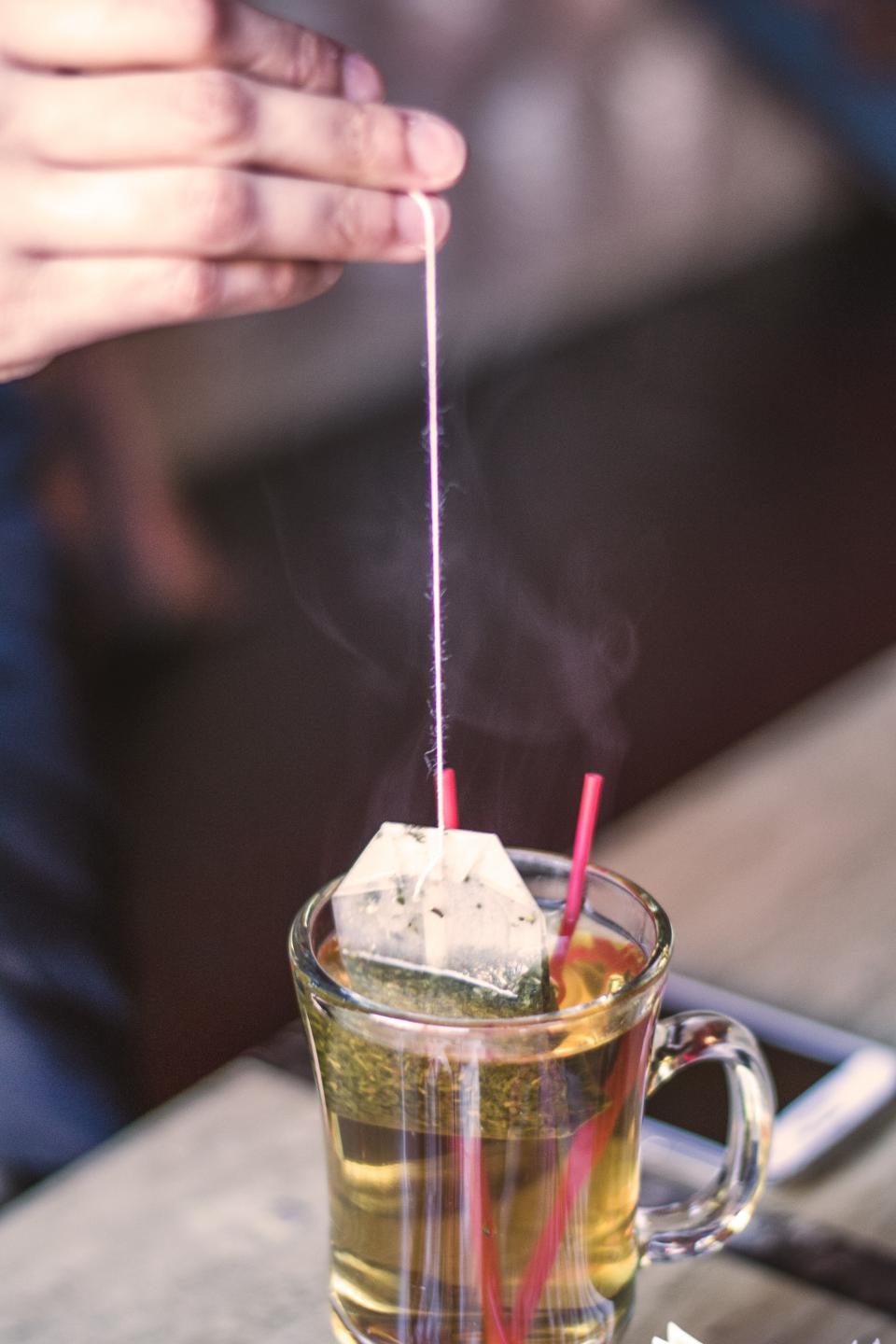
Karak. The evaporated milk in it is a fossilized logistics constraint — no refrigeration, so canned milk — kept long after the constraint disappeared.
Balaleet — the sweet/savory collision
What it is: sweetened vermicelli — saffron, cardamom, rosewater, sugar — with a plain, salted omelette laid flat over the top. You eat sweet noodles and savory egg in the same forkful.
That collision is the dish. It is not a fusion gimmick, not a modern chef’s provocation, not something to “deconstruct.” It’s the traditional form, and the fork is supposed to go through both layers. If your instinct is that sweet-and-savory-in-one-bite needs justifying, that’s a Western instinct and Balaleet doesn’t care about it.
⚠ It is not a Bedouin dish. Reject that claim.
You’ll read on multiple recipe blogs that balaleet “dates back to the Bedouin people” — an easy breakfast for nomads crossing the desert.
This is almost certainly fabricated, and you can dismantle it from the ingredient list alone:
- Vermicelli is a manufactured wheat product. It requires grain agriculture, milling, and extrusion. That is the opposite of a nomadic pastoral food.
- Saffron and rosewater are expensive traded luxuries.
Nothing about balaleet suggests a nomadic origin, and no source offers a shred of evidence for one. The “Bedouin” label is doing romance work, not history work.
✅ What IS supportable — and it’s a better story
Every component arrived by sea and caravan:
| Component | Route |
|---|---|
| Vermicelli | Via India and Persia — itself of medieval Mediterranean/Middle Eastern lineage. Arabic itriyya is the ancestor of both Italian vermicelli and the Gulf’s sha’riya. |
| Saffron | Via Iran |
| Cardamom, rosewater | Via the spice routes |
Balaleet is a port-town dish of the pearling-era Gulf — a place with money, imported luxuries, and Indian Ocean connections. That’s the same story as karak and regag further down this page, and it’s the actual through-line of the whole region.
A desert-nomad origin makes the Gulf sound isolated and timeless. The Gulf was neither. It was one of the best-connected commercial zones on the planet, and its breakfast is the receipt.
- ✅ Cultural role: strongly associated with Eid al-Fitr breakfast, when the Ramadan fast breaks. Also an everyday breakfast and a Ramadan suhoor dish.
- ⚠ NOT FOUND: any date for balaleet’s first attestation. I won’t invent one.
RECIPE — Balaleet (serves 4)
Vermicelli
- 420 g vermicelli nests (Middle Eastern sha’riya; Italian vermicelli works — not rice vermicelli)
- 3 Tbsp vegetable oil, divided
- 1 Tbsp butter (or ghee — more traditional)
- 100 g sugar
- ½ tsp saffron threads
- 60 ml rosewater
- ½ tsp turmeric (mostly for color)
- 2 tsp ground cardamom
- Pinch black pepper
- Pinch salt
Eggs
- 4 eggs, pinch saffron, pinch cardamom, salt and pepper
Method
- Steep the saffron in the rosewater, 10 min. Don’t skip it. Blooming saffron in liquid is what gets the color and flavor out; thrown in dry, it’s expensive orange confetti.
- Break the nests roughly. Toast half the vermicelli in 2 Tbsp oil over medium until golden brown, then add the untoasted half. (Toasting only half gives you two textures and two flavors. Toasting all of it makes it one-note.)
- Cover with boiling water and cook 4–5 min, to al dente. Drain. ⚠ Do not overcook — mushy balaleet is the common failure.
- Wipe the pan. Return the noodles with the butter and remaining 1 Tbsp oil. Add sugar, turmeric, cardamom, pepper, salt and the saffron-rosewater. Toss over low heat until the sugar dissolves and coats, 2–3 min.
- Omelette: beat the eggs with saffron, cardamom, salt and pepper. Cook flat and thin in a lightly oiled pan over medium-low, ~2 min, until just set — pale, not browned. A browned omelette fights the noodles; a pale one sits on top of them.
- Lay the omelette over the noodles. Serve immediately, hot.
All of these variations are legitimate: eggs scrambled and folded through instead of laid on top; served cold or at room temperature (common at Eid buffets); garnished with fried onion, pistachio, or rose petals.
→ Full recipe: Balaleet
Bagilla / baqilla — stewed fava
What it is: dried fava (broad) beans, soaked and boiled long and soft, eaten hot. The word bāqillā’ is simply the Arabic for the legume itself. The dish is named “favas.” Nothing more. I find that genuinely clarifying — it’s a food so basic it never got a name beyond its own ingredient.
Regional truth: this is Iraqi, Kuwaiti, Bahraini and broadly Gulf. In Iraq it’s street food sold from huge metal cauldrons, sprinkled with sumac. The Iraqi breakfast bagila bil dihin (باقلة بالدهن) — “favas with fat” — is fried eggs over the beans and soaked flatbread, finished with hot ghee poured over the whole plate.
⚠ It is not ful medames. Related, distinct, and worth getting right:
| Bagilla | Ful medames | |
|---|---|---|
| Bean | Large broad bean | Small brown fava |
| Size | Larger | Smaller |
| Skin | Thicker | Thinner |
| Taste | Similar but coarser | — |
RECIPE — Bagilla (serves 4)
- 500 g dried large fava/broad beans
- Soak overnight (12 hr) in plenty of cold water. Non-negotiable.
- Drain; cover with fresh water by 5 cm. Bring to a boil, skim, then simmer 1.5–3 hours — until completely soft but still holding their shape. ⚠ Salt only in the last 30 min — early salt toughens the skins.
- Drain, reserving a little cooking liquid.
Street style: hot beans in a bowl, a splash of the cooking liquid, sumac, salt, a drizzle of olive oil or ghee. That’s it.
As bagila bil dihin — the full Iraqi breakfast:
- Tear tannur or pita bread into a bowl; ladle the hot beans and their liquid over it so the bread soaks.
- Top with 2 fried eggs per person.
- Heat 3 Tbsp ghee until shimmering and pour it over the whole plate. Sumac, salt, pepper. Eat immediately.
Nakhi — spiced chickpeas
What it is: boiled chickpeas, eaten hot as a breakfast or a snack, sold from carts. Notable as one of only two wholly vegan items in the traditional Bahraini breakfast repertoire.
It is deliberately, almost aggressively plain. This is laborer’s food and it shouldn’t be dressed up. Every instinct you have to improve it is the wrong instinct.
RECIPE — Nakhi (serves 4)
- 400 g dried chickpeas, soaked overnight with ½ tsp baking soda (helps them soften)
- 1 tsp salt
- 1 tsp cumin (optional and regional — the sources say “traditionally prepared plain, in hot water with some salt and maybe a touch of cumin”)
- Drain and rinse the chickpeas. Cover with fresh water by 5 cm.
- Add salt and cumin. Simmer 1–1.5 hr until tender.
- Serve hot in their own broth, in a bowl, with salt, cumin, and a squeeze of lime. Some add chili.
Nakhi and bagilla are frequently served together — that’s the classic pairing, sometimes combined into a single two-bean plate.
Khubz — the flatbread
What it is: the generic Arabic word for bread. In the Gulf it usually means either the pocket pita-style khubz arabi or the large thin khubz rigag (below).
Here’s the detail that tells you everything about this page’s argument: the bakeries turning it out all morning are overwhelmingly staffed by South Asian and Iranian bakers, and almost nobody makes it at home. The most basic, most Arab item in the Gulf pantry is, in practice, made by migrants.
RECIPE — Khubz arabi (makes 8)
- 500 g bread flour
- 7 g instant yeast
- 10 g salt
- 10 g sugar
- 2 Tbsp olive oil
- 320 ml warm water
- Mix and knead 8 min to smooth. Bulk rise 1–1.5 hr, doubled.
- Divide into 8 (~105 g each), ball, and rest 20 min covered.
- Roll each to ~20 cm, 4 mm thick. Rest another 15 min — ⚠ under-rested dough won’t puff.
- Bake on a screaming-hot stone or steel at 260 °C / 500 °F for 2–3 min. They should balloon completely. Wrap in a towel the instant they come out — the trapped steam keeps them soft and collapses them into a pocket.
The puff is a physics problem, not a skill problem. It needs (a) even thickness, (b) a fully rested sheet, and (c) heat violent enough to flash the surface moisture to steam before the interior sets. Any one of those missing and you get a cracker. No amount of practice substitutes for a hot enough oven.
Regag — the paper-thin bread (and yes, the crisps are real)
What it is: a paper-thin, crisp, lacy flatbread cooked on a large flat griddle (tawa or saj), traditionally by women working the pan in a market stall. Popular across the UAE, Oman and Bahrain — regional again, not national. Comparable to Iranian lavash or a very thin crêpe, but drier and crisper.
The critical technique fact: regag is cooked on one side only. No flipping. About 30–45 seconds, until dry and crisp. That’s the whole discipline of it.
What goes in it
The bread is cooked and then topped while still on the griddle, then folded. The canonical fillings:
- Egg and cheese — the standard. Cracked straight onto the hot bread and smeared flat.
- Cheese and honey
- Cheese and Oman chips — ✅ Confirmed, and delightful. Oman Chips is a brand of chili-flavored potato crisps, an absolute fixture of Gulf childhood. They get crushed straight onto the bread with the cheese. This is genuinely traditional street practice, not a novelty — sources list it plainly among the standard fillings, right alongside Nutella and cheese-and-honey.
- Nutella; also dates, spicy Arabic sauces, or plain.
I want to be clear about why the crisps matter and aren’t just a fun fact. A “traditional” cuisine that includes a branded snack food from a factory is a cuisine that’s still alive and still absorbing things — which is exactly what it’s been doing for a thousand years, and exactly what the Bedouin-fantasy version of Gulf food refuses to let it do. Oman chips in regag is the same behaviour as vermicelli in balaleet. Only the century changed.
RECIPE — Regag (makes ~10)
Batter — three ingredients
- 250 g all-purpose flour (a 50/50 all-purpose + whole wheat mix is also traditional and has more flavor)
- ½ tsp salt
- ~500 ml water
- Whisk the flour and salt; gradually add water, whisking, until you have a completely smooth, lump-free, very thin batter — crêpe consistency or thinner. It should be nearly watery. Rest 20 min; re-whisk.
- Heat a large flat griddle or tawa over medium-high. It must be genuinely hot, and unoiled.
- Pour a small ladle on and immediately spread it in a fast circular sweep with a regag spreader (the back of a ladle or an offset spatula will do). As thin as you can get it — you should nearly see through it.
- Cook 30–45 sec until dry and crisp. Do not flip.
- While it’s still on the griddle: crack an egg on, smear it flat; scatter cheese; let it melt ~20 sec; add crushed Oman chips if using. Fold in quarters or roll it up. Lift off and eat immediately — it goes soft within a couple of minutes.
→ Full recipe: Regag
Egg & cheese paratha — and why it belongs here
Straightforwardly the South Asian paratha, naturalized. Sold from every cafeteria in Dubai, made by Keralite and Pakistani cooks, eaten by everyone.
This isn’t “fusion.” It’s what breakfast in Dubai actually is for a large share of the population. Writing a Dubai breakfast page that features a romanticized Bedouin menu and leaves out the paratha would be the real distortion — you’d be describing a museum diorama and calling it a city.
RECIPE — Egg & cheese paratha (makes 6)
- 300 g all-purpose flour, 150 g whole wheat flour, 1 tsp salt, 2 Tbsp oil, ~280 ml warm water
- Ghee or oil for laminating and frying; 6 eggs; grated cheese
- Knead to a soft dough, 8 min. Rest 30 min, oiled and covered.
- Divide into 6. Roll each thin; brush with ghee, dust with flour, then either (a) roll it into a rope and coil it into a snail, or (b) fold letter-style, then in thirds again. Rest 15 min. This lamination is what makes the layers — the ghee is a barrier between sheets of dough, and the layers are just that barrier surviving the roll-out.
- Re-roll each coil to ~18 cm.
- Cook on a medium-hot tawa, ghee on both sides, ~1.5 min per side, until blistered and golden.
- For the egg paratha: while the second side cooks, pour a beaten seasoned egg over the top, scatter cheese, then fold the paratha over it and press; cook another 1 min per side to set. Serve with karak.
When it’s done, crush the paratha between your palms — the classic Kerala move. It fluffs the layers apart, and it’s the difference between a laminated bread and a laminated brick.
Karak — the real story of Gulf breakfast
What it is: very strong black tea, boiled hard with cardamom, evaporated milk and a lot of sugar. Served scalding in tiny cups or paper cups, from cafeterias and drive-through hatches, for about a dirham.
And it’s an Indian import. Tell it as the migration story it is:
- Karak is Indian kadak chai — “strong” tea — brought to the Gulf by South Asian migrant workers during the 1960s–70s oil boom. Indian chaiwallas came looking for work and brought their tea with them.
- The Keralite diaspora — and note this, because it upends the chronology people assume: they had centuries-old trading links to Arabia long predating oil — came to dominate the affordable food-service sector. Their cafeterias became social institutions. Keralites now number over 2 million in the UAE alone.
- They adapted it to local tastes: fewer spices than Indian masala chai (cardamom carries it, often alone), more sugar, and evaporated milk instead of fresh.
⚠ The evaporated milk is the key — and the reason is practical, not aesthetic
This is my favorite fact in the entire Gulf section.
Canned milk didn’t require refrigeration. In the pre-air-conditioning Gulf, that was decisive. Fresh milk was a logistics problem; a tin wasn’t.
What began as a workaround became the signature. Evaporated milk is now the thing that distinguishes Gulf karak from Indian chai — and it’s so integral that using fresh milk would be considered inauthentic.
A constraint fossilized into an identity. The thing they used because they had to is now the thing that makes it theirs. If you made karak “properly” with fresh milk, you’d be making the wrong drink.
It was cheap, filling and energizing — a laborer’s drink for long hours in brutal heat. By the 1990s–2000s it was fully naturalized: household gatherings, the majlis, late-night tea shops, drive-through karak windows.
The honest framing: karak reads today as quintessentially Emirati and Qatari. It is also, unambiguously, an Indian import carried by migrant labor. Both are true, at the same time, with no tension between them — and that’s the clearest illustration of this page’s whole argument.
The evaporated milk has its own page in my ingredients: Evaporated Milk — worth reading for why the tin works, because it’s the same shelf-stability logic that put it in the Gulf in the first place.
RECIPE — Karak (makes 4 small cups)
- 500 ml water
- 6 green cardamom pods, crushed — crush them; you want the oils out, not decoration
- 3 Tbsp CTC Assam tea
- 200 ml evaporated milk
- 3–4 Tbsp sugar (yes, that much — it’s meant to be sweet, and pulling it back doesn’t make it better, it makes it not karak)
- (Optional and regional: a pinch of saffron, or a sliver of ginger)
⚠ CTC is not optional. Loose-leaf orthodox tea will not give you karak. CTC (Crush–Tear–Curl) granules are built to brew hard and fast — that’s the entire texture of the drink. Substituting a nice orthodox Assam is like substituting a nice baguette into a bánh mì: technically better tea, wrong dish.
- Boil the water with the crushed cardamom, 3–4 min, for a fragrant infusion.
- Add the CTC tea. Boil hard, 4–5 min, until deep mahogany — nearly opaque. This over-extraction is the point. It’s what kadak means.
- Add the evaporated milk and sugar. Bring back to a rolling boil, then pull it off the heat the moment it climbs the pan. Some cooks repeat this rise-and-pull 2–3 times — it builds body.
- Strain through a fine sieve and pour from a height into small cups. That aerates it, and cools it just enough to drink.
→ Full recipe: Karak chai
Chapati with cheese and honey — the whole thesis in one item
The most characteristically Doha breakfast is also the most obviously South Asian: chapati from a cafeteria, spread with processed cheese — Kraft or La Vache Qui Rit triangles, and I’m being specific because that’s what’s actually used, not some artisanal stand-in — and drizzled with honey. Eaten with karak. Sweet, salty, cheap, everywhere.
Look at what’s on that plate:
An Indian bread. A French processed cheese. Arabian honey. Indian tea in an Arabian cup. Assembled by a Keralite cook. Eaten by everyone. Understood as local.
That’s not a corruption of Qatari food. That is Qatari food. If your definition of authentic excludes what an entire country eats every morning, your definition is broken, not the breakfast.
RECIPE — Chapati (makes 8)
- 300 g atta (Indian whole wheat flour — finer than Western whole wheat; worth buying)
- ½ tsp salt
- 1 Tbsp oil
- ~200 ml warm water
- Ghee to finish
- Mix to a soft, slightly tacky dough — softer than you think is right. Knead 8 min. Rest, covered, 30 min. (The rest is what makes them pliable rather than leathery.)
- Divide into 8 (~65 g). Roll each to ~16 cm, ~2 mm.
- Cook on a dry, hot tawa: ~30 sec until bubbles appear, flip, ~30 sec until brown spots.
- The puff: either press the edges with a folded towel until it balloons, or flip it directly onto an open gas flame for 3–5 seconds — it inflates like a balloon.
- Brush with ghee and stack in a towel-lined container.
To serve, Doha style: hot chapati, 2 triangles of processed cheese spread on while it’s still hot enough to melt them, honey drizzled over, folded in half. With karak. Don’t overthink it. The whole appeal is that nobody involved is overthinking it.
The Palestinian and Levantine layer
Alongside the Emirati and South Asian layers, Dubai has a substantial Levantine — Palestinian, Lebanese, Syrian, Jordanian breakfast culture: hummus (often served warm, with olive oil and whole chickpeas, at breakfast), falafel, and fool / ful medames. These are breakfast foods in the Levant, and the diaspora brought the habit with them, not just the recipe.
⚠ Remember: fool (ful medames) and the Gulf’s own bagilla are cousins, not the same dish. Different bean, different size, different skin. In Dubai you can eat both within a block of each other — which is the most concrete possible way to make the “the Gulf is a crossroads” point without a word of abstraction. Two bean stews from two food cultures, both at breakfast, both at home, fifty meters apart.
⚠ NOT FOUND: figures or dates for the Palestinian community’s specific culinary footprint in Dubai. So I’m not going to quantify it.
Already in the collection: Hummus from Scratch · Falafel, Authentic
Qatar, briefly — and deliberately so
Qatari breakfast is balaleet, regag, karak, bagilla, nakhi, khubz, and chapati with cheese and honey.
That’s the same repertoire as Kuwait, Bahrain and the UAE, which is why this page didn’t give Qatar its own chapter. Writing three separate national menus would have required me to invent differences that don’t exist, and I’d rather leave a section conspicuously short than pad it with fiction.
The pearling ports, the dhow trade and generations of intermarriage made one connected world along this coast. The nation-states arrived late to a party the food had been at for centuries.
More at Breakfast Favorites and Why breakfast?. Karak’s cousin — the tea that got the same treatment in a different empire — is on the Irish breakfast page, and if you want the caffeine argument in full, that’s coffee.
Sources & further reading
Balaleet
- Every Little Crumb — Balaleet بلاليط — the recipe used above; describes it as Gulf-wide (UAE, Kuwait, Bahrain).
- Dalool’s Kitchen — Balaleet, Kuwait’s Sweet & Savory Breakfast
- Beryl Shereshewsky — Balaleet
- Tara’s Multicultural Table — Balaleet (Emirati…) — labeled Emirati here, which is the shared-claim point making itself.
- ⚠ The “Bedouin origin” claim appears on several of these. Treat as unsourced.
Bagilla, nakhi, khubz
- One Arab Vegan — “Nakhi and Bajela” Bean Salad — the Bahraini framing, the vegan note, and the bajela-vs-ful comparison.
- Food on the Move — Bagilla: Iraqi Boiled Fava Beans — the soaking, the street cauldrons, the sumac.
- Measuring Cups, Optional — Iraqi Breakfast: Bagila bil Dihin
- Scoop Empire — Bagila Bil Dihin, the Ultimate Iraqi Breakfast
Regag
- Saveur — Omani Egg and Cheese Flatbreads (Ragag Ma Beed Wa Jibne) — the best-quality source here.
- The Odehlicious — Emirati Regag Bread Recipe
- Gulf News — Recipe for Emirati Regag
- Worldchefs — Regag Bread
- UAE Universe — Regag — the Oman chips / Nutella / cheese-and-honey filling list.
Karak
- The Juggernaut — Karak Chai is Really the Story of South Asian Migrants — the best source on this page, and the migration framing this whole section is built on.
- The Fourth Plate — How India’s Kadak Became the Gulf’s Karak — evaporated milk, the Rainbow brand, the adaptation.
- Arab America — Karak Tea: A Traditional Qatari Tea — framed as Qatari here. The shared-claim point, again.
- Lana News — Keeping up with the Karak Chai
Comments (0)