French Toast: The Open Project
I’ve made a lot of French toast. What I’ve never done is make my own bread for it — every loaf has been store-bought cinnamon bread, and I’ve been quietly annoyed about that for years.
So this page isn’t a recipe. It’s the project, with the questions I actually have, and — for the first time — real answers to them. I asked for information rather than opinions, because information is the key to experimentation and to great tasting food, and I’d rather run a good experiment than take somebody’s word for it.
Here’s what came back. Some of it I was right about. One thing I was wrong about, and it’s the one everybody’s wrong about.
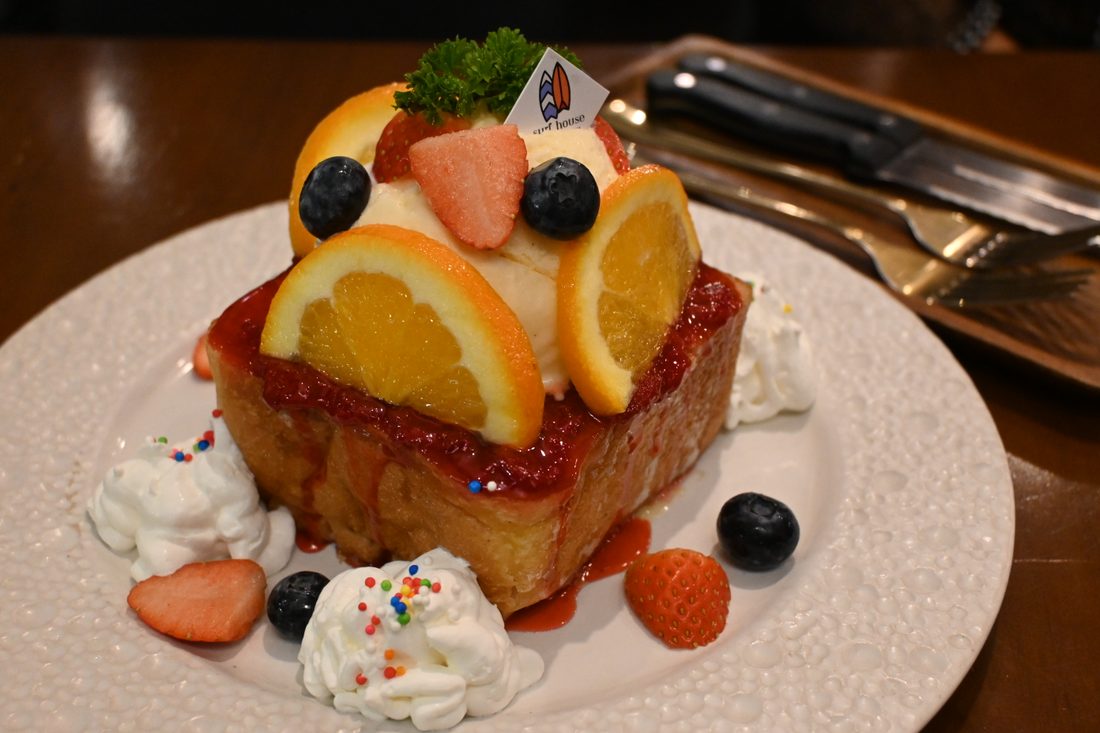
The thing I’ve made a hundred times on somebody else’s bread. Everything on this page is about fixing that.
Q1: “Should it be sourdough?”
Yes — but as a sourdough Pullman, not a sourdough boule. And the reasoning corrected an assumption I didn’t know I had.
The classic French toast breads — brioche, challah, Pullman — are enriched and tight-crumbed. That’s not snobbery; it’s structural. The custard has to be held, not drained. A rustic open-crumb loaf has holes, and holes let custard run straight through and out. You get a soggy bottom, a dry top, and a chewy crust that fights the fork.
The reframe that fixed my thinking: open crumb is a product of artisan boule practice, not of the starter. Sourdough doesn’t cause big holes — high hydration, minimal degassing, and a hot open bake do. Put the same starter in a Pullman pan with the lid on and degas at shaping, and you get a tight, even, square crumb.
So the pan delivers the structure, and the sourdough adds flavour at no structural cost. That’s the best of both, and I already have the starter and the pans.
One control that matters: keep the ferment lactic, not acetic. Sharp vinegar tang fights sweet cinnamon custard. Warm, shorter, sweeter fermentation — not a long cold acetic one. (The lactic/acetic distinction is exactly the thing I wrote about on the sourdough page, so this is a lever I already know how to pull.)
Q2: “Should it have a glaze?”
No — and my instinct was right for exactly the right reason, which is satisfying because I couldn’t have told you the reason.
Two numbers settle it:
| Temperature | |
|---|---|
| Sucrose begins to caramelize | 320 °F / 160 °C |
| Diluted custard sets (interior) | 176–185 °F / 80–85 °C |
Those constraints are incompatible on a griddle. To set the custard you need the interior to reach ~180 °F, which takes time at moderate pan heat. A sugar glaze on the surface is sitting directly on the pan, and it will hit 320 °F and start burning long before the middle is done. You’d be choosing between a raw centre and a scorched face.
Glaze belongs on cinnamon bread you eat as bread. Not on bread you’re going to fry.
The swirl gap — and this one’s been tested
If not a glaze, then a cinnamon swirl — which has its own famous failure: the gap. That hollow tunnel where the swirl separates from the loaf.
King Arthur actually tested this, which is more than most of this page can say:
- Egg wash between the layers BINDS them. Use it.
- ⚠ Butter is a barrier — and it actively CAUSES the gap. The thing everyone reaches for is the thing doing the damage.
- Flour in the filling absorbs the sugar as it liquefies, so it doesn’t turn to syrup and float the layers apart.
That’s three concrete fixes, and I’d never have guessed the butter one. I’d have buttered it.
Q3: “Should it be sliced and left out overnight?”
No. And this is the one where the popular explanation is wrong — including the version I believed.
Everyone says stale bread works better because it’s drier, so it soaks up more custard. Half-right, wrong mechanism, and the wrong mechanism leads you to the wrong technique.
Staling is not drying out. Staling is starch retrogradation — amylose and amylopectin recrystallizing — and here’s the proof: it happens FASTER in the refrigerator than at room temperature.
Think about that. If staling were drying, the fridge — a cold, humid box — would slow it down. It speeds it up. The drying theory is disproved by your own refrigerator, which is the tidiest debunk in this whole dive.
So the two processes come apart:
| What it does | Do you want it? | |
|---|---|---|
| Drying (moisture loss) | More absorption capacity | ✅ Yes. This is the actual goal |
| Staling (retrogradation) | Firmer, but costs flavour and adds no capacity | ❌ No |
Leaving slices out overnight gives you both — and you only want one.
The method instead: oven-dry, morning of. 275 °F / 135 °C, 10–15 minutes, no colour. You get the absorption capacity without the staling flavour penalty, in a quarter hour, with fresh bread.
⚠ Honest sourcing flag: Serious Eats recommends this, but they block crawlers entirely, so every Kenji/Gritzer claim here is second-hand and I’m labelling it as such rather than quoting someone I couldn’t read. Cook’s Illustrated’s exact ratio is paywalled — marked NOT FOUND rather than guessed at.
Q4: The custard — milk vs PET milk vs cream
You’ll notice this is my newest idea and I hadn’t tested it. It turns out it’s the best idea on this page, and the reason is better than I knew.
The classic ratio: 1 egg : 80 ml dairy. Weigh the eggs — they vary 15%+ by size.
Evaporated milk is not just concentrated milk. It’s sterilized in the can at 110–120 °C for 15–20 minutes — which means Maillard browning has already happened before you open it. That’s not a guess; it’s documented via HMF, lactulose and furosine markers, the standard chemical fingerprints of heat-treated milk.
So PET milk walks into the pan with a head start on browning, and for four stacked reasons: 2× the lactose, 2× the protein, the reaction already begun, and less water to boil off.
And cream surprised me: cream has LESS protein than milk — butterfat displaces it. So it’s richer and structurally weaker. The fat genuinely interferes with the set.
| Browns fastest | Sets firmest | Soaks deepest | Predicted character | |
|---|---|---|---|---|
| Evaporated | 1st | 1st | 3rd | Caramelly, “cooked,” dulce-de-leche, firm |
| Whole milk | 2nd | 2nd | 1st | The baseline. Clean, custardy |
| Cream | 3rd | 3rd | 3rd | Rich, tender, may read underset |
⚠ Every cell of that table is a PREDICTION. No controlled test exists. That’s the whole reason to run it.
Two design warnings that will save the experiment
1. Cook to interior temperature (~180 °F), not to colour or a timer. This is the one that matters. If you cook to colour, the fastest-browning sample looks done first — and you’ve measured nothing but browning rate, which you already predicted. You’d have run the experiment and learned nothing.
2. Weigh each slice before and after soaking. Absorption becomes a measured number instead of an impression. Cheapest instrumentation in the whole project.
The fourth arm — add this one
Straight comparison confounds two explanations: is evaporated milk different because it’s concentrated, or because it’s pre-cooked?
Add a fourth sample: evaporated milk diluted 1:1 with water. That’s back to roughly milk’s concentration but still carrying every Maillard product from the can.
That arm separates the two variables, and it’s the one that actually answers the question.
Q5: “Cinnamon, nutmeg, clove — or is the bread enough?”
Not redundant. They do different jobs, and this is a genuinely useful distinction:
- Spice in the bread is baked-off and background. It’s been through a 400 °F oven; the volatiles are long gone. What’s left is a base note.
- Spice in the custard is volatile and foreground. It never gets hotter than ~180 °F inside, so it stays bright and aromatic.
They layer rather than compete. So: both.
Two specifics: nutmeg belongs in the custard (it’s a top note; wasted in the bread), and ⚠ clove is the muddier — it’s the one that turns a stack into potpourri. Restraint.
And the flag I hadn’t considered: my syrup is a third cinnamon source. Bread + custard + syrup = three. The real risk isn’t redundancy, it’s total load. If the syrup is carrying cinnamon, back off in the custard.
Q6: The syrup — “how thick, and how do I get it that thick?”
Yes. Cook it to a temperature. And the number is one I already know from a completely different project.
The principle, and it’s the foundation of all candy-making:
- A syrup’s thickness IS its concentration — % sugar by weight (°Brix). Not cooking time, not “how long you reduced it.” Two syrups at the same Brix are the same thickness regardless of how they got there.
- Boiling point elevation is a colligative property — dissolve more sugar, the boiling point rises, proportionally and rigorously.
- Therefore while a syrup boils, its temperature is a direct readout of its concentration.
The thermometer isn’t measuring how hot it is. It’s measuring how concentrated it is. “Just reduce it” and “cook it to a temp” are the same action — reducing raises the temperature, and the temperature tells you how far you’ve reduced. Cooking to a temperature is just reducing with an instrument attached.
The number
Pancake-syrup thickness is maple thickness, and maple has a legal definition and a rule of thumb, both verified:
Maple syrup is 66.0% solids (66 °Brix) — and you hit it by boiling to 7.1 °F above the boiling point of water.
- USDA: “The solids content of the finished maple syrup shall not be less than 66 percent by weight (Brix).”
- Maine Maple Producers Association: “Syrup at 66° Brix boils at 7.1 degrees Fahrenheit above the temperature of boiling water.”
⚠ And a correction to my own premise: I’d have said 66.9. 66.9 is Vermont-only. USDA and Maine both say 66.0 — the exact trap already flagged in my own tree syrups research. I nearly imported my own error from one project into another.
⚠ ALTITUDE — measure your water’s boiling point on the day. Do not assume 212 °F. The rule is “+7.1 °F above today’s boiling point,” not “219.1 °F.” Boil plain water, read the thermometer, add 7. The interval method also cancels out any error in your thermometer, which is a free bonus.
So: will my 1:1, boiled 5 minutes, be thin?
Yes. As I suspected. It lands around 50–60 Brix — coffee-syrup thin.
And here’s the part that explains why it feels like nothing’s happening and then suddenly does: the last 6 Brix points carry most of the viscosity. Getting from 50 to 60 barely changes the pour. Getting from 60 to 66 is where it becomes syrup. That’s why boiling “a bit longer” never seems to work and then overshoots.
The fix is not a longer boil. It’s a thermometer.
Brown sugar
Three separate questions, three different answers:
- Crystallization: brown sugar’s molasses carries invert sugar (glucose + fructose), which is a real crystallization inhibitor. Good — your syrup is less likely to go grainy in the jar. This is a genuine advantage over white.
- Boiling point: invert sugar shifts the boiling point elevation slightly. The effect is small — don’t correct for it.
- Flavour: the molasses is the whole point.
⚠ One honest caveat on the candy-stage tables you’ll find everywhere: the temperatures are reliable — that’s what people actually measure. The percentage columns disagree across sources, and the measured physical chemistry (Claasen’s boiling-point-elevation data, the standard reference in sugar technology) contradicts the popular candy charts. Trust the temperature column. The percentages are folklore passed between recipe writers.
A cross-check that made me trust the whole thing: maple’s 66% ↔ +3.9 °C, and Claasen’s 80% ↔ +9.3 °C, sit on the same sensible non-linear curve. The maple industry and the sugar-technology literature agree, and they have no idea they’re agreeing. That’s two unrelated fields corroborating, which is the kind of agreement worth trusting.
The project, as it stands
The recipes:
- Bread, Cinnamon Sourdough Pullman — the loaf I want: enriched, sourdough, pan-baked with the lid on, swirled not glazed, egg wash between the layers, flour in the filling, no butter in the swirl.
- French Toast, The Custard Test — four arms (milk / evaporated / cream / diluted evaporated), the 1 egg : 80 ml ratio, cook to 180 °F internal, weigh before and after.
- Syrup, Brown Sugar Cinnamon (Jeff’s) — my 1:1:2, finished to a temperature: today’s boiling point + 7 °F for pancake-thick, or stop early for coffee-thin.
- Already in the collection: Cinnamon Simple Syrup (white sugar, 4 sticks — the thinner, cleaner cousin) and plain French Toast.
Still open, and honestly:
- The loaf. Untested. Sourdough Pullman is the reasoned answer, not a proven one.
- The custard test. Four arms, never run. Every cell in that table is a prediction and I’d like to be wrong about at least one.
- The syrup. I now know the number. I haven’t made it.
Three experiments, all specified, none run. That’s what this page is for — and when I’ve run them, the predictions get replaced with results, including the ones that make me look silly.
Back to the rest of my favorites, or on to New Orleans.
Sources & further reading
- USDA, United States Standards for Grades of Maple Syrup — the 66% figure.
- Maine Maple Producers Association, “The Science of Syrup” — the 7.1 °F rule, verbatim.
- King Arthur Baking — the tested cinnamon-swirl gap fixes (egg wash binds; butter causes the gap; flour in the filling).
- Starch retrogradation — Cook’s Illustrated. The reason “stale = dry” is wrong.
- ⚠ Serious Eats / Kenji López-Alt — recommends low-oven drying, but the site blocks crawlers entirely, so it’s cited here second-hand and flagged. Cook’s Illustrated’s custard ratio is paywalled → NOT FOUND, not guessed.
- Full working notes, with every claim tagged TESTED / ESTABLISHED / INFERRED / NOT FOUND, are in
02-inputs/breakfast-favorites-research/french-toast-science.md.
Comments (0)