Amsterdam, Sweden & St Petersburg
Three cities’ worth of morning food, and a running theme I didn’t go looking for: almost every origin story on this page is wrong, and the true versions are better.
The stroopwafel’s famous date is impossible on its own terms — it credits a man who wasn’t baking yet. The poffertjes monastery tale turns up mostly on sites selling poffertjes pans. Two of the three Swedish dishes here aren’t breakfast at all, and I’m going to say so rather than pretend. And the one thing on this page I fully expected to have to hedge — a Soviet-era doughnut shop, still open, still doing the same thing since 1958 — checked out completely.
I ate in Amsterdam, in Sweden, and in St Petersburg.
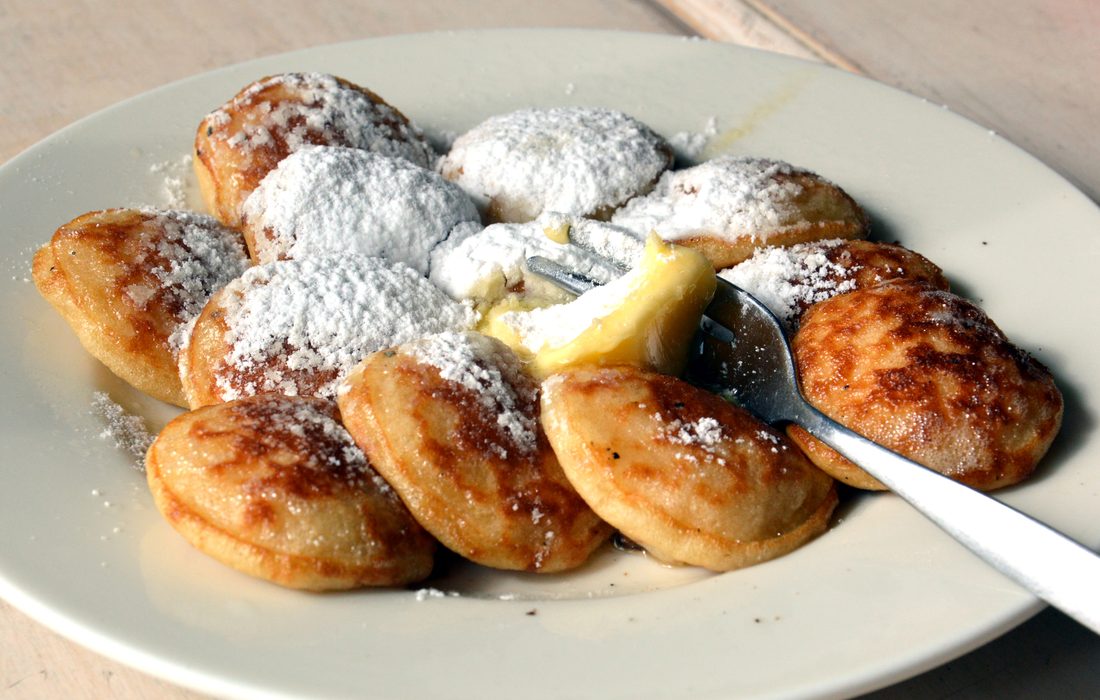
Poffertjes, in the pan that defines them. Buckwheat, not wheat — and the monastery origin story is folklore sold mainly by people who sell the pans.
Amsterdam
Stroopwafel — ⚠ the famous date is impossible
What it is: two thin, crisp waffle wafers with a caramel-syrup filling between them. Made by pressing a stiff dough in a waffle iron, slicing the hot round horizontally through its thickness, and sandwiching syrup between the halves.
The origin claim you’ll see everywhere — “Gouda, ~1784, Gerard Kamphuisen” — is self-contradictory. Those two facts cannot both be true.
Here’s what the sources actually support:
| Element | Status |
|---|---|
| Gouda | ✅ Agreed by everyone. |
| The date | ⚠ Sources say either “the late 18th century” or “the early 19th century.” Vague — and the vagueness is the honest signal. The specific 1784 figure appears in places and is not supported. |
| Gerard Kamphuisen | ✅ He’s real, and one story credits him. But his bakery opened in 1810. |
| Oldest known recipe | 1840. |
| The leftover-crumbs story | ⚠ Plausible, thematically tidy, unverified. |
Do the arithmetic yourself, because it’s not subtle:
If Kamphuisen invented it, it happened between 1810 and 1840. Which rules out 1784 entirely. The man the date credits wasn’t baking yet.
One commentator notes that Wikipedia states 1784 and then immediately gives a fuzzier timeframe — an internal inconsistency, not documentation. That’s a source arguing with itself in consecutive sentences, and it’s a good reminder that a number in an encyclopedia is not the same thing as evidence.
So the responsible statement is: the stroopwafel is from Gouda — everyone agrees on that. After that it gets murky. The story credits a baker named Gerard Kamphuisen, working from leftovers and syrup, but Kamphuisen didn’t open his bakery until 1810, and the oldest recipe we have is from 1840. Somewhere between 1810 and 1840, in Gouda, is as precise as the evidence allows. I’d rather give you a thirty-year window that’s true than a year that isn’t.
What IS documented afterward:
- After 1870 stroopwafels spread to other Dutch cities.
- By 1960 Gouda had 17 stroopwafel factories. Four remain.
And the ritual, which is not a tourist affectation: rest the stroopwafel on top of your hot coffee or tea and let the steam warm it through and soften the syrup for a minute or two before eating. In Australia they’re literally sold as “coffee toppers.” This is the correct way to eat one, and it’s what makes a shop-bought stroopwafel taste like a market-fresh one. The steam is doing the work the iron did an hour ago. If you’ve only ever eaten them cold out of the packet, you’ve been eating a different, worse food.
RECIPE — Stroopwafels (makes ~12)
Dough
- 250 g all-purpose flour
- 125 g butter, softened
- 75 g brown sugar
- 1 egg
- 7 g instant yeast
- 60 ml warm milk
- ½ tsp cinnamon
- Pinch salt
Syrup filling
- 200 g dark treacle / Dutch stroop (or golden syrup + 1 Tbsp molasses)
- 100 g brown sugar
- 75 g butter
- 1 tsp cinnamon
- Pinch salt
Method
- Rub the butter into the flour, sugar, cinnamon and salt. Add the egg, yeast and warm milk; bring together to a stiff dough — firm, not slack. Rest 45–60 min at room temperature.
- Filling: melt everything together, bring to a simmer, cook 3–4 min to ~110 °C. Keep it warm and pourable. If it sets, you can’t spread it, and re-melting it in the middle of the assembly is how the whole batch goes wrong.
- Divide the dough into ~35 g balls.
- Press in a hot pizzelle or stroopwafel iron, ~30–45 sec, until golden and crisp.
- Work fast — this is the hard part. Immediately: trim to a circle with a cookie cutter, then split the hot wafer horizontally through its thickness with a long, thin serrated knife into two thin discs. You have about 15 seconds before it’s too brittle to split. Have the cutter and the knife laid out before you press the first one.
- Spread warm syrup on one disc, press the other on top. The filling hardens as it cools and glues the halves together.
Realistic advice: the horizontal split is genuinely difficult and the first several will shatter. An alternative that works: press two thinner wafers separately (~20 g each) and sandwich them. Purists will object. It will taste the same, and you’ll actually make some.
Already in the collection: Stroopwafel, by Tracy VK
Poffertjes — ⚠ the monastery story is folklore
What they are: small, round, yeast-raised pancakes with a soft, almost custardy interior, cooked in a cast-iron poffertjespan with 20–30 hemispherical dimples, served piled up with butter and powdered sugar.
Two things separate poffertjes from mini pancakes, and both are the actual craft:
- They are yeast-raised, not chemically leavened. That’s where the flavor and the soft interior come from. A baking-powder poffertje is a tiny pancake wearing a costume.
- They’re turned while the batter is still wet on top. The uncooked batter runs down and fills the other half of the sphere, which is how you get a round poffertje with a soft middle rather than a browned disc. That’s why the dimpled pan exists. The pan isn’t a novelty mold; it’s a tool for making a sphere out of a liquid, in two halves, using gravity.
⚠ The buckwheat / monastery / Napoleon story
The tale: at the end of the 18th century, in a monastery that baked the church’s sacred bread, monks faced a wheat shortage because 99% of wheat flour had been requisitioned by the French army during the Napoleonic Wars. They experimented with buckwheat, creating poffertjes around 1795. Vendors who bought from the monastery took the recipe, marched with Napoleon’s army into the Netherlands, and sold them at fairs.
My assessment, point by point:
- ❌ No primary source is ever cited. Not once.
- ❌ It appears near-verbatim across sites that sell poffertjes pans. That’s a commercial-folklore red flag and it should be treated as one. When the people telling you the history are the people selling you the equipment, the history is marketing.
- ❌ The “99%” figure is a fabrication-shaped detail — suspiciously precise, never attributed. Do not repeat it. Real statistics come with a source; invented ones come with a decimal point to look serious.
- ❌ The chronology is shaky. 1795 predates the Napoleonic Wars proper (usually dated 1803–1815), though it does fall within the French Revolutionary Wars. The sources blur the two — which is exactly what unsourced stories do.
- ✅ What’s plausible underneath, and needs no French army at all: buckwheat is genuinely, historically Dutch. It grew well on the poor sandy soils of the Netherlands’ east and south and was a real peasant staple for centuries. A buckwheat pancake in the Low Countries requires no explanation. The wheat-shortage story may just be a later rationalization of a food that was simply already there.
That last point is the one I’d underline. The folklore assumes buckwheat needs a reason — some crisis that forced the Dutch to use a grain they’d been happily growing all along. It’s a story that only makes sense if you don’t know anything about Dutch agriculture.
RECIPE — Poffertjes (makes ~25)
- 125 g buckwheat flour
- 125 g all-purpose flour
- 350 ml milk, lukewarm
- 7 g active dry yeast
- 1 egg
- 25 g butter, melted (plus ~55 g for cooking)
- 1 tsp caster sugar
- Pinch salt
- Warm the milk to ~35 °C; whisk in the yeast and sugar; let it foam 5–10 min.
- Whisk in the flours, egg, melted butter and salt to a smooth batter, thinner than pancake batter — it should pour freely.
- Prove at room temperature, away from drafts, 1 hour. It should be visibly bubbly. Don’t stir it down — fold gently if you must.
- Heat the poffertjespan (or an aebelskiver pan) over low heat. Butter each dimple.
- Fill each dimple ~¾ full.
- When the tops are still slightly wet, turn each with two skewers (or a skewer and a fork) — a quick flick. The wet batter fills the dome.
- Cook until golden on both sides, ~1–2 min per side on low. ⚠ Low heat is essential. High heat browns the outside before the inside sets, and then you’ve made twenty-five small disappointments.
- Serve piled up with a knob of cold butter melting on top and a heavy dust of powdered sugar.
→ Full recipe: Poffertjes
Albert Cuyp Markt
Amsterdam’s largest and best-known street market, in De Pijp, running the length of Albert Cuypstraat. It’s a genuine daily working market — produce, fish, cheese, textiles, household goods — not a tourist arrangement, though it’s very much on the tourist path now.
Visitors know it for stroopwafels made on the spot — and that’s a real, worthwhile difference, not hype: a warm stroopwafel straight off the iron is a distinct food from a packaged one. Also poffertjes, haring and kibbeling stands.
⚠ NOT VERIFIED: the founding date and the current opening hours. Both are easy to state wrongly and easy for you to check, which is exactly why I’m not stating them. Dutch market hours shift seasonally — check before you go.
Sweden — ⚠ these are not breakfast
Here’s where I have to be straight with you, because the honest answer is more interesting than the one the page title implies.
Tunnbrödsrulle and parisare are late-night food. They’re gatukök — literally “street kitchen” — food. The Swedish equivalent of a kebab shop at 2 a.m. Eating one at breakfast would strike a Swede as roughly as odd as a British person having a doner with their cornflakes.
An actual Swedish breakfast is filmjölk, knäckebröd, cheese, a boiled egg, and coffee. That’s it. It’s austere and it’s fine.
But don’t skip these, because there’s a genuinely good story here, and the right framing isn’t “breakfast” — it’s the food Sweden eats when the sun’s been down for sixteen hours. And the tunnbröd itself has a real, old history that has nothing to do with drunkenness.
Tunnbrödsrulle
What it is: a soft tunnbröd flatbread wrapped around mashed potato, hot dogs (korv), and a battery of toppings — shrimp salad, raw and crispy onion, lettuce, ketchup, mustard, sometimes a whole parisare patty inside it.
Two separate histories, and the sources are right to keep them apart:
1. Tunnbröd is genuinely old and genuinely northern — and this has nothing to do with late-night food. It comes from northern Sweden, where the harvest window was short, the frost came early, and flour was scarce and had to be used before winter destroyed it. A thin bread that didn’t need to rise was the better option: quick, flour-efficient, storable. That’s a real, sound agricultural explanation, and it’s the part worth telling properly.
2. The tunnbrödsrulle as street food is recent — the 1960s. Stockholm street vendors started serving hot dogs in tunnbröd with instant mashed potato and toppings. Fast, filling, eatable standing up in the cold. It spread to grill kiosks nationwide.
- Credit for the “deluxe” tunnbrödsrulle goes to Elov “Loffe” Bråtfors, who ran a snack stand from 1962 to 2015. ⚠ This attribution comes from food writing, not an archive. Report it as credited, not proven. NOT FOUND: archival confirmation.
And here’s the detail worth saying out loud: a northern famine-era bread, invented because there wasn’t enough flour, is now the wrapper for the single most gluttonous item in Swedish cuisine. Scarcity technology, repurposed for excess. That’s not irony, that’s just what happens when a thing works.
RECIPE — Tunnbrödsrulle (makes 4)
Soft tunnbröd (makes 6)
- 250 g all-purpose flour
- 100 g rye flour (the northern touch; barley flour is even more traditional)
- 7 g instant yeast
- 1 tsp salt
- 1 tsp sugar
- 1 tsp ground fennel or anise seed (traditional, and worth it)
- 200 ml milk, warm
- 25 g butter, melted
- Mix, knead 8 min, rise 1 hr.
- Divide into 6; roll very thin, ~25 cm. Dock all over with a fork — or a kruskavel, the spiked Swedish rolling pin, if you happen to own one.
- Dry pan, high heat, ~45–60 sec per side — brown spots, still soft and pliable. Stack under a towel immediately or they’ll go crisp and you’ll have made crackers.
The assembly (per rulle)
- 1 tunnbröd, warmed
- 150 g mashed potato — ⚠ be honest: the real thing uses instant mash. Not because kiosk cooks are lazy, but because it holds and pipes better. Use real potato at home if you want (150 g potato, 20 g butter, 30 ml milk, salt) — but know what you’re deviating from.
- 2 boiled or grilled hot dogs (korv)
- 2 Tbsp räksallad (shrimp salad: 100 g small shrimp, 3 Tbsp mayo, 1 Tbsp crème fraîche, dill, lemon, salt)
- Shredded lettuce, sliced raw red onion and crispy fried onion — both. That’s not a redundancy, it’s the point. One is sharp and wet, the other is sweet and crunchy.
- Ketchup, mustard, occasionally gurkmajonnäs (pickle mayo)
Method: spread the mash across the bread’s lower third, lay the sausages on, pile on shrimp salad, lettuce, both onions, sauces. Roll tight, twist the bottom closed. Eat standing up, outdoors, ideally at an unreasonable hour.
Parisare
What it is: a beef patty pressed onto a slice of bread and fried, bread and all — the patty cooks into the bread. Served with pickles, capers, onion, sometimes a raw egg yolk or a fried egg on top, and beetroot. Also a gatukök item, though it turns up in husmanskost (Swedish home cooking) too, and it’s closer to a plated dish than the tunnbrödsrulle is.
⚠ NOT FOUND: a documented origin or date, despite the French-sounding name. Sources link it loosely to biff à la Lindström-adjacent traditions or to Denmark’s pariserbøf, but nothing verified was located. Don’t assert a French origin. The Danish pariserbøf is clearly a relative; which came first was not established.
RECIPE — Parisare (serves 2)
- 300 g ground beef — 20% fat. Leaner will dry out and won’t bind to the bread, which is the entire mechanism of the dish.
- 1 egg yolk
- 1 Tbsp finely minced onion
- 1 tsp Dijon
- Salt, plenty of black pepper
- 2 thick slices white bread, crusts on
- Butter for frying
To serve: 2 fried eggs, capers, pickled beetroot, sliced pickle, raw onion
- Mix the beef, yolk, onion, mustard, salt and pepper — lightly, just to combine.
- Divide over the two bread slices and press flat, right to the edges and slightly over. The patty must be an even, thin layer bonded to the bread.
- Meat side down into foaming butter over medium-high. Fry 3–4 min until well browned and crusted.
- Flip and fry the bread side, 2 min, until golden and crisp — it will have soaked up fat and juices, which is the entire idea. You are, deliberately, frying bread in beef.
- Top with a fried egg; scatter capers and onion; beetroot and pickle alongside.
Fried herring on flatbread (stekt strömming)
Closest of the three to something you might actually eat early, and genuinely traditional. Stekt strömming — fried Baltic herring — is classic Swedish husmanskost, sold from harbor stands (Stockholm’s Strömmingsvagnen being the famous one) on tunnbröd with mashed potato and onion.
Still not really breakfast. But a daytime food rather than a 3 a.m. one, which on this page counts as a rousing endorsement.
RECIPE — Stekt strömming (serves 4)
- 8 herring fillets (~600 g), butterflied, pinbones out
- 100 g rye flour (traditional) mixed with 1 tsp salt, ½ tsp white pepper
- 1 egg, beaten
- 100 g breadcrumbs (optional; rye alone is the older way)
- Butter + neutral oil for frying
- Chopped dill
- Press the fillets flesh-side into the seasoned rye flour. If breading, egg then crumbs.
- Fry skin-side down first, in butter and oil over medium-high, 2 min, flip, 1–2 min. They’re thin, they cook fast, and overcooked herring is dry and sad.
- Serve on warm tunnbröd with mashed potato, raw red onion, dill, and a wedge of lemon. Lingonberry alongside.
St Petersburg
⚠ First: blini vs blinchiki vs oladyi vs blintz
This gets muddled constantly, including by people who should know better, so let’s fix it before anything else.
| Term | What it actually is |
|---|---|
| Blini (блины) | In modern Russian: pan-sized, thin, leavened pancakes. Blini are always thin. Traditionally yeast-raised, often buckwheat — the yeast is what distinguishes them from a crêpe. ⚠ In English, “blini” has drifted to mean small savory pancakes with caviar and sour cream. That’s a Western drift from the Russian meaning and it’s the source of most of the confusion. |
| Blinchiki (блинчики) | Literally “little blinis.” Thin unleavened pancakes folded or rolled around a filling — cheese, fruit, or Russian-style pre-fried minced meat — then sautéed or baked. |
| Blintz | The Yiddish/Ashkenazi name for essentially the same thing as blinchiki. Blintz ≈ blinchiki, NOT ≈ blini. This is the single most common error. |
| Oladyi (оладьи) | Small and thick — several cooked at once on one pan. Fluffy, drop-scone-like. Served with smetana, varenye, jam, povidl or honey. |
| Syrniki / tvorozhniki | Curd-cheese pancakes — and formally a type of oladyi. |
The one-line version, which is all most people need:
Blini are big and thin. Oladyi are small and thick. Blinchiki are blini wrapped around a filling. And a blintz is a blinchik with a Yiddish name.
Maslenitsa is worth a line: blini are the ritual food of Butter Week, the pre-Lenten festival — round and golden as a sun symbol.
RECIPE — Blini (yeast-raised, makes ~12 pan-sized)
- 150 g all-purpose flour
- 100 g buckwheat flour (traditional; use 250 g wheat for a milder, more modern blin)
- 400 ml milk, lukewarm
- 7 g instant yeast
- 2 eggs, separated
- 20 g sugar
- 1 tsp salt
- 30 g butter, melted
- Warm the milk to ~35 °C, whisk in the yeast and sugar, stand 10 min until foamy.
- Whisk in the flours, egg yolks, salt and melted butter. Cover; rise 1.5–2 hr until bubbly.
- Whip the egg whites to soft peaks and fold in. Rest 20 min. Do not stir after this — you’ll knock out everything you just built.
- Cook in a lightly buttered pan over medium: ladle and swirl thin, ~1 min until the surface is set and lacy with holes, flip, 30 sec.
- Brush each with butter and stack.
Serve: smetana; salted or smoked fish; salmon roe. Or sweet, with jam and honey.
RECIPE — Oladyi (makes ~16)
- 250 g flour, 300 ml kefir (the key — its acid plus baking soda gives the lift), 1 egg, 30 g sugar, ½ tsp salt, 1 tsp baking soda
- Whisk the kefir, egg, sugar and salt. Add the flour and soda; mix just to combine — lumps are fine. Rest 15 min; the batter should be thick enough to mound on a spoon.
- Drop heaped tablespoons into 1 cm of hot oil over medium. 2 min per side until deep golden and puffed.
- Drain; serve hot with smetana and jam.
Syrniki — and the tvorog problem
What it is: small, thick pancakes of tvorog (творог) — fresh curd cheese — bound with egg, sugar and a little flour or semolina, pan-fried in butter until deeply golden and just molten inside. The definitive Russian breakfast, and formally a type of oladyi.
⚠ The tvorog problem — the practical heart of this whole section
Tvorog is a fresh curd cheese: similar to ricotta and cottage cheese, but drier and tangier. It’s hard to buy in the US, and the substitution is where syrniki go wrong. The sources are emphatic and, unusually, entirely consistent with each other:
| Substitute | Verdict |
|---|---|
| Farmer’s cheese | ✅ Best. This is what tvorog is sold as in the US. Eastern European/Russian groceries; Lifeway, Friendship. |
| Ricotta, well drained | ✅ Workable — but you MUST drain it. “Drain it in a colander overnight in the fridge to get the extra liquid out, otherwise your syrniki will fall apart when you form them.” |
| Quark | ✅ Good. A creamy curd cheese, close to tvorog. |
| Cottage cheese | ❌ DON’T. |
That last one deserves its own paragraph, because the reason is better than “it’s not as good.” Two independent problems: the consistency is far too wet, and — the decisive one — “cottage cheese melts when heated while tvorog retains its shape and texture.”
It’s not a texture compromise. It structurally fails in the pan. You won’t get worse syrniki; you’ll get a puddle.
Make your own tvorog — honestly, the real answer, and it’s easy: heat 2 L whole milk to 85 °C, take it off the heat, stir in 60 ml lemon juice or white vinegar, let it stand 10 min until the curds separate cleanly from greenish whey, then strain through cheesecloth 1–2 hr (longer = drier). Yields ~350–400 g.
RECIPE — Syrniki (makes 12)
- 500 g farmer’s cheese / tvorog, well drained
- 2 large eggs
- 50 g sugar
- 40 g semolina or all-purpose flour, plus more for shaping
- 1 tsp vanilla extract
- Pinch salt
- Butter and/or neutral oil for frying
- Drain the cheese if it’s at all wet: line a sieve with paper towel, add the cheese, let the whey drip off. ⚠ Wet cheese = syrniki that disintegrate. This is the whole game.
- Mash the cheese with the eggs, sugar, vanilla and salt, then the semolina/flour. Don’t overwork — you want it just cohesive.
- Semolina vs flour is a real choice, not a shrug: semolina gives “more pronounced farmer’s cheese flavor”; all-purpose flour makes them “more pancake-y.” A mix is balanced. Semolina also absorbs moisture as it rests — if you use it, rest the mix 15 min and it firms up nicely.
- Scoop with a 1-inch cookie scoop onto a floured board; flatten gently into discs ~2 cm thick. Thick is correct — thin syrniki dry out.
- Fry in butter and/or oil over medium, in batches of about 5, 2–3 min per side, until deep golden. Medium, not high: they must heat through to the center before the outside burns, and there’s a lot of moisture to drive off.
- Serve hot with smetana, jam, honey, or sgushchyonka (condensed milk).
Already in the collection: Syrniki (Russian Cheese Pancakes)
Pirozhki
What they are: small filled buns, either baked or fried, savory or sweet. Sold from kiosks everywhere; a walking breakfast.
RECIPE — Pirozhki (makes 16)
Dough
- 500 g flour, 250 ml warm milk, 7 g instant yeast, 50 g sugar, 1 tsp salt, 2 eggs, 60 g melted butter
- Foam the yeast in the warm milk with a pinch of the sugar, 10 min. Add everything else; knead 10 min to a soft, silky dough. Rise 1.5 hr, doubled.
Filling — cabbage & egg (the classic breakfast one)
- 500 g cabbage shredded fine, 1 onion diced, 40 g butter, 3 hard-boiled eggs chopped, dill, salt, pepper
Sweat the onion in butter 5 min; add the cabbage and cook 15–20 min until soft and sweet with no water left. Cool completely, then fold in the egg and dill. ⚠ Cool it fully — warm filling wrecks the dough.
Shape and cook
- Divide into 16 (~55 g). Flatten, fill with ~2 Tbsp, pinch firmly sealed, place seam-down. Proof 25 min.
- Baked: egg wash; 190 °C / 375 °F, 20–22 min until deep gold. Fried: deep-fry at 170 °C / 340 °F, ~2–3 min per side.
→ Full recipe: Pirozhki
Vatrushka
What it is: a round, open sweet bun with a well of sweetened tvorog in the middle — an enriched dough ring with a cheesecake heart. Bakery-counter classic.
RECIPE — Vatrushka (makes 10)
Use the pirozhki dough above.
Filling
- 400 g tvorog / farmer’s cheese, well drained
- 1 egg yolk
- 60 g sugar
- 1 Tbsp semolina (absorbs moisture; keeps the filling from weeping)
- 1 tsp vanilla
- Zest of ½ lemon
- Optional: 40 g raisins
- Divide the dough into 10 (~90 g); ball and flatten to ~8 cm discs on a lined tray. Proof 30 min.
- Press a wide, deep well into each with the bottom of a floured glass — leave a good rim.
- Beat the filling smooth; spoon it into the wells generously (~2 Tbsp).
- Egg-wash the rims. Bake at 180 °C / 355 °F, 18–20 min, until the rim is golden and the filling is just set with a slight wobble.
Pyshki — and the Pyshechnaya. ✅ It’s still there.
What they are: ring doughnuts — yeast-raised, deep-fried, and buried in powdered sugar. Lighter and less sweet than an American doughnut; the sugar is all on the outside.
⚠ A linguistic quirk worth having: in Moscow the same thing is generally a ponchik (пончик). Pyshka is the Petersburg word. Petersburgers are firm about this, and I’d advise not testing them on it.
✅ The Pyshechnaya — VERIFIED, and safe to recommend
Пышечная на Большой Конюшенной — Bolshaya Konyushennaya St. 25, St Petersburg.
I went into this expecting to write a “verify before you go, it may well be gone” hedge. It checked out.
- Operating since 1958 — continuously, through the Soviet collapse and everything after. Its official site is literally pyshki1958.ru.
- Still open. The city extended its lease by a further three years, and it remains at its original location.
- It occupies the building of the former French Reformed Church.
- It makes Leningrad pyshki to the Soviet recipe — a deliberate, defended continuity.
- In 2016 it was granted protected status as a cultural object. It is both a working doughnut shop and a recognized gastronomic landmark.
- Hours are listed as Mon–Fri 09:00–20:00; Sat, Sun and holidays 10:00–20:00. ⚠ Verify these before you rely on them — hours drift, and the existence is what I’m vouching for, not the timetable.
This is one of the very few Soviet-era food institutions that survived intact and is still doing the same thing in the same room. That’s the story — not the doughnut.
RECIPE — Leningrad pyshki (makes ~16)
From Russian sources, following the GOST-era spec.
- 520 g wheat flour
- 10 g dry yeast (or 8 g fresh/pressed)
- 5 g salt
- 60 g sugar
- 310 ml warm water — at 36–38 °C (the sources are specific, and it matters for the yeast)
- 2 eggs
- 30 g butter, melted
- Neutral oil for deep-frying
- Powdered sugar — a lot
- Combine the flour, dry yeast, salt and sugar in a large bowl. Add the eggs and melted butter, then pour in the 36–38 °C water.
- Knead a soft dough. Cover with film; rise 1 hour. Knock back, cover again, and let it rise a second time.
- Oil your work surface — not flour, oil. Turn the dough out and divide into egg-sized pieces. With oiled hands, form balls. Cover with a towel; rest on the surface 20–30 min.
- Poke a hole through the center of each with your fingers and drop it straight into the hot oil — immediately, no second proof. (This is the actual traditional method: hole made by hand, fried at once.)
- Deep-fry at 160 °C. Turn once; fry to deep gold on both sides — a couple of minutes total. ⚠ 160 °C is lower than you’d expect and it’s deliberate. It lets the interior cook through and keeps them pale-gold and pyshny — “fluffy,” which is what the name means — rather than dark and crusted. A pyshka that looks like an American doughnut has been fried wrong.
- Drain briefly, then dredge thickly in powdered sugar while still hot so it sticks and half-melts.
Serve with coffee with milk, standing at a shared table, exactly as they’ve done it since 1958.
What this page taught me
Three of the four famous origin stories here collapsed under a calendar check. The one institution I assumed would have quietly closed is still frying doughnuts at the same address after 67 years.
The lesson isn’t “be cynical.” It’s “check the dates.” Folklore almost never survives arithmetic, and the true story is usually shorter, less heroic, and better.
More at Breakfast Favorites and Why breakfast?. The stroopwafel-on-the-cup trick is really a coffee technique, and if you want a European breakfast that is documented within an inch of its life, that’s the Irish breakfast.
Sources & further reading
Stroopwafel
- Wikipedia — Stroopwafel — the 1810/1840 bracket, the post-1870 spread, 17 factories by 1960, the method, “coffee toppers.”
- Tasting Table — Gouda’s Famous Stroopwafel Was Created From Bakery Leftovers
- Stroopwafel Workshop — History of the Stroopwafel — flags the 1784-vs-fuzzy-timeframe inconsistency.
Poffertjes
- 196 Flavors — Poffertjes — the recipe above; also carries the monastery story.
- Halo Sweetness — The history of the Mini Pancake — the 1795 monastery / Napoleon / “99%” claim, uncited.
- Perfect Poffertjes — History — a commercial site carrying the same story, which is rather the point.
Sweden
- The Nordic Dish — Tunnbrödsrulle: Sweden’s Greatest Late-Night Wrap — the “little to do with late-night food” tunnbröd history; northern flour scarcity.
- Sandwich Tribunal — Tunnbrödsrulle, Mutant Hot Dog Wrap of Sweden — the 1960s Stockholm vendors; Elov “Loffe” Bråtfors, 1962–2015.
- Swedishness — Tunnbrödsrulle
- TasteAtlas — Tunnbrödsrulle
St Petersburg
- Ленинградская пышечная на Большой Конюшенной 25 — official site
- ru.wikipedia — Пышечная на Большой Конюшенной
- Санкт-Петербург Центр — Легендарная пышечная… продолжит работу — the lease extension.
- Restoclub — Пышечная на Большой Конюшенной — hours.
- Gastronom — Пышки на дрожжах — the 520 g / 310 ml / 36–38 °C / 160 °C spec.
- Поваренок — ГОСТовские пышки
- Wikipedia — Blini — the blini/oladyi/blinchiki definitions.
- 196 Flavors — Oladyi
- Let the Baking Begin — Syrniki and Homemade Farmer’s Cheese (Tvorog) — the semolina-vs-flour note and the cottage-cheese warning.
- Vikalinka — Syrniki — the ricotta-draining instruction.
Comments (0)