S.O.S. — The Whole Investigation
I’ve been eating this my whole life and I’ve made it three ways: on plain grits, on cheese grits, and on fried cheese grit cakes, all topped with an over-easy egg. The grit cakes are the best thing I do with it, and it isn’t close.
What I haven’t done is the two experiments that would actually settle anything: SOS on polenta, side by side against the grits — and bacon fat in the roux instead of the butter I’ve always used.
So this page is half history, half chemistry, and half open lab notebook. The research turned up things I did not expect, including the fact that the S.O.S. everyone describes is not the one the Army first wrote down.
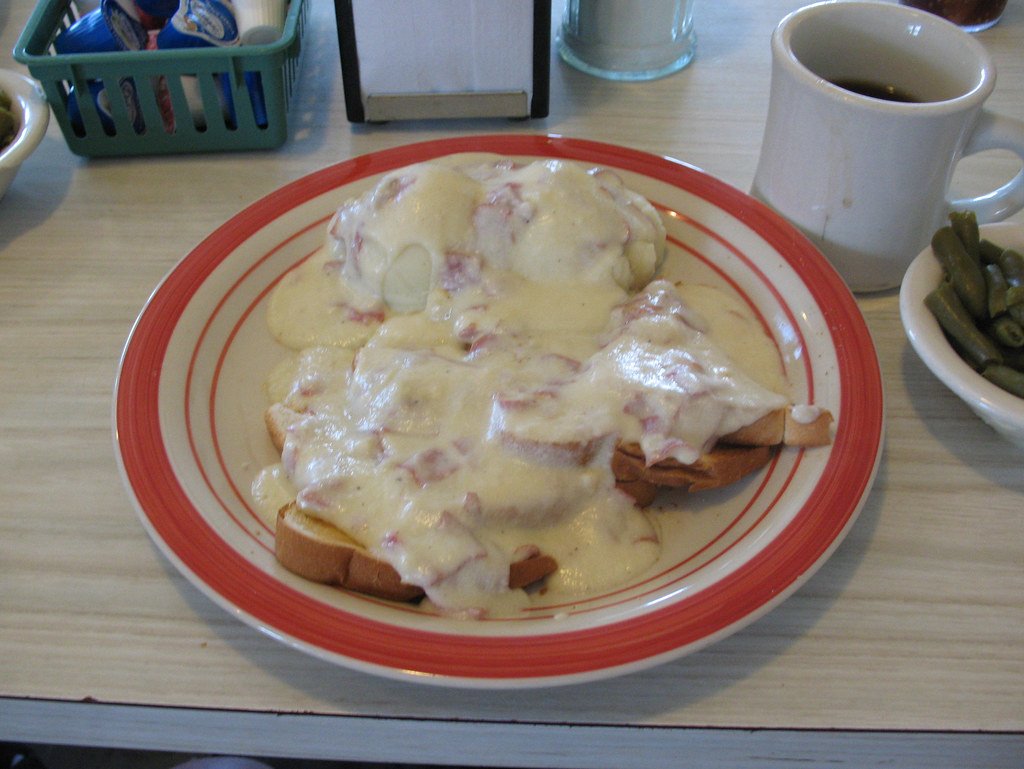
S.O.S. in its classic form, on the shingle. The whole point of this page is what happens when you swap the shingle out.
The Army wrote it down twice, and the two don’t match
Both manuals are online and I had them pulled and read rather than trusting the retellings.
1910 — Manual for Army Cooks, Recipe 251
Here’s what everyone tells you S.O.S. is: butter, flour, milk — a béchamel with chipped beef in it.
Here’s what the 1910 manual actually specifies: the flour is browned in the fat, and the gravy is built on six quarts of beef stock, with only two cans of evaporated milk and parsley.
That’s not a béchamel. It’s a brown gravy.
The white, milky S.O.S. everyone describes is the 1944 version — TM 10-412, the same Army manual whose 660 recipes are in my collection. Somewhere between the wars the dish got paler.
And it got leaner while it did. Beef per serving fell from 4 oz (1910) to 1.1 oz (1944).
Sit with that sequence: the dish went pale, the meat nearly vanished — and that’s exactly when the name turned hostile. Nobody calls a beef-stock gravy with four ounces of meat “shit on a shingle.” They call the pale, thin, 1.1-ounce version that. The insult tracks the recipe.
The name
⚠ NOT FOUND, and I want to be straight about it. Plenty of sources say “the first S.O.S. recipe is the 1910 manual” — and the recipe is there. The name is not. No source I checked provides a dated first attestation for “Shit on a Shingle,” “Same Old Stuff,” or “Stew on a Shingle.”
So the ordering of those three — which came first, which is the bowdlerization of which — is barracks folklore with no paper trail. I’d love to be corrected with a citation.
The 1910 find that ties this whole page together
While reading the 1910 manual for S.O.S., the research turned up Recipe 197, “Hominy, fried”: spread it an inch deep, chill it, cut it into two-inch squares, flour them, fry them.
That is the fried grit cake. Printed in 1910.
The thing I thought was my own good idea — the best version of this dish I make — was in the Army cook’s manual before my grandparents were born. I’m delighted rather than deflated.
⚠ “Hominy grits” is not hominy
This is the correction that reorganised the page, and it comes straight out of federal documents rather than a food blog.
Nixtamalization is a ~3,500-year-old Mesoamerican technology: cook and steep dried maize in an alkaline solution — calcium hydroxide (cal), traditionally wood-ash lye — for 6–12 hours. The result is hominy (nixtamal). It does four separate things:
- Structural — the alkali breaks down hemicellulose and pectin, dissolving the glue that holds the pericarp on. That’s why hominy kernels are naked and puffy.
- Nutritional — the big one. In untreated maize, 50–80% of the niacin is bound as niacytin, which non-ruminant mammals cannot absorb. Alkaline hydrolysis cleaves it and raises bioavailability to as much as 80%. It also adds calcium and improves the lysine/tryptophan balance.
- Flavour — the unmistakable masa aroma. (⚠ I wanted to name the compound and couldn’t source it — a specific molecule gets attributed to masa aroma in places but nothing tied it to nixtamal. Not printing a compound name I can’t stand behind.)
- Functional — gelatinizes starch so masa can form a dough.
Now the part that matters:
🔴 The bag in your American grocery store labelled “hominy grits” is almost certainly NOT nixtamalized.
The proof is the government’s own paperwork. USDA Commercial Item Description A-A-20035E, “Hominy Grits, Enriched”, defines hominy grits by reference to 21 CFR §137.260 — the standard for enriched corn meal — and specifies that instant hominy grits “must be derived from specially processed degerminated corn grits.”
The words lime, alkali and nixtamal do not appear anywhere in the document. Neither §137.260 nor its parent corn-meal standards contain an alkaline step. Quaker’s box says “Enriched White Hominy,” and it is not hominy in the Mesoamerican sense. It’s a legacy name for degerminated corn grits.
And there’s a second shoe:
🔴 There is no FDA standard of identity for “grits” at all. 21 CFR Part 137 Subpart B has standards for corn meal and corn flour — white, yellow, bolted, degerminated, self-rising — and no section for grits. “Grits gauze” appears in Part 137 only as the name of a sieve mesh. Anyone who tells you grits are legally defined is wrong.
Look at the irony sitting in that first document, too. Enrichment — adding synthetic niacin back to corn meal — is the industrial patch for exactly the problem nixtamalization solved 3,500 years earlier. We removed the ancient process, got the deficiency, and then bolted a vitamin premix onto the fix.
Pellagra — the reason this isn’t trivia
That niacin point has a body count.
When maize crossed to Europe and then through the American South, the corn travelled and the alkaline process didn’t. The result was pellagra — the “four Ds,” dermatitis, diarrhoea, dementia, death — epidemic across the South in the early twentieth century.
The people who had grown maize for millennia had the answer built into their cooking. We took the grain and left the technology, and it killed people for decades. That is the moral centre of the American corn story, and it’s why “hominy grits aren’t hominy” is worth more than a pedant’s footnote.
And 1910 didn’t even mean corn
One last terminological banana skin, verified verbatim from the same manual:
§67: “Grits. — Grains, as of wheat or oats coarsely ground.” §71: “Hominy. — Indian corn from which the outer husk has been removed.”
In 1910 the Army used “hominy” for the corn product and “grits” for a grind, not a grain. The meanings drifted, and most writers project today’s definitions backwards onto a document that says the opposite.
Grits vs polenta — what actually differs
The honest answer, before the table: it depends entirely on what you buy, and for most people the difference is smaller than they’d like.
- Quaker quick grits vs a supermarket tube of polenta: both are degerminated dent-corn meal at different grinds. The difference is minor and mostly textural.
- Anson Mills antebellum dent grits vs a real Italian flint polenta (otto file): substantially different, and worth a real side-by-side.
| Attribute | Stone-ground dent grits | Flint polenta |
|---|---|---|
| Texture | Creamy base with distinct soft bite; heterogeneous | Uniformly toothsome, firmer, “grainy-clean” |
| Corn flavour | Corn-forward, sweet, cream-corn | Mineral and floral first, less overt sweetcorn |
| Body | Fines release starch → self-thickening, glossy | Less free starch → sets rather than creams |
| Gravy handling | Absorbs and merges with the gravy | Holds up under it; stays distinct |
That last row is the one that matters for S.O.S., and it’s the actual hypothesis of your experiment. S.O.S. gravy is salty, thick and assertive. Grits marry with it — they go soft and the whole thing becomes one creamy dish. Polenta resists it — you keep two textures, gravy sitting on a firm bed, which is much closer to what the shingle was structurally doing in the first place.
⚠ That table is mechanism-based reasoning from sourced properties, not a reported taste test. There is no published side-by-side of S.O.S. on grits vs polenta — unsurprisingly, since it’s a novel comparison. Which means when you run it, it’s original.
And the buy-side warning that makes or breaks the test: it is only a valid comparison if you buy real stone-ground dent grits and real flint polenta. Comparing two bags of degerminated commodity cornmeal proves nothing — you’d be testing grind size and calling it a cuisine.
⚠ The bacon fat question — your answer
You asked whether to use bacon fat instead of butter, or half and half. Here’s what I found, and the first part is the most important:
Nobody has tested this. Not Kenji, not Cook’s Illustrated, not McGee. There is no controlled test of a bacon-fat roux versus a butter roux anywhere I could find. Every confident claim out there is folklore.
And two of the popular claims are wrong:
- “Bacon fat has a higher smoke point so it’s better for a roux.” The two are within about 25 °F of each other, and both are limited by their solids, not their fat.
- “It thickens differently.” The flour thickens. The fat disperses. And the roux’s colour affects thickening about four times more than anything else you could change.
But there is one real effect, and nobody mentions it:
Butter is only ~81% fat. Bacon fat is ~100%.
So a tablespoon of bacon fat delivers roughly 20% more actual fat than a tablespoon of butter. Swap 1:1 and you haven’t made the same roux — you’ve made a fattier, looser one.
The fix: use about 20% less bacon fat than the butter called for. Roughly 4 tsp bacon fat per 5 tsp butter. (For the 1910 recipe’s 1 lb of butter: about 13 oz of bacon fat.)
Two more things worth knowing:
- You also lose butter’s water. Butter is ~16% water, which flashes off during the foaming and never reaches the sauce. Bacon fat has none — so the finished gravy runs very slightly looser. Small, and swamped by the ratio point above.
- ⚠ Salt is the real hazard. Bacon fat is already salty and chipped beef is very salty. This is a seasoning problem, not a chemistry one. Season at the very end and taste before you add any salt at all.
My verdict, and it’s aesthetic, not scientific: half and half is what I’d cook. Enough bacon fat to carry smoke phenols and pork aroma into a gravy that is pale and salty and needs the help; enough butter that the milk solids can brown and give you a nutty backbone that pure bacon fat can’t.
And the joke at the end of it: the 1910 manual says “1 pound fat, butter preferred.” Fat is the default and butter is the upgrade. Cooking S.O.S. in bacon fat isn’t a modern hack — it’s the older way round, and the butter you’ve always used was the fancy option.
The tasting — your experiment, laid out
You’ve done three of the four bases. Here’s the protocol that would make the fourth mean something.
Controls that matter:
- One batch of gravy, split. Otherwise you’re testing your roux, not the base.
- Same day, same sitting. Memory is a terrible instrument.
- Real ingredients — stone-ground dent grits, actual flint polenta. See the warning above.
- Same egg treatment on all four (over-easy), or leave the egg off entirely for the tasting and add it back for eating. The yolk is a sauce; it will mask differences.
- Taste the bases plain first, before any gravy. You cannot judge how something carries a gravy if you don’t know what it tastes like alone.
The sheet — print it and write on it:
| Plain grits | Cheese grits | Fried grit cakes | Polenta | |
|---|---|---|---|---|
| Corn flavour (1–5) | ||||
| Texture — creamy vs toothsome | ||||
| Does it MARRY the gravy or HOLD UNDER it? | ||||
| Salt balance (gravy is salty — does the base carry it?) | ||||
| Still good at bite 10? | ||||
| Would I make it again? |
The one question the whole thing is really asking is that middle row. My prediction, stated as a prediction so you can prove me wrong: the polenta will hold its own under the gravy and the grits will surrender to it — and you may well find you want the surrender, because that creamy merge is what S.O.S. on grits is.
Write it down as you go. This is genuinely untested ground and your notes are the only data that will ever exist on it.
The recipes
- Creamed Chipped Beef on Toast (S.O.S.) — the one already in the collection.
- S.O.S., Army 1910 (Brown Gravy) — the browned roux and beef stock version. This is not the dish you think you know, and it deserves a try.
- S.O.S., Bacon Fat Roux — with the 20% correction built in.
- Grit Cakes, Fried Cheese — the best thing on this page.
- Polenta for S.O.S. — the missing quarter of your tasting.
Why the grit cakes set (and why instant grits won’t)
Worth knowing, because it explains a failure you may have already hit.
Cooking grits gelatinizes the starch: granules swell, burst, and amylose and amylopectin unwind into solution. Chilling retrogrades it: those freed chains realign into crystalline order and squeeze water out of the gel, firming the mass.
The key asymmetry: amylose recrystallizes fast; amylopectin is much slower. Amylose is linear, so it packs tightly — and high-amylose starches form very firm, opaque gels. Corn is high-amylose. That’s the whole reason grit cakes work, and why they set within hours but keep firming for a day.
Bonus: the retrograded surface enters a glassy state that crisps better. The chill isn’t just for handling — it improves the crust.
Two practical corollaries:
- ⚠ Instant grits set poorly. They’re pre-gelatinized and heavily degerminated, with damaged starch. Use coarse stone-ground grits for cakes.
- ⚠ Go easier on the cheese and butter than you would for eating grits. Fat interferes with the amylose network and gives a softer, more fragile cake. (That one is my reasoning from the retrogradation science, not a sourced claim — test it.)
Next: shrimp and grits, which is the other thing that belongs on a bed of corn.
Sources & further reading
- US Army, Manual for Army Cooks (1910) — Recipe 251 (the brown-gravy S.O.S.), Recipe 197 (“Hominy, fried”), and §67/§71 on what “grits” and “hominy” meant. Read directly.
- US Army, TM 10-412, Army Recipes (1944) — the white-gravy version. archive.org — and all 660 of its recipes are in this collection.
- USDA Commercial Item Description A-A-20035E, Hominy Grits, Enriched — ams.usda.gov (PDF). The document that proves “hominy grits” aren’t hominy.
- 21 CFR Part 137 Subpart B — corn meal standards. Note the absence of any standard for grits.
- Nixtamalization — Masienda’s guide · Texas Monthly · Hominy (Wikipedia).
- Starch retrogradation — Cook’s Illustrated · Wikipedia.
Comments (0)