New Orleans
Let’s start with the thing that unravels every plaque, menu and tour-guide script in the French Quarter:
They weren’t called beignets until 1958.
Not 1862. Not 1755. 1958 — the year “Volare” was on the radio. Until then, the thing you queue for at 2am under the green-and-white awning was sold as a “French Market doughnut,” which is exactly what it looks like and exactly what everyone called it.
The rename is documented. Times-Picayune writer Howard Jacobs recorded it: a deliberate marketing decision that traded a plain descriptive name for a French one, invoking the city’s cultural roots and a claim that the pastries were “made the way they were in Belgium.” It met little resistance — nobody in New Orleans stood up for “French Market doughnut,” and why would they. “Beignet” is a better word. It’s also, as the trade name of this specific pastry in this specific city, younger than rock’n’roll.
Which produces a compounding problem for the sentence printed on roughly every coffee cup in the parish.
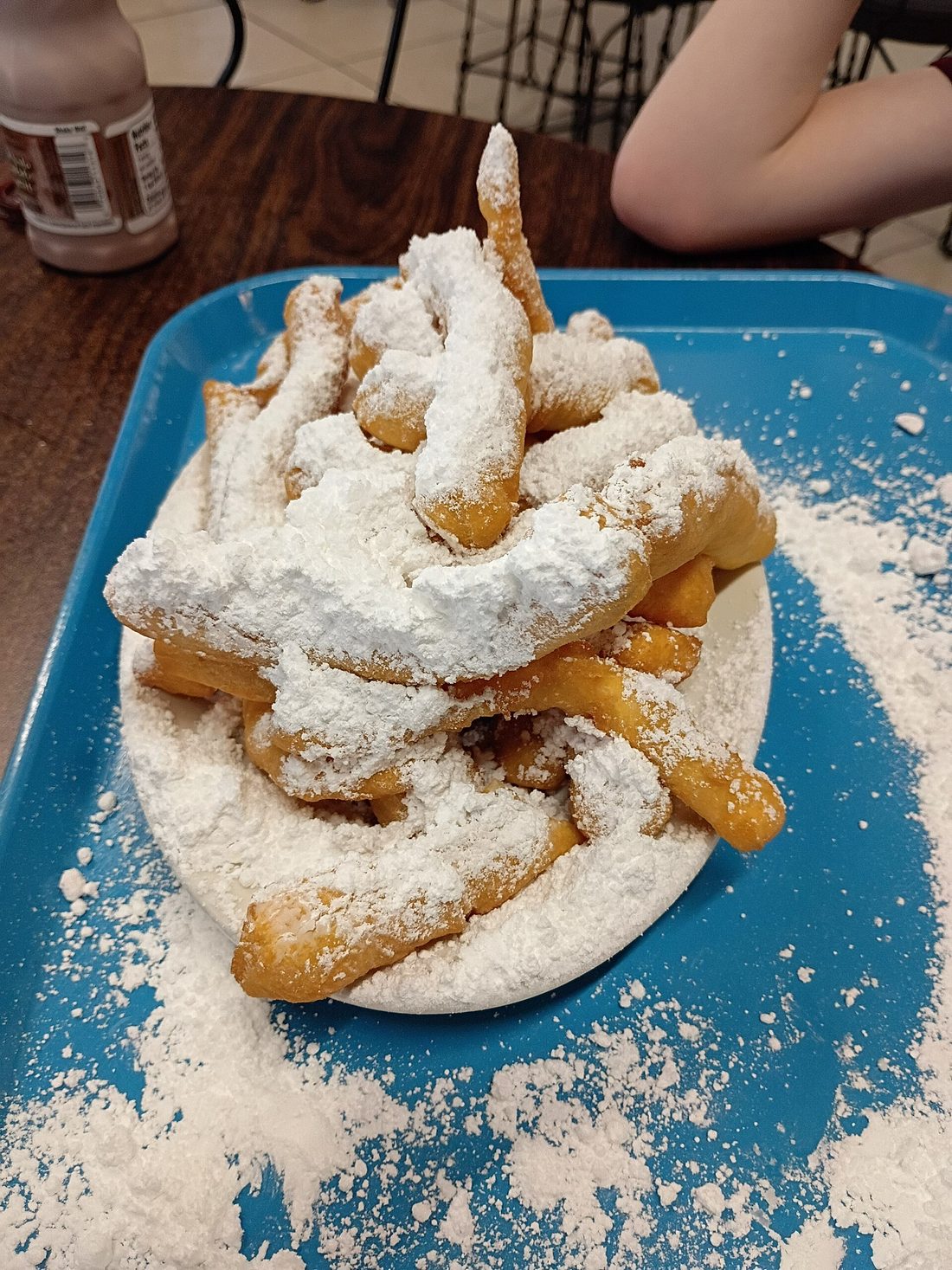
Beignets — a name they didn’t have until 1958. For most of their life they were “French Market doughnuts."
"Serving beignets since 1862” is two claims, and both have problems
Take it apart.
Claim one: they’ve been serving beignets since 1862. This is anachronistic on its face. Whatever was sold at that stand in 1862, nobody called it a beignet, because that name didn’t attach to this pastry for another ninety-six years. That’s not a gotcha about wording — it tells you the pastry’s identity as a French thing is a 20th-century retail decision layered on top of a food that was, by its own name, a doughnut sold at a market.
Claim two: 1862. Here I have to be careful, because the honest answer is neither “true” nor “false.”
⚠ The 1862 date is company-sourced and not independently verified. Follow the chain:
- Café du Monde itself states 1862.
- Wikipedia asserts 1862 flatly — no hedge, no dispute noted — and doesn’t even name a founder in the body, attributing the modern era to the Fernandez family.
- nola.com’s “300 for 300” series ran a piece literally titled “1862: The first cup at Cafe Du Monde.”
- Some secondary sources name Fred Koeniger as founder of “The Original French Market Coffee Stand” — ⚠ also not independently verified, and absent from Wikipedia’s body text.
Every one of those roads leads back to the same place: the business’s own account. I found no historian challenging 1862 and no primary documentation confirming it either.
So here’s the verdict, stated as precisely as I can:
The date is plausible, corporate-sourced, and unproven. The French Market coffee stands are genuinely antebellum — this isn’t a wild claim. But “the oldest coffee stand in New Orleans, est. 1862” is a corporate claim repeated by reference works until it hardened into a fact, not an archivally demonstrated one.
That’s not an accusation. It’s a description of the evidence. Most old family businesses have exactly this problem: the paperwork burned, flooded, or was never made, and what’s left is what grandpa said. The failure isn’t the company’s for saying 1862. It’s the encyclopedias’ for printing it without a hedge.
The Ursuline nuns didn’t give anyone the recipe (probably)
The other story you’ll hear: that Café du Monde’s recipe came from France via the Ursuline nuns, who arrived in New Orleans in 1727 and are genuinely important to the city’s food history.
This is explicit legend. Never confirmed. I’m not calling it false — I’m telling you nobody has ever produced anything supporting it, and it has the exact shape of a story invented to give a commercial recipe a holy pedigree. Don’t repeat it as fact. I won’t.
What is defensible about the lineage
The standard account, which I’ll give you as a lineage argument rather than a documented transmission:
French settlers carried fried-dough traditions to Acadia in the 17th century. After the British expulsion — Le Grand Dérangement, from 1755 — Acadians resettled in Louisiana and became Cajuns, and the fritter tradition merged with Native American, African-American, Spanish, French and Caribbean cooking into what Louisiana eats now.
That’s plausible and widely held. It’s also a story about where people went, not a receipt for a recipe. Nobody can hand you a document showing this dough travelling from Acadia to Jackson Square. Treat it as ancestry, not as a chain of custody.
Then there’s the deep cut, and I like this one enough to give it a paragraph even though it’s a hypothesis and I’m labelling it as one.
Food historian Cathy Kaufman has proposed that Mardi Gras beignets descend from the medieval Islamic luqam al-qadi — a fried dough that appears in the Baghdad Cookery Book (1226 CE / 623 AH). Kaufman flags it herself as a proposal: “I propose that…” So: scholarly hypothesis, not fact.
I mention it because it doesn’t stop here. The same medieval Arab fried-dough thread turns up at the other end of the hemisphere — one of the three competing origin theories for Uruguay’s torta frita is that the form came through the Arab conquest of Iberia and rode Spanish immigration to South America. Two fried doughs, five thousand miles apart, with independent scholars pointing at the same medieval ancestor. Neither claim is established. Both being unestablished in the same direction is at least interesting.
Why square? Nobody knows, and I’m not going to pretend otherwise
A beignet is square. No hole. Three to an order.
⚠ NOT FOUND: any source giving a reason. I went looking, and every source states the fact — “square with no hole in the center” — and then moves on. There is no primary source explaining the intent.
What I can offer is mechanical reasoning, which is not history and I’m labelling it as mine:
Roll a sheet, cut a grid with a knife or a wheel, and you get zero scrap and need no tooling. Every offcut is a beignet. A round cutter leaves waste you have to re-roll (and re-rolled dough is tougher), and it means buying and washing a cutter.
For a high-volume market stand, that’s simply the cheapest geometry. It’s the obvious practical logic. It is also, as far as the record goes, my inference and nobody’s documented claim. If you find the source, I want it.
The yeast, though, is a real and load-bearing fact. It’s what separates a beignet from a cake doughnut: a lean-ish enriched dough that puffs violently and hollows out in the fryer, giving you the pillow with the near-empty interior. The Café du Monde-style dough is enriched with evaporated milk. If your beignets come out dense, the problem is almost always the dough was rolled too thick or the oil was too cool — not the recipe.
The other New Orleans breakfast: crêpes
Beignets get the queue and the postcards. But the city’s French inheritance shows up at breakfast in a quieter form, and a crêpe is a more useful thing to know how to make than a beignet is, because you can make one on a Tuesday without heating two litres of oil.
The whole crêpe is in one instruction: rest the batter. An hour at room temperature, or overnight in the fridge. This isn’t a nicety. It hydrates the flour and relaxes the gluten you just whipped up in the blender. Unrested batter gives rubbery crêpes, reliably, every time, and no amount of pan technique saves it.
Everything else is consistency (heavy cream — thin with milk if it’s thicker) and heat (medium, around 190 °C / 375 °F, buttered lightly). Sixty millilitres of batter, swirl immediately, 45–60 seconds until the edges lift and lace-brown, flip, 20–30 seconds more. Stack them under a towel; they steam each other pliable. Sweet with lemon and sugar or praline; savoury with ham, gruyère and an egg.
Both recipes are in the collection:
- New Orleans Beignets — evaporated-milk dough, overnight cold rest if you have the patience (better flavour, and cold dough rolls cleanly), 6 mm thick, cut into 6 cm squares, fried at 175 °C / 350 °F. That temperature is the whole game: below 165 °C they soak grease, above 190 °C they brown before the interior sets.
- Crêpes with Confiture — and rest the batter.
One technique note that applies to both and that people get wrong: drain fried dough on a rack, not on paper. Paper traps steam against the bottom and softens the crust you just built. And bury the beignets in powdered sugar while they’re hot — it’s not a garnish decision, it’s the only time it’ll stick.
The callback: New Orleans got there first, again
Here’s a pattern worth noticing, because it happens twice on this site.
New Orleans has a reputation as the city that borrows — that Charleston owns the Lowcountry canon and New Orleans does a Creole cover version. Go read the shrimp and grits page and watch that fall apart: New Orleans got shrimp-and-grits into print in 1891 and onto a menu in 1895 — roughly forty years before the 1930 Charleston book everyone treats as the origin point.
That doesn’t overturn the Gullah Geechee origin of the dish, and I’m careful about that on the other page. Print lags practice, especially for food cooked by people who were never published.
But it does mean New Orleans keeps turning out to be earlier in the record than its reputation suggests, and simultaneously later than its own marketing suggests. The city’s actual history is consistently more interesting than either the tourists’ version or the gift-shop’s version. It got shrimp and grits into print forty years before Charleston, and it started calling its doughnuts beignets in 1958.
Both of those are true. Neither is on a coffee cup.
Next: Mexico, Guatemala & Panama — where the corn thread starts, and where three flours that all say “corn” on the bag turn out to be three incompatible technologies.
Sources & further reading
- Shelby Loyacona, “Beignets,” New Orleans Historical — the 1958 rebrand. The best source on this page, and the one that reframes everything.
- Café du Monde’s own history page — the origin of the 1862 claim, and the end of every citation chain that repeats it.
- Wikipedia, Café du Monde — asserts 1862 flatly, with no hedge and no founder named in the body.
- nola.com, “1862: The first cup at Cafe Du Monde” — the “300 for 300” series.
- nola.com on the French Market building’s history — a separate question from the business’s history, and worth keeping separate.
- Gambit / Blake Pontchartrain on Café du Monde and Morning Call — the local-history column.
- Wikipedia, Beignet.
Comments (0)