Coffee · 7 of 35
Chicory and New Orleans Coffee
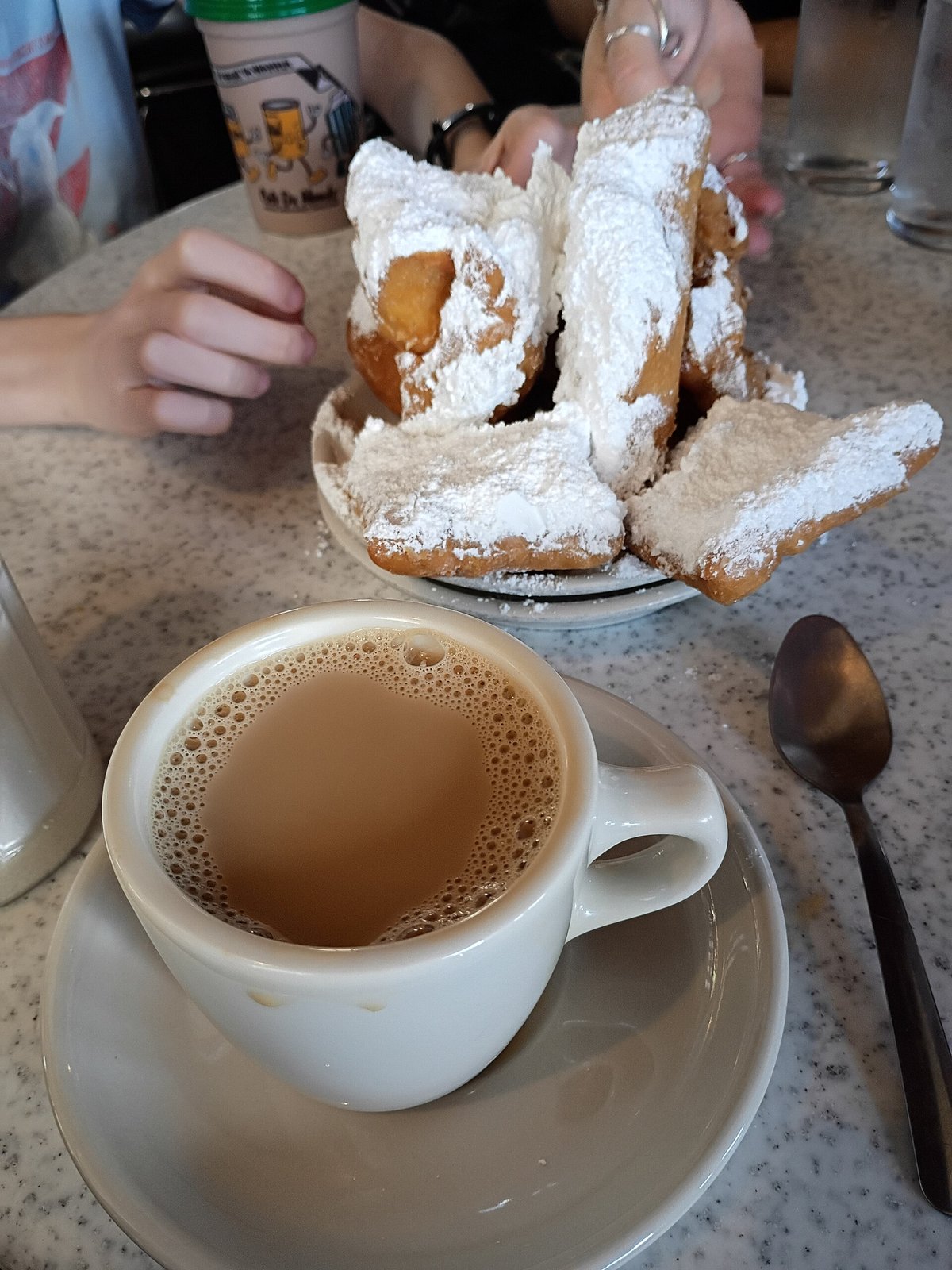
Chicory coffee is New Orleans’s coffee: dark, bitter-sweet, a little woody, and almost always served with hot milk. Every telling of how it got there is the same story. Napoleon’s blockade taught the French to stretch coffee with chicory, the French brought the habit to Louisiana, and the Union blockade of the Civil War made New Orleans fall back on it. When the coffee came back, people had come to like it.
Parts of that are true. Chicory did boom under Napoleon, and it was remembered afterwards as a Confederate wartime drink. But the two best-known Creole cookbooks of the next half-century, published in 1885 and 1901, make their coffee from Java and Mocha with no chicory at all. When New Orleans made chicory its own is not on record. Below: what chicory is, where the stories hold and where they do not, and how to brew, blend and roast it at home.
The short version
| Question | Answer |
|---|---|
| What is chicory? | The root of Cichorium intybus, a blue-flowered plant of the daisy family, dried, roasted and ground. No caffeine. |
| What does it add? | Dark colour, body, a bitter-sweet roasted taste. Roasting turns its fibre (inulin) into caramel-like compounds. |
| Did Napoleon start it? | No. Chicory coffee was made in the Netherlands and Germany by the late 1600s or 1700s; a Braunschweig licence dates from 1769–70. Napoleon’s Continental Blockade (from 1806) made it boom in France, Belgium and Germany. |
| Did the Civil War start it in New Orleans? | Not proven. Chicory coffee was remembered after the war as a Confederate drink. But Louisiana papers before the war mention chicory only as a foreign adulterant, and the city’s own cookbooks of 1885 and 1901 call for pure Java and Mocha. |
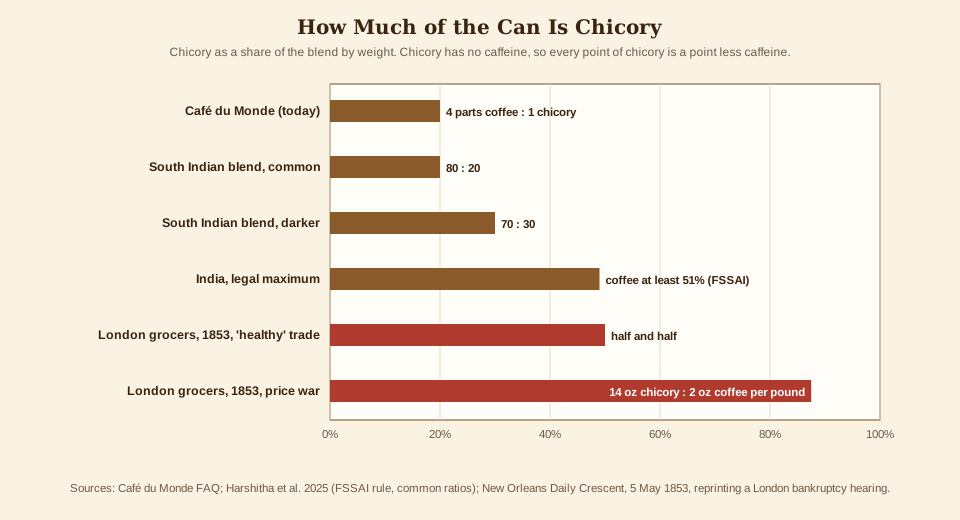
| How much chicory is in the can? | Café du Monde: 4 parts coffee to 1 chicory (20%). South Indian filter blends: usually 20–30%; Indian law caps it at 49%. |
| How do I brew it? | Like any ground coffee, a little coarser; drip, French press, or cold brew. Then half hot milk for café au lait. |
| Can I roast my own? | Yes: dried root pieces, a hot oven or skillet, roasted to dark brown. No tested standard method exists; the one below is a starting point. |
| Anything to watch? | Roasted chicory carries more acrylamide than coffee (the EU benchmark is ten times higher). And chicory is fibre: a lot of it can upset the stomach. |
What chicory is
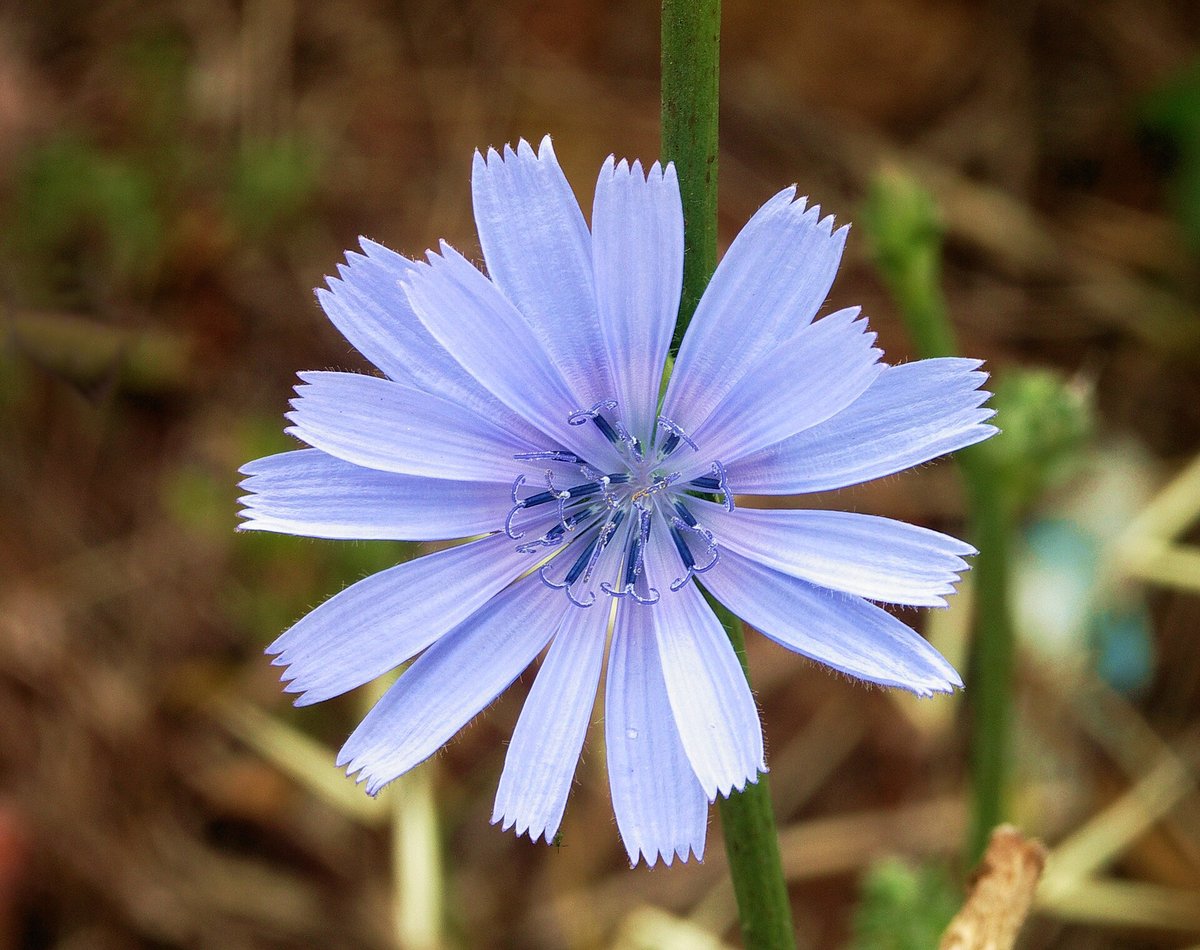
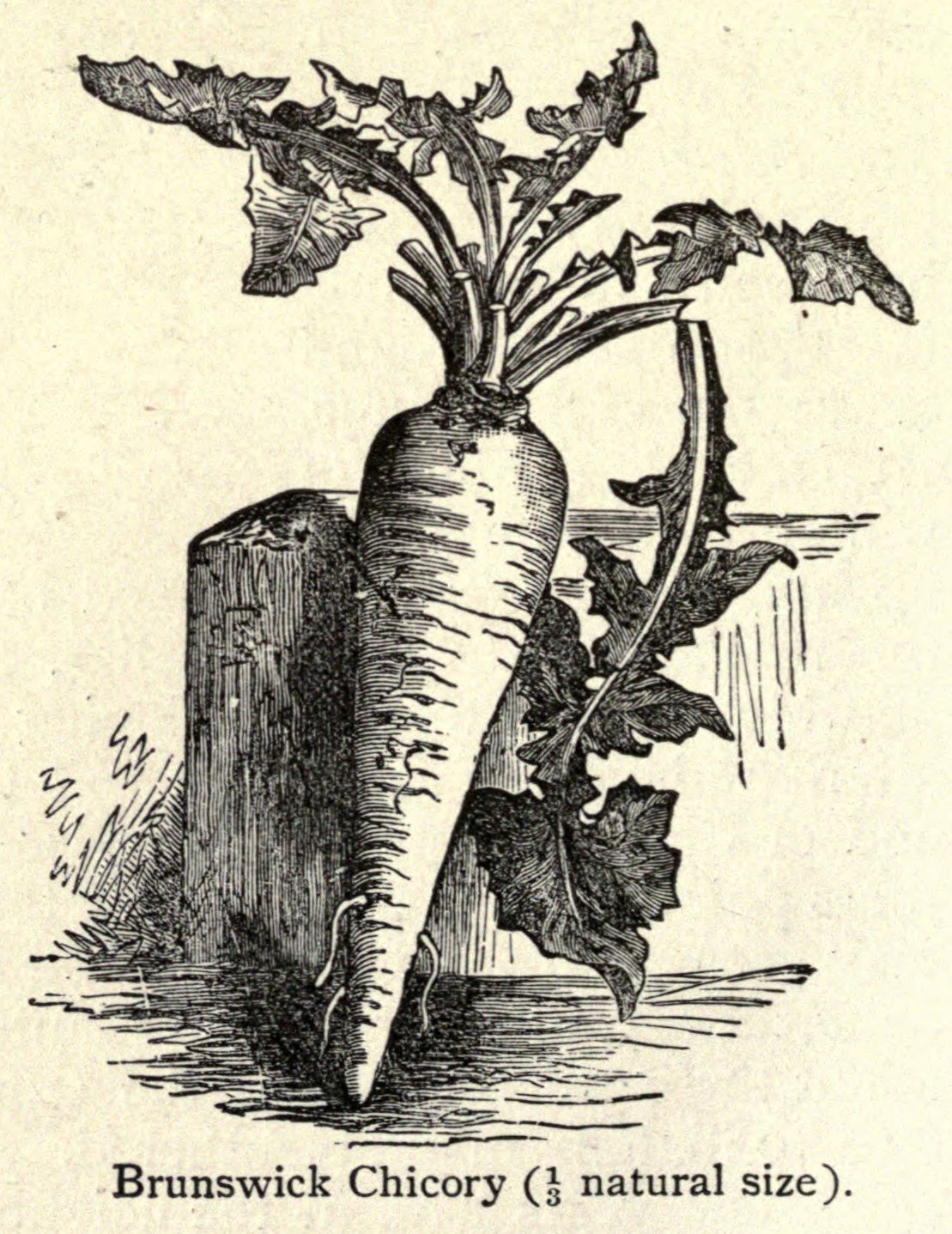
Chicory is Cichorium intybus, a perennial of the daisy family. One species has been bred into several crops: leafy kinds (radicchio, puntarelle, sugarloaf), the forced white heads called Belgian endive or witloof, and a big-rooted kind grown for its root. European law defines coffee chicory as the roots of Cichorium intybus “not used for the production of witloof chicory,” cleaned, dried and roasted (EU Directive 1999/4/EC). So Café du Monde’s line that chicory is “the root of the endive lettuce plant” is close: same species, different crop.
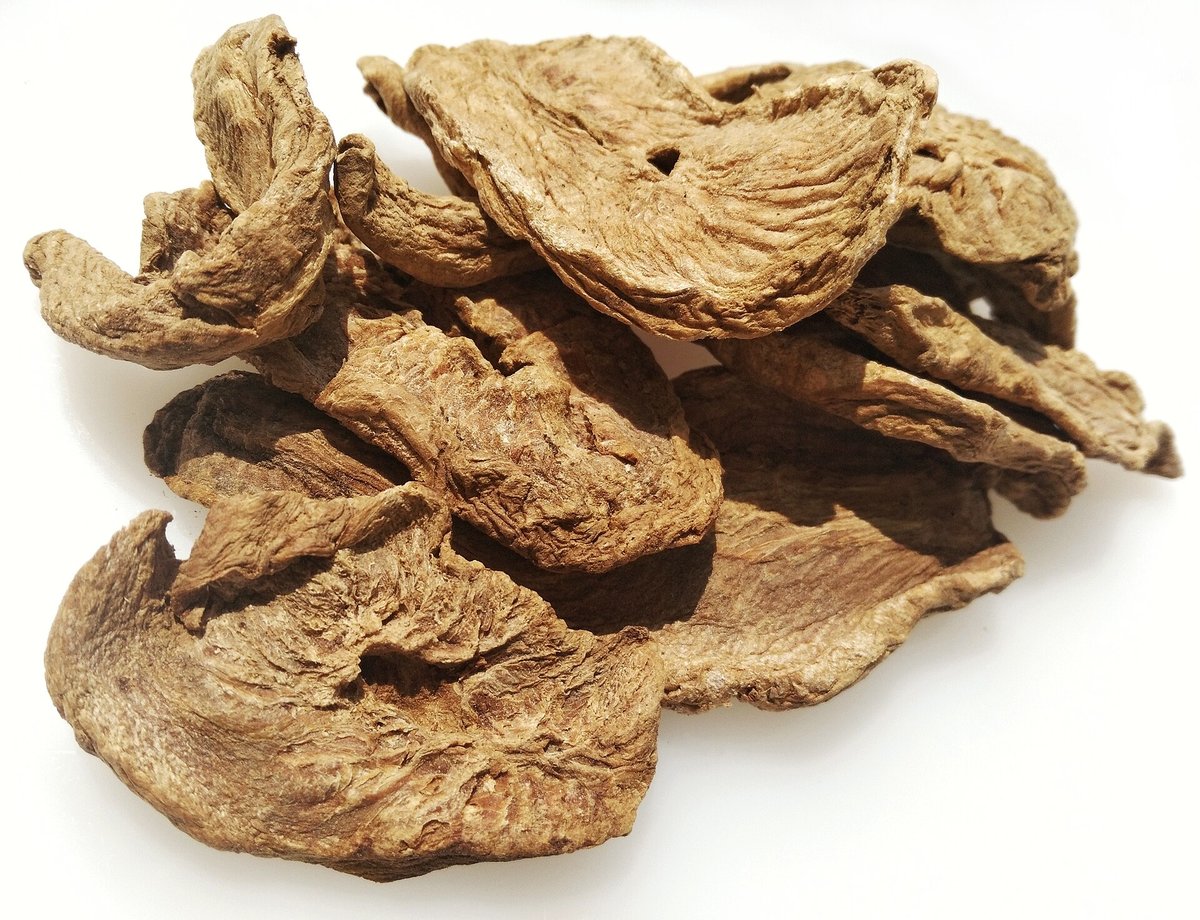
What happens to the root:
| Step | What it does |
|---|---|
| Harvest and wash | the root is about three-quarters water |
| Cut into small pieces (cossettes, about 6 mm) | so it dries evenly |
| Dry to about 10% moisture | it will now keep |
| Roast | to the colour the maker wants; this makes the flavour |
| Grind or granulate | to blend with coffee, or to sell on its own |
The French figures come from the French Wikipedia article on chicory drinks, which describes the industrial process.
The chemistry, briefly. A 2025 review of coffee-chicory blends (Harshitha and others) puts chicory root at about 68% inulin by dry weight. Inulin is a fibre made of chains of fructose. Roasting breaks those chains and browns them, making furan compounds, among them hydroxymethylfurfural (HMF), which give the caramel, roasted smell. That is why roasted chicory tastes like burnt sugar and wood rather than like a vegetable.
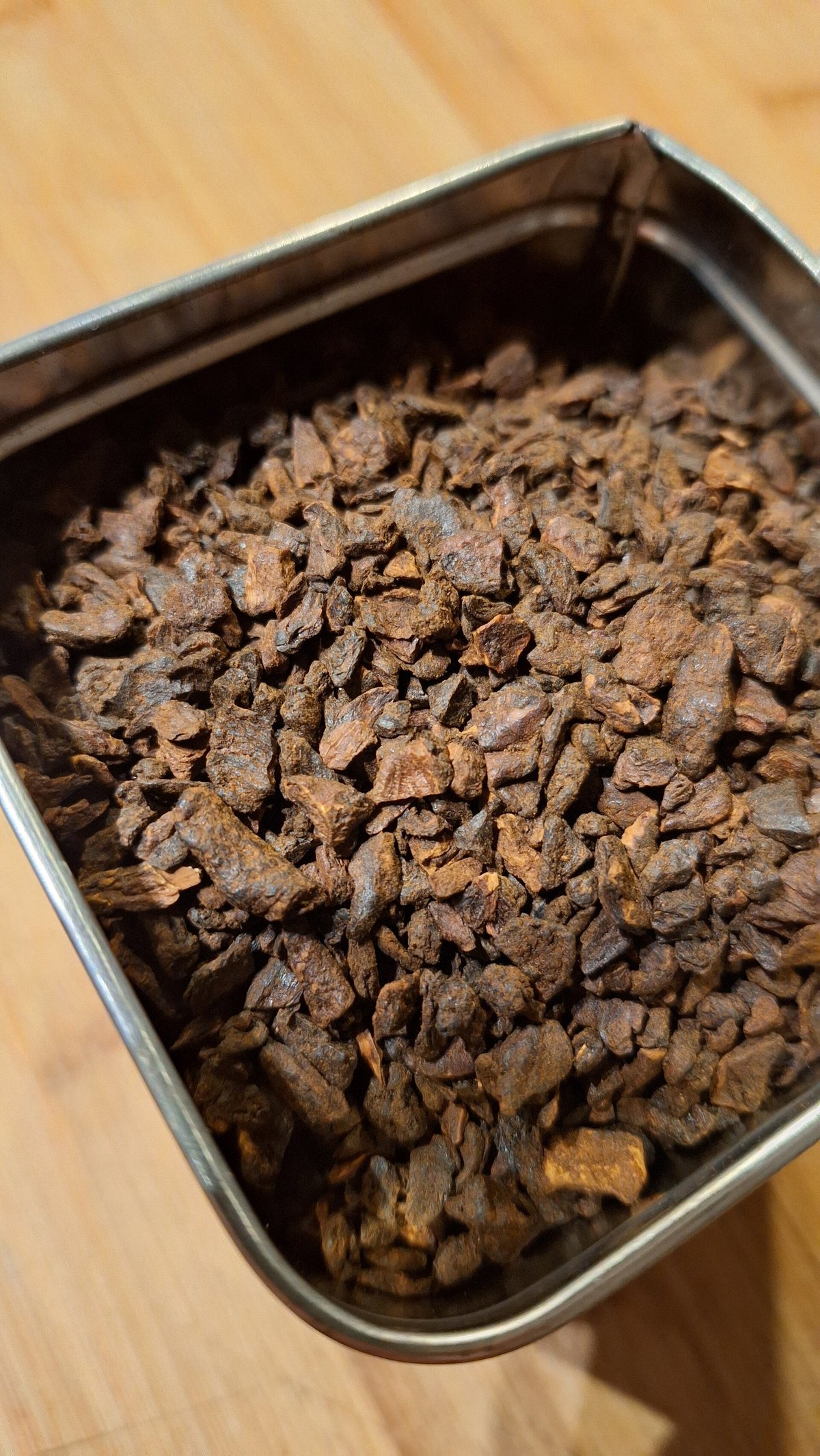
No caffeine. Chicory contains none, so every spoonful of chicory in a blend is a spoonful less caffeine. The USDA’s FoodData Central lists instant coffee powder at 3,140 mg of caffeine per 100 g and instant coffee-with-chicory powder at 2,060 mg: about a third less. The Caffeine and Health page has the numbers for ordinary coffee.
Where it began: the Netherlands, Germany, and then Napoleon
The popular story says chicory coffee was invented when Napoleon’s Continental Blockade cut France off from colonial coffee. It is older than that by a long way.
| When | What | Source and strength |
|---|---|---|
| Late 1600s | chicory used as a coffee substitute, first in the Netherlands (French account) or across Central Europe from about 1680 (German account) | encyclopaedia articles; the sources disagree on place |
| 1750 | ”Holland first replaced coffee with chicory” | the 2025 review; a third date |
| 1769–70 | Major Christian von Heine and the Braunschweig innkeeper Christian Gottlieb Förster licensed to make chicory coffee in Braunschweig and Berlin | German Wikipedia |
| about 1795 | 22 to 24 chicory works in Braunschweig | same |
| 1806–1812 | the Continental Blockade restricts coffee imports; chicory “experienced its true boom, particularly in France, but also in Belgium and Germany” | French Wikipedia |
| 1858 | Jean-Baptiste-Alphonse Leroux buys a works in Orchies, northern France; the firm specialises in chicory from 1871 | same |
So the blockade did not start chicory coffee; it made a German and Dutch habit into a French one. Germany’s chicory works came first, which is why a root variety in the old seed catalogues is called Brunswick.
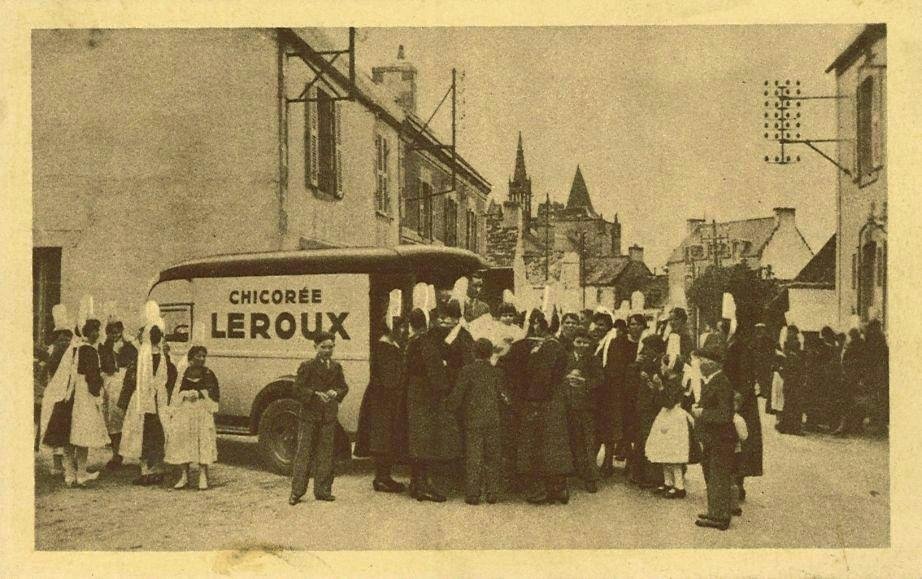
Today Leroux holds about 96% of the French market and processes about 80,000 tonnes a year, and of roughly 496,000 tonnes of chicory root grown worldwide in 2017, about two-thirds came from Belgium (French Wikipedia figures). Belgium and northern France are still where chicory is grown, roasted and drunk, often on its own as a hot drink.
Chicory in Britain: the adulteration scandal
By the 1850s chicory had a second reputation: as the cheapest way to cheat a coffee buyer. New Orleans readers saw it in their own papers. The New Orleans Daily Crescent of 31 August 1852 reported that a British Treasury order “forbidding the mixing of chicory with coffee” had pushed up the price of coffee. On 5 May 1853 the same paper reprinted a London bankruptcy hearing in which two coffee makers explained that when their trade “was in a healthy state” they “made it up half chicory and half coffee,” and when competition drove the price down, “14oz. of chicory and 2oz. of coffee to the pound.” The reporter added: “It was not, however, asked how much chicory was in the chicory.”
New Orleans: testing the Civil War story
The story, as Café du Monde’s neighbours and most guidebooks tell it: during the Civil War the Union blockaded Southern ports from 1861 and took New Orleans in 1862, coffee ran short, the French-descended city stretched it with chicory as the French had under Napoleon, and the taste stuck. Here is what the record shows.
Before the war, chicory was in the papers as a foreign scandal. The Library of Congress’s Chronicling America collection holds digitised Louisiana newspapers from those years. Every mention of chicory from 1848 to 1859 in those pages is about adulteration somewhere else: the London hearing above, a Punch joke that the coffee grounds fortune-tellers read “consist chiefly of chicory, roasted corn, beans and potato flour,” a Wisconsin complaint that “coffee [is made] of chicory.” None describes chicory as something New Orleans drank by choice. The collection is incomplete, so this shows only that chicory was not a subject in those papers, not that nobody in the city used it.
After the war, chicory coffee was remembered as a Confederate drink. In June 1874 a New Orleans Bulletin correspondent travelling to South Carolina wrote from Montgomery, Alabama that he had last visited that city “during the existence of the Confederacy,” and that the illusion of being back in wartime was made “more perfect when … we were presented with a cup of real chicory coffee,” with corn dodger and fried bacon. He tried to pay with a Confederate dollar. To that writer, chicory coffee was a taste of the war years, and one worth remarking on, which suggests it was not what he drank every morning in New Orleans.
Chicory blending was national, not local. In July 1875 the same paper noted that German chicory “is used in this country to a considerable extent to mix with ground Rio coffees,” and in April it had listed chicory “for coffee” among US imports. Chicory in American coffee was common across the country in the 1870s.
New Orleans’s own cookbooks leave it out. Lafcadio Hearn’s La Cuisine Créole (1885) says “Old Java and Mocha are the best coffees,” that dripped coffee is “the French mode,” and that it is “served with boiling milk at breakfast.” The Picayune Creole Cook Book (1901; this page quotes the fifth edition of 1916) opens with a whole chapter on “Creole Coffee.” It praises “the famous French Market, with its world-renowned coffee stands,” demands Java and Mocha “of the best quality,” and insists that “the GOOD CREOLE COOK NEVER BOILS COFFEE, but insists on dripping it.” Neither book mentions chicory in coffee. In the Picayune, chicory appears as a green, in a chicory sauce for lamb, not in the coffee.
What can be said with confidence:
| Claim | Verdict |
|---|---|
| The French used chicory to stretch coffee under Napoleon’s blockade | True, though they did not invent it |
| The Confederate South drank chicory coffee in wartime | Supported: a New Orleans writer associated it with the Confederacy in 1874 |
| New Orleans took up chicory because of the Civil War | Not proven. Plausible, but no wartime New Orleans source has been produced |
| Chicory coffee has always been the New Orleans standard | Not supported. The city’s best-known cookbooks of 1885 and 1901 (reprinted to 1916) call for Java and Mocha |
| Chicory coffee is a New Orleans speciality today | True. Café du Monde and other New Orleans roasters sell coffee-and-chicory blends |
When chicory became the city’s signature, and why, is not on record in any dated source. One possibility, consistent with the evidence but unproven, is that chicory stayed in the cheap coffee sold at the French Market stands and to working households, while the cookbooks described what better-off kitchens bought.
Café du Monde, the French Market and the brands
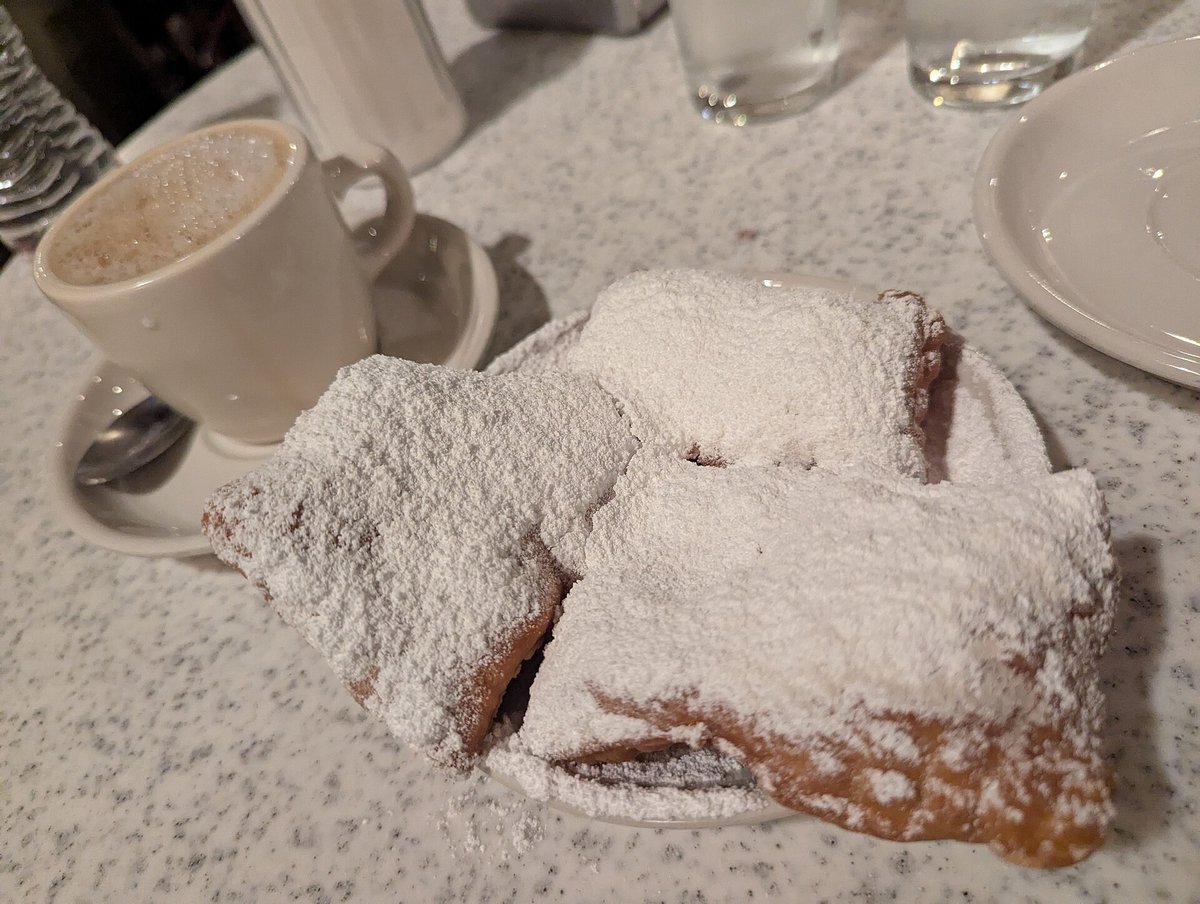
Café du Monde sits in the French Market at the edge of Jackson Square. Its own history gives the original menu as “dark roasted Coffee and Chicory, Beignets, White and Chocolate Milk, and fresh squeezed Orange Juice,” served “Black or Au Lait” (history page). The company dates itself to 1862, a date the Breakfast Favorites New Orleans page examines, along with the fact that beignets were sold as “French Market doughnuts” until 1958. Its FAQ gives the blend: “4 part coffee 1 part chicory.” A 15 oz can of its Coffee and Chicory cost $9.95 on its own shop in October 2026, and its decaf is made by the ethyl-acetate process.
Other names in the story:
| Brand | Founded | Notes |
|---|---|---|
| Café du Monde | 1862 (company’s date) | coffee and chicory, 4:1; also a French Roast with chicory |
| French Market Coffee | 1890 | started by the Bartlett and Dodge families in the French Market, moved to 800 Magazine Street in 1920; now owned by Reily Foods (history) |
| Community Coffee | 1919 | Henry Norman “Cap” Saurage, Baton Rouge; began with free cups in his grocery store (our story) |
A recipe for the doughnuts that go with it: New Orleans Beignets, and a richer buttermilk version with chocolate ganache. The Picayune book’s own breakfast fritters, calas, and its pain perdu are in the collection too, as is a New Orleans bread pudding with whiskey sauce.
Café au lait, the New Orleans way
The 1916 Picayune is precise about café au lait: make strong dripped coffee, pour half a cup of coffee into each cup, and add half a cup of very hot milk or cream. “The milk should always be boiled, and the cream very hot.” Its coffee is strong: “one cup, or the ordinary mill, of coffee to make four good cups of the liquid.”
| Step | What to do |
|---|---|
| 1 | Brew a coffee-and-chicory blend strong: about 1 part coffee to 10–12 parts water by weight, against the 1:15–1:17 of an ordinary cup (Ratios) |
| 2 | Heat whole milk until it steams and just begins to foam at the edge; do not boil it hard |
| 3 | Fill the cup half with coffee and half with milk, pouring both at once if two jugs are to hand |
| 4 | Sugar to taste. Chicory’s bitterness takes sugar well |
The strong brew matters because half the cup is milk. A coffee brewed to ordinary strength turns weak and grey when cut half and half.
How to brew chicory coffee
Brew a coffee-and-chicory blend the way the Brewing page describes, with three adjustments:
- Grind a little coarser for drip and pour-over if the brew runs slowly or stalls in the filter.
- Use a little less than with plain coffee if the blend is heavy on chicory. Chicory gives a lot of colour and body per gram.
- Paper filter or press, either works. I own a French press and a pour-over kit; both make good chicory coffee. A press gives more body; paper gives a cleaner cup and keeps back the coffee oils discussed on Caffeine and Health.
New Orleans iced coffee (cold brew with chicory)
New Orleans-style iced coffee is cold brew made from a coffee-and-chicory blend, sweetened, and cut with milk.
| Step | Amount |
|---|---|
| Coffee-and-chicory blend, coarsely ground | 100 g (about 1 cup) |
| Cold water | 800 g (about 3⅓ cups) |
| Steep, covered, in the refrigerator | 12 hours (caffeine extraction is complete by about 7) |
| Strain through a paper filter | gives about 600 mL of concentrate |
| To serve | equal parts concentrate and cold milk over ice; sweeten with simple syrup or, as the stall plans to do, honey syrup |
This recipe is a starting point, not a published standard. The iced coffee page covers cold brew, ice, and what Michigan’s rules say about serving it at a stall; Honey in Coffee covers honey syrups; and Syrups the rest.
Making a blend, and roasting chicory at home
Blending. Buy roasted chicory granules (sold by some coffee retailers and health-food shops) and mix them with ground coffee by weight:
| Blend | Chicory share | Character |
|---|---|---|
| Light | 10% | a hint of roast and body; a good first try |
| Café du Monde style | 20% | the New Orleans standard |
| South Indian style | 20–30% | thick, strong, made for milk and sugar |
| Heavy | 30–40% | very dark, bitter-sweet; the “heavy chicory” blends sold in New Orleans |
Use a dark-roasted coffee: the New Orleans blends are dark roasts, and a light, fruity coffee and chicory pull in opposite directions.
Roasting the root. Chicory root is easy to roast in a home oven. No published standard method exists for home cooks; this is a starting point based on the industrial steps above.
- Dig or buy roots. Wild chicory roots are thin; cultivated root chicory is thicker. Scrub them well.
- Cut into pieces about ¼ inch (6 mm), the size of the industrial cossettes.
- Dry in a low oven, about 200 °F (95 °C), or a dehydrator, until the pieces snap rather than bend.
- Roast at about 350 °F (175 °C) on a tray, stirring every 10 minutes, until the pieces are evenly dark brown and smell of caramel and coffee. Expect 30 to 60 minutes; watch closely at the end, because the pieces burn quickly once they darken.
- Cool, then grind in a burr or blade grinder. Store airtight; ground chicory takes up moisture and clumps.
Two cautions. Roasted chicory carries a lot of acrylamide: the EU’s benchmark for chicory-only coffee substitutes is 4,000 µg per kilogram, against 400 for roast coffee (Regulation 2017/2158). A benchmark is a target for makers, not a safety limit, and a few grams in a blend is a small amount. And most of chicory root is inulin, a fibre the gut bacteria ferment, so a very heavy chicory drink can cause wind in people not used to it.
Chicory around the world
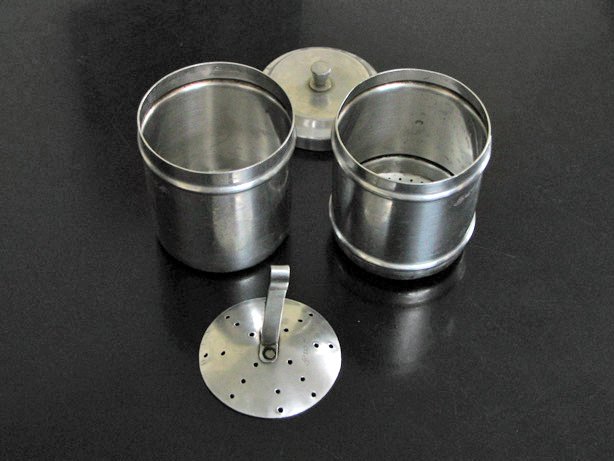
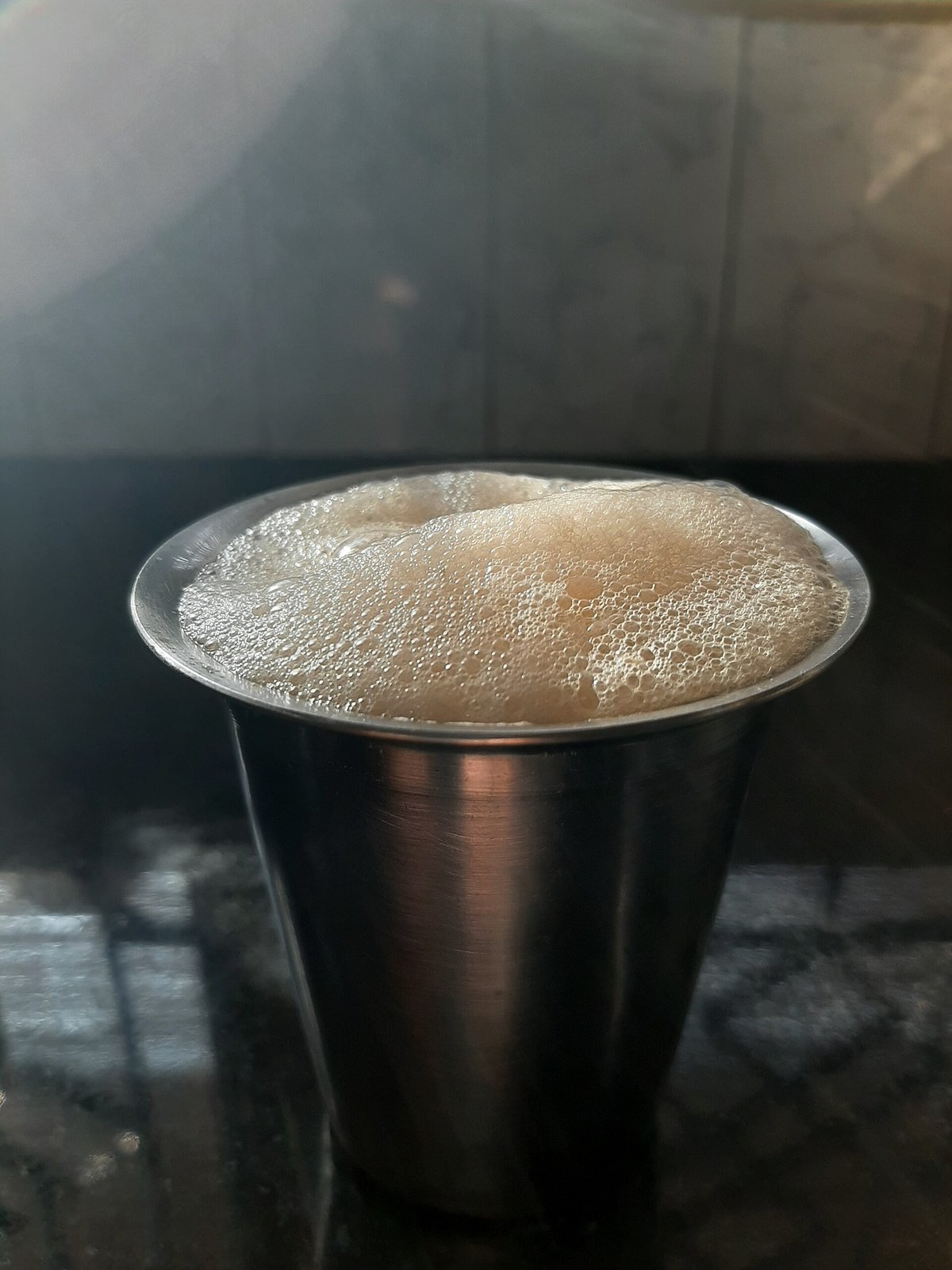
South India. Filter coffee (filter kaapi) in Tamil Nadu and Karnataka is usually a coffee-and-chicory blend, dripped slowly through a two-part steel filter into a thick decoction, then mixed with hot milk and sugar and poured back and forth between a tumbler and a bowl (dabarah) until it foams. India’s food regulator, FSSAI, requires a “coffee-chicory mixture” to contain at least 51% coffee, both roasted and ground separately; the most common blend is 80:20, with 70:30 and 60:40 also sold (Harshitha and others, 2025). The Additions page describes the pour.
Belgium and northern France. The chicory heartland. Roasted chicory is sold on its own, in granules and as liquid extract, and drunk as a hot drink with milk, as well as blended into coffee. Europe’s 1999 directive sets standards for “chicory extract,” “soluble chicory” and “instant chicory” as products in their own right.
Germany and Central Europe. Zichorienkaffee and grain-and-chicory blends, the old wartime substitutes, are still sold as caffeine-free coffee alternatives.
Corrections to common claims
More, beyond chicory, are on Coffee Myths and Corrections.
| The claim | What the record shows |
|---|---|
| ”Napoleon invented chicory coffee.” | It was made in the Netherlands and Germany decades before his 1806 blockade. The blockade made it widespread in France. |
| ”New Orleans has always drunk chicory coffee.” | Its classic cookbooks of 1885 and 1901 call for Java and Mocha with no chicory. |
| ”The Civil War is why New Orleans drinks chicory.” | Possible, not proven. Chicory coffee was remembered as a Confederate drink, but no New Orleans source from the war years shows the city adopting it. |
| ”Chicory is the root of endive lettuce.” | The same species, but a different crop: coffee chicory is a root variety, and European law excludes roots used for growing Belgian endive. |
| ”Chicory coffee is a kind of coffee.” | It is a roasted root with no caffeine. A blend is coffee plus chicory. |
| ”Chicory makes coffee stronger.” | Darker and heavier, yes. Stronger in caffeine, no: it lowers it. |
Sources
- The Picayune Creole Cook Book, fifth edition (New Orleans: The Times-Picayune, 1916; first published 1901), chapter I, “Creole Coffee,” Internet Archive.
- Lafcadio Hearn, La Cuisine Créole (New York: Coleman, 1885), “Coffee.”
- Library of Congress, Chronicling America: New Orleans Daily Crescent, 31 August 1852 and 5 May 1853; Daily Crescent, 22 March 1851; Bossier Banner, 8 July 1859; New Orleans Bulletin, 30 June 1874, 27 April 1875 and 28 July 1875.
- European Union, Directive 1999/4/EC (coffee extracts and chicory extracts); Regulation 2017/2158 (acrylamide benchmark levels).
- Harshitha and others, Coffee and chicory blend: properties, nutrition, and health implications, Journal of Food Science and Technology, 2025.
- USDA, FoodData Central: instant coffee powder; instant coffee with chicory, powder.
- Wikipedia (German), Zichorienkaffee; Wikipedia (French), Chicorée (boisson).
- Café du Monde, History, Frequently asked questions, Coffee and Chicory.
- French Market Coffee, Since 1890.
- Community Coffee, Our story.
Comments (0)