Coffee · 13 of 64
Coffee Beer and Coffee Stouts, from Grand Rapids to the Homebrew Keg
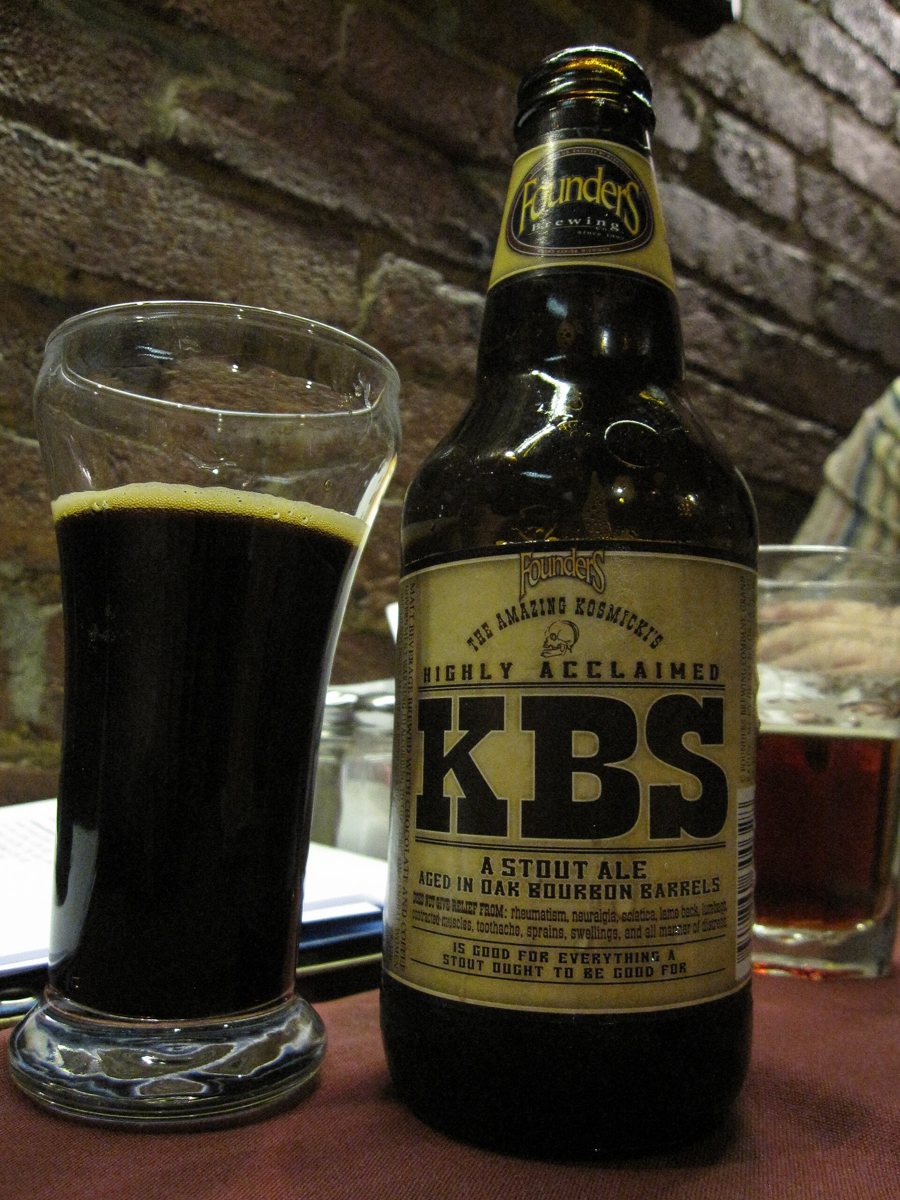
Roasted malt and roasted coffee share a great deal: both are browned by the same reactions, and both taste of chocolate, toast and bitterness. So stout and porter, the dark, roasty beers, were the obvious place for American craft brewers to add coffee when they started doing it in the 1990s. Coffee beers are now common, and one of the most famous, Founders’ Kentucky Breakfast Stout, comes from Grand Rapids.
Rhode Island’s coffee-syrup beer, Narragansett’s Coffee Milk Stout, is on Coffee Milk and Coffee Syrup; coffee in spirits is on Coffee Liqueurs, Irish Coffee and Coffee Cocktails.
The short version
| Question | Answer |
|---|---|
| When did coffee beer start? | In 1990s American craft brewing. The earliest well-dated one found is Redhook’s Double Black Stout (1995), made with Starbucks coffee; Dogfish Head’s Chicory Stout dates from its pub’s opening the same year; the claim that New Glarus made one in 1994 has no dated record behind it. |
| Michigan’s famous one? | Founders Breakfast Stout (by 2001) and its bourbon-barrel version KBS (on draft around 2003), Grand Rapids. |
| How is the coffee added? | In the hot side (mash or boil), as whole beans steeped in the finished beer, or as cold-brewed or hot-brewed coffee blended in before packaging. |
| How much coffee? | Roughly 7 to 11 grams of coffee per litre of beer in the examples here. |
| How much caffeine? | Usually little: brewers’ own figures run 2.7 to 7.5 mg per 12 oz, against about 95 mg in an 8 oz cup of coffee. Labels rarely say. |
| Is it legal? | Yes. The FDA’s 2010 action against caffeinated malt drinks was about added caffeine and expressly not coffee; US brewers may add real coffee without filing a formula. |
How it began
The 1990s. The best-documented early coffee beer is Redhook Double Black Stout, “a joint venture with Starbucks”, introduced in 1995 and discontinued in 2000, later revived without Starbucks (Jeff Alworth, Beervana, 2008); in 1999 Redhook even sold a Doubleblack barbecue sauce made with the stout and Starbucks coffee (Funding Universe). An unsigned beer-news article credits Dan and Deborah Carey of New Glarus Brewing, Wisconsin, with “the first … commercial coffee beer” in 1994, but names no beer and gives no source, and “first ever” is not provable (inside.beer).
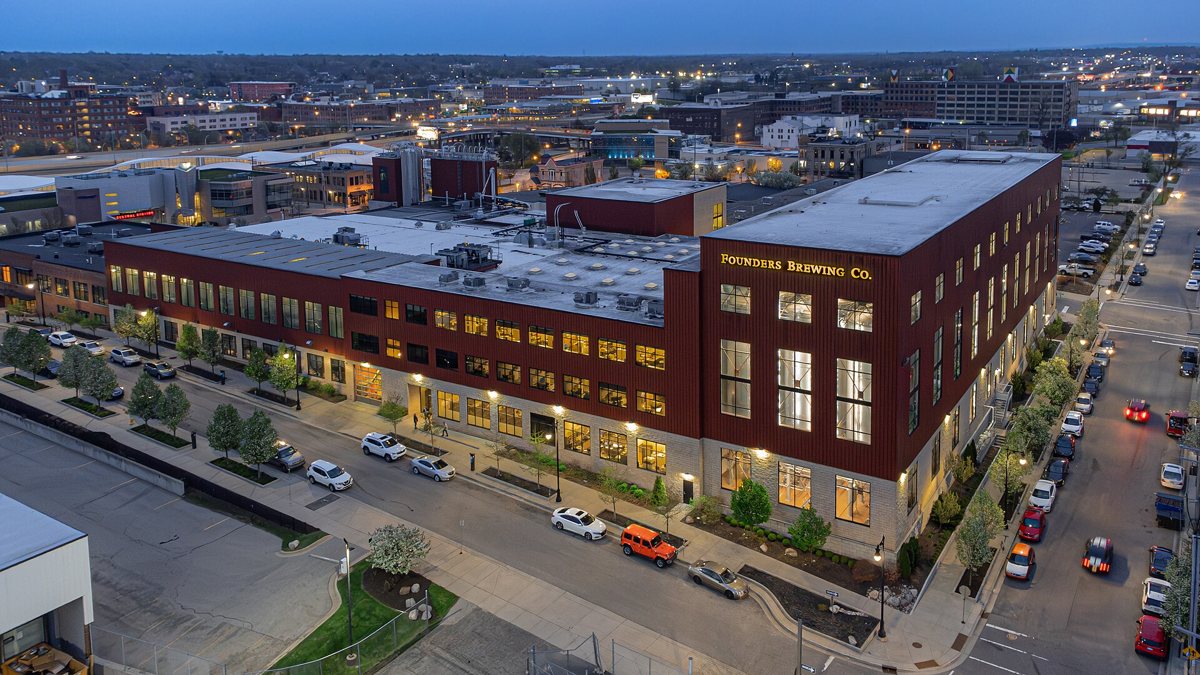
Grand Rapids. Founders Brewing Co. opened in Grand Rapids in 1997 and is now majority-owned by the Spanish brewer Mahou San Miguel (Wikipedia). In its own history of KBS it says that in 2001, in a rented space in the Brassworks building downtown, it was already brewing Breakfast Stout when a friend offered some bourbon barrels: “Let’s throw some Breakfast Stout in ‘em and see how it turns out.” An “imperialized” version went into the barrels, and “we put Kentucky Breakfast Stout on draft in our taproom – this must’ve been around 2003.” By 2006 it was a “unicorn” on the beer forums, and its yearly release, “always … during the ides of March”, drew lines around the Grandville Avenue taproom by 2010 (Founders, 2018).
Breakfast Stout today is a year-round 8.3% stout with flaked oats and chocolate malt and “two types of coffee”, described as tasting of “roasted coffee, chocolate, and caramelized sugar, with low bitterness” (Founders).
Elsewhere in Michigan. Short’s Brewing of Bellaire makes Cup of Joe, a coffee milk stout with coffee from Higher Grounds Trading Co. of Traverse City: about 80 lb of ground coffee in a batch, scattered “throughout the brewing process”, roughly 1.5 oz per gallon (Sprudge, 2017).
How brewers add the coffee
There is no standard; each point gives a different result.
| When | How | What it gives |
|---|---|---|
| Mash or boil | Ground coffee in the hot wort | The least coffee aroma and, by brewers’ accounts, the least caffeine |
| ”Dry-beaning” | Whole or cracked beans in a mesh bag in the finished beer, pulled after hours or a few days, by taste | Strong coffee aroma; bitterness rises the longer the beans stay |
| Cold brew at packaging | Cold-brewed coffee blended into the finished beer | Smooth coffee flavour, easy to dose by taste; carries more caffeine |
| Hot coffee at packaging | Brewed coffee, cooled, blended in | Similar to cold brew in practice (see below) |
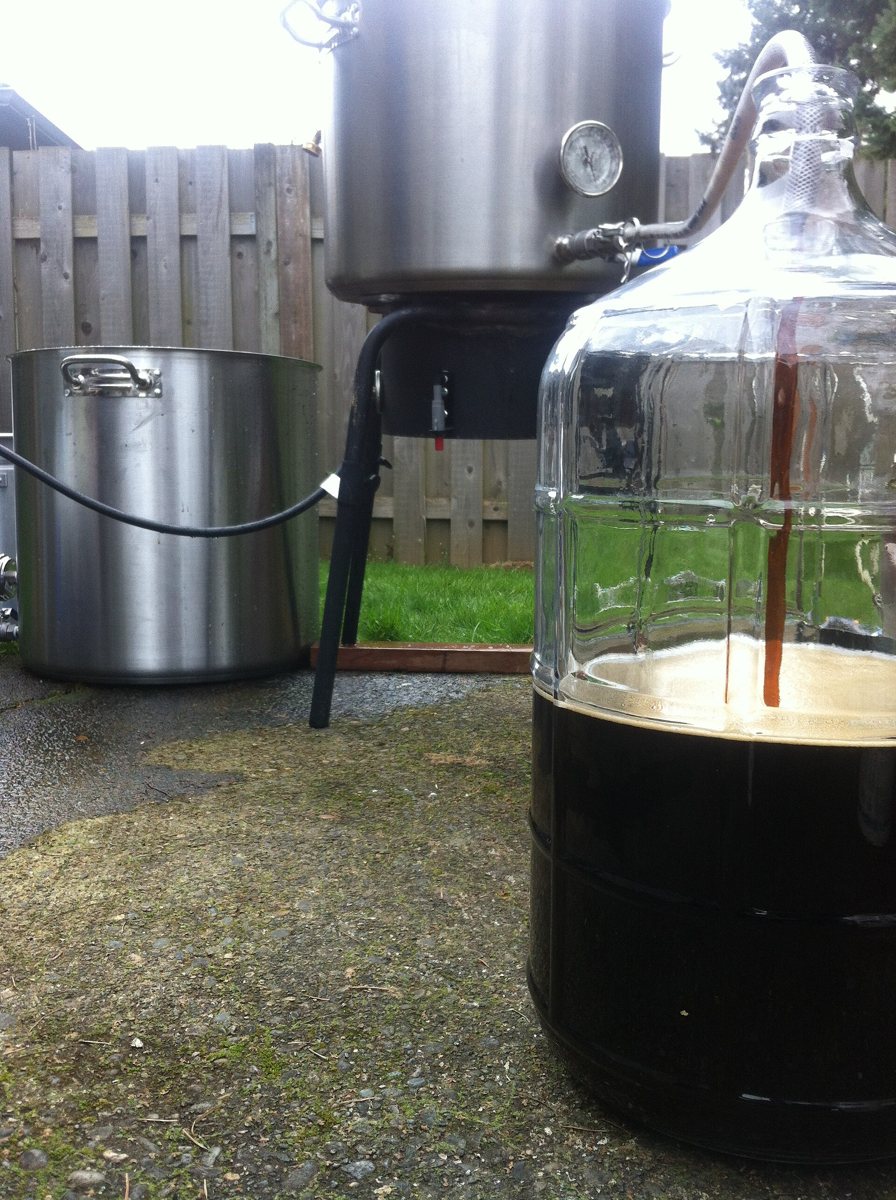
Hot or cold? The homebrew test site Brulosophy tried it in 2020: cold brew made with 170 g of coffee in 887 mL of water against the same coffee made hot, each added to half of a stout in the keg. In ten triangle tests the brewer picked the odd beer only twice, no better than chance (Brulosophy, 2020). One taster is not proof, but it suggests the choice matters less than homebrew lore says.
How much. Brulosophy’s dose works out to about 7.7 g of coffee per litre of beer; Short’s 1.5 oz per gallon is about 11 g per litre. For comparison, a cup of filter coffee is about 60 g per litre (Ratios), so a coffee stout has roughly a sixth of a cup’s coffee in it, spread through a beer that already tastes of roast. Recipe: Cold-Brew Coffee Addition for a Homebrewed Stout.
How much caffeine
Less than most people expect. In 2019 brewers told The Takeout that Harpoon’s Dunkin’ Coffee Porter carries 2.7 mg of caffeine per 12 oz and Boulevard’s Steep Drop nitro coffee milk stout 7.5 mg; coffee added on the hot side gives less than cold brew blended in (The Takeout, 2019). An 8 oz cup of brewed coffee has about 95 mg (Caffeine and Health). The range across all coffee beers is wide. A 2025 conference abstract, “Caffeine Characterization in Coffee Stouts” (AIChE Annual Meeting), measured 21 store-bought coffee stouts by HPLC and found “from 0 mg to 40+ mg per 12 oz serving”, clustered at the two ends; in its own test brews caffeine rose with the amount of coffee added, and beans cracked before steeping gave the most. US beer labels are not required to state caffeine.
Caffeine does not make anyone more sober; the cautions on alcohol and caffeine apply here too, though a coffee beer carries far less caffeine than an espresso martini.
The law
The FDA. On 17 November 2010 the FDA sent warning letters to four makers of caffeinated malt drinks, including Four Loko and Joose, saying the added caffeine in them had not been shown to be safe. Its own questions and answers drew the line at coffee: “These Warning Letters are not directed at alcoholic beverages that only contain caffeine as a natural constituent of one or more of their ingredients, such as a coffee flavoring. The alcoholic beverages that are the subject of FDA’s Warning Letters are malt beverages to which the manufacturer has directly added caffeine as a separate ingredient” (FDA, archived 2011). A coffee stout, whose caffeine comes in with the coffee, is outside that action.
The TTB. US breweries must file a formula with the Alcohol and Tobacco Tax and Trade Bureau for beers made with unusual ingredients, but TTB Ruling 2015-1 lists ingredients exempt from that rule, and coffee is one: “Coffee beans, coffee grounds, or coffee brewed with water. Does not include extracts, essential oils, or syrups” (TTB, list revised 2024; Ruling 2015-1). So a brewery may add real coffee freely; a coffee extract or syrup needs approval. Chicory, chocolate and cocoa are on the same list.
At home. Brewing beer at home for personal use is legal in the US; distilling is not (Coffee Liqueurs).
What is not known
- The first commercial coffee beer. Redhook 1995 is the best-dated, with Dogfish Head’s Chicory Stout from the same year (Dogfish Head). New Glarus’s Coffee Stout is often dated 1994, and said to have been halted by the ATF over caffeine, but both rest on uncited magazine lines (Gear Patrol, 2016).
- When Founders first brewed Breakfast Stout; its own history says only that it existed by 2001.
- Which stouts the 2025 survey tested, and who made it: only its abstract is published, and it names no brands.
Sources
- Founders Brewing Co., A brief history of KBS (2018) and Breakfast Stout.
- Wikipedia, Founders Brewing Company.
- Jeff Alworth, Redhook Double Black, Beervana (2008); Funding Universe, Redhook Ale Brewery history.
- inside.beer, The world joins the trend with coffee beer (2016).
- Sprudge, Cup of Joe by Short’s Brewing Company (2017).
- Brulosophy, Brewing with coffee: hot vs. cold brew in stout (2020).
- The Takeout, How much caffeine is in coffee beers? (2019).
- FDA, Questions and answers on caffeinated alcoholic beverages (2010, archived).
- TTB, Ruling 2015-1 and Attachment 1.
Comments (0)