Brewing
Every way of making coffee humans have invented — the paper cone, the stovetop pot, the glass globe with a flame under it, the metal filter perched on a glass in Hanoi — is the same job wearing different clothes. Hot water meets ground coffee, dissolves some of it, carries it away. Everything else is engineering: how fine you grind, how hot the water is, how long they stay together, how much water per gram, how much you stir, and what’s in the water before it ever touches the bean. Understand those six levers and every method here stops being a ritual you memorize and becomes a machine you can drive. Espresso is its own beast and gets its own page at Espresso; brewing at volume, as a business, is over in the coffee program. Everything else, we do properly here.
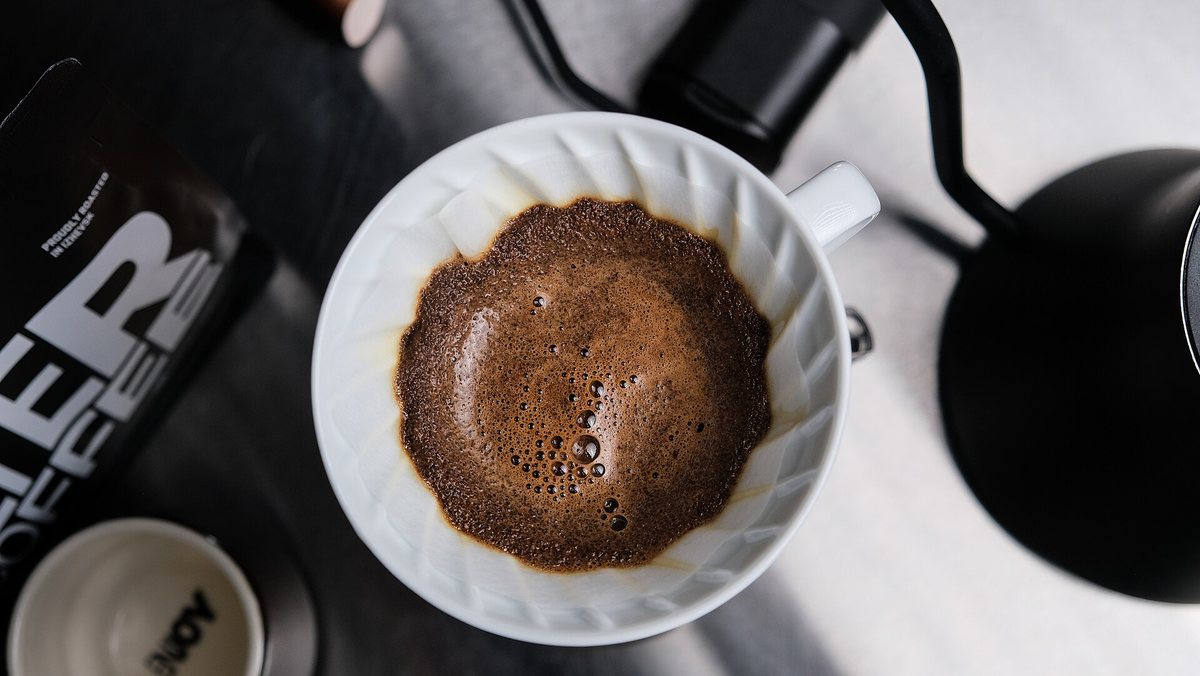
Brewing is extraction, and extraction has a sweet spot
A roasted bean is only about 30% water-soluble; the rest is cellulose that never leaves the filter. Of that 30%, the compounds come out in order, and that order is the whole drama. Acids and fruit first — small, light molecules water grabs fast. Then sugars, caramels, body. Last and slowest, bitterness and drying tannins.
So under-extracted coffee — stopped too early, ground too coarse, water too cool — tastes sour, thin, oddly salty, with a hollow finish: all front-end acid, no sugar behind it. People misread this constantly as “too strong” or “bad beans.” It’s neither; you didn’t finish the job. Over-extracted — too long, too fine, too hot — tastes bitter and astringent, drying your tongue like an over-steeped tea bag. Right is the window between: the acids and all the sugar, stopped just before the bitterness. The number on it is extraction yield: roughly 18–22% of the coffee’s mass dissolved into the cup. That’s the SCA’s brewing-control work — a very good map, not a law, since roast level changes how fast the bitter end arrives.
TDS vs. extraction yield, because these get confused. Yield is how much you took out of the beans. TDS (total dissolved solids) is how concentrated the liquid is — filter coffee lands around 1.15–1.45%. Add a splash of water to a perfect brew: the yield hasn’t moved at all, but TDS drops and it tastes weak. Strength is TDS; sour and bitter are extraction. Separate dials — which is why “it’s weak, brew it longer” is such a common and wrong instinct. Weak but balanced → more coffee. Sour or bitter → fix the grind. And no, you don’t need a refractometer; it’s for holding a café’s batch brewer identical every day. Sour → finer. Bitter → coarser. That’s 90% of the science, free, right now.
The six levers
Grind sets surface area — finer extracts faster. Biggest lever; turn it first. Time is the other half of that equation: a 4-minute press and a 30-second espresso land in similar places because their grinds differ enormously.
Temperature: about 90–96°C (195–205°F), roughly the SCA’s guidance. Below ~90°C you can’t get sweetness out and everything skews sour; at a hard boil you scald. Boil, then wait — an open kettle drops into range in about 30 seconds. Honest exception: immersion forgives, and boiling water in a French press isn’t the crime it’s made out to be, since the slurry sheds heat fast.
Ratio — the golden ratio for filter is 1:15 to 1:18, one gram of coffee per 15–18 grams of water. 1:15 is strong and syrupy, 1:18 lighter and tea-like. Start at 1:16. And buy a scale: it costs less than a bag of good beans, and scoops are a lie — light and dark roast differ in density enough to matter.
Agitation — stirring, pour turbulence, the plunge — speeds extraction by moving fresh water against grounds. It’s the lever nobody tracks and everybody unknowingly changes.
Water chemistry, which matters more than people think. Coffee is 98–99% water, so it’s strange we spend $20 on beans and brew them with whatever comes out of the wall — and the dissolved minerals are what actually grab flavor off the coffee. Distilled and RO water make bad coffee: with nothing to bind to, water extracts poorly and the cup tastes flat and dead. Very hard water is also bad — it over-extracts, muddies, buffers away the brightness, and deposits scale in everything heated. Target roughly 50–150 ppm TDS with modest alkalinity, around where the SCA’s water guidance sits: moderate minerals, low alkalinity, no chlorine. If your coffee is dull no matter what beans you buy, this is the variable you haven’t checked.
Grind matters most
If you take one action from this page: buy a burr grinder.
A blade grinder is not a grinder. It’s a spice chopper with coffee in it — it smashes beans at random until you stop it, producing dust and boulders in the same batch. That’s fatal rather than sloppy: the dust over-extracts instantly while the boulders barely extract, in the same cup, so you get bitter and sour simultaneously and no adjustment fixes it — the problem isn’t the setting, it’s the distribution. Keep it for spices.
A burr grinder crushes beans between two surfaces a fixed distance apart, so particles come out at a size you chose. Uniform particles extract at the same rate, and that’s what makes coffee taste clean and makes your adjustments mean anything. A modest steel hand grinder beats an expensive brewer fed by a blade grinder. Spend on the grinder before the brewer — the argument I make in full on Espresso.
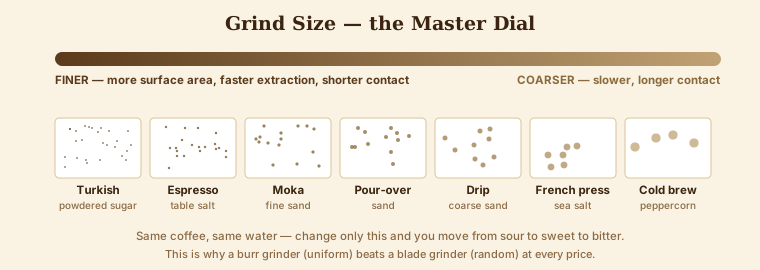
| Grind | Feels like | Method | Contact time |
|---|---|---|---|
| Extra fine | Powdered sugar | Turkish / ibrik | Boiled, ~3 min |
| Fine | Table salt | Espresso | 25–30 s |
| Fine-medium | Salt-to-sand | Moka, AeroPress | 1–3 min |
| Medium-fine | Fine sand | V60, Kalita, Chemex | 2:30–4:30 |
| Medium | Beach sand | Automatic drip | 4–6 min |
| Coarse | Coarse sea salt | French press, percolator | 4 min / varies |
| Extra coarse | Cracked peppercorn | Cold brew | 12–24 h |
Notice the pattern down that table: coarser grind, longer contact time. Always trading.
Immersion vs. percolation
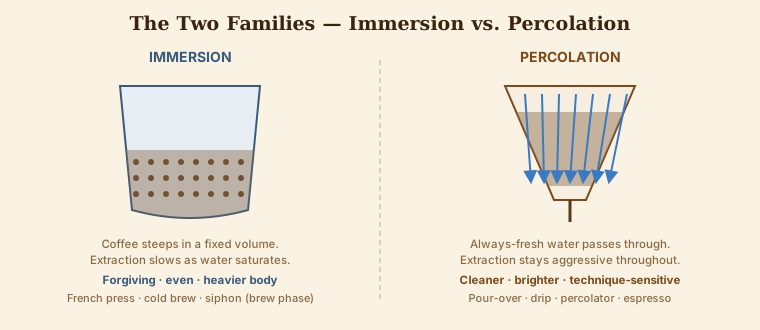
Immersion — French press, cold brew, a siphon’s steep — means coffee sits in a fixed body of water. Every particle sees the same water for the same time, and as that water saturates, extraction slows itself down. That self-limiting is why immersion forgives: an extra 30 seconds in a press does far less damage than 30 seconds in a V60. The trade is a lower ceiling and a heavier body.
Percolation — pour-over, drip, espresso — means fresh water flows through the bed and leaves. Arriving water is always unsaturated, so extraction never slows; it stays aggressive to the last drop. Higher ceiling, cleaner cup, no mercy — nothing self-limits, so grind and technique matter enormously. Hybrids are where the fun is: AeroPress steeps then presses, a siphon steeps then filters, moka percolates under pressure.
Pour-over
Percolation by hand: the most controllable, most rewarding, most punishing way to make one cup. You are the pump.
The bloom. Pour just enough to wet the grounds — about twice the coffee’s weight, 44 g on 22 g — and wait 30–45 seconds. The bed swells and hisses: that’s carbon dioxide from roasting escaping, and it matters because CO₂ physically repels water. A gassy bed pushes water away and channels around itself; bloom first and the rest of the pour meets a wetted, settled bed. Fresh coffee blooms dramatically, stale coffee barely moves — a free freshness test every morning (the same degassing clock that means beans want a few days off the roast; see Roasting).
Off the boil, because boiling water scalds and hurries the bitter end — kill the kettle and wait ~30 seconds. A gooseneck kettle is worth buying immediately: the narrow spout places water precisely instead of glugging craters into the bed. Pulse pour in gentle spirals from the center out, and stay off the paper — water running down the filter wall bypasses the coffee entirely.
The cones are not interchangeable.
Hario V60 — a 60° cone, spiral ribs, one big hole, barely restricting flow at all, so grind and pour rate control everything. That’s the appeal (total control, brilliant clarity) and the problem (it punishes a sloppy pour or a bad grinder). A scalpel.
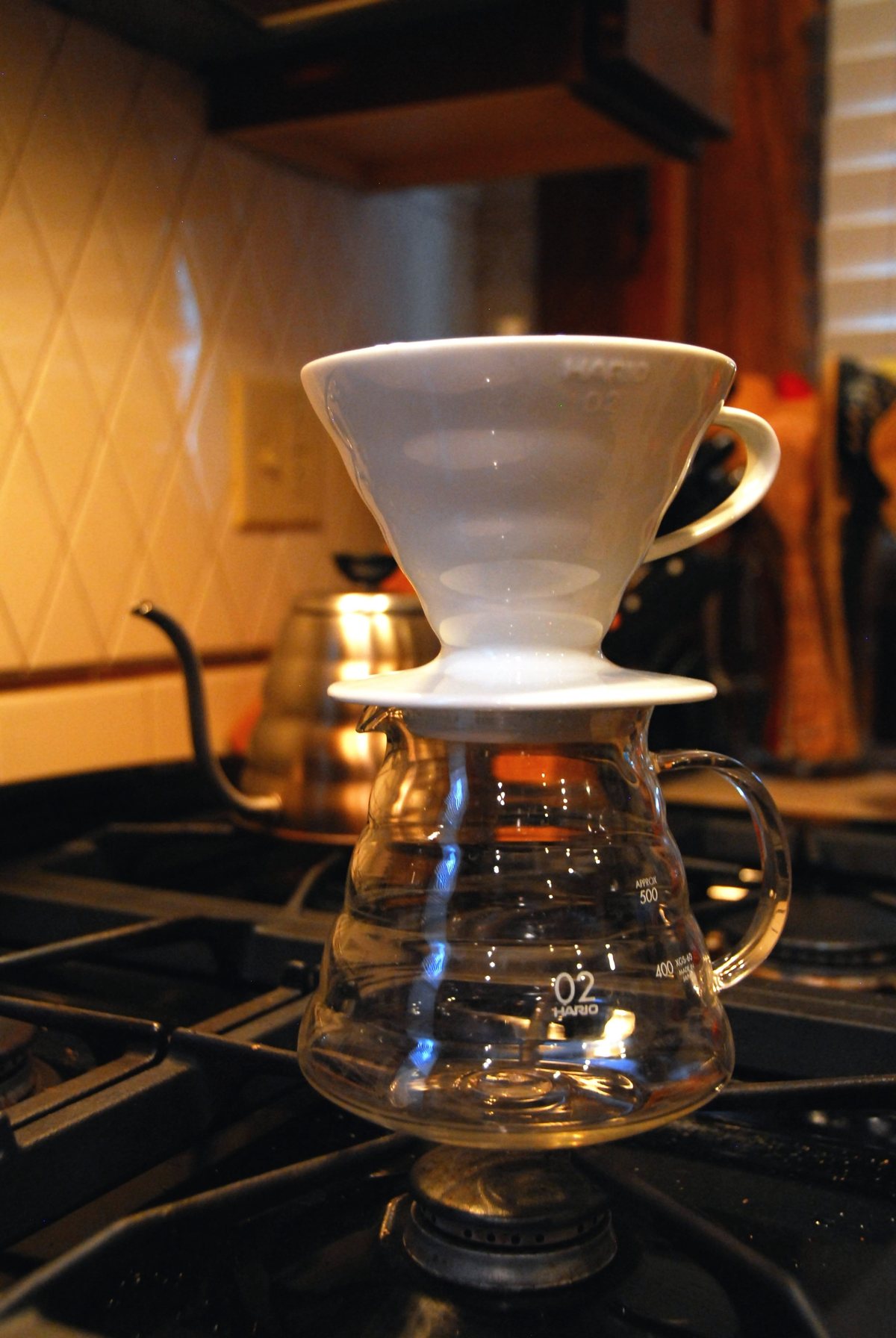
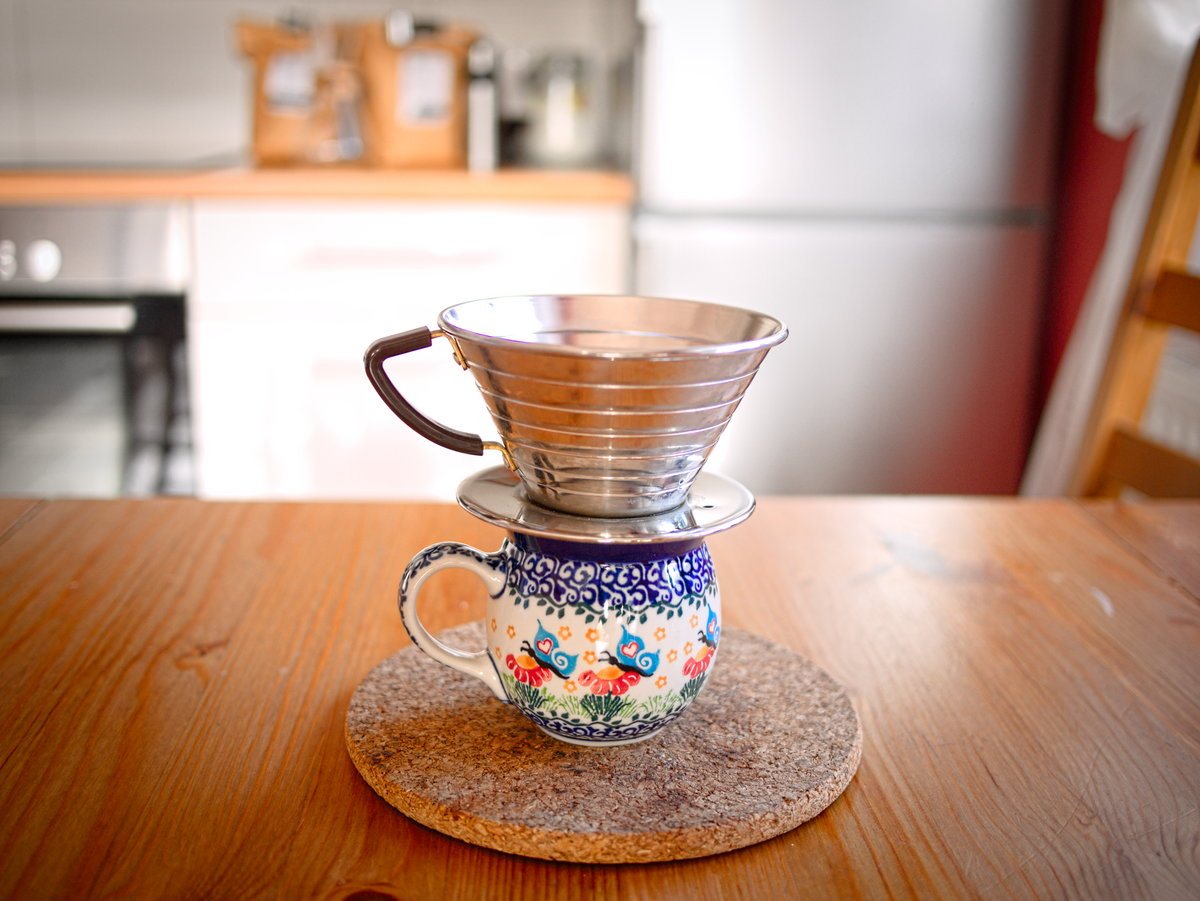
Kalita Wave — flat bottom, three small holes. The flat bed extracts more evenly and the restricted holes make the brewer do some flow-rate work instead of leaving it all to you. Meaningfully more forgiving, and my pick for a first pour-over.
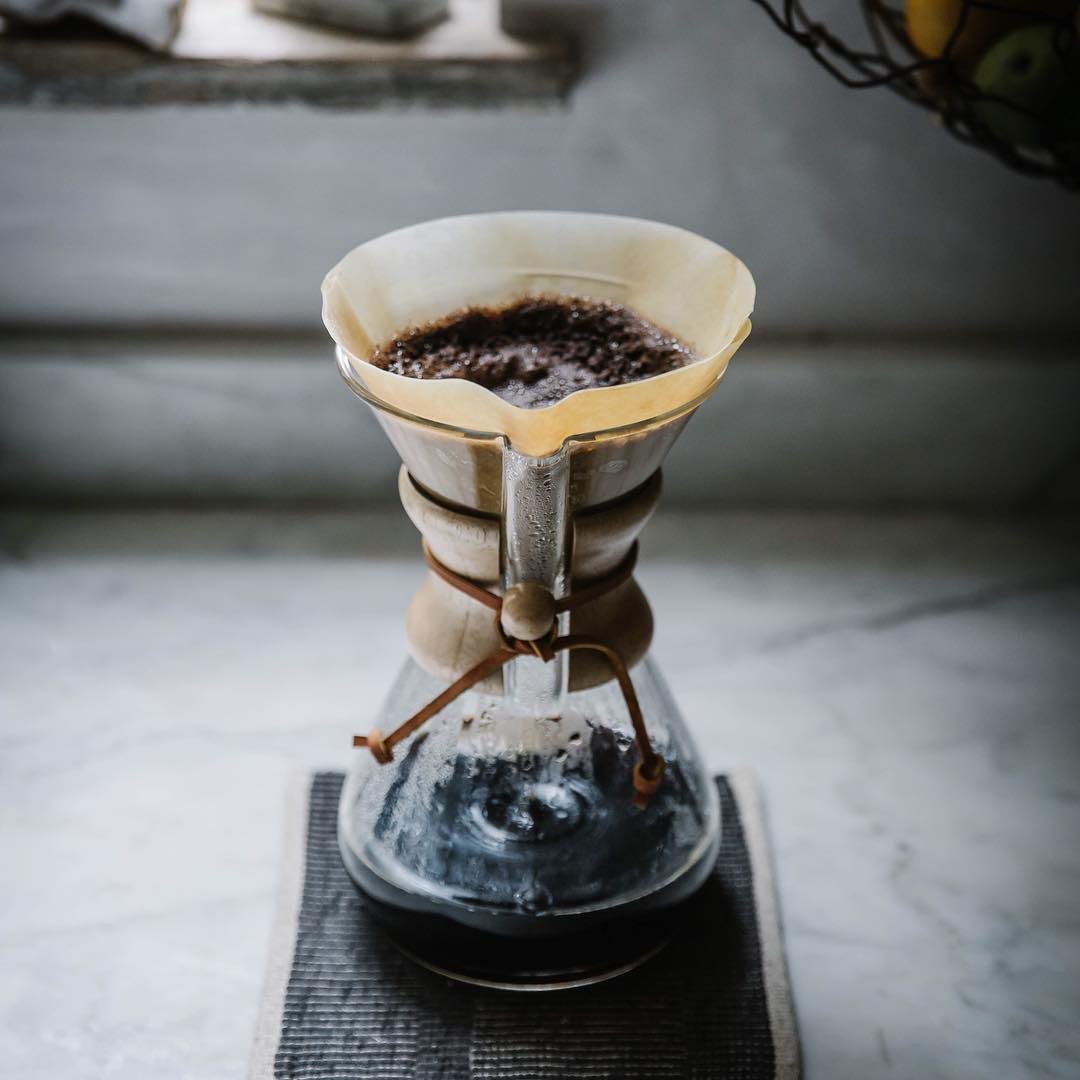
Chemex — the glass hourglass, and the trick is the filter: roughly 20–30% thicker than standard paper, trapping oils and fines. Extremely clean and bright, no sediment, no body — you trade richness for clarity. Flows slowly, so grind coarser than a V60.
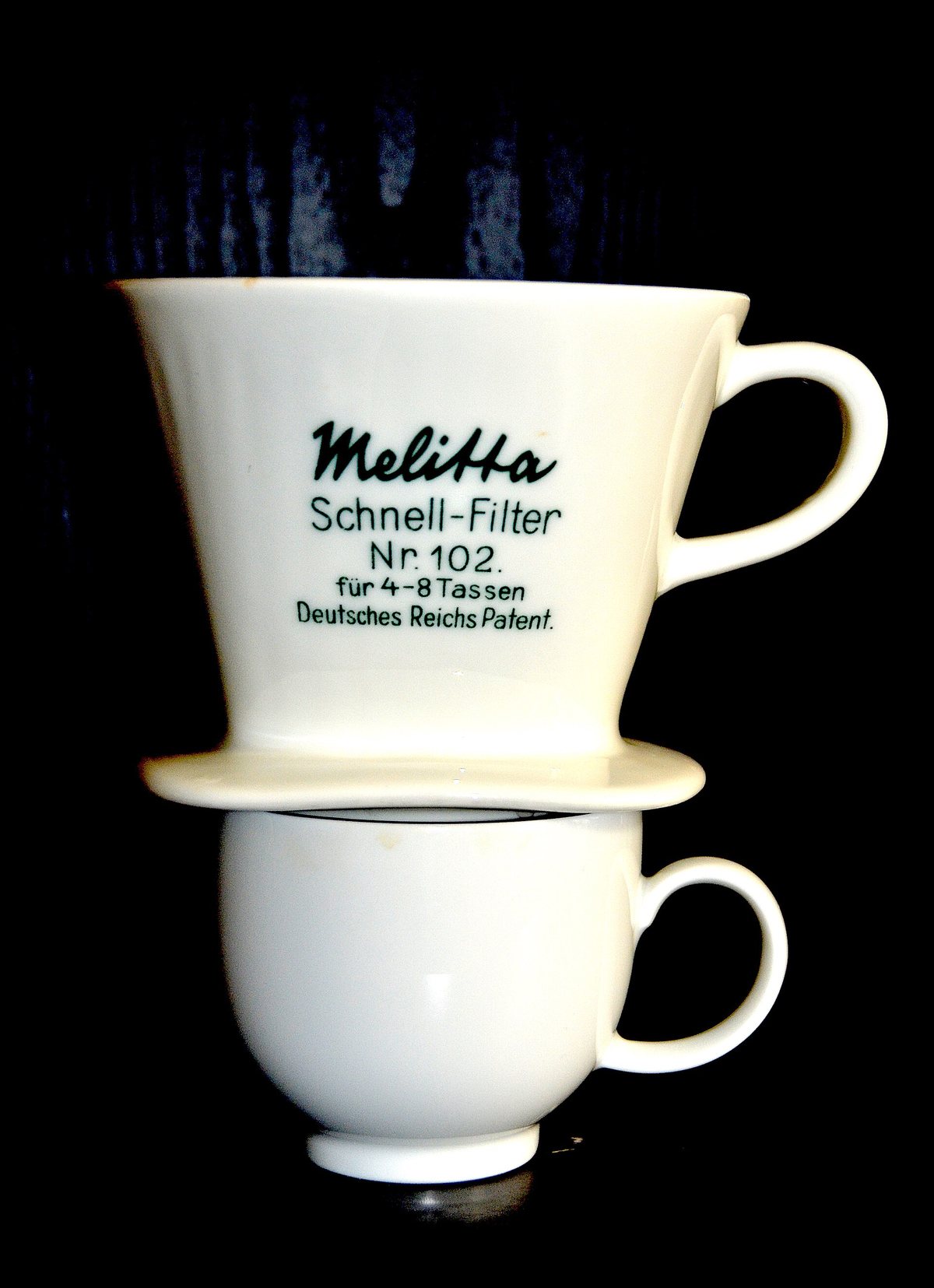
Melitta — the original, patented by Melitta Bentz in 1908 when she punched holes in a brass pot and lined it with blotting paper. Restricted, forgiving, cheap, unfashionable, completely fine.
A recipe that works. 22 g coffee, medium-fine, 360 g water at ~94°C (1:16.4). Rinse the paper and dump that water. Bloom with 45 g, wait 40 s. Pour to 150 g in slow spirals, let it drop; to 250 g, let it drop; to 360 g. ~3:00 on a V60, 3:30–4:00 on a Kalita or Chemex. Fast and sour → finer. Slow and bitter → coarser. One thing at a time.
Automatic drip
The workhorse — the coffee most of America actually drinks, brewed while we’re in the shower. I’m not going to sneer at it; I’m going to tell you why yours is bad. An element boils a slug of water, which rises through a tube and is distributed over a bed of medium grounds: percolation, automated.
Cheap machines fail in two ways. They never get hot enough — a $30 machine typically delivers water in the 80s °C (170s °F), so it can’t extract sugars, the result is thin and sour, and then it sits on a hot plate turning bitter on top of that. That is the flavor most people think coffee just has. And they dump instead of shower, dribbling from one hole onto one spot, which craters and over-extracts while the perimeter stays dry.
The fix is the SCA-certified list — the Specialty Coffee Association tests home brewers on brew temperature, contact time, and evenness, and publishes what passes. Short list, starts around $150–200, and it’s the highest-leverage decision in drip coffee: you are buying a heater that works and a showerhead. On baskets, flat-bottom spreads a shallow, even bed and is more forgiving; cone concentrates it deeper and is fussier.
And the carafe ruins it. A glass carafe on a hot plate keeps cooking the coffee, driving off aromatics and building bitterness — stewed within 20–30 minutes. That burnt-office-coffee smell isn’t the beans, it’s the hot plate. A thermal carafe holds it hot with no applied heat for an hour.
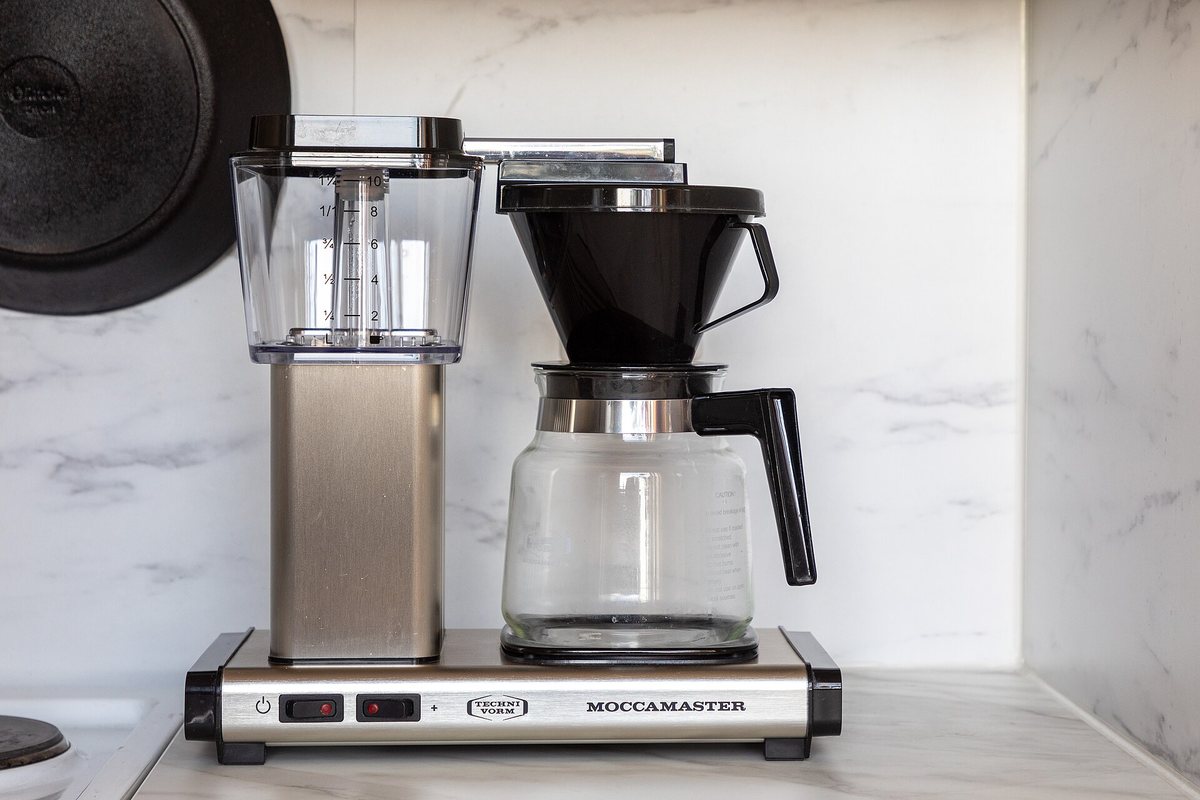
Made well — good beans, medium grind, 1:16, a machine that hits temperature, a thermal carafe — drip is genuinely excellent and it makes ten cups. It’s also the right coffee for cooking: my coffee steak marinade wants plain brewed American drip, not a $22 single-origin geisha, and there’s no shame in that at all. See cooking with coffee.
Percolator
Now the one everybody has an opinion about. Let’s be accurate, then let’s be fair.
The mechanism. A small chamber at the bottom, a vertical tube rising out of it, a basket of grounds near the top. Heat it; the bottom water boils; steam pressure forces a slug up the tube, where it sprays out and showers down over the grounds, drips through, and returns to the bottom chamber — to be heated and sent up again. That’s the perk you hear. And there’s the problem: it recirculates. After the first minute what’s going up that tube isn’t water, it’s coffee. The machine re-brews already-brewed coffee through the same grounds, over and over, while boiling it the whole time — both of the things we just established you shouldn’t do. Left alone it drives past the sweet spot and keeps going, which is why percolator coffee is remembered as bitter, and why automatic drip (Mr. Coffee landed in 1972) demolished it in a decade. Drip is the same idea with the recirculation removed. A stovetop percolator at least lets you control the heat; an electric perks until a thermostat trips, almost always longer than you’d want.
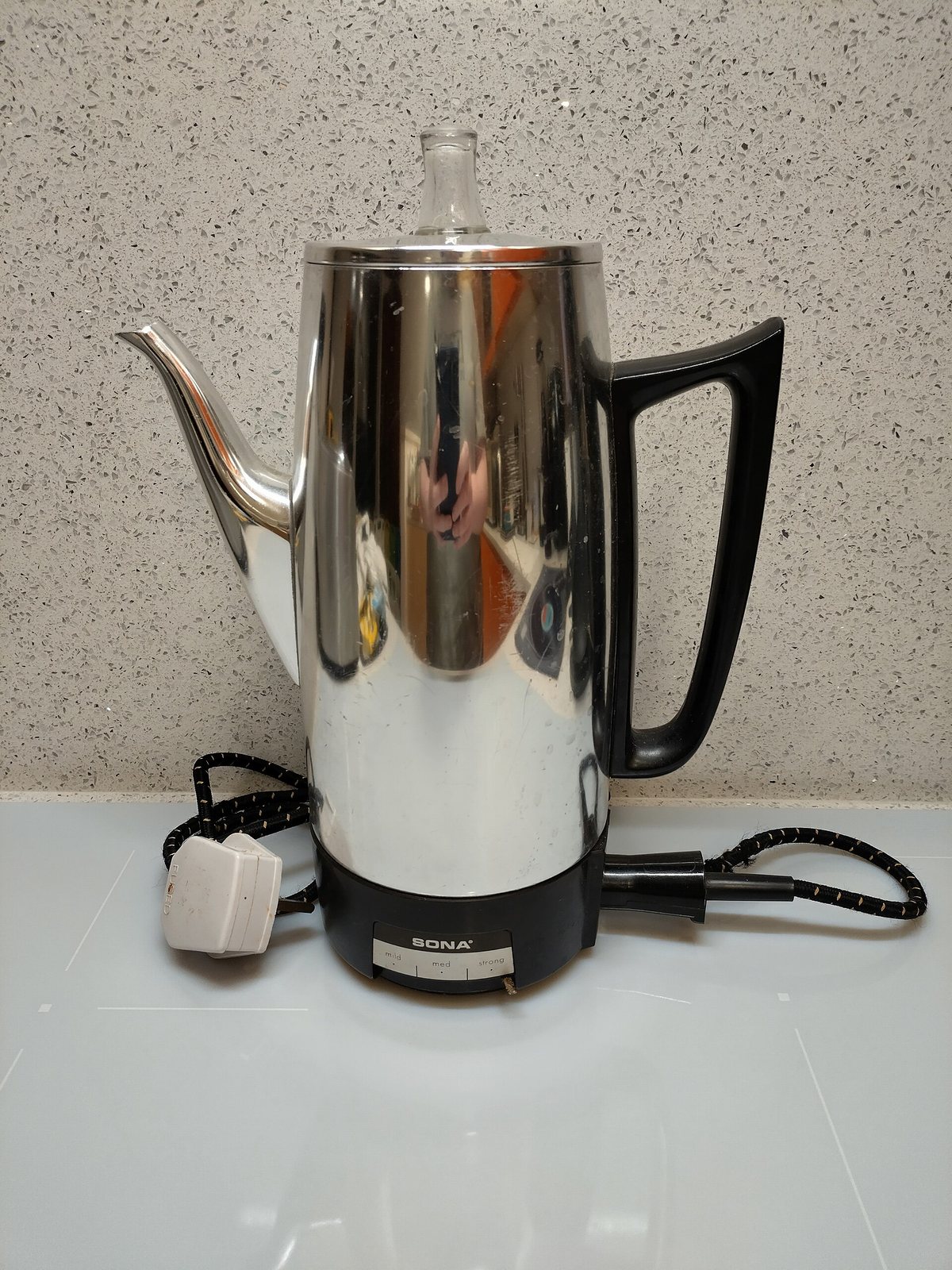
Now the fair part. It’s not a bad machine, it’s an unforgiving one that got handed to a nation that walked away from it. It does things nothing else does: twelve cups over a campfire, no filters, no power, no fragile parts. I’ll take a beat-up steel percolator over any cone-and-grinder ritual on a cold morning at a campsite and it isn’t close.
How to do it as well as it can be done: grind coarse, coarser than French press — fines fall through the basket and boil into sludge for the whole cycle. ~1:15; percolators are usually run far too strong. Start with hot water, so the pot isn’t extracting for minutes before it perks. Drop the heat the moment it starts perking, to the lowest setting that keeps it gently blooping — a percolator on high is a bitterness machine. And pull it at 5–7 minutes and watch it: it has no concept of finished and will happily perk to tar. That’s the whole ballgame — the percolator has no off switch, so you are the off switch.
French press
Full immersion, and the best coffee-per-dollar-of-equipment on earth: a glass cylinder and a mesh plunger for twenty bucks. Coarse grounds steep about 4 minutes, then a metal mesh presses them down — and that filter is the device’s entire personality. Paper traps oils and fines; metal lets them through. So the cup has body, the oils giving it a round, almost silky mouthfeel, and sediment, a fine silt in the last centimeter. If you love it that’s richness; if you hate it that’s mud. Both are legitimate.
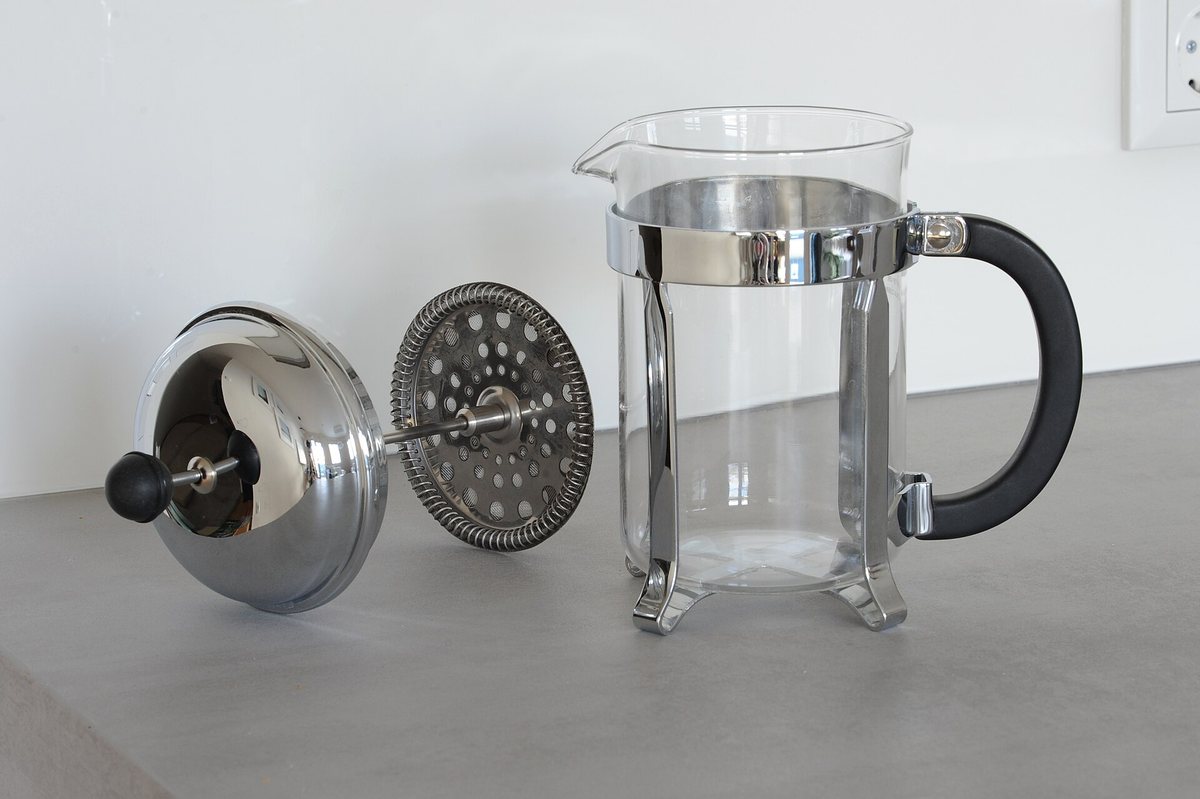
Method: ~1:15 (30 g coffee, 450 g water), coarse, water just off boil. At 4 minutes the grounds have formed a raft — break the crust with a spoon so it sinks, and skim the foam and floaters off and throw them out; that’s where the bitterness and most of the fines live. Then wait another 5 minutes before plunging. Yes, that’s a 9-minute brew, and it’s dramatically better: the fines sink, the plunge stays gentle, the cup is far cleaner. Plunge slowly, and decant immediately — coffee left on the grounds is bitter by cup two.
One honest health note. Unfiltered coffee — French press, boiled Turkish and Scandinavian methods, to a lesser degree moka and espresso — contains cafestol and kahweol, diterpenes a paper filter removes and a metal one doesn’t. Cafestol has been shown in controlled studies to raise LDL cholesterol, dose-dependently, over weeks. Not a reason to panic, and nobody should stop drinking French press over it. It’s a reason to know the paper filter is doing something — and if your doctor is watching your LDL and you drink five presses a day, that’s a lever you didn’t know you had.
Moka pot
The aluminum octagon on every stove in Italy — Bialetti’s Moka Express, 1933, essentially unchanged. Water in the bottom chamber, fine-medium grounds in a basket above it, a collection chamber on top. Heat the base; steam pressure pushes water up through the bed and out into the top. It is not espresso — roughly 1–2 bar against espresso’s ~9, so no real crema and a fundamentally different drink. What it makes is a small, strong, syrupy coffee that’s wonderful on its own terms; “stovetop espresso” just sets everyone up for disappointment. And the Italian reality is worth saying, because the specialty world has gotten precious about this pot: it’s a home object, not a bar object. The bar is where you get espresso, standing up, in ninety seconds. The moka is what’s on the stove at 7 a.m., and nobody is weighing anything.
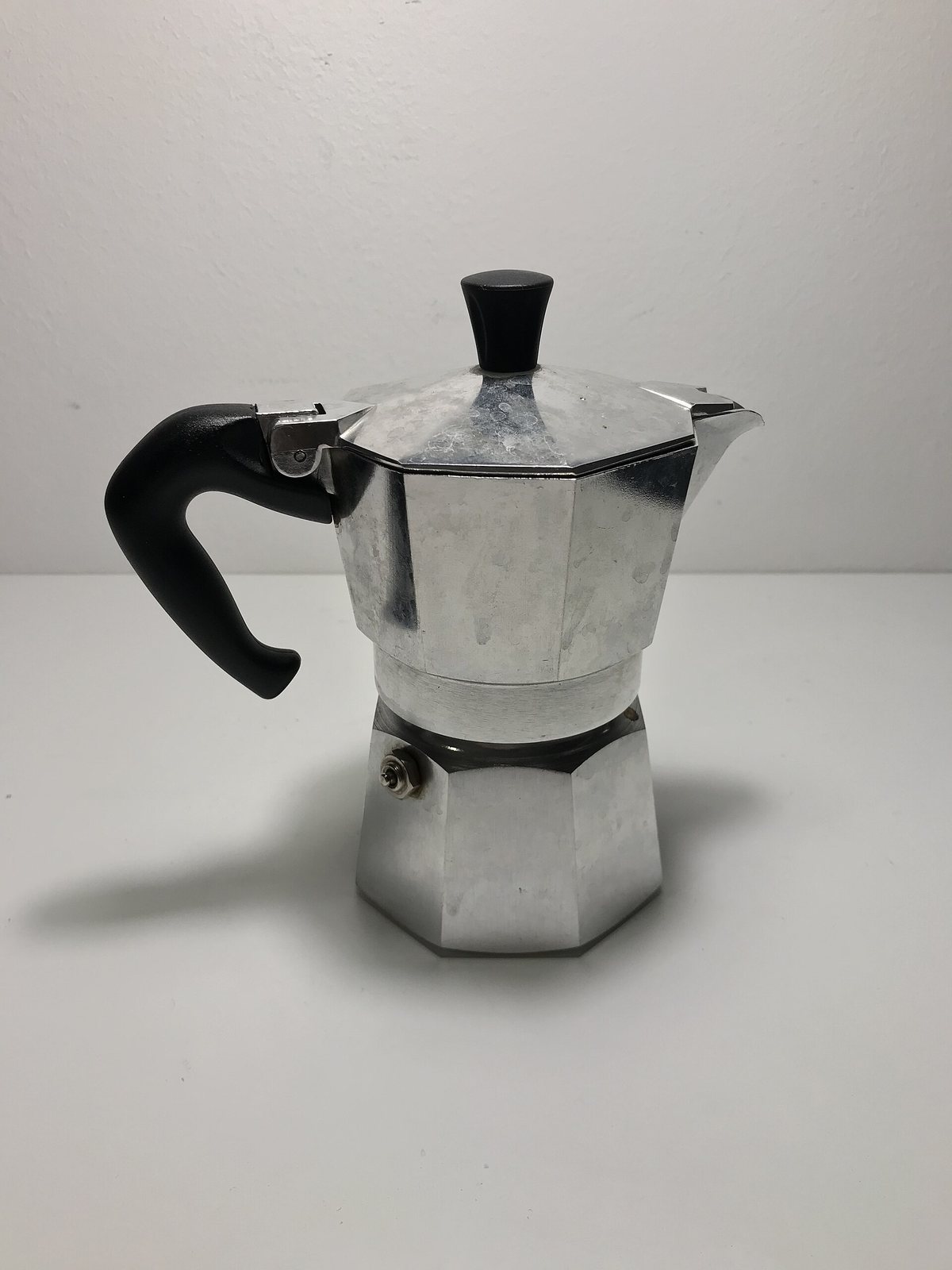
Technique that helps: fill the base with pre-boiled water, to the safety valve, no higher — the big one, because cold water means the whole assembly bakes on the flame for minutes with the coffee in it, and that’s the classic scorched, metallic moka taste. Fill the basket level and don’t tamp; a tamped basket chokes and can build genuinely unsafe pressure. Low heat, lid open. And pull it at the gurgle — when the smooth honey stream turns pale and spluttering, that’s steam breaking through behind the water. Kill the heat and run the base under cold water to stop it dead.
Vacuum / siphon
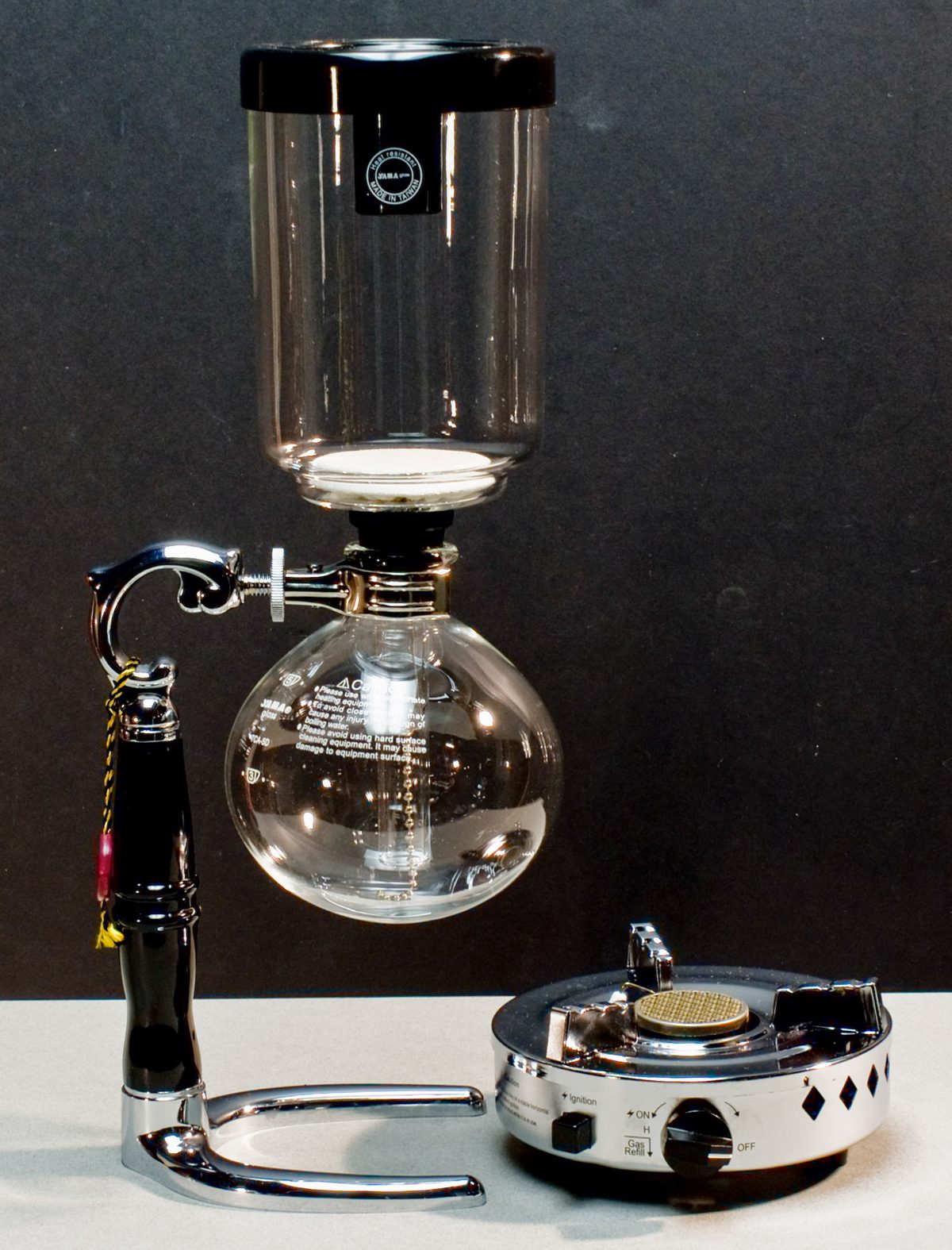
The most beautiful way to make coffee and — annoyingly for anyone wanting to dismiss it as theater — one of the best-tasting. Two glass globes stacked, a filter between. As the lower globe heats, vapor pressure pushes the water up the tube into the upper globe, where it meets the grounds — a full-immersion brew held at a stable temperature by the heat below. Then you remove the heat: the lower globe cools, the vapor condenses, pressure drops, and the resulting partial vacuum sucks the coffee back down through the filter, leaving a dome of spent grounds up top. Immersion and filtration, in sequence, by pressure alone.
That’s why it tastes the way it does: immersion’s even extraction and full aromatics, then a filtered pull that leaves the fines behind — clean like a pour-over and complete like a press at once. It’s one of the few methods where the drink genuinely justifies the fuss. Filters: cloth gives the richest cup and is a real chore (rinse, store wet, never soap); glass rod is elegant and passes more body; metal is the easy middle and what most people should use. Hario and Yama are the standard names; butane burners are traditional and fast, halogen beam heaters are steadier and are what siphon-service cafés use.
Method: 1:15–1:16, medium-fine (a click coarser than V60), pre-boiled water in the lower globe. Let the water rise, add coffee, stir to submerge everything (grounds float and won’t extract otherwise), steep ~90 seconds, stir again, pull the heat. The 30–60 second draw-down is the best show in coffee, and a flat, even dome on top means you stirred correctly.
AeroPress
Invented in 2005 by Alan Adler — who also invented the Aerobie flying ring, which tells you something about the man’s grasp of practical physics. A hybrid: coffee steeps in a tube (immersion), then you press it through a paper filter with a plunger (light pressure, nothing like espresso). Immersion’s evenness plus paper’s clarity, in 90 seconds, and cleanup is popping a puck into the trash. It’s the most forgiving brewer there is, which is why it’s what I’d hand a beginner. Medium-fine, any ratio you like, steep 1–2 minutes, press slowly over 30 seconds — and if you hear it hiss, stop; that’s air pushing through, and it drags bitterness with it.
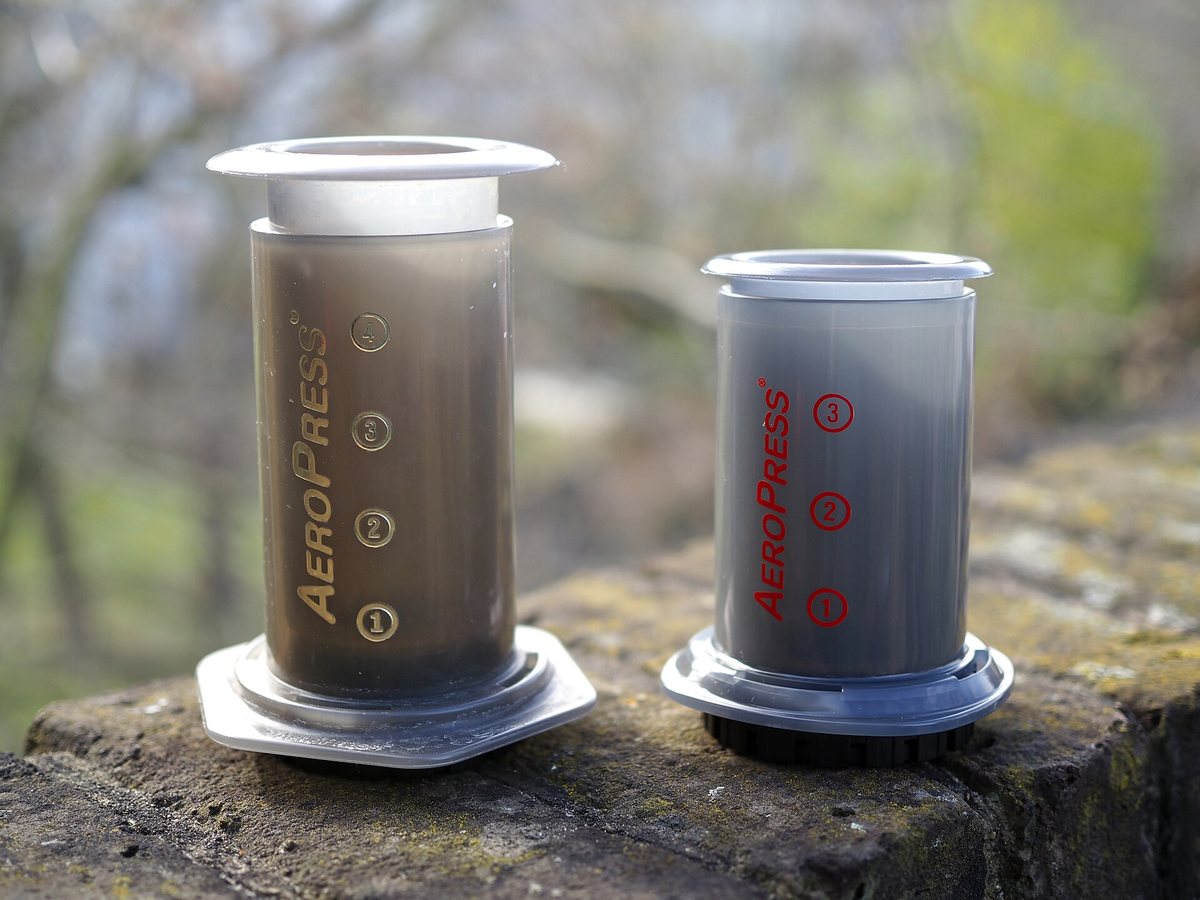
And it travels. Plastic, nearly indestructible, no power, fits in a bag. An AeroPress and a hand grinder beats every hotel-room coffee maker ever built by a margin that isn’t funny. The inverted debate, briefly: standard orientation drips a little during the steep; inverted prevents that at the cost of flipping a tube of hot liquid onto a cup. The flavor difference is small, the flip is a real burn risk, and inserting the plunger a little way at the start seals it with no acrobatics.
Cold brew vs. iced coffee
Two different drinks, and the most misunderstood distinction in the coffee case.
Cold brew is a method: time instead of heat. Extra-coarse grounds steep in cold or room-temperature water for 12–24 hours, then get filtered. Because the water’s cold, extraction is slow and — critically — selective: many acidic and some bitter compounds barely dissolve at low temperature. The result is low-acid, smooth, sweet, chocolatey, heavy, with almost none of that bean’s brightness. It’s a different drink from that bean, not a cold version of it. Usually a concentrate around 1:5, cut 1:1 to serve; keeps a week or two.
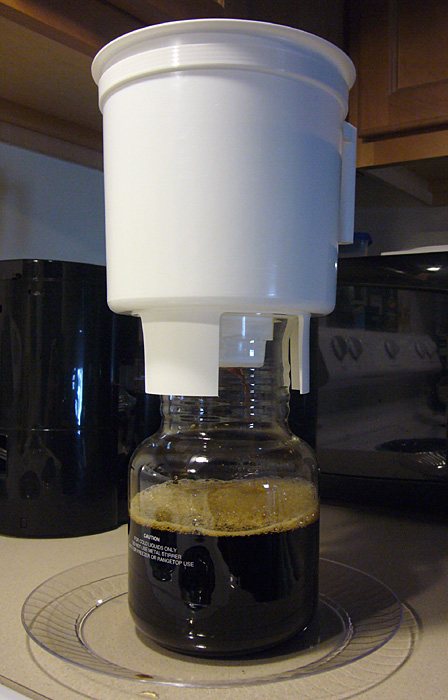
Iced coffee is a temperature: hot coffee, then cold. The naive version — brew hot, refrigerate — is mediocre, because the aromatics escape during the slow cool and it goes flat. Japanese iced / flash chilling is the fix and it’s the best iced coffee there is: brew hot, directly onto ice, having replaced part of your brew water with the ice. A 360 g recipe becomes ~240 g of hot water through the cone and ~120 g of ice in the carafe below. Two things happen and both matter. You get hot-brew extraction — the acidity, the florals, the origin character cold brew leaves in the grounds. And the coffee chills instantly rather than slowly, trapping the volatile aromatics in the liquid instead of letting them evaporate over a long cool-down. That’s why it tastes so much more alive. The dilution math is already done — the melting ice is the rest of your water. For a bright Ethiopian in July it isn’t close; for a dark blend you’re drowning in milk and sugar, cold brew is better and easier.
The world’s methods
Not curiosities — some of the best coffee on earth, and several of them older than everything above.
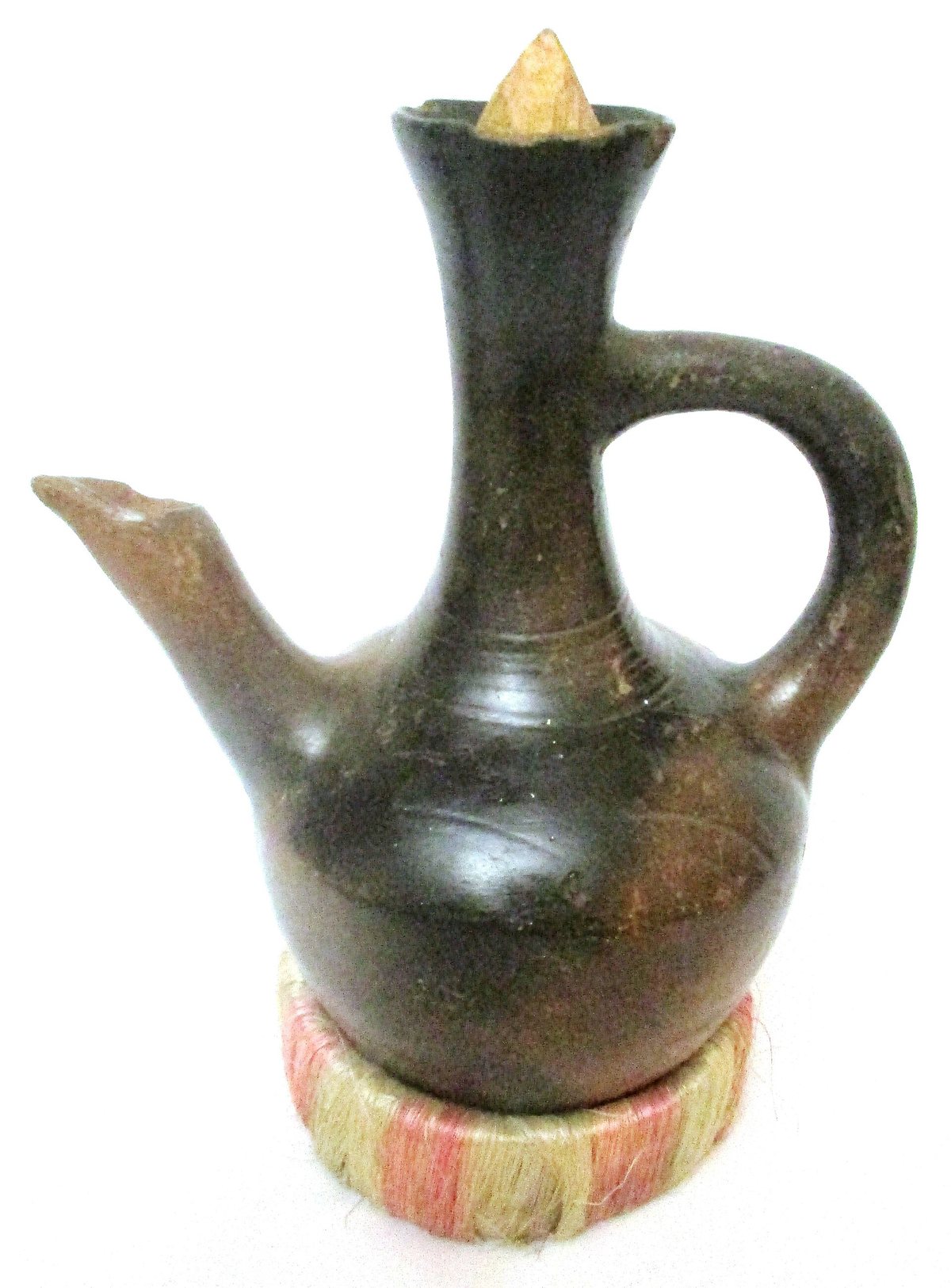
Ethiopian jebena. The oldest living coffee ritual, and where all of this started (see the history). Green beans roasted in a pan over coals in front of you, ground by hand, brewed in a round-bellied clay jebena and poured from a height through its long neck, which strains the grounds. Three rounds — abol, tona, baraka — each weaker, and leaving before the third is genuinely rude. It takes an hour. That’s the point: the coffee is the excuse for the hour.
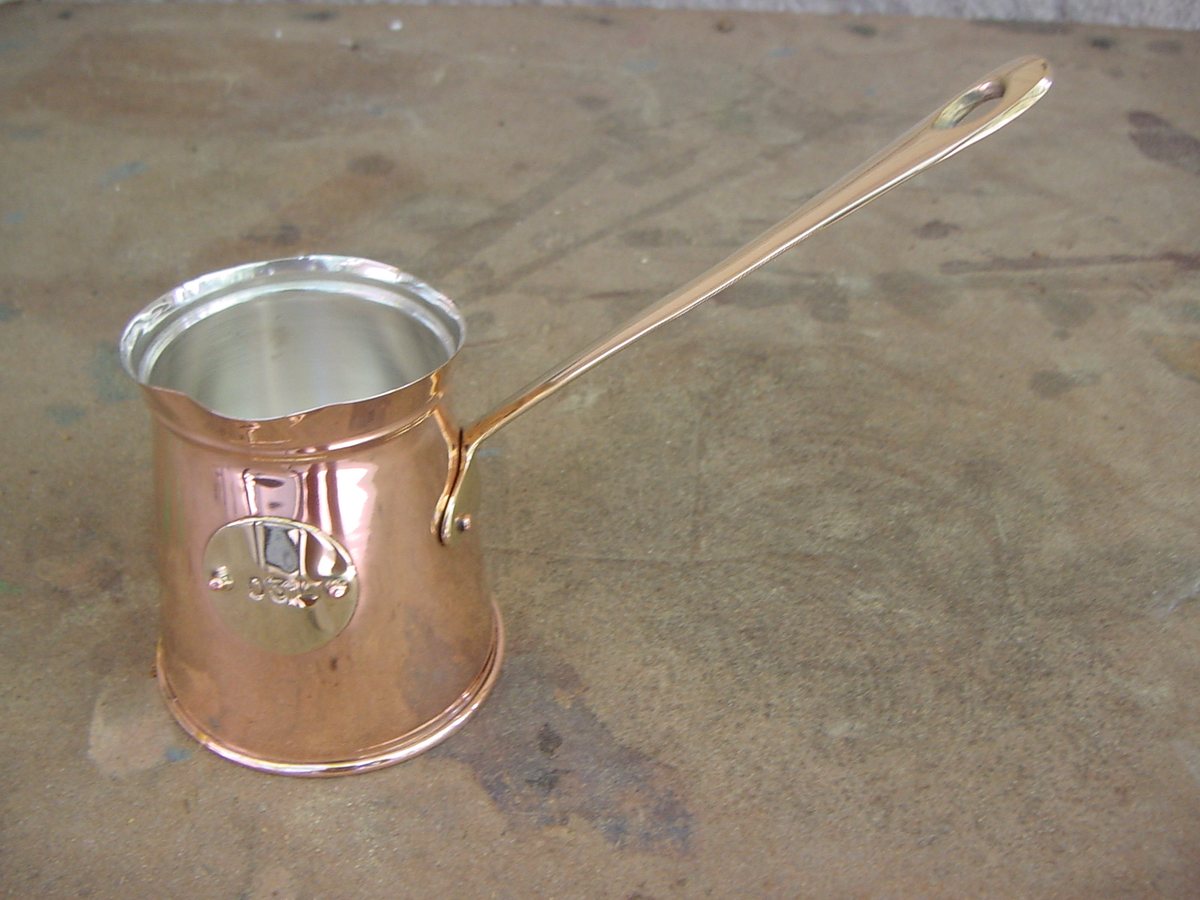
Turkish / ibrik. Powder-fine coffee, finer than espresso, genuinely like flour, into a small long-handled copper cezve with cold water and sugar decided up front — sade to çok şekerli, because you can’t add it later. Brought slowly to a foam and pulled just before the boil. Unfiltered: the grounds settle to a sludge and you stop when you reach it. Thick, intense, and the foam is the mark of whether it was made right.
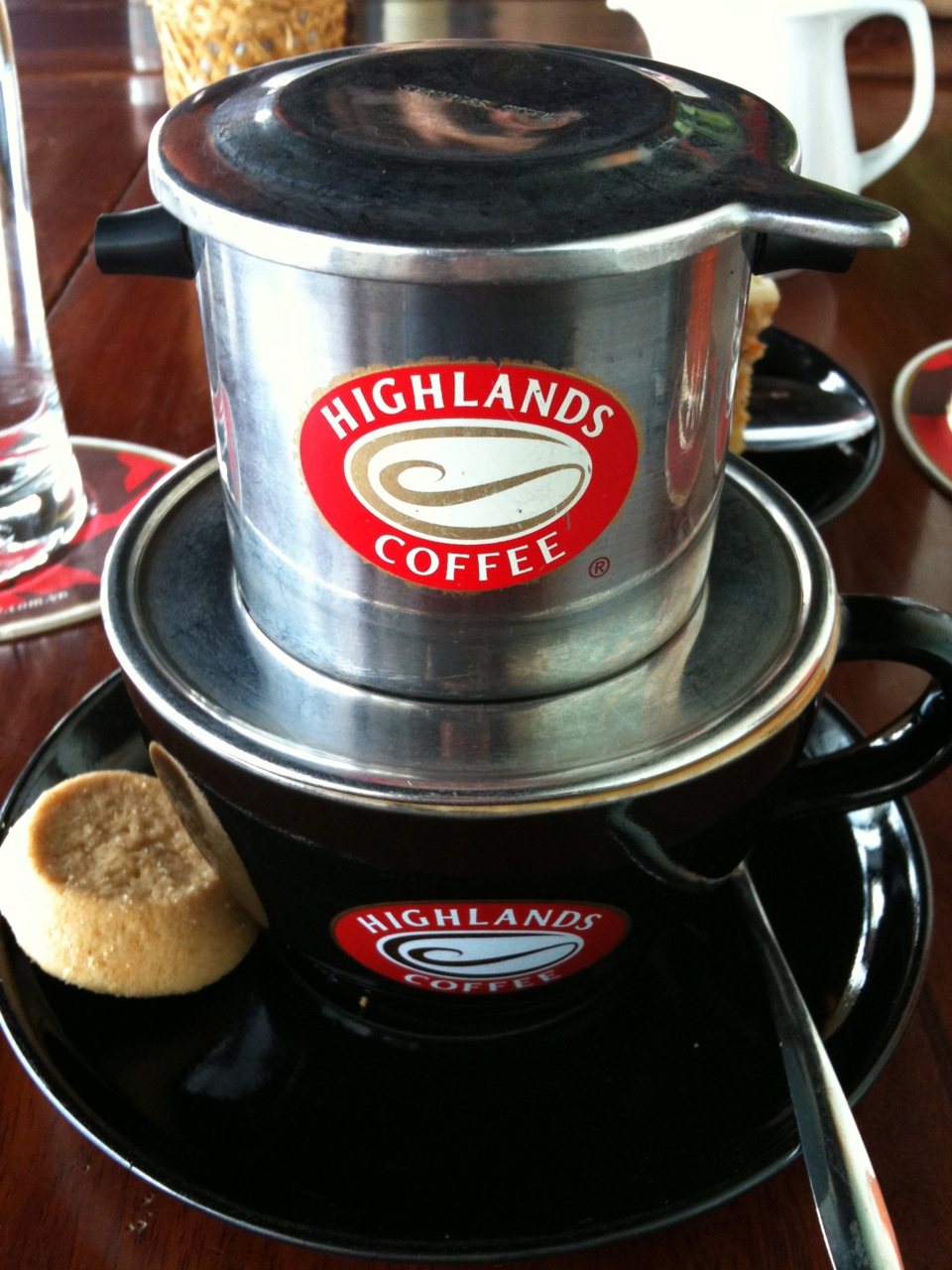
Vietnamese phin. I drank cà phê sữa đá every morning I was in Vietnam and never got over it. A small stamped-metal filter sits right on the glass; coarse dark robusta goes in under a gravity press, hot water on top, and then you wait — four or five minutes of individual drops falling onto a layer of sweetened condensed milk in the bottom. Stir it up through, pour over ice. The robusta isn’t a compromise, it’s the point: harsh, bitter, enormously caffeinated, and the only thing strong enough to punch through that much condensed milk and still taste like coffee (more on robusta at origins). The condensed milk isn’t affectation either — fresh dairy was scarce under French colonial rule, so the can went in instead, and the drink that came out of that constraint is better than the one it replaced.
Cuban cafecito. My first was through a walk-up window in Miami and it rearranged what I thought a shot of coffee could do. It’s espresso — dark, robusta-leaning — but the sugar isn’t stirred in after. You catch the first few dark drops in a cup with a pile of sugar and beat it, hard, until it whips into a pale, thick, caramel-colored cream: the espuma. Then you pour the rest of the shot up through it. It’s mechanically meringue, and it gives you a small, ferociously sweet coffee with a foam cap that no amount of stirring sugar into a finished shot will reproduce. A cortadito is that cut with steamed milk; a colada is a big one poured into a stack of tiny tacitas to hand around the job site.
Instant, and the craft revival. Instant is brewed coffee dehydrated — spray-dried (blasted into hot air; cheap, harsh) or freeze-dried (gentler, keeps far more aromatics). For decades it was uniformly bad and treated as a joke. That’s changed, and I’d rather say so than be a snob: specialty roasters now freeze-dry good single-origin into sachets, and while it’s not a fresh V60 of the same bean, it is unquestionably better than the hotel-lobby carafe and it fits in a jacket pocket on a trail.
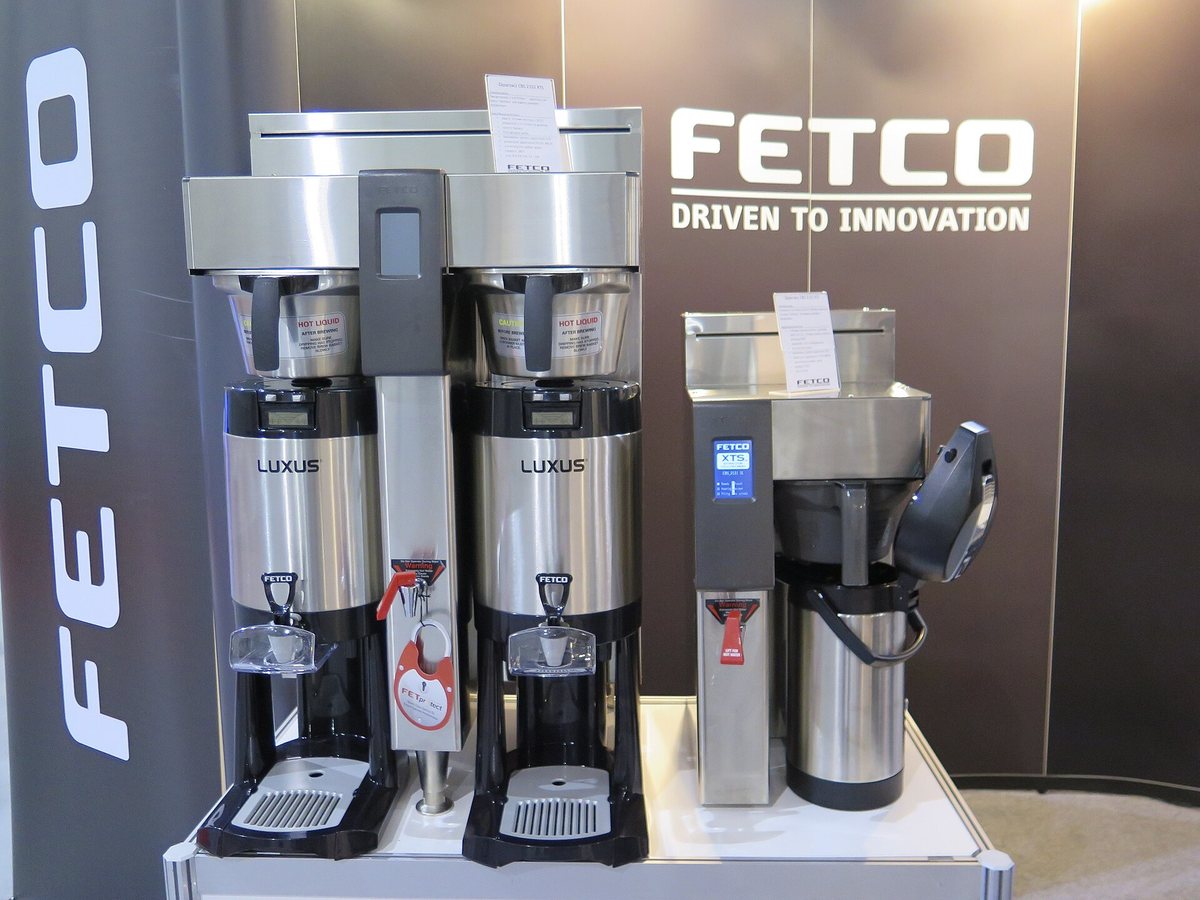
The batch brewer and airpot — the percolator’s cousin, for volume. A Fetco or Bunn flowing properly-heated water through a big flat bed at 1:16–1:17, into an insulated airpot with no hot plate anywhere. It hits temperature under load and the airpot holds coffee hot without cooking it. It’s why a good café’s plain drip beats what most people make at home — the commercial view is on the coffee program.
What I’d reach for, and when
There’s no best method. There’s a best method for the morning you’re having.
- One really good cup, tasting the bean — pour-over; Kalita if I’m talking to someone, V60 if I’m not.
- A pot for the house, hands-off — automatic drip, SCA-certified, thermal carafe. No apologies.
- Something rich on a cold morning — French press. Break the crust, wait, pour slowly.
- A small strong jolt after dinner — moka, or a cafecito if I want the whole ritual.
- Company, and something to show them — siphon. A magic trick that also makes a great cup.
- Travel or a hotel room — AeroPress and a hand grinder. Over a campfire, the percolator, watched.
- July — flash-chilled Japanese iced for a bright bean, cold brew concentrate for everything else.
- A marinade, a braise, a cake — plain drip. See cooking with coffee; it’s also what’s under a proper tiramisu and the coffee half of Keller’s coffee and doughnuts.
Do exactly two things from this page — buy a burr grinder and buy a scale — and you’ll make better coffee tomorrow with the beans you already own and the brewer you already have. Everything else here is refinement on top of those two.
From here: Espresso for the pressure side, Beans and Origins for what’s going in the grinder, Roasting and roasting your own for where the flavor is created, Roasters for who to buy from, and Additions for what goes in after.
Comments (0)