Coffee · 11 of 35
Coffee to Water: The Ratios
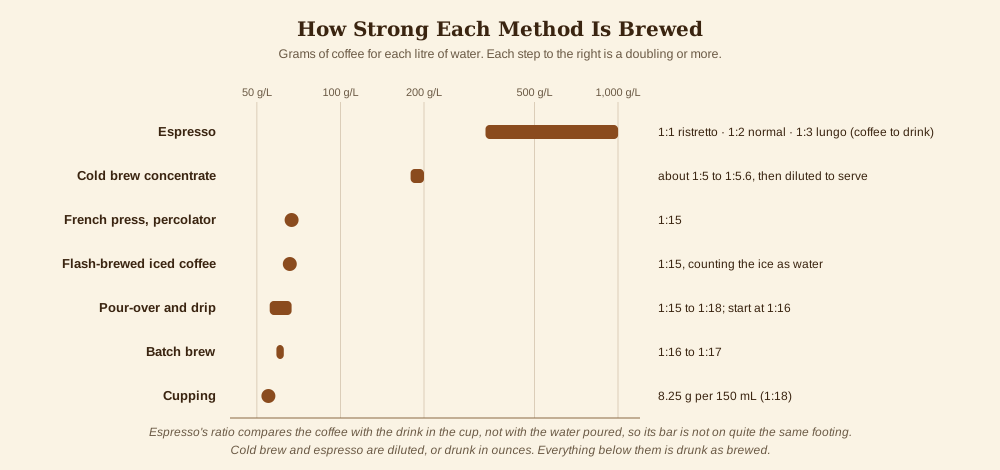
Ratios turn up on nearly every coffee page here: 1:16 for a pour-over, 1:2 for espresso, 1:5 for cold brew, “55 grams per litre” for a tasting pot. Here they are in one place, with what each one is comparing and the weights for common cup and pot sizes.
How to read one
A brew ratio is coffee to water, by weight, coffee first. 1:16 means 1 gram of coffee for every 16 grams of water.
- A bigger second number is a weaker cup. 1:15 is stronger than 1:18.
- A gram of water is a millilitre, so a scale does both jobs. 320 g of water is 320 mL.
- Grams per litre is the same thing written the other way. Divide 1,000 by the second number: 1:16 is 62.5 g per litre. The trade’s “55 grams per litre” is about 1:18.
- Weigh both. A scoop of dark roast weighs less than the same scoop of light roast, so a ratio by volume changes with the coffee.
| Ratio | Grams of coffee per litre of water | Tastes |
|---|---|---|
| 1:15 | 66.7 | Strong, heavy |
| 1:16 | 62.5 | The usual starting point |
| 1:17 | 58.8 | A little lighter |
| 1:18 | 55.6 | Lighter, tea-like; the standard for tasting |
Without a scale
The National Coffee Association gives “1 to 2 tablespoons of ground coffee for every 6 ounces of water (the ‘Golden Ratio’)”. A level tablespoon of ground coffee weighs roughly 5 g, a little less for a dark roast and more for a fine grind, so spoons are an approximation that drifts with the coffee. As a start:
| Water | Level tablespoons, about 1:16 | Roughly |
|---|---|---|
| 6 fl oz (one drip-machine “cup”) | 2 | 11 g |
| 8 fl oz | 3 | 15 g |
| 12 fl oz | 4½ | 22 g |
| 1 litre (about 34 fl oz) | 12½ | 63 g |
A scale to buy, from $45, is on A Home Coffee Kit.
A drip machine’s “cup” is not a mug. Most count a cup as 5 to 6 fl oz, so the “10” on a carafe is 50–60 fl oz of water. Measure coffee for the water poured in, not for the number of mugs.
Ratio sets strength; grind sets flavor. If the cup is sour and thin, grind finer. If it is bitter and harsh, grind coarser. If it tastes right but is too weak or too strong, change the ratio — and if it is sour or bitter and heavy, it is too strong: add water (Troubleshooting). Brewing explains why.
Filter coffee, by cup and pot
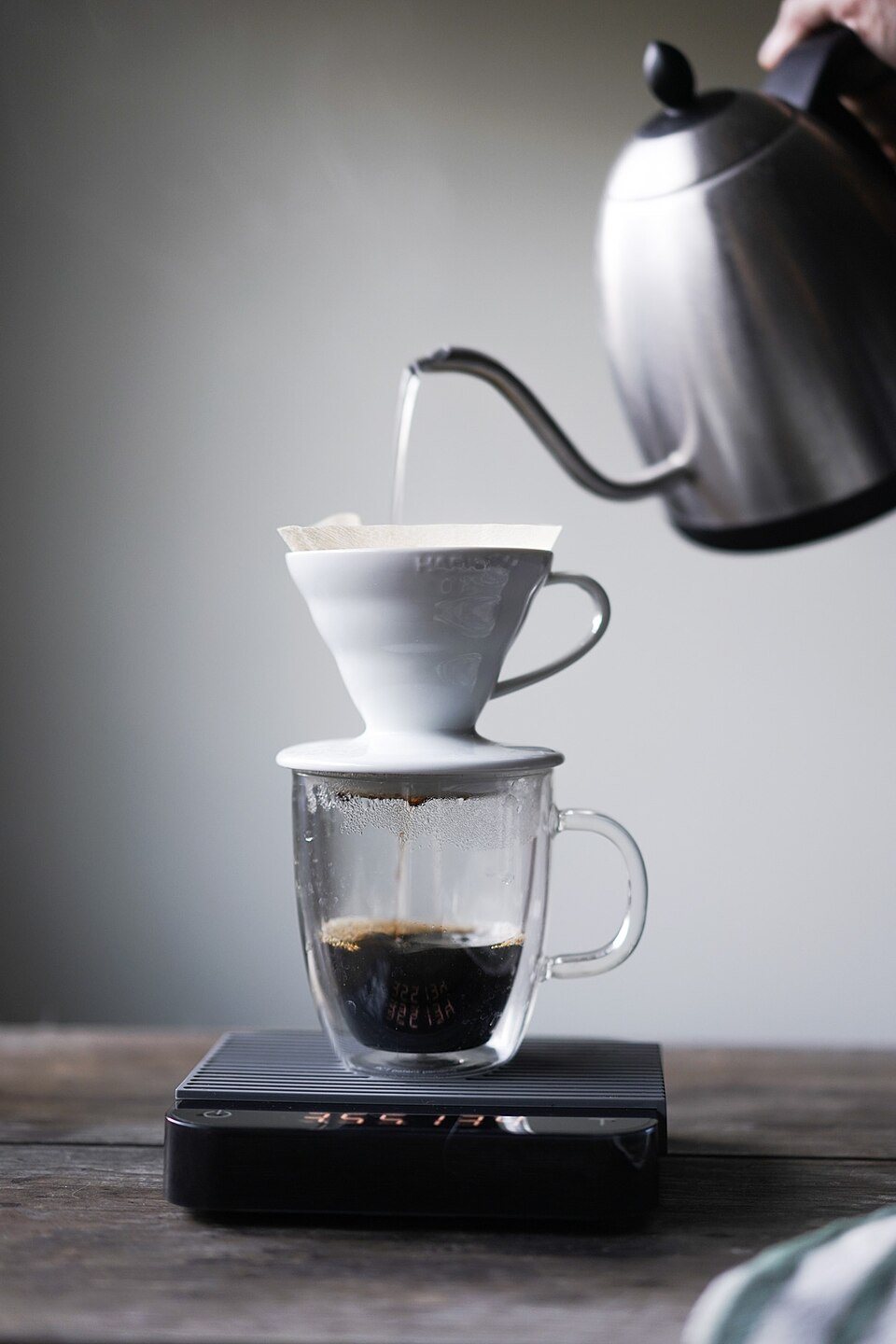
For pour-over, automatic drip, batch brew and French press. Grams of coffee for the water in the first column.
| Water | Makes about | 1:15 | 1:16 | 1:17 | 55 g per litre (about 1:18) |
|---|---|---|---|---|---|
| 237 g (8 fl oz) | one small cup | 16 g | 15 g | 14 g | 13 g |
| 355 g (12 fl oz) | one 12 oz cup | 24 g | 22 g | 21 g | 20 g |
| 473 g (16 fl oz) | one 16 oz cup | 32 g | 30 g | 28 g | 26 g |
| 1,000 g (1 litre) | three 10 oz cups | 67 g | 63 g | 59 g | 55 g |
| 2,200 g (2.2 L airpot) | about 32 two-ounce tastes | 147 g | 138 g | 129 g | 121 g |
| 3,800 g (3.8 L airpot) | about 55 two-ounce tastes | 253 g | 238 g | 224 g | 209 g |
The cup holds less than the water poured. The grounds keep about twice their own weight in water, by the usual rule of thumb. 22 g of coffee and 355 g of water gives about 310 g in the cup.
By method
The ratio each page on this site gives, with where it comes from.
| Method | Ratio | An example | Where |
|---|---|---|---|
| Pour-over (V60, Kalita, Chemex) | 1:15 to 1:18; start at 1:16 | 22 g coffee, 360 g water | Brewing |
| Automatic drip | 1:16 | 63 g coffee to 1 litre | Brewing |
| Batch brew | 1:16 to 1:17 | 138 g coffee to a 2.2 L airpot | Brewing |
| Tasting pots at a stall | 55 g per litre, give or take 10% | 110 to 130 g coffee to a 2.2 L pot | Sampling |
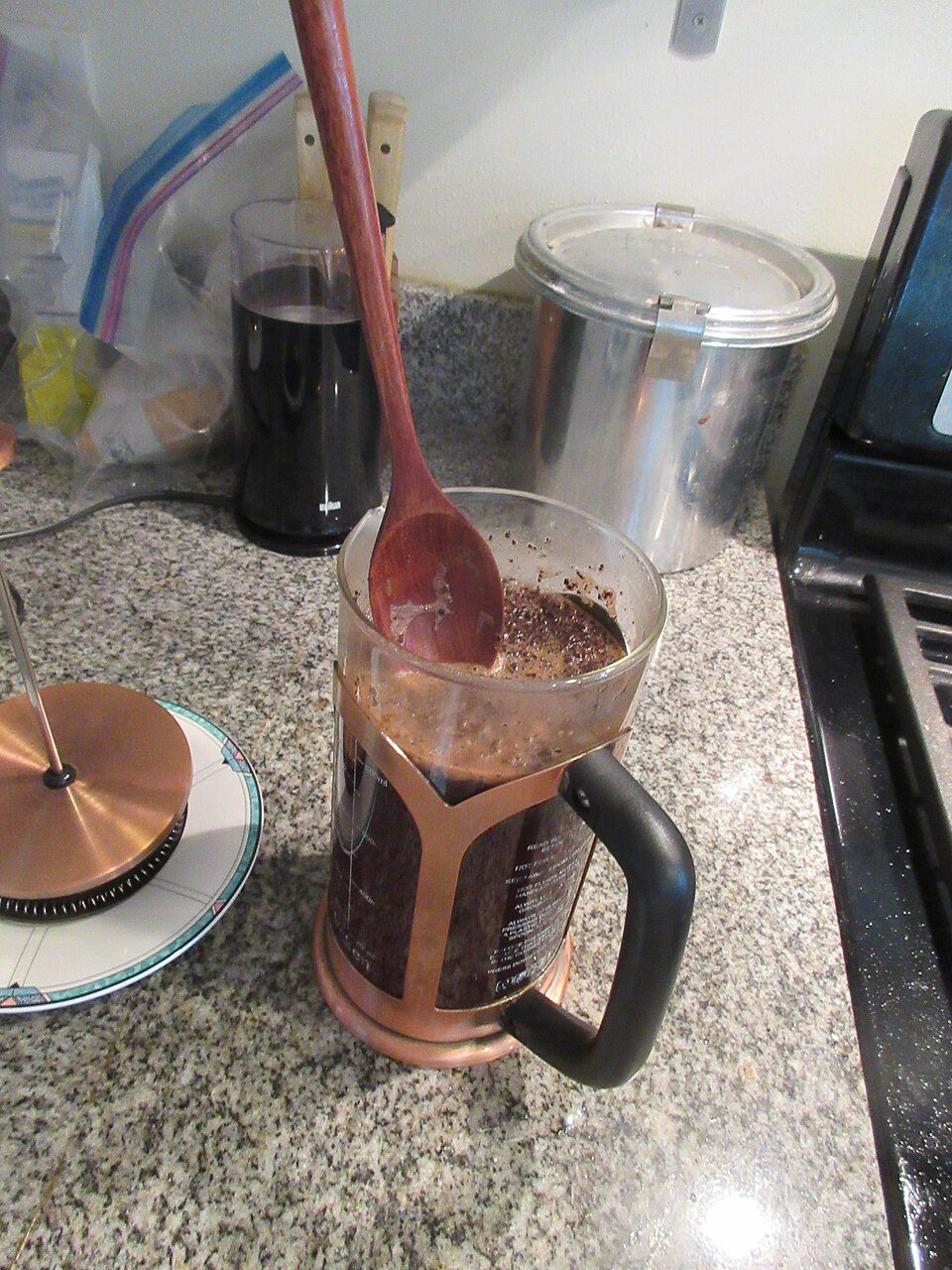
| French press | about 1:15 | 30 g coffee, 450 g water | Brewing |
| Percolator | about 1:15 | Brewing | |
| Siphon | 1:15 to 1:16 | Brewing | |
| AeroPress | 16 to 18 g of coffee for one cup | The maker’s own instructions; the brewer forgives almost any ratio | Brewing |
| Flash-brewed iced coffee | about 1:15, with 40% of the water as ice | 23 g coffee, 210 g hot water, 140 g ice | Iced Coffee and Ice |
| Cold brew concentrate | about 1:5 | Toddy’s recipe: 12 oz (340 g) coffee to 8 cups (1.9 L) water, about 1:5.6; served 1 part concentrate to 2 parts water or milk, so about 4 oz of concentrate in a 12 oz drink | Brewing, Iced Coffee and Ice |
| Phin (Vietnamese) | By volume: 2 parts water to 1 part coffee | 2 tablespoons of fine-ground coffee in a 4 oz phin, from one phin maker (not espresso-powder fine, which can stall the drip) | The Drinks |
| Cupping | 8.25 g of coffee per 150 mL of bowl | See the table below | Cupping |
| Espresso | 1:2, coffee to drink | 18 g in, about 36 g out | Espresso |
| Moka pot | Set by the pot: basket filled level, water to the valve | Roughly 15 g in a 3-cup pot, 20–25 g in a 6-cup | Brewing |
| Turkish / cezve | About 1:9, by the cup | 7–8 g coffee to 60–70 mL water for one small cup | Brewing |
Cupping
The Specialty Coffee Association’s standard doses by the size of the bowl, filled to the rim: 8.25 g of coffee for every 150 mL, which is 5.5 g per 100 mL, or about 1:18. Each bowl’s dose may be off by no more than 0.2 g.
| Bowl, filled to the rim | Coffee |
|---|---|
| 150 mL | 8.25 g |
| 200 mL | 11.0 g |
| 250 mL | 13.75 g |
| 300 mL | 16.5 g |
| 350 mL | 19.25 g |
To find a bowl’s volume, put it on the scale, zero it and fill it to the rim with water; the grams are the millilitres. The rest of the protocol is on Cupping.
Espresso
Espresso’s ratio is a different measurement. It compares the dry coffee in the basket with the weight of the drink in the cup, not with the water that went into the machine.
| Shot | Ratio, coffee to drink | With an 18 g dose |
|---|---|---|
| Ristretto | about 1:1 to 1:1.5 | 18 to 27 g out |
| Normale | about 1:2 | about 36 g out |
| Lungo | about 1:3 or more | 54 g or more out |
Espresso covers what each does to the taste.
Ratios that are not coffee to water
Several numbers on these pages look like brew ratios and are not. Each compares two other things.
| Where it appears | The ratio | What it compares |
|---|---|---|
| Cold brew, to serve | 1:1, or Toddy’s 1:2 | Concentrate to water or milk |
| Flash-brewed iced coffee | 60:40 | Hot water to ice, within the total water |
| Cortado | about 1:1 | Espresso to steamed milk |
| Flat white | about 1:3 to 1:4 | Espresso to milk |
| Honey syrup | 3:1 | Honey to warm water (Honey in Coffee) |
| Phin | 2:1 | Water to coffee, by volume |
A card to print
The same numbers are on a one-page reference card: Coffee to Water: the Ratios, by Weight (PDF). The rest of the cards are on Reference Cards.
Sources
- Specialty Coffee Association, Standard 102-2024, Coffee Value Assessment: Sample Preparation and Tasting Mechanics, for the cupping dose and its tolerance.
- The SCA’s Golden Cup figure of 55 g per litre is given as secondary sources quote it, not from the standard itself.
- National Coffee Association, drip coffee, for the tablespoon guidance.
- Toddy, cold brew instructions.
- AeroPress instructions and one phin maker’s guidance, as cited on the pages linked above.
- The filter-coffee and tablespoon tables are arithmetic. The water held back by the grounds, and the weight of a tablespoon, are rules of thumb, not measurements.
Comments (0)