Starting a Coffee Business · 24 of 39
Sampling: Letting People Taste the Coffee
People buy a bag of coffee from a stranger after they have tasted it. For a stall the question is how to get a good ounce of each coffee into someone’s hand, quickly, all morning, without mains power. The two ways are to brew ahead into insulated pots at the stall, or to brew in front of the customer. A home tasting, with the same coffees side by side, is on Hosting a Tasting.
One rule first, from the rules page: samples are brewed at the stall, never at home. A pot of coffee is a beverage, which the cottage food exemption excludes, so a pot brewed in the home kitchen and carried to the market is not allowed under either route. Under a food service licence, brewing tasting cups at the stall is part of the licensed operation. Whether a cottage food seller with no licence may brew samples at the stall is not settled in anything Michigan has published, and it needs an answer from MDARD before the first market.
Brew ahead or brew live
| Brewed ahead into airpots, at the stall | Brewed in front of the customer | |
|---|---|---|
| Speed | A sample in seconds | 3 to 4 minutes per brew |
| What the customer sees | A pump pot | The whole show |
| Hot water needed at the stall | Little or none | All of it |
| Coffees on offer at once | Three or four, one pot each | One at a time |
| Hands | Free to talk and sell | Busy |
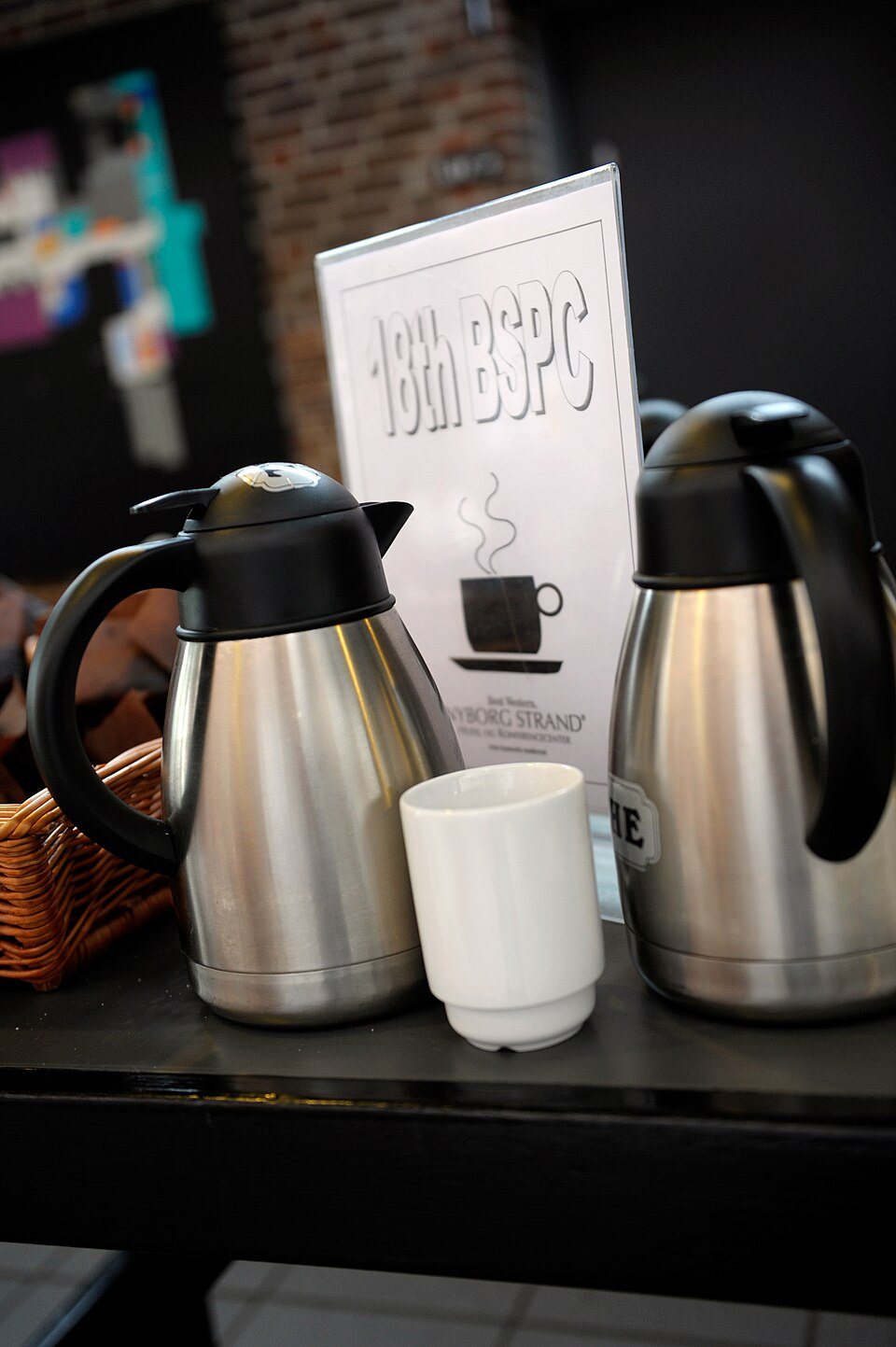
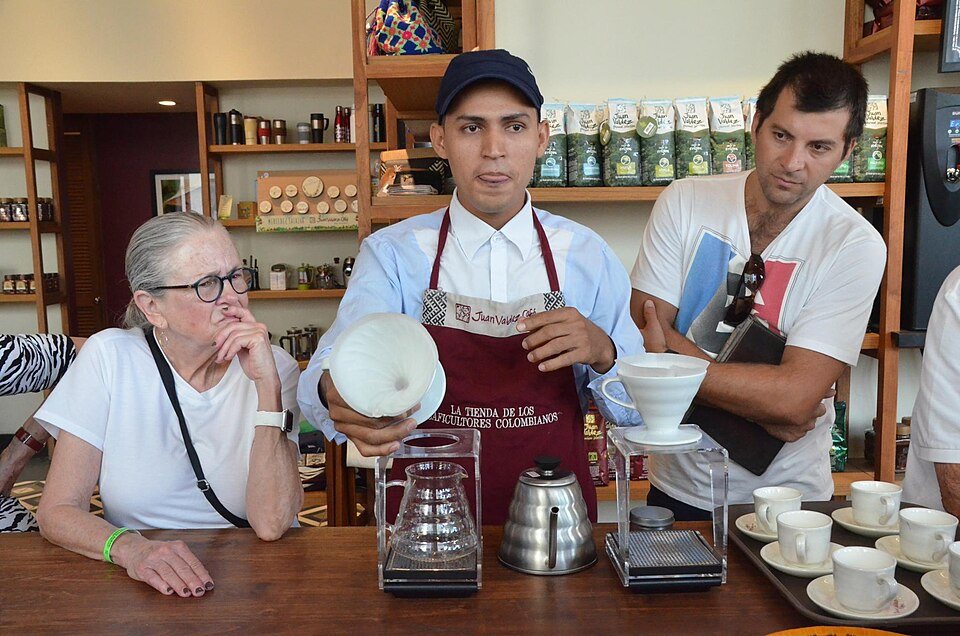
The appeal of brewing live is real, and the cost is that the person brewing is not selling. The answer that gets both: samples come from airpots, and one pour-over is always in progress for the customers who are buying a cup. People watch the pour-over and taste from the pots.
Does coffee held in a pot still taste good?
The trade habit is to throw brewed coffee out after 30 minutes. The one published study that tested it does not support the habit. Researchers held light, medium and dark roasts in three kinds of carafe for up to three hours, and had 93 coffee-industry professionals compare coffee held for 30 minutes with coffee held for 180:
“Surprisingly, the panel of coffee industry professionals showed no preference for fresh over held.”
The trained panel did measure changes. Sourness rose over time in the light and medium roasts, and aroma faded. The authors’ conclusion was that “even if the changes over time are noticeable, they may not negatively impact overall liking.”
For a stall that means a sealed vacuum airpot is good for about three hours. The study did not test longer, and it did not test a pot being pumped every few minutes outdoors on a cold morning. Brew a fresh pot at the midpoint of a market, and put the brew time on a tag on each pot. The same holds for an airpot station at an event (Catering and Event Coffee Carts). Airpots need their liner cleaned daily in a business, and some are not rated for boiling water: Cleaning and Descaling.
Brewing a pot without power
Commercial airpot brewers draw 1,370 to 2,400 watts, well beyond a portable power station. The unpowered way is a large manual dripper set on the pot:
- A large pour-over cone set on the airpot’s mouth drips straight into it. An 8- or 10-cup Chemex does the same job into its own carafe, to be poured into the pot.
- Some airpots are built for it. Zojirushi’s 3.8-litre model has a “Brew-Thru” stopper that takes coffee straight from a brewer.
- The ratio is the industry’s standard: 55 grams of coffee per litre of water (the ratios, by pot size), give or take 10%, with water at about 200 °F. A 2.2-litre pot takes 110 to 130 g of coffee.
Every pot is brewed at the stall: the first ones during set-up, the mid-market refill in a quiet moment, all with water carried hot in airpots from home (Hot Water and Power). Carrying plain hot water is not addressed by the guidance, which does not list water from an approved supply as a prepared food; brewed coffee is plainly covered. So set-up starts early enough to have three pots brewed by opening: allow about 15 minutes for three drippers.
The cup
Michigan’s sampling guidelines limit samples to “bite-size portions” and call for “paper sampling cups.” They do not define a bite-size drink. One to two ounces is a taste; four ounces is a small coffee.
| Cup | Per cup | Notes |
|---|---|---|
| 1 oz or 2 oz paper portion cup | about 1.5¢ | Sold for cold condiments. Whether a given one tolerates near-boiling liquid is not stated; check the maker’s rating before using it for hot coffee. |
| 4 oz paper hot cup, plain | 3¢ | Made for hot drinks |
| 4 oz compostable hot cup | 4¢ to 6¢ | The better fit for a stall that sells honey |
| 4 oz double-wall hot cup | 8¢ | Comfortable to hold; the most expensive |
Two hundred samples a day costs $3 in portion cups and $8 in compostable 4 oz cups. With the coffee, sampling costs about $18 a market in the first season (The Numbers); the same cups are priced beside the drink cups on Cups, and Standing Out. The 4 oz hot cup, poured a third full, is the safe choice: it is rated for the temperature, it does not burn fingers, and a 1½ oz pour looks deliberate in it. What “compostable” actually buys in central Michigan is on Compostable, PFAS and Waste.
A reusable tasting cup is the option that would stand out: small ceramic or enamel cups, like a cupping bowl or a sake cup. Without a sink they cannot be washed at the stall. They would have to go home dirty in a closed bin and come back clean from a licensed kitchen, which the market stage of this business does not have. That is one for the shop.
A cupping table
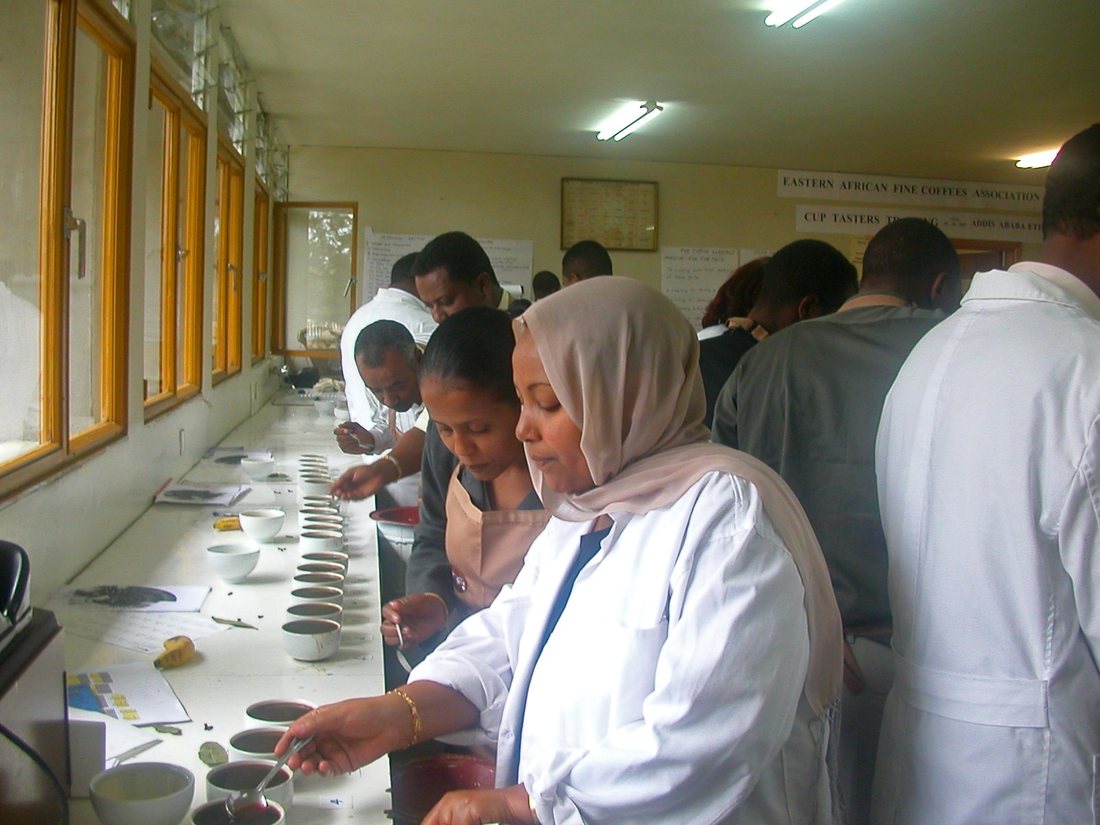
The trade tastes coffee by “cupping”: 8.25 g of coarse-ground coffee in a bowl, 150 ml of water at 200 °F, a crust broken after four minutes, and the coffee slurped from a spoon (Cupping has the whole protocol). It uses the same 55 g per litre ratio, needs less than half a litre of water for three coffees, and is the most honest side-by-side comparison there is. The Tasting Score Card is a one-page sheet for three coffees, for anyone who wants to write it down.
At a market the shared bowl is the problem. Michigan’s guidelines require that samples be “protected from customer handling.” A version that keeps the format: the vendor breaks the crust and ladles from each bowl into the customer’s own small cup. It is slow, and it is a draw for exactly the customer who buys three bags. It suits a quiet weekday market more than a Saturday.
Handwashing and the rest of the rules
Sampling brings the sampling rules with it, licence or no licence:
- a canopy overhead;
- samples protected by a cover or served by the vendor;
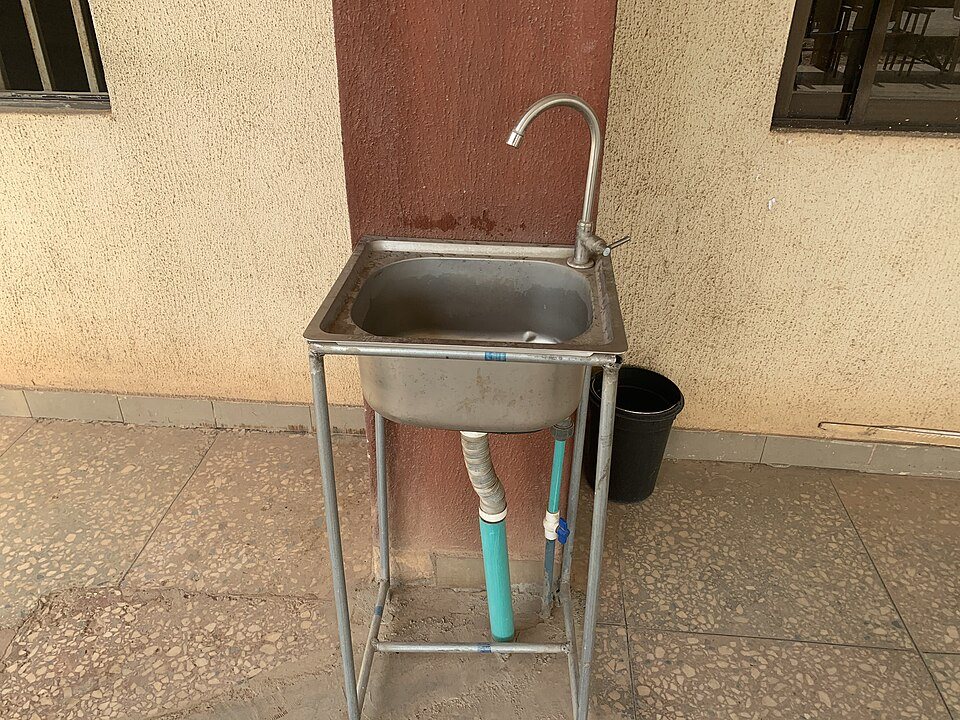
- a handwashing station within about 15 feet: at the least, a five-gallon insulated container with a spigot and warm water, a catch bucket of the same size or larger, soap and paper towels.
Three more, which no rule asks for:
- A lidded bin for used sample cups at the end of the table, or they end up on it.
- An allergen card on any sample with milk or honey in it, and the honey line from Honey in Coffee: no honey for children under one.
- Children and hot coffee. Pour samples for adults, set the pots at the back of the table out of reach, and keep the cups a third full. Serving Hot Drinks Safely covers temperatures and lids.
Some markets go further. Alma’s handbook requires that samples be prepared in advance in an approved kitchen, and at least one Michigan market requires its own permit for any food or drink sample. Ask each market. A liability policy should cover samples as well as sales (Insurance).
Selling from the sample
Nothing published measures how many tasters buy. What follows is a way of setting up the table, to be tested, not a finding:
- Three pots, light to dark, left to right, each with a card naming the coffee, its origin and three plain flavor words. Most people pick a favourite out of three within a minute.
- The matching bag directly behind each pot, with the price on it.
- An 8 oz bag beside the 12 oz. A smaller commitment is an easier yes after a one-ounce taste.
- A paid sample bag, 2½ to 4 oz for $4 to $8. Two Michigan roasters sell these online, and since March 2026 a cottage food roaster may do the same within Michigan (Selling Online and by Mail); at a market it is the answer to “I’d like to try it at home first.”
- The honey beside the dark roast. A taste of dark coffee with a few drops of honey syrup sells both.
- Note which pot empties first. The pot that is refilled first, market after market, is the coffee to roast more of; the line-up on Green Coffee and the Line-Up is meant to be corrected this way.
Sampling as one part of a market marketing routine is on Marketing on a Shoestring.
Sources
- Batali, Cotter and others, “The effect of post-brew holding time and carafe type on the sensory properties of drip brew coffee,” Journal of the Science of Food and Agriculture 103(8), 2023 (abstract).
- SCA Golden Cup standard and cupping protocol, as quoted by secondary sources.
- MDARD, “Guidelines for Providing Safe Food Samples at Farmers Markets” (2015).
- Brewer wattages from Bunn, Avantco and Fetco listings; Zojirushi SR-AG38 specifications.
- Cup prices from WebstaurantStore and Good Start Packaging, read 2 October 2026.
- Alma farmers market handbook; Birmingham (Michigan) farmers market rules, 2026.
Comments (0)