Starting a Coffee Business · 30 of 39
Subscriptions and a Coffee Share
A coffee subscription sends the same customer a bag on a schedule. A coffee share is the farm version of the same idea, built for a market seller: members pay once, before the season, and collect a bag at the stall every week. Farms have sold vegetables this way for decades under the name community-supported agriculture (CSA). Applied to coffee, it turns the hardest thing about a market stall, not knowing how many bags will sell on Saturday, into a number known in April.
I keep bees and sell honey at markets, and the coffee stall is a plan. Nothing on this page is something I run yet. The subscription terms are from roasters’ and platforms’ own pages, the law from the Michigan statute and MDARD, all read in October 2026, and the share is a design with the arithmetic shown.
The short version
| Question | Answer |
|---|---|
| What do roasters’ subscriptions look like? | A bag every one, two or four weeks; at Counter Culture about 10 to 20% below the one-off price, free shipping over $30, skip, pause or cancel at any time. |
| Cheapest way to run one | Shopify Basic ($29 a month billed yearly) with the free Shopify Subscriptions app; or Square Plus at $49 a month. |
| Can a Michigan home roaster sell subscriptions? | Yes, since March 2026, to Michigan buyers only, with the chance to meet first (Selling Online and by Mail). |
| The coffee share | Twenty weeks, one 12 oz bag a week collected at the stall, paid up front: $300 against $340 at the table. |
| What it earns | About $136 a member with green coffee bought in small lots, $171 if the up-front money buys the season’s green by the 65 lb box, against $172 for the same twenty bags sold one at a time. |
| The real gain | Sold bags, known in spring; cash to buy green cheaply; customers who come back every week. |
| How many members | About 8 on a Behmor roaster; 20 or more needs a Bullet R2. |
| Honey | An add-on: a 1 lb jar every four weeks, five jars for $45. |
| Missed pickup | Held one more week, then posted (member pays postage) or credited. |
How coffee subscriptions work
A roaster’s subscription is a standing order. The customer picks a coffee, or lets the roaster pick, chooses how often, and is charged and sent a bag each time. The terms are much the same everywhere. As a worked example, Counter Culture Coffee’s page on 5 October 2026:
| Term | Counter Culture, October 2026 |
|---|---|
| Discount | ”Save $2 on every order of 12 oz”; a single-origin subscription bag $21 against $26 |
| Shipping | Free on orders of $30 or more |
| Choice | A rotating single origin (roaster’s choice), a rotating blend, or a fixed coffee |
| Frequency | Set by the customer |
| Commitment | ”You can cancel, change your coffee, or adjust delivery anytime—no commitment needed!” |
| Gifts | Prepaid 3-, 6- and 12-month subscriptions |
Frequency is the term that matters most. A household that drinks two cups a day uses about 12 oz a week (two 20 g brews a day is 280 g a week, and a 12 oz bag is 340 g), so weekly suits a heavy drinker, every two weeks a light one, and monthly suits someone who buys from more than one roaster. Coffee should be used within about two to four weeks of roasting (Keeping Coffee), so any interval longer than a month means stale coffee at the bottom of the bag.
Why customers cancel. No churn figures for coffee subscriptions are published. The reasons are easy to see, though: bags pile up faster than they are drunk; a card expires and the payment fails; the coffee stops being interesting; or the price is no longer worth it next to the supermarket. The answers are built into the terms above: let customers skip and change frequency in one click, rotate the coffee, and send a reminder before a card expires.
The law on automatic renewal. A subscription sold online and charged automatically falls under the federal Restore Online Shoppers’ Confidence Act (15 USC 8403). The seller must disclose “all material terms of the transaction before obtaining the consumer’s billing information,” get the customer’s “express informed consent” before charging, and provide “simple mechanisms for a consumer to stop recurring charges.” A cancel button in the customer’s account, as every platform below provides, meets the last point. A prepaid season share is not an automatic renewal and does not raise the question.
Platforms for a subscription
| Platform | Monthly cost, October 2026 | What it adds | Fit for a Michigan cottage roaster |
|---|---|---|---|
| Shopify Subscriptions on Shopify Basic | App free; Shopify $29 billed yearly, $39 monthly; cards 2.9% + 30¢ online | Weekly, monthly or yearly billing with a discount; customers “cancel, skip, or pause”; works in the shop and at the POS | Good. Its reviewers note two gaps: no single billing date for everyone, and no swapping the product inside a subscription |
| Square Plus | $49 (Square pricing); online cards 2.9% + 30¢ | “Bundles and subscriptions” (not on the free plan), loyalty, in the same system as the market reader | Good if the stall already uses Square |
| Local Line | Core $109 plus $29 for subscriptions, or Premium $199 | Built for CSAs: pickup points, season shares, add-ons | Well suited to a share; dear for a small one |
| Barn2Door | Entrepreneur $119 plus $399 setup | Farm store with subscriptions | As Local Line |
| Cratejoy | From $24.99 plus 1.25% + 10¢ a transaction, and referral fees | A national marketplace of subscription boxes | Not for a cottage roaster: its buyers are nationwide, and cottage food may go only to Michigan |
Square Plus includes a loyalty programme; paper punch cards cost less (Marketing on a Shoestring).
For a prepaid season share, none of these is needed. A share is one payment, so a payment link or a single product in a free Square Online shop does the job, and a printed list does the rest.
The coffee share
Where the idea comes from
The federal food rules define a CSA as “a program under which a farmer or group of farmers grows food for a group of shareholders (or subscribers) who pledge to buy a portion of the farmer’s crop(s) for that season” (21 CFR 1.227). The USDA’s National Agricultural Library puts the spirit of it as members “sharing the risks and benefits of food production.” Members pay before the season, the farm uses the money to plant, and each week the share is whatever the farm has.
A coffee share keeps the shape and changes the crop. The roaster cannot grow coffee in Michigan, but the up-front money does the same job as the farmer’s: it buys the season’s green coffee in one order, at the box price. No published figures exist on how coffee shares sold by small roasters perform, so the numbers below are a model.
A design for a season
| Proposal | |
|---|---|
| Season | 20 weeks, matching the summer market: early June to mid-October |
| Full share | One 12 oz bag every week: 20 bags. $300, or $15 a bag against $17 at the table |
| Half share | One bag every two weeks: 10 bags. $155 |
| The coffee | Roaster’s choice, a tour of the line-up (Green Coffee and the Line-Up): a different coffee most weeks, with a card saying what it is and how to brew it. A member who wants the same coffee every week can ask. |
| Whole bean or ground | Whole bean by default. Ground on request, ground at home before bagging and labelled for the brewer (The Michigan Rules explains why not at the stall) |
| Honey add-on | A 1 lb jar every fourth week: five jars, $45 |
| Sign-up | Opens in March, closes when the share is full or on 15 May |
| Payment | In full, or half at sign-up and half on 1 July |
| Pickup | At the stall, any time during the market |
Pricing it
A share is a discount for money in advance and a promise to come back. Too small a discount gives no reason to commit; too large gives away the margin. The worked numbers, using the bag costs from Bags, Labels and What a Bag Costs ($7.80 a bag while green is bought in small lots, $6.06 by the 65 lb box) and Square’s in-person card fee of 2.6% + 15¢:
| One full-share member, 20 weeks | At the table | Share, green in small lots | Share, green by the box |
|---|---|---|---|
| Paid | 20 × $17 = $340 | $300 | $300 |
| Coffee, bag and label | −$156.00 | −$156.00 | −$121.20 |
| Card fees | −$11.84 (20 sales) | −$7.95 (one sale) | −$7.95 |
| Left | $172.16 | $136.05 | $170.85 |
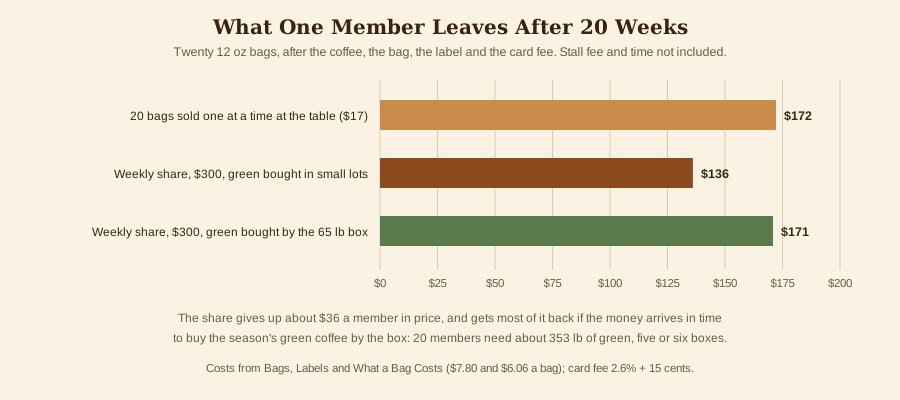
That is the finding of the model. A 12% discount is paid for by the box price, provided the money arrives before the green coffee is bought. Twenty full shares are 400 bags, 300 lb of roasted coffee, about 353 lb of green at 15% roasting loss: five or six 65 lb boxes, ordered in May. The saving, $1.74 a bag, is $696 across twenty members, against the $722 the share gives up. The coffee on the market table is cheaper too, because it comes out of the same boxes.
Twenty members over a season:
| 8 members (Behmor scale) | 20 members (Bullet R2 scale) | |
|---|---|---|
| Paid in spring | $2,400 | $6,000 |
| Bags over the season | 160 | 400 |
| Roasted coffee a week | 6 lb | 15 lb |
| Left after coffee and fees, small lots | about $1,090 | about $2,720 |
| Left, green by the box | about $1,370 | about $3,420 |
| Share of the $50,000 cottage food cap | 5% | 12% |
Arithmetic, 20 members by the box: 6,000 − (400 × 6.06 = 2,424) − (20 × 7.95 = 159) = 3,417. For comparison, The Numbers has one market a week leaving about $2,690 from 432 bags sold over the table in the first season. The share is on top of that, and needs no extra stall fee.
Half shares at $155 for ten bags price each bag at $15.50, a little more than a full share’s $15, because the work per bag is the same and the commitment is half.
The honey add-on. At the $10-a-pound retail value The Numbers uses, five 1 lb jars are worth $50; $45 is a 10% discount. Honey is not a cottage food in Michigan; it is sold under its own exemption, with its own cap by MSU Extension’s reading (The Michigan Rules). Honey in Coffee suggests which honeys go with which coffees, which is what the add-on’s card should say.
The roasting schedule
A share bag should be collected two to five days after roasting, when filter coffee has rested and is at its best (Keeping Coffee). For a Saturday market that means roasting on Wednesday or Thursday.
| Day | Share work |
|---|---|
| Monday | Choose the week’s coffee; write the card |
| Wednesday | Roast the share coffee |
| Thursday | Bag, seal, label; a name sticker on each |
| Friday | Print the pickup list; pack the share crate |
| Saturday | Pickup at the stall; tick names off |
| Saturday evening | Message anyone who did not come |
How many members a roaster can carry is set by the machine. By its manual, the Behmor makes about 2.6 lb of roasted coffee in a four-hour session. Eight weekly shares are 6 lb, two to three sessions on top of the coffee for the table. Twenty shares are 15 lb a week: about six Behmor sessions, or about two hours on a Bullet R2 at the rough 7.5 lb an hour Choosing a Roaster estimates. Start with a share the Behmor can honestly make, eight to ten members, and grow it with the roaster.
When someone misses a pickup
A farm share’s lettuce cannot wait a week for its member. A bag of coffee can, so a generous rule costs little:
- Held one week. The bag goes back in the crate for the next market. A bag a week past its pickup is still within its best weeks.
- Then posted or credited. After two markets, the member chooses: posted to a Michigan address at their cost (about $7.33 to $7.86, Selling Online and by Mail), or a credit for a bag at the end of the season.
- Holidays. A member going away tells the stall a week ahead and the weeks are added to the end of the season, up to two.
- Unclaimed at the end of the season. The bag is the member’s; after a final message, it may be given away at the stall. MDARD says a cottage operator may “personally give away your product from your sales booth,” but may not donate it to a soup kitchen, fundraiser or auction for someone else to give away.
If the roaster misses a market, through illness, weather or a broken roaster, the member is owed the bag, posted or added at the end. Shared risk is the farm CSA’s bargain for crops; a share of a roasted product the roaster controls should not ask members to carry the roaster’s bad weeks.
How it fits Michigan law
| Requirement | How the share meets it |
|---|---|
| Direct to the consumer | Each member buys for themselves and collects in person |
| ”Directly interact” before an online sale | Sign-up at the stall, or online with pickup at the stall, where the meeting happens |
| Michigan only | Pickup is in Michigan; posting only to Michigan addresses |
| Labelled cottage food | Each bag carries the full label, the home-kitchen statement included |
| Payment | MDARD: operators “may advertise online and collect payments in-person or through a pay app” |
| The $50,000 cap | A full share is $300; twenty are $6,000 |
| Sales records | The sign-up list, the payments and the weekly pickup sheet |
One question has no published answer: whether $6,000 paid in April counts toward the cap in April or bag by bag as each is collected. It matters only near the cap, but it belongs on the list for MDARD. Bagged coffee and honey are both exempt from sales tax, so the share carries none.
Gift shares and a winter season
Two extensions follow once the summer share works:
- A gift share. A prepaid four- or eight-bag card, collected at the stall. It sells in November and December, when Gift Baskets also sell.
- A winter share. If a winter market or a pickup point runs from November to April, a fortnightly share keeps members through the months a summer-only stall loses them.
What is not known
- How coffee shares run by small roasters perform: sign-up numbers, renewals and missed pickups are not published.
- Churn rates for coffee subscriptions of any size.
- Whether MDARD counts a prepaid share toward the cap when paid or when delivered.
Questions to put to MDARD, in writing
- Is a prepaid season share of bagged cottage food, collected in person at a farmers market stall, a direct sale to the consumer under MCL 289.4102?
- When does a prepaid share count toward the gross-sales cap: on payment, or as each item is collected?
- May a share bag that a member does not collect be posted to them at a Michigan address under the mail-order provision?
Sources
- Counter Culture Coffee, subscriptions, read 5 October 2026.
- Shopify Subscriptions; Shopify pricing; Square pricing; Square Online plans; Cratejoy seller pricing; Local Line pricing; Barn2Door pricing. All read 5 October 2026.
- 21 CFR 1.227 (definition of a CSA program); USDA National Agricultural Library, Community Supported Agriculture.
- Restore Online Shoppers’ Confidence Act, 15 USC 8403.
- Michigan Food Law, MCL 289.4102; MDARD, Cottage Food: Selling and Samples.
- Bag costs, roaster capacity and season figures from this section: Bags, Labels and What a Bag Costs, Choosing a Roaster, The Numbers.
Comments (0)