Starting a Coffee Business · 22 of 39
Reference Cards
Twelve one-page charts to print and keep by the roaster, the brewer or the till. Each is a single landscape page built around one table. They collect the working numbers from the pages of this section (the business section and the main Coffee pages), so each card says on its last line where its figures come from, and which of them are judgement and not measurement.
Each card is offered two ways: a PDF to download and print, and a web version to read on a screen.
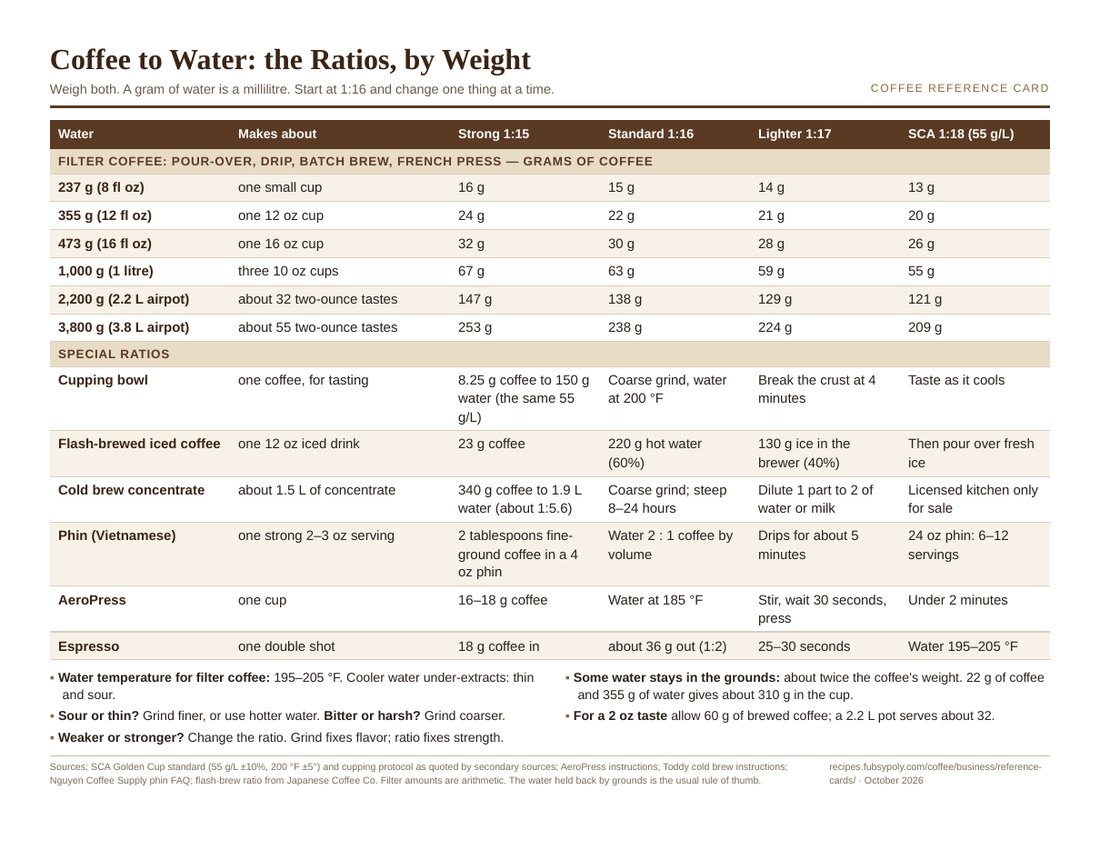
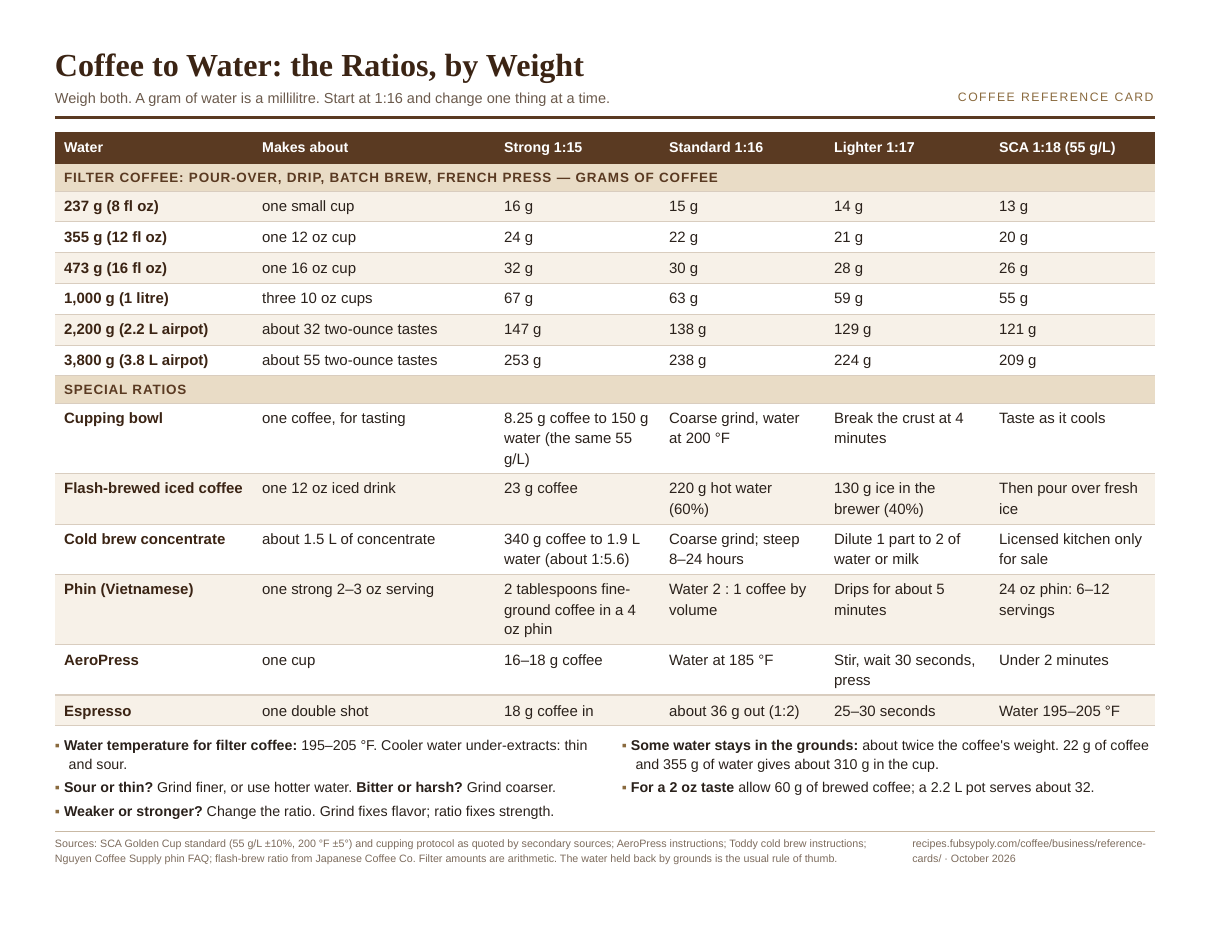
Coffee to Water: the Ratios, by Weight
How much coffee for how much water, by weight, from one cup to a 3.8-litre airpot, with the special ratios for cupping, flash brew, cold brew, phin, AeroPress and espresso.
The card counts tastes at 2 oz (about 32 from a 2.2-litre pot); Sampling pours 1½ oz, which gets about 43 from the same pot. Its 12 oz cup takes 22 g at 1:16; the stall’s menu uses 20 g for a cup that leaves room in a 12 oz cup (The Drinks).
Download the PDF · Web version
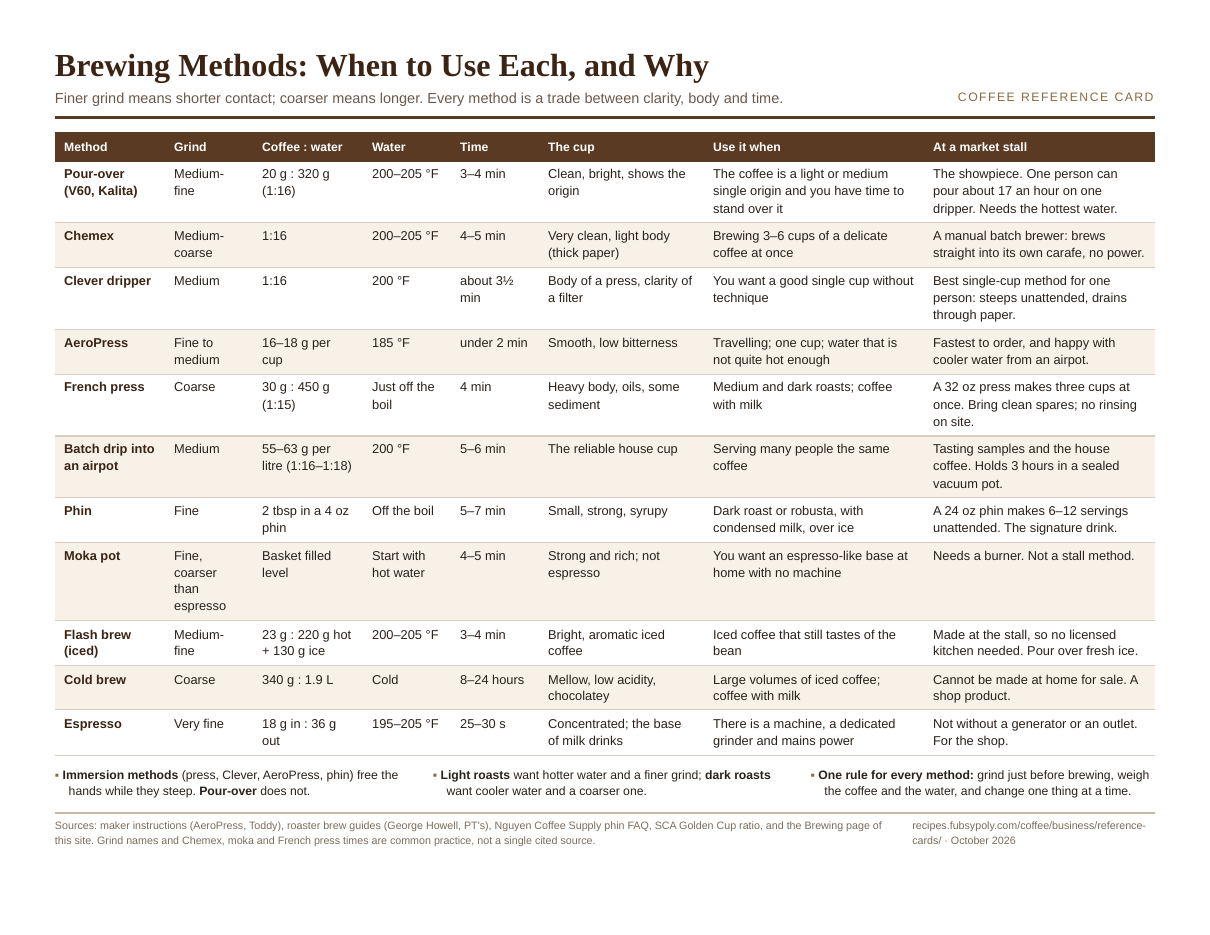
Brewing Methods: When to Use Each, and Why
Eleven methods side by side: grind, ratio, water temperature, time, what the cup is like, when to use it, and how it behaves at a market stall.
Download the PDF · Web version
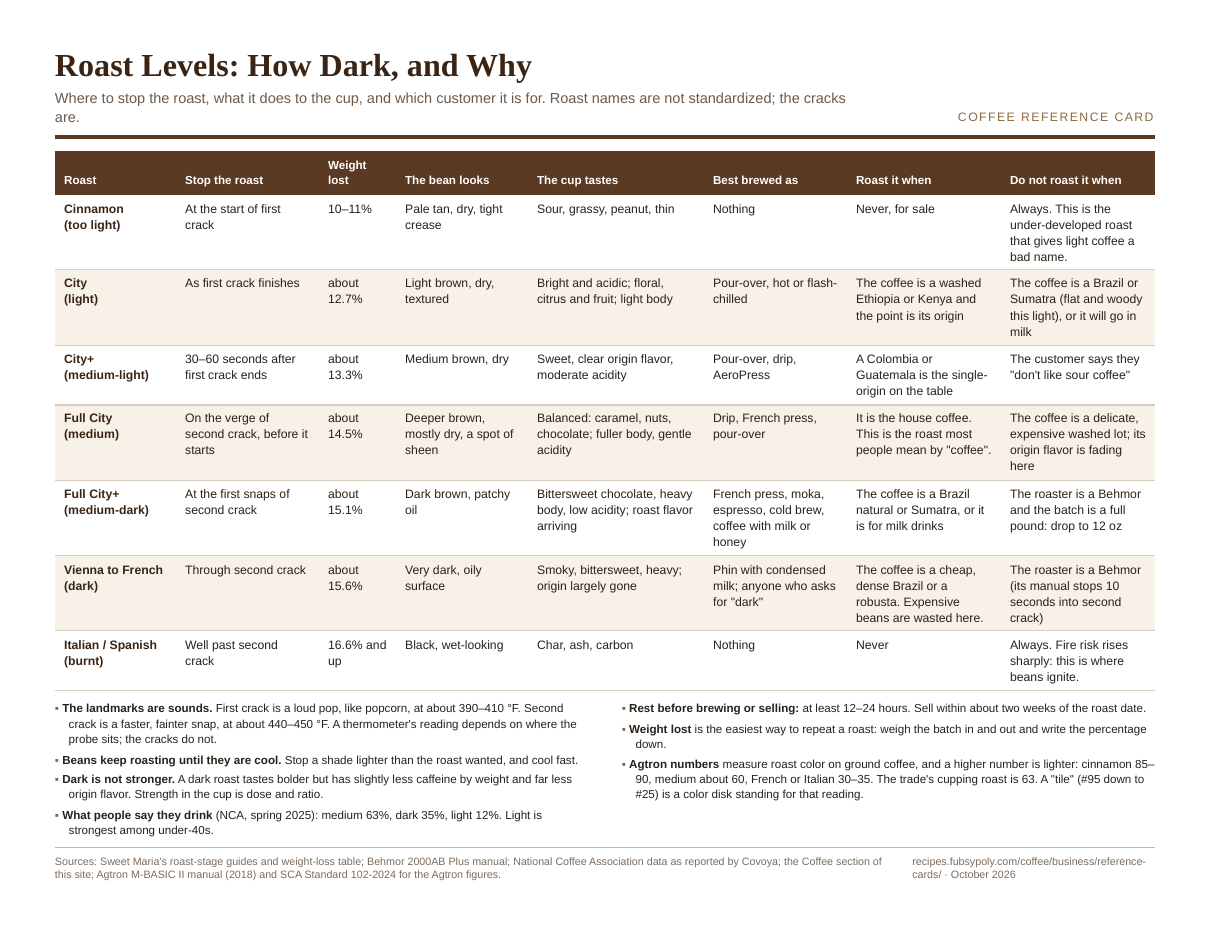
Roast Levels: How Dark, and Why
From too light to burnt: where to stop the roast, the weight lost, what the bean looks like, what the cup tastes of, and when not to roast it that way.
Download the PDF · Web version
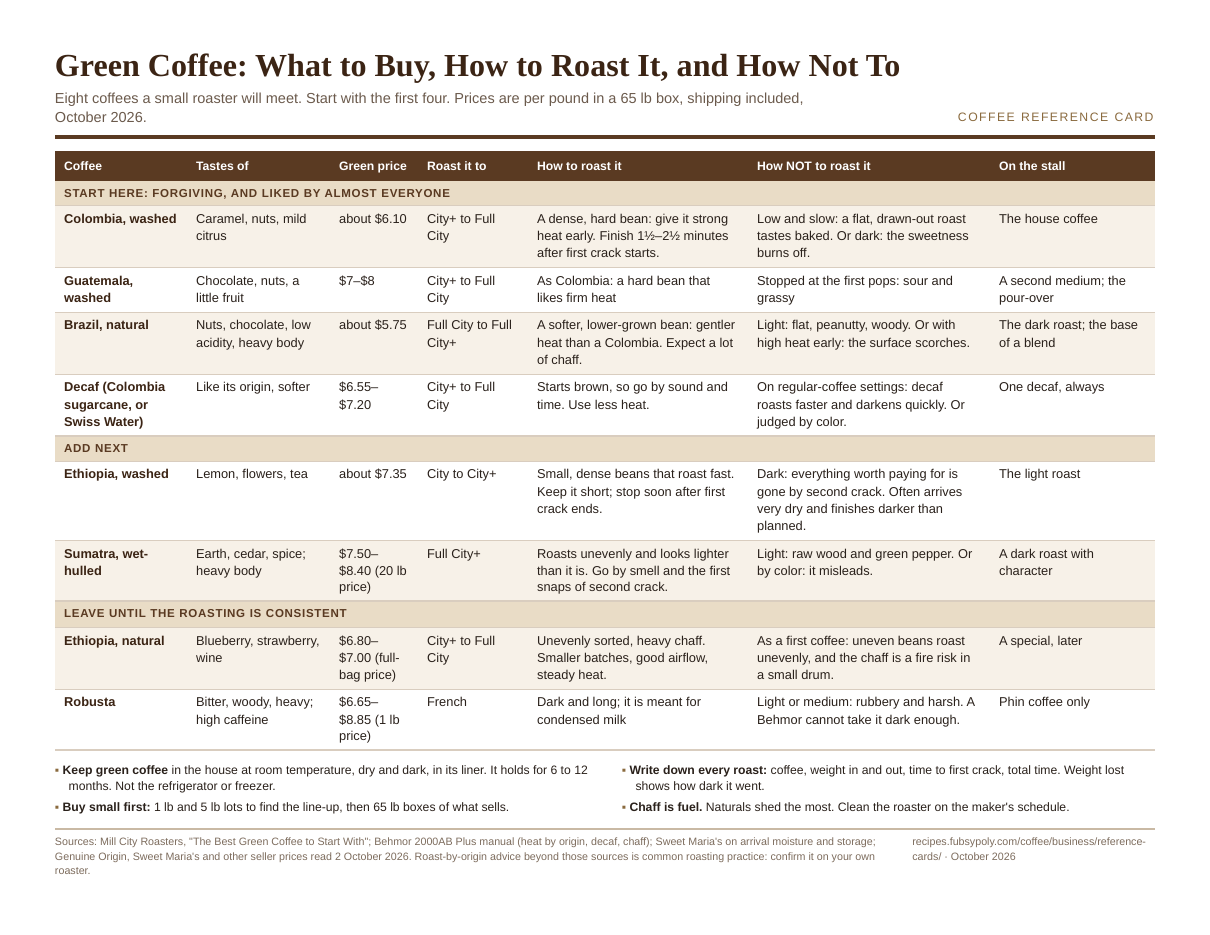
Green Coffee: What to Buy, How to Roast It, and How Not To
Eight green coffees: what each tastes of, what it costs, how to roast it and, in its own column, how not to.
Download the PDF · Web version
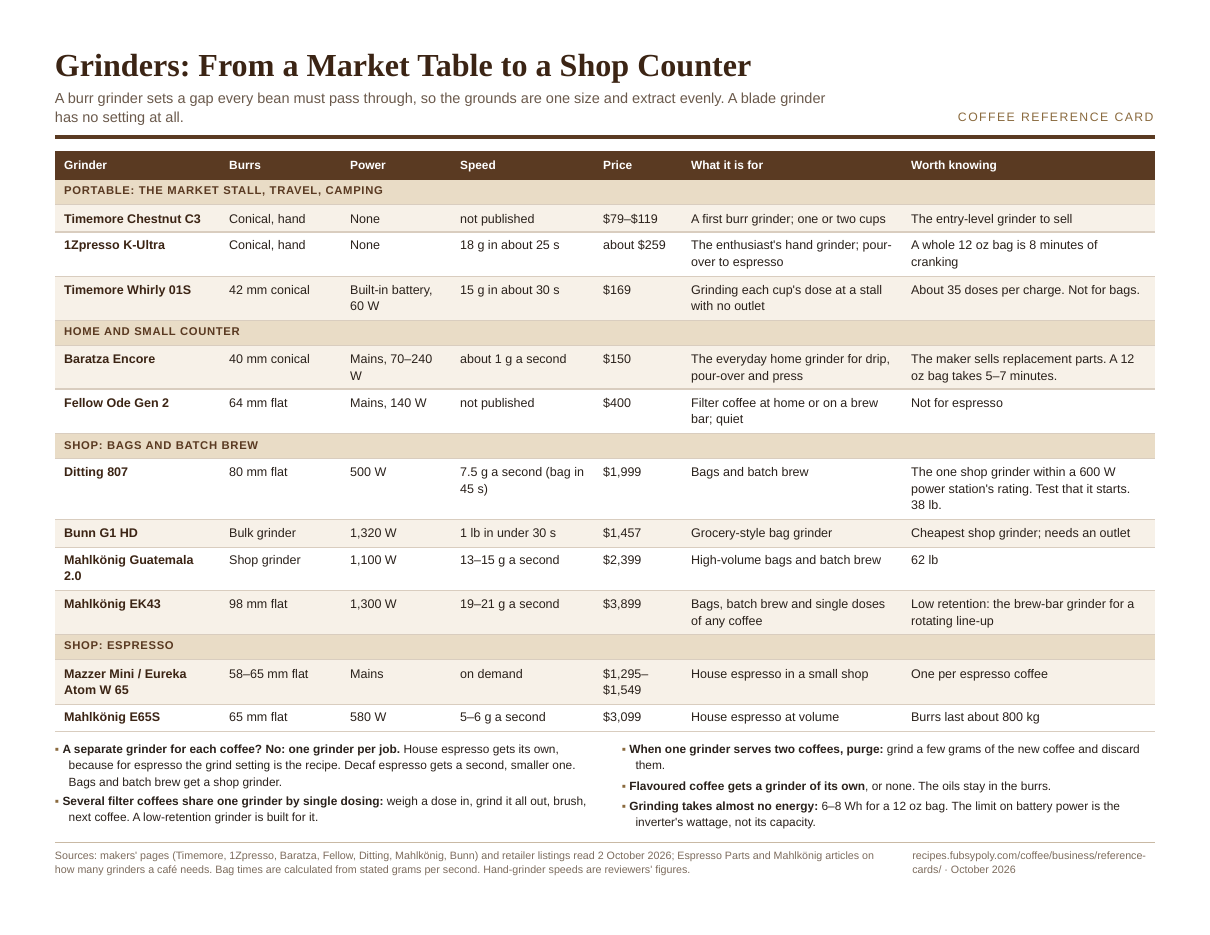
Grinders: From a Market Table to a Shop Counter
From a hand grinder for a market table to a shop grinder, with burrs, power, speed and price, and the answer to whether each coffee needs its own grinder.
Download the PDF · Web version
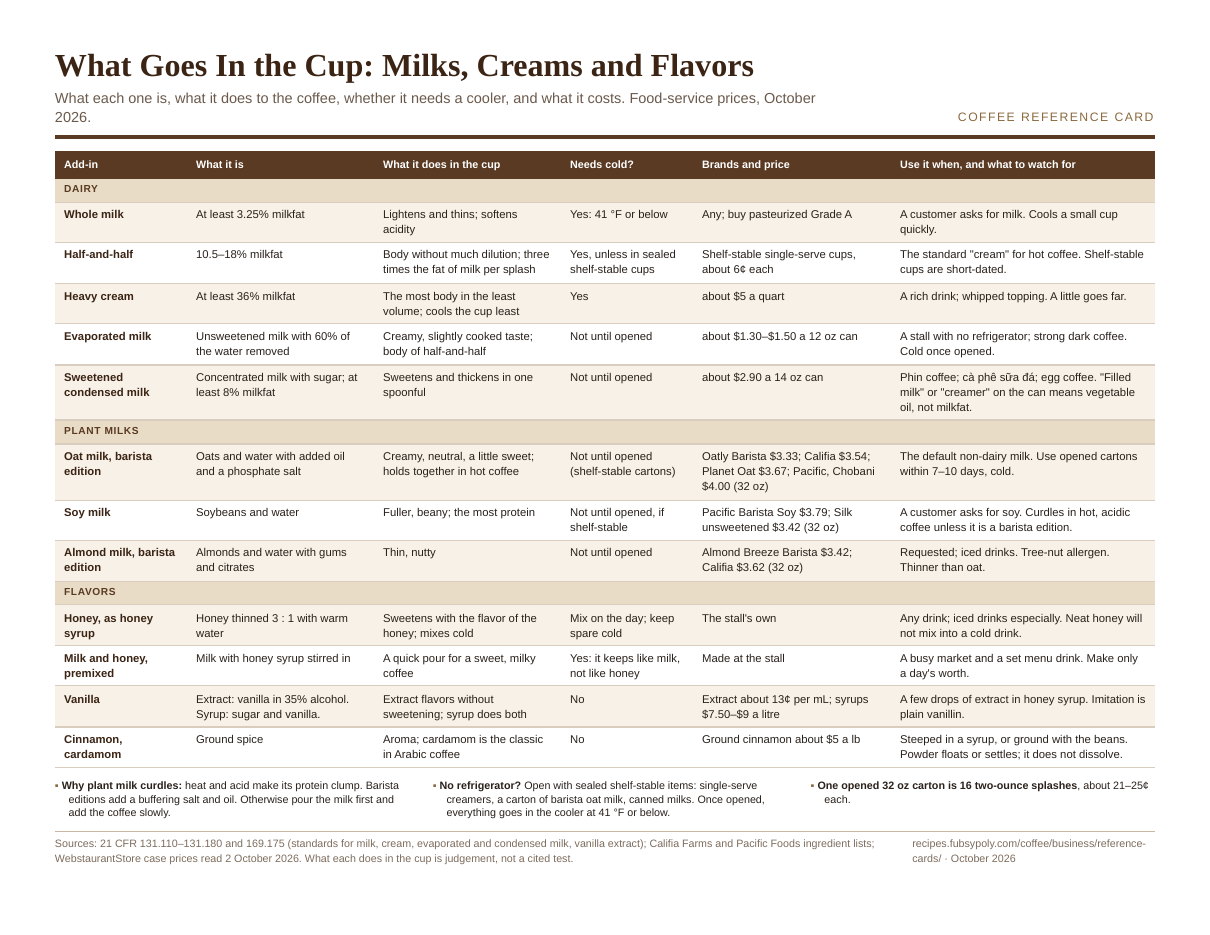
What Goes In the Cup: Milks, Creams and Flavors
Milk, cream, condensed and evaporated milk, oat, soy and almond milk, honey, vanilla and spice: what each is, what it does, and whether it needs a cooler.
Download the PDF · Web version
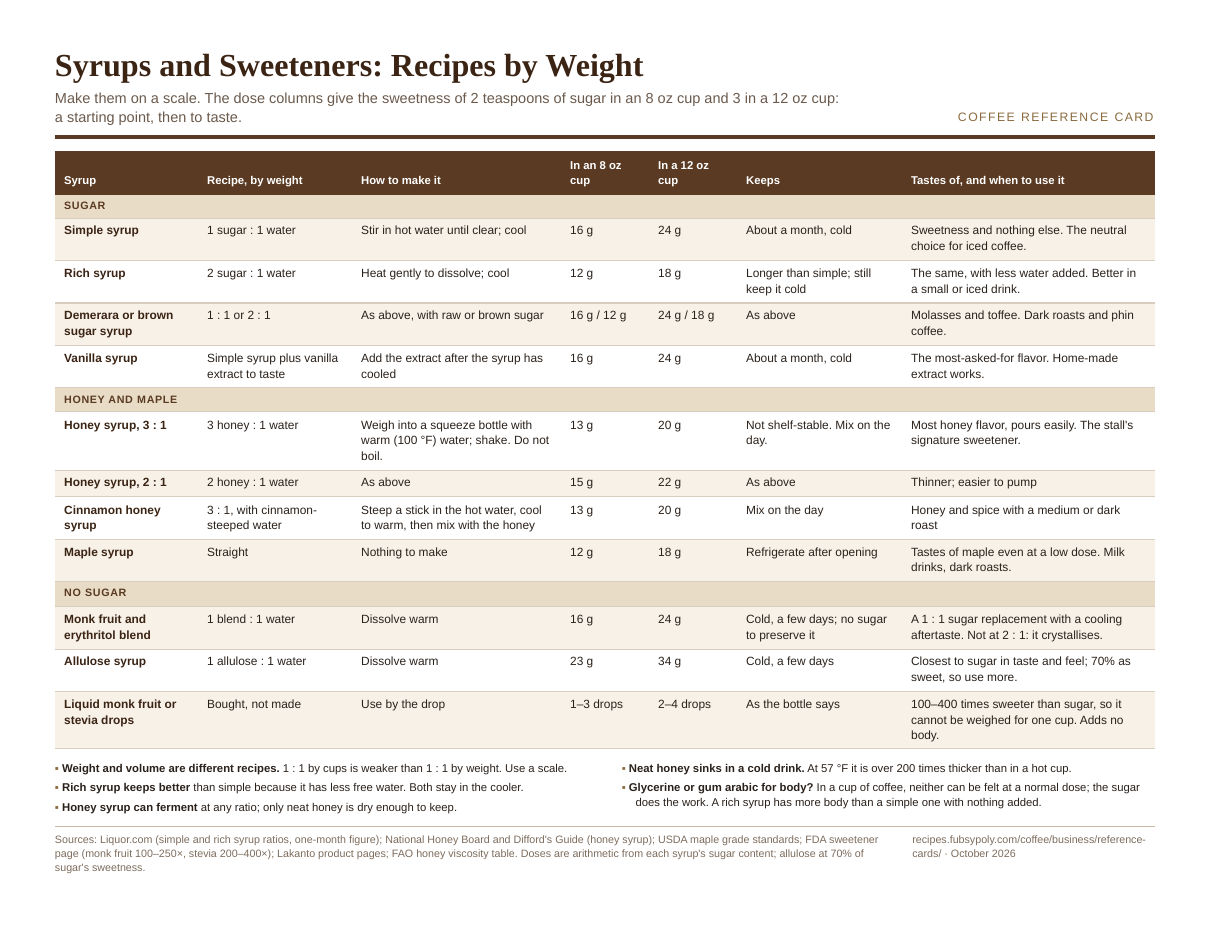
Syrups and Sweeteners: Recipes by Weight
Simple, rich, demerara, vanilla, honey, maple and sugar-free syrups, by weight, with the dose for an 8 oz and a 12 oz cup. The reasoning, and the case for and against glycerine and gum arabic, is on Syrups.
Download the PDF · Web version
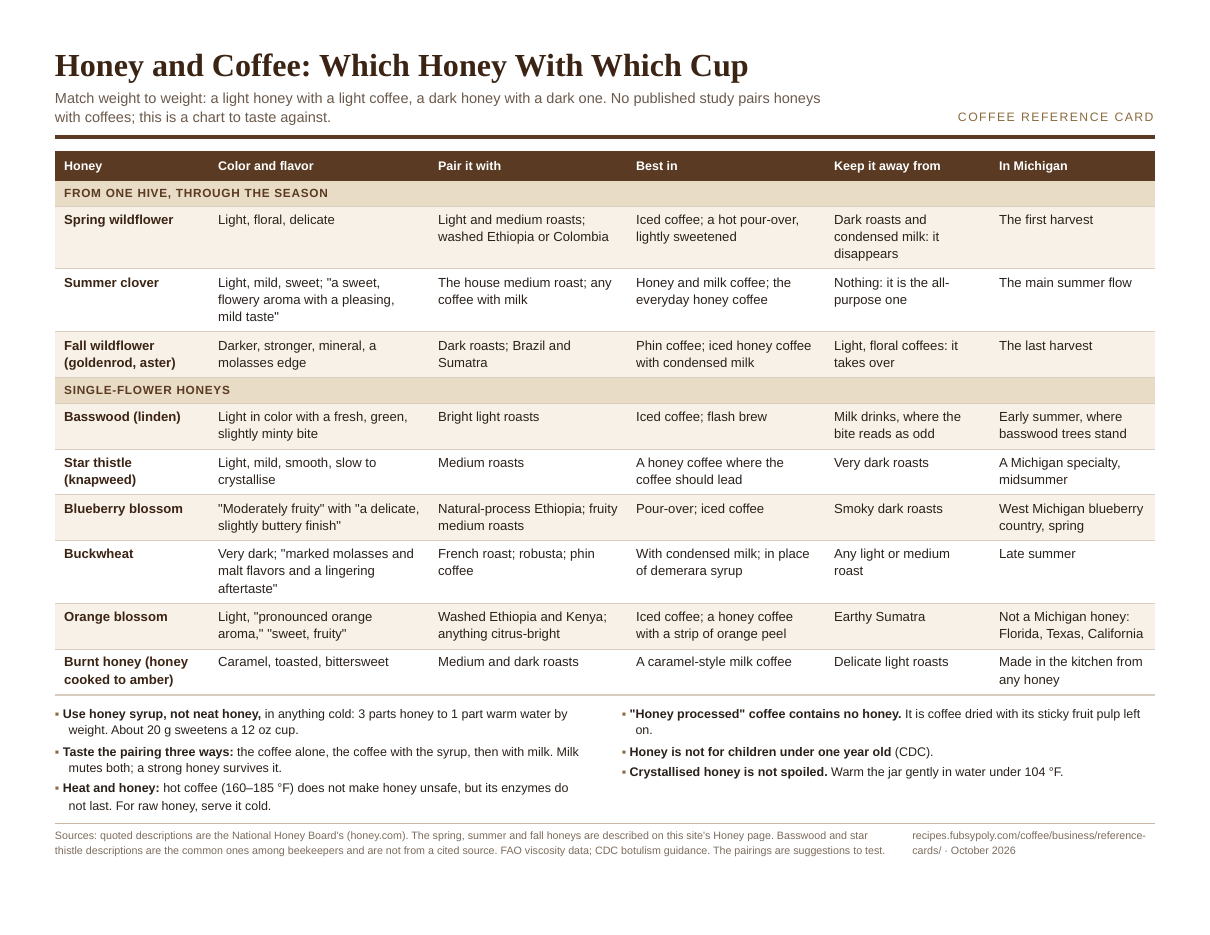
Honey and Coffee: Which Honey With Which Cup
Nine honeys, from a light spring wildflower to buckwheat, and the coffee each suits.
Download the PDF · Web version
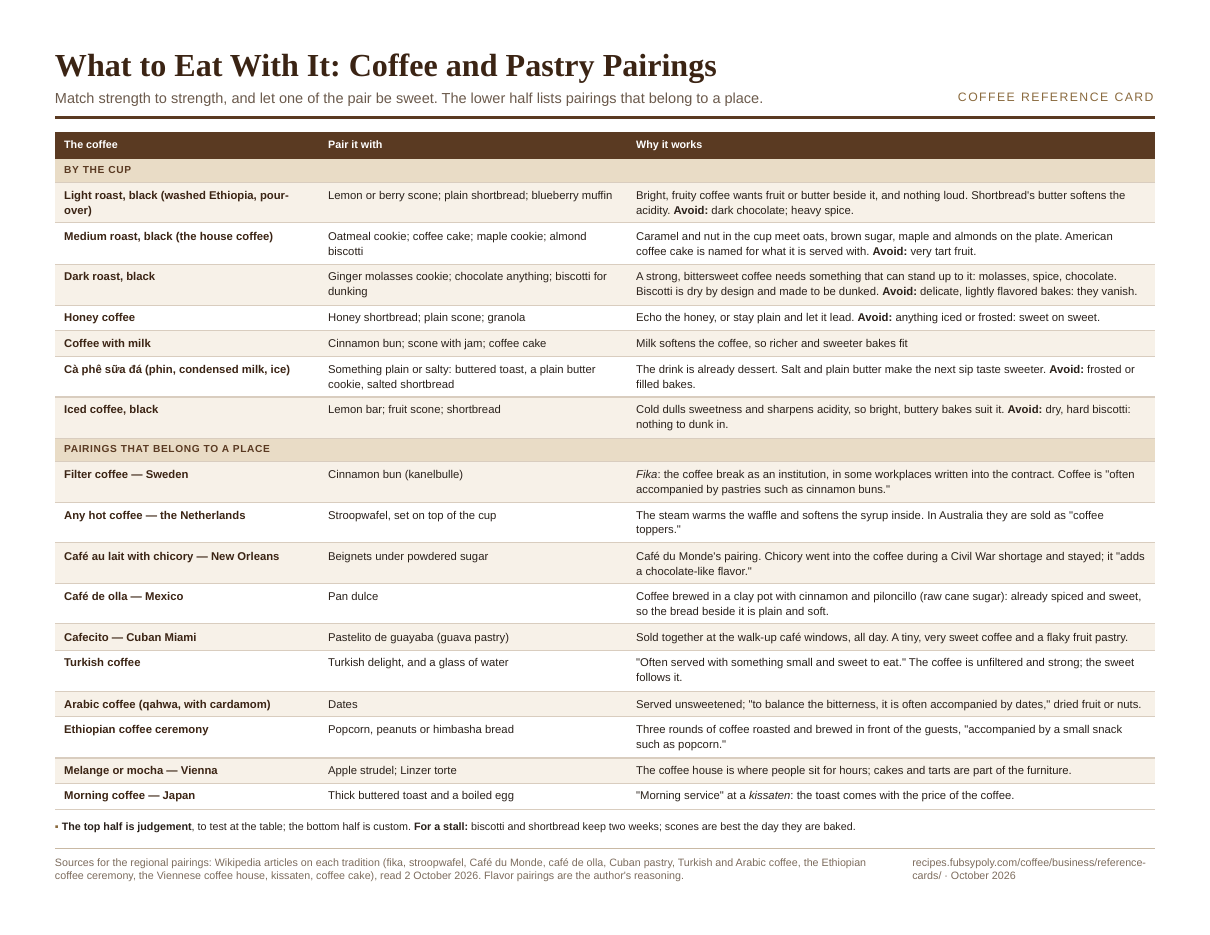
What to Eat With It: Coffee and Pastry Pairings
Which bake goes with which cup and why, and the pairings that belong to a place: cinnamon buns in Sweden, beignets in New Orleans, dates with Arabic coffee.
Download the PDF · Web version
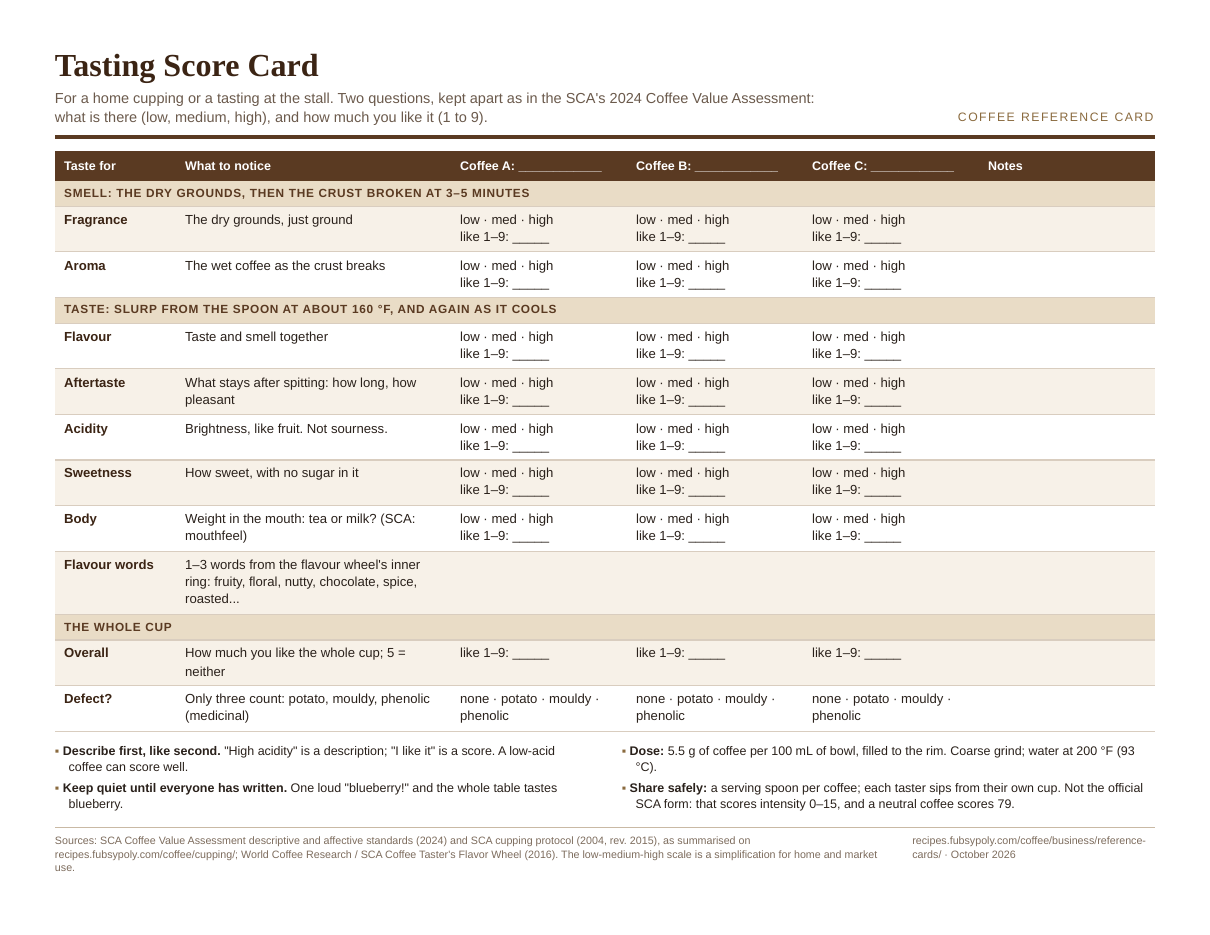
Tasting Score Card: Describe It, Then Say How Much You Like It
A score sheet for three coffees at a home cupping or a stall tasting: fragrance, aroma, flavour, aftertaste, acidity, sweetness and body, each marked low, medium or high and then liked from 1 to 9, with a row for flavour words, an overall score and the three defects. It borrows the idea of the SCA’s Coffee Value Assessment, describing and liking kept apart, in plain words; how a cupping runs is on Cupping.
Download the PDF · Web version
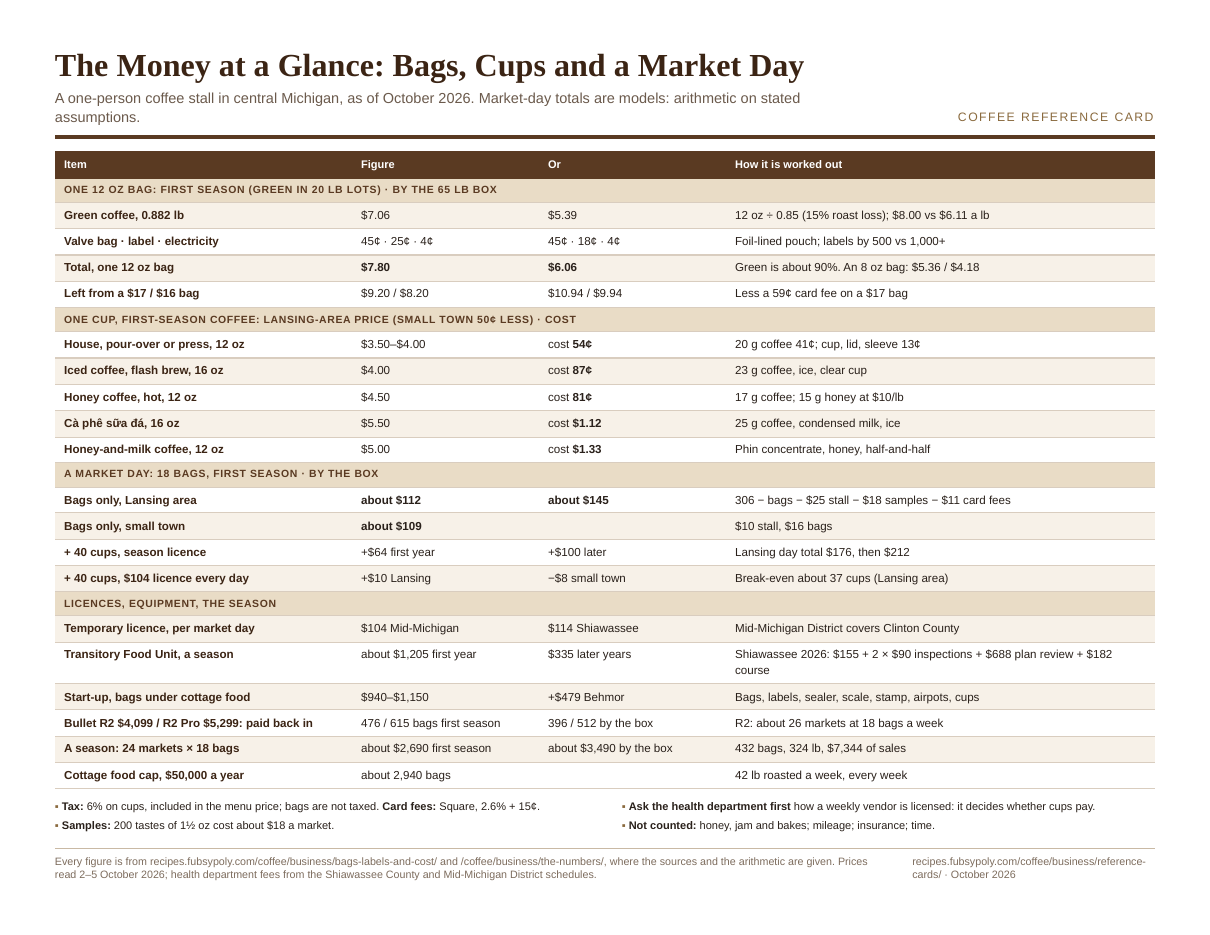
The Money at a Glance: Bags, Cups and a Market Day
What a 12 oz bag costs to make in the first season and by the box, what each cup costs against its price, the market day modelled with and without cups, the licence fees, the start-up cost and how many bags pay for a Bullet R2. Every figure comes from Bags, Labels and What a Bag Costs and The Numbers, where the arithmetic is shown.
Download the PDF · Web version
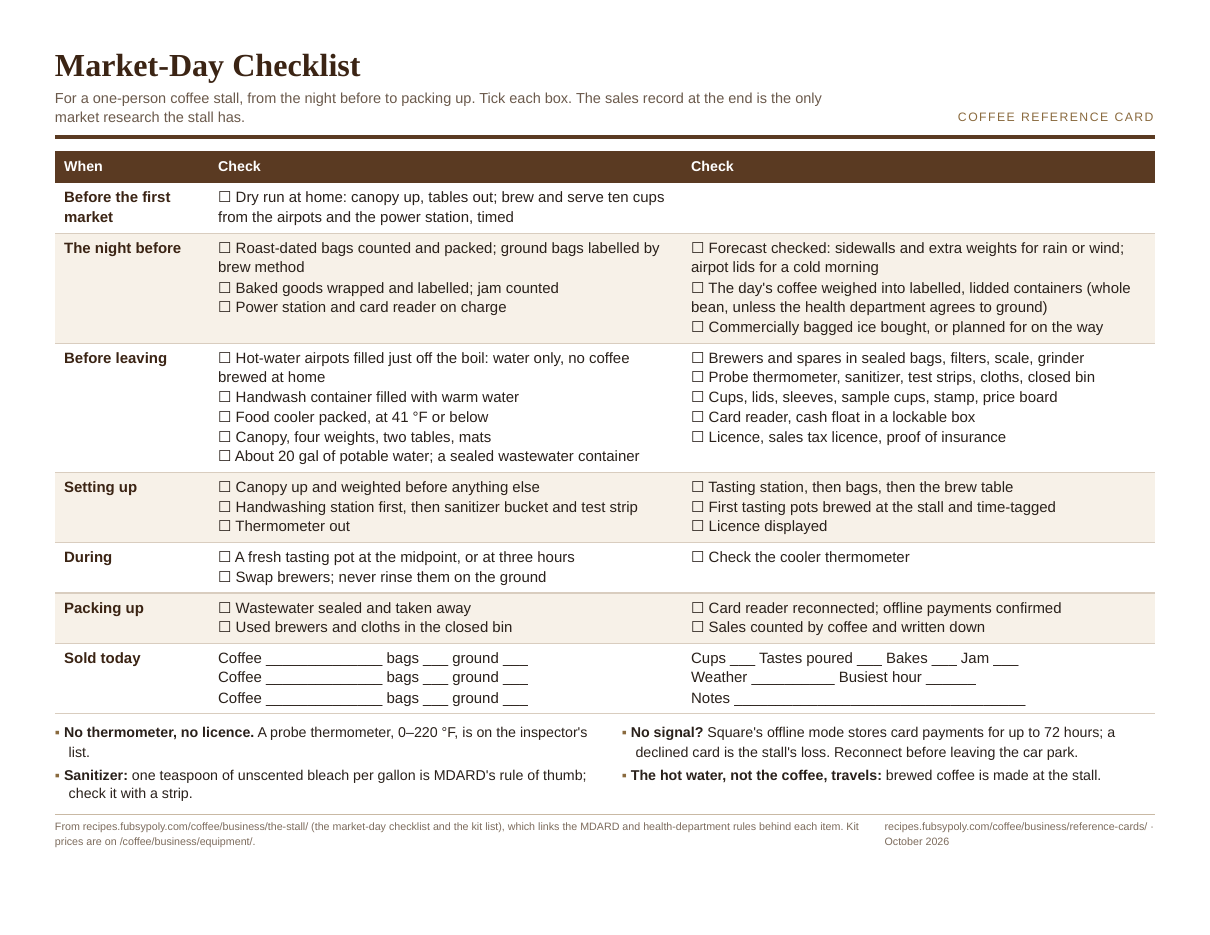
Market-Day Checklist
The checklist from The Stall as a sheet to tick: the night before, before leaving (with the kit to pack), setting up, during the market and packing up, and a box at the bottom to write down what sold.
Download the PDF · Web version
Using them
- Print on plain letter paper, landscape, at 100%. The type is small on the densest cards; card stock or a laminate makes them last on a bench.
- The numbers are starting points. The roast, the grinder and the water all differ from one kitchen to the next; write the corrections on the card.
- Prices on the cards are from October 2026.
Comments (0)