Starting a Coffee Business · 4 of 39
Catering and Event Coffee Carts
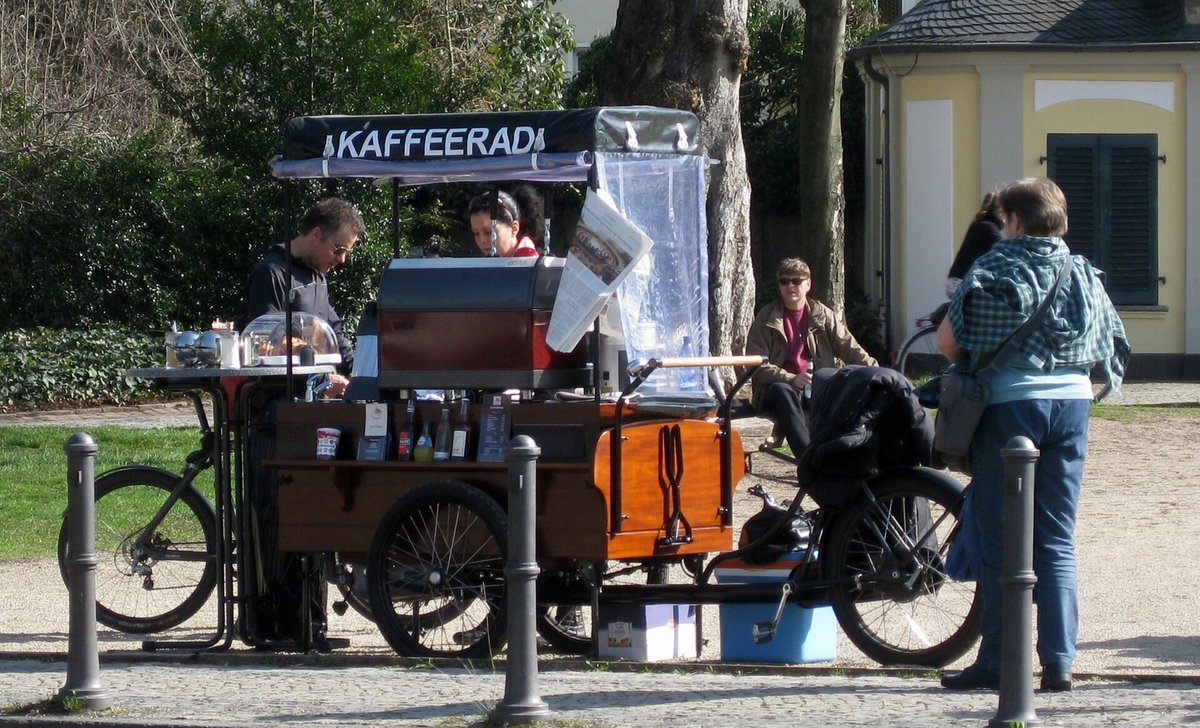
A wedding, an office meeting, an open house, a farm dinner or a festival will pay for coffee brought to them. Event coffee is sold by the hour or by the guest rather than by the cup, so one booking can be worth a whole market season’s Saturday, and it happens on weekdays and evenings when markets do not. It is also the coffee job with the most moving parts: a quote, a contract, a deposit, a licence that depends on the county, power at a venue that may not have it, and a hundred people who all want coffee in the same fifteen minutes after the cake.
This page covers the three ways to serve, what each costs to set up, how caterers price, how much coffee a crowd drinks, staffing, the Michigan licence question, insurance and contracts, and two worked quotes. Prices are as published on 5 October 2026. I have sold coffee across a counter before, in my coffee and ice cream shop in Beaufort, South Carolina, around 1990, where nearly all of it was ground on site and brewed in French presses. Event catering is part of the plan for the stall, not something I do now.
The short version
| Question | Answer |
|---|---|
| The three service models | Airpot station (batch-brewed coffee in insulated pots), pour-over bar (made to order by hand), espresso cart (a machine and a barista). Cheapest and fastest to slowest and dearest. |
| What a Michigan coffee caterer charges | Peculiar Coffee in Lansing: espresso-bar “Packages start at $400,” a two-hour standard service, unlimited drinks, travel in the quote. |
| How much coffee a crowd drinks | Plan on about one 8 oz cup per guest after a wedding dinner and 1½ cups a person at a morning meeting; these are planning assumptions, not a published standard. |
| Set-up cost | An airpot station: a few hundred dollars more than a market stall already owns. An espresso cart: $14,289 for a ready-made Astra coffee cart before the machine. |
| Coffee without power | Airpots filled with water boiled elsewhere, a pour-over bar, or a manual lever espresso maker (Espresso Without Power). |
| Licence | Serving brewed coffee is food service. A temporary licence per event ($104 to $126 in the counties on the rules page) or an annual Transitory Food Unit licence. Whether a private, invitation-only event needs one is a question for the county. |
| Worked quotes | 120-guest wedding, attended airpot station: about $720. 40-person office morning: about $250, or $350 if a temporary licence is needed for one morning. |
The three ways to serve
| Airpot station | Pour-over bar | Espresso cart | |
|---|---|---|---|
| What the guest gets | Drip coffee, decaf, hot water for tea, milk and honey at the side | One cup brewed to order from a choice of two or three coffees | Lattes, cappuccinos, americanos, iced drinks |
| Speed | As fast as guests can pour | About 50–60 cups an hour for one person running four drippers (an estimate from a 3½–4 minute brew) | About 30–40 drinks an hour per barista on one group (an estimate from a 25–30 second shot plus steaming milk) |
| Staff | One attendant, or none for a drop-off | One person per four drippers | One barista per group, plus a helper for a crowd |
| Power at the venue | None needed if water is boiled elsewhere; a brewer on site needs an outlet | A kettle, or airpots of hot water | A commercial machine needs a dedicated circuit; Peculiar Coffee’s own words are “You point us at an outlet” |
| Set-up cost beyond the market kit | Airpots, a cart or table, a decaf | Drippers, a stand, a second kettle | A cart, a machine, a grinder: thousands |
| Fits | Weddings after dinner, offices, open houses, funerals, any crowd that arrives at once | Farm dinners, small offices, a tasting at a gallery opening | Weddings that want a show, corporate events, festivals with a long line |
The speeds in the table are estimates from brewing times, not measurements; the first few events will replace them.
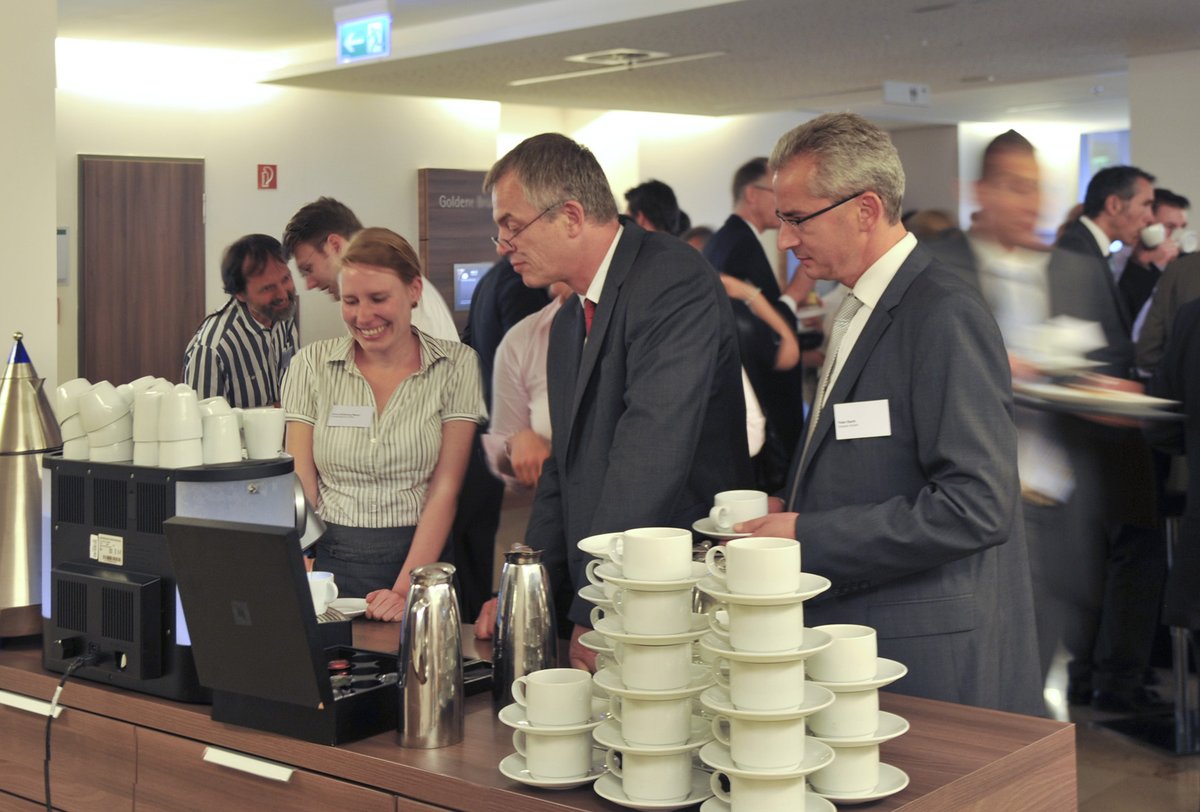
An airpot station is the market-stall kit doing a different job. Coffee is brewed in batches, held in vacuum airpots and served from the pump. It is the only model that serves a hundred people in fifteen minutes. Brew close to service: in the one published test, coffee in a sealed carafe was as well liked at three hours as at thirty minutes, and nothing longer was tested, so coffee brewed at dawn for an evening wedding is outside anything known.
A pour-over bar is the stall’s pour-over at a party, and it is the one model where the roaster’s own coffees are the attraction. It is slow by design, so it fits forty guests, not two hundred; at a larger event it is the special beside an airpot station.
An espresso cart is what most people mean by “a coffee cart.” It sells the experience as much as the coffee, and it costs the most: a cart, a commercial machine, a grinder, milk held cold, a dedicated power circuit, and a trained barista per group head.
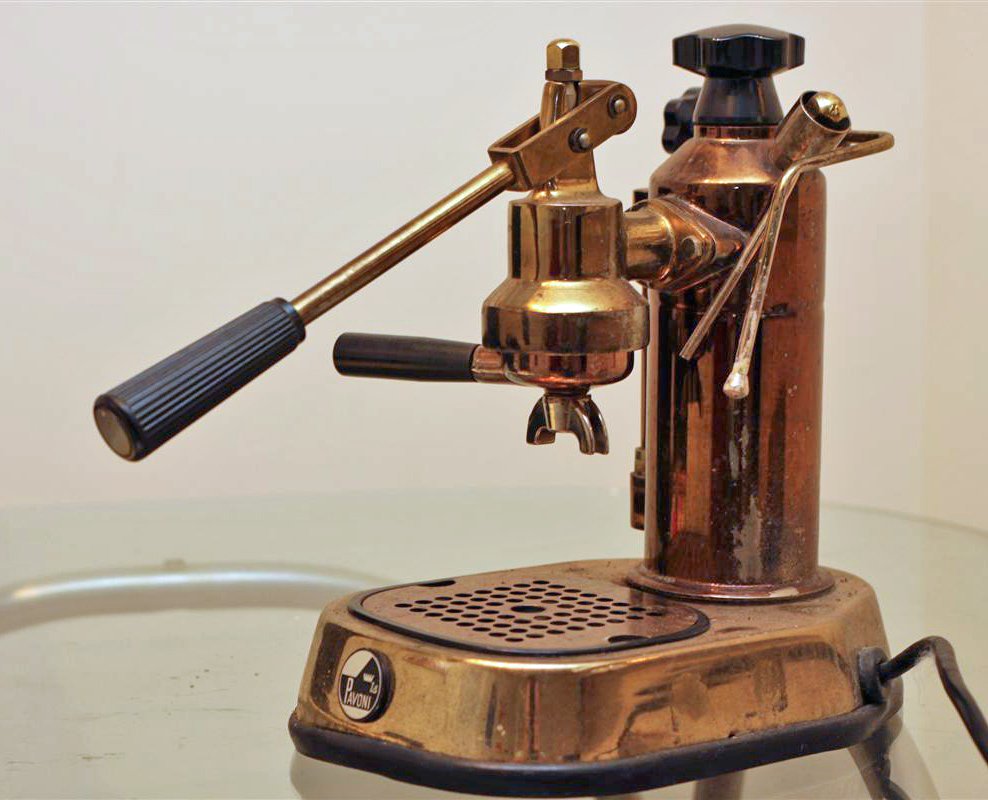
Espresso without power. A manual lever maker pulls a shot with arm pressure and water from a kettle. Flair sells the Classic at $159, the 49 Pro at $359 and the 58 Plus 2 at $699 as of October 2026. One lever maker makes perhaps fifteen to twenty drinks an hour in practised hands (an estimate, not a measurement), which suits a farm dinner of thirty and nothing larger. It is a special, not a service model.
What it costs to set up
| Item | Price, October 2026 | Notes |
|---|---|---|
| Wheeled beverage cart, Safco | $519 | A rolling shelf, not a bar |
| Beverage service cart with doors, Cambro | $1,699 | Two doors; built for catering service |
| Mobile coffee cart, Astra “Mobile Chic,” 30 × 72 in. | $14,289 | A finished bar; machine extra |
| Mobile coffee kiosk, Lakeside | list $15,101.50 | |
| Portable hand sink with heated water, PolyJohn, Paragon or Ozark River | $1,419–$1,939 | The market booth’s insulated-jug set-up may be accepted instead; ask the county |
| Airpot brewer, plumbed, Bunn CWTF15-APS | $980 | Needs a water line: a shop or base kitchen, not a venue |
| Vacuum airpots, 3.8 L | $28–$100 each (Equipment) | Eight to ten for a 120-guest event |
| Manual lever espresso maker (Flair) | $159–$699 | |
| Cups, lids, sleeves | 13¢ a set (Cups, and Standing Out) | Many venues supply china for weddings; ask |
A ladder of set-ups:
- The market kit, as it is: airpots, a table, a canopy, the handwashing jug. Office mornings and open houses. Nothing new to buy but more airpots.
- Plus a pour-over stand with four drippers and a second kettle: farm dinners, a special at a wedding.
- Plus a rolling cart ($519–$1,699) and a self-contained hand sink ($1,419–$1,939): a venue that wants a tidy station indoors.
- A built espresso cart with a commercial machine and grinder: a business of its own, and a truck or trailer is the next step from there.
A used cart, a used machine and a used grinder cut the fourth rung by half or more; Equipment has which used gear is safe to buy.
How much coffee a crowd drinks
No industry body publishes a figure for cups per guest, so the quotes on this page use stated assumptions:
| Event | Assumption | Coffee per 100 guests |
|---|---|---|
| Wedding, after dinner | 1 cup (8 oz) per guest, a quarter of it decaf | 100 cups, about 24 litres; about 3 lb of roasted coffee |
| Office morning, 2 hours | 1½ cups per person | 150 cups, about 36 litres; about 4½ lb |
| Open house or farm event, all afternoon | 1 cup per visitor | as the wedding |
| Festival booth | Counted in cups sold, as at a market | The Numbers |
Arithmetic: an 8 oz cup is 237 ml; 100 cups is 23.7 litres; at about 55 g of coffee to a litre (Ratios), 24 litres takes 1.3 kg, which is 2.9 lb. Add 10% for spills, refills and the last pot.
One 3.8-litre airpot holds about 16 eight-ounce cups. A 120-guest wedding wants about eight pots, brewed in rounds so the last ones are fresh.
How caterers price
Coffee caterers price in one of three ways, often combined:
- A package with a floor. Peculiar Coffee, a Lansing espresso caterer, builds each quote on “your guest count, service duration, menu, and venue”; “Packages start at $400”; “Our standard event is a two-hour service”; guests “can order as many drinks as they want during service”; travel “is factored into your quote.” Its package includes the barista, “Stylish espresso bar with commercial-grade coffee equipment,” and a standard café menu with tea and hot cocoa, with add-ons such as cold brew and custom cups.
- Per guest, for airpot service: a price per head with a minimum.
- Per hour, with a minimum number of hours, for a barista and a machine.
The price has to cover the coffee and cups, which are small; the people, who are most of it; the travel; the licence, if one is needed for that event; and a share of the equipment and insurance. A price built from those is on the worked quotes below.
A catering cart, which goes to its customers, is the one coffee business that fits a Google service-area profile (Marketing on a Shoestring).
Staffing
| Event | Model | People |
|---|---|---|
| Office morning, 40 people | Airpot station | One |
| Wedding, 120 guests | Attended airpot station | Two: one serving, one brewing and restocking |
| Wedding, 120 guests | Espresso cart, two hours | Two baristas on a two-group machine, at the estimated 30–40 drinks each an hour |
| Farm dinner, 30 | Pour-over bar or lever espresso | One |
Anyone handling food at a licensed event works under the licence holder’s food-safety rules, and a Transitory Food Unit needs a certified food protection manager (Food-Safety Certification). Help that is paid is an employee; Michigan’s workers’ compensation threshold is on Insurance.
The licence question in Michigan
Michigan’s Food Law defines a food service establishment to include a “catering kitchen,” a “food concession,” and any “place in which food or drink is prepared for direct consumption through service on the premises or elsewhere,” and “any other eating or drinking establishment or operation where food is served or provided for the public” (MCL 289.1107(t)). Brewed coffee is a drink prepared for direct consumption. The routes:
| Route | What it is | Cost | Fits |
|---|---|---|---|
| Temporary food establishment licence, per event | One location, up to 14 consecutive days | $104 (Mid-Michigan District) to $126 (Bay County), plus late fees (the county table) | An occasional wedding or festival |
| Transitory Food Unit, annual | A licence to operate anywhere in the state without the 14-day limit | $155–$165 plus two $90 inspections, a plan review, and a certified manager (The Numbers) | Regular events, and the market stall on the same licence |
| A licensed base kitchen, with the event as its extension | Coffee brewed in a licensed food service establishment and carried to the event | The base’s licence | Drop-off airpots for offices |
The third route comes from the statute itself. “If food is prepared in a food service establishment licensed under this chapter and the food is transported from the food service establishment to a fixed temporary serving location, the serving location is not required to be separately licensed… if no food preparation is conducted at the serving location and the food is transported and served by employees of the food service establishment” (MCL 289.4105(3)). Coffee brewed in a licensed kitchen, such as an incubator kitchen, and carried to an office in airpots fits those words. A cart that grinds and brews at the venue is preparing food there, and does not.
What the law does not settle is the private event. The definition ends “served or provided for the public,” and a wedding reception for invited guests, paid for by the couple, may or may not be “the public” in the county’s reading. The coffee itself has its own question: whether a licensed booth may brew coffee roasted at home under cottage food (question 9 on the rules page). Coffee from a toll roaster or a licensed roastery settles that one.
Questions for the county health department (environmental health), in writing:
- Does coffee served by a hired caterer at a private, invitation-only event (a wedding, an office meeting) need a food service licence?
- If so, is a temporary licence per event right, or a Transitory Food Unit for a business doing events most weeks?
- May coffee brewed in a licensed kitchen and delivered in airpots to an office be served there as an extension of that kitchen under MCL 289.4105(3), including a drop-off with no attendant?
- At an event where a licensed caterer is already serving the meal, can the coffee be served under the caterer’s licence?
- For a cart at a venue with running water, is the venue’s handwashing sink acceptable, or must the cart carry its own?
The events are in different counties, so ask each county the cart will work in.
Sales tax. Coffee in a cup is prepared food, taxed at 6% (the rules page). Whether set-up, travel and service charges on a catering invoice are taxed with the coffee is a question for Treasury; the quotes below show tax on the whole invoice, which is the cautious reading.
Insurance
Every venue will ask for a certificate of insurance naming it as an additional insured, and some ask for it a month ahead. The food-vendor programme on Insurance (FLIP, from $299 a year, $1,000,000 per occurrence, product liability included, unlimited additional insureds) is written for market and event vendors and excludes fixed premises. Two questions to ask before the first booking: does the policy cover off-premises catering at a private event, and does it cover the gear in the car on the way? The burn risk of hot coffee in a crowd, and what to do about it, is on Serving Hot Drinks Safely.
Contracts and deposits
A booking is a contract, and a written one prevents most of the disputes. A one-page agreement should cover:
- Date, start and end of service, address, the contact on the day.
- The service model, the menu, and the guest count, with the date by which the final count is due.
- Price, what it includes, and what costs extra (extra hours, guests over the count, travel beyond a radius, a licence for that county).
- Deposit: a share of the total due at booking to hold the date, and when the balance is due (before or on the day).
- Cancellation: whether the deposit is refunded, and up to when.
- What the venue supplies: power (the circuit and the distance to it), water, a table, access time for set-up, china or not.
- Weather plan for an outdoor event.
- Insurance certificate: who is named, by what date.
- Who may serve what: alcohol in coffee drinks is out unless the venue’s licence covers it.
The deposit terms I plan to use: half on booking, not refunded inside 30 days of the event, and the balance a week before. That is a plan, not an industry rule.
Worked quote: a 120-guest wedding
Assumptions: an attended airpot station after dinner, two hours of service, regular and decaf coffee, hot water and tea, milk, half-and-half and honey; 30 miles each way; two people; the venue supplies china. First-season coffee costs from The Numbers (2.07 cents a gram).
| Cost | Working | Amount |
|---|---|---|
| Coffee | 120 cups + 10% = 31 litres; 31 × 55 g = 1,705 g × 2.07¢ | $35 |
| Milk, half-and-half, honey, tea, stirrers, napkins | $40 | |
| Disposable cups for the guests who wander off with one | 40 sets × 13¢ | $5 |
| Labour | 2 people × 5 hours (load, drive, set up, 2 hours of service, clear) at an assumed $25 an hour | $250 |
| Travel | 60 miles at an assumed 70¢ a mile | $42 |
| Equipment, insurance share | $25 | |
| Cost, no licence | $397 | |
| Temporary licence, if the county requires one | $104 | |
| Cost with a licence | $501 |
The quote: $6.00 a guest, minimum $400, which is $720 for 120 guests; with 6% tax, $763.20. At that price the job leaves about $220 over cost with a licence and $320 without, after paying both people $25 an hour. A pour-over special for the head table adds about an hour and $75.
An espresso cart for the same wedding would need two baristas and a two-group machine on a dedicated circuit for two hours; at 30–40 drinks an hour each, that serves 120 to 160 drinks. Peculiar Coffee’s published floor of $400 is for its smallest package; a 120-guest espresso bar is quoted by guest count, hours and travel.
Worked quote: a 40-person office morning
Assumptions: two hours, 8:00 to 10:00; an airpot station with regular and decaf; 1½ cups a person; one person; 15 miles each way.
| Cost | Working | Amount |
|---|---|---|
| Coffee | 60 cups + 10% = 15.6 litres; 858 g × 2.07¢ | $18 |
| Cups, lids, sleeves | 70 sets × 13¢ | $9 |
| Milk, creamer, honey, sugar | $13 | |
| Labour | 1 person × 3½ hours at an assumed $25 | $88 |
| Travel | 30 miles at 70¢ | $21 |
| Cost, no licence | $149 | |
| Temporary licence, if required for one morning | $104 | |
| Cost with a licence | $253 |
The quote: $250 flat, or $6.25 a person, for up to 40 people; $350 if a temporary licence must be bought for the morning. The office-morning arithmetic shows the same thing as the market-day model on The Numbers: a per-event licence is the largest single cost of a small job. A business that does an event most weeks is cheaper on an annual Transitory Food Unit licence, or on a licensed base kitchen delivering airpots under MCL 289.4105(3) if the county agrees that fits. Offices that book every week become wholesale accounts instead.
What is not known
- How Michigan counties treat coffee at a private, invitation-only event.
- Whether a drop-off of airpots with no attendant counts as “served by employees” under MCL 289.4105(3).
- What Michigan coffee caterers charge beyond Peculiar Coffee’s published $400 floor.
- How many cups a guest drinks: the quotes use stated assumptions.
- How many drinks an hour one barista makes on one group, or one person on a pour-over bar; the figures here are estimates from brewing times.
Sources
- Peculiar Coffee pricing, Lansing page and menu, read 5 October 2026.
- MCL 289.1107 (definitions) and MCL 289.4105 (exemptions and extensions).
- County licence fees and the Transitory Food Unit, from The Michigan Rules and The Numbers, and their sources.
- WebstaurantStore listings for carts, portable hand sinks and the Bunn brewer, read 5 October 2026.
- Flair Espresso prices, read 5 October 2026.
- Insurance figures from Insurance and its sources.
Comments (0)