Starting a Coffee Business · 14 of 43
Hiring Your First Helper

A one-person coffee stall can run for a long time on one person. At some point it cannot: the line at the table is longer than one pair of hands can serve, a second market day comes along, or the roasting, the baking and the market all fall in the same week. That is when the question of help arrives, and with it a set of rules that most first-time employers have never read. I sell honey at farmers markets and I am planning a coffee stall beside it, so the day it needs a second person is part of the plan. What follows is set out in the order the decisions come.
The law here is federal and Michigan’s, as of October 2026. Each section says what changes in other states. Nothing here is legal or tax advice; where the answer is “ask,” the page says who and gives the question.
The short version
| Question | Answer |
|---|---|
| Can a friend “volunteer” at my stall? | Not under federal law. “Under the FLSA, employees may not volunteer services to for-profit private sector employers” (US Department of Labor). A coffee stall is a for-profit business. |
| Family? | Different rules. A spouse, or a child under 18 working for a parent, is not in “employment” for Michigan unemployment tax (MCL 421.43), and federal child-labour age limits do not apply to a parent employing their own child outside hazardous work (29 CFR 570.2). Paying them is still payroll. |
| Employee or contractor? | Almost certainly an employee. The test is control: the IRS looks at “the extent of the right to direct and control the worker” (IRS). Someone working your table, on your schedule, with your gear, is an employee. |
| The paperwork | EIN, state withholding registration, Form I-9, Forms W-4 and MI-W4, a new-hire report within 20 days, payroll taxes every payday, quarterly and annual returns. The timeline is below. |
| Minimum wage | $13.73 an hour in 2026, $15.00 from 1 January 2027 (Opening a Coffee Shop). Under 18: 85% of that, $11.67 and $12.75. Michigan’s wage law covers employers with two or more employees at one time; the safe plan is to pay the state rate anyway. |
| Unemployment tax | Michigan liability starts at $1,000 of wages in a year or someone employed in 20 weeks. New employers pay 2.7% on the first $9,000 of each person’s wages ($9,500 for an employer behind on its reports or payments). Federal: 0.6% on the first $7,000, after the state credit. |
| Workers’ compensation | Required at three employees at once, or one working 35 hours a week for 13 weeks (Insurance). One part-time market-day helper is usually below it; price a policy anyway. |
| Paid sick time | Yes, from the first hour: 1 hour for every 30 worked, usable up to 40 hours a year at a small business (MCL 408.963). |
| A teenager? | From 14. A state work registration is needed, and hours are limited, especially under 16. |
| Tips | The helper’s. The owner may not take a share of employees’ tips (29 U.S.C. 203(m)). |
| Payroll service? | For one helper, yes: Square Payroll is $35 a month plus $6 per person paid (Square). It files most of the returns on this page. |
| What does a helper cost a market day? | Six hours at $13.73 plus about 10% employer taxes is about $90; at $15.00 in 2027, about $99. |
When a stall needs help
Start Here sets out six stages, from a market table to a shop. Help turns up in a different place at each:
| Stage | Help usually needed? | Why |
|---|---|---|
| 1. A market table | No | One person can set up, sell and pack down a table of bags. |
| 2. Bags under cottage food | Rarely at the market; sometimes at home | The work that grows is roasting, cooling, bagging and labelling, and under cottage food that work happens in the home kitchen. Labelling and bagging help is still employment if it is paid. |
| 3. A licensed booth with cups | Often | Brewing to order, taking money and answering questions at once is where one person runs out of hands. A pour-over takes three to four minutes of attention; a line of six is twenty minutes. |
| 4. Truck, cart or catering | Usually for events | A wedding or office event of 100 cups wants one person at the station and one keeping the pots full (Catering). |
| 5. A licensed roastery | Sometimes | Production roasting and wholesale deliveries can still be one person’s week. |
| 6. A shop | Always | A café open eight hours needs two people at the morning peak (Opening a Coffee Shop). |
The money decides it as much as the line does. The Numbers models a market day: bags alone leave about $110 to $145, and adding forty cups under a season licence brings the day to about $176 to $212. A helper for six hours costs about $90 in 2026. On a bags-only day a paid helper takes most of what is left. On a cups day with a season licence, a helper costs about half of the day’s margin, and pays for themselves only if the second pair of hands sells more than about twenty extra cups or bags than one person could.
Signs it is time:
- People leave the line. Count them for three market days.
- Cups are the bottleneck and the bags sit unsold while you brew.
- You cannot leave the table to use a restroom or wash your hands without closing.
- A second market day, or a catering job, falls on a day you are already booked.
- The roasting and bagging for the week no longer fit before market day.
Some of those have cheaper answers than a hire: a batch brew in an airpot instead of pour-overs to order (The Drinks), pre-bagged weights, a card reader that takes tap payments without a signature (Taking Cards), or a shorter menu. Try those first.
Family, friends and “volunteers”
Friends and regulars
The kind offer from a friend to “help out at the market for coffee and a muffin” is the one the law is clearest about. The Fair Labor Standards Act allows volunteering for charities and public agencies, but the Department of Labor states plainly: “Under the FLSA, employees may not volunteer services to for-profit private sector employers.” Paying in coffee, product or a share of the take does not change the answer; payment in kind is still payment, and someone who works a for-profit stall regularly is an employee owed at least minimum wage.
A friend who stands in for ten minutes while you walk to the restroom is not a payroll question in practice. A friend who works the table every Saturday is.
Family
| Who | Michigan unemployment tax | Federal child-labour age rules | Minimum wage, income tax withholding |
|---|---|---|---|
| A spouse | Not “employment” (MCL 421.43(g)): “service performed by an individual in the employ of the individual’s son, daughter, or spouse” | Not relevant | If paid, wages are wages: withholding applies |
| Your child under 18 | Not “employment”: “service performed by a child less than 18 years of age in the employ of the child’s parent” | The minimum ages do not apply to “the employment by a parent of his own child,” except in the hazardous occupations closed to anyone under 18 and in manufacturing and mining (29 CFR 570.2) | If paid, the same |
| Your parent | Not “employment” (the same subsection: service for one’s son or daughter) | Not relevant | If paid, the same |
| Brother, sister, cousin, in-law | Ordinary employment | Ordinary rules | Ordinary rules |
Two things the table does not settle. First, how the business is set up matters: the family exclusions are written for a person’s own business, and an LLC taxed as a corporation is a separate employer; ask the accountant. Second, Michigan’s own youth employment law has its own scope, and the sections that set the hours and the registration do not name a parent’s business as an exception. Ask LEO’s Wage and Hour Division: “Does the Youth Employment Standards Act apply to my own 15-year-old working at my farmers-market coffee stall, and if so, do I register them?”
Paying family is often a sensible thing to do, and an accountant can say what it does to the household’s taxes. It has to be real: work actually done, at a rate that would be paid to anyone else, with records.
Employee or contractor
Calling a helper an “independent contractor” and handing over cash with no withholding is the most common mistake a small business makes with its first helper, and the label does not decide it. The IRS looks at three groups of facts:
| Category | The IRS question | At a coffee stall |
|---|---|---|
| Behavioral control | ”Does the company control or have the right to control what the worker does and how the worker does his or her job?” | You set the hours, the menu, the recipe and the price. Employee. |
| Financial control | How the worker is paid, who pays expenses, who supplies the tools | You own the table, the kettle, the grinder and the beans, and pay by the hour. Employee. |
| Type of relationship | Contracts, benefits, how permanent it is, whether the work is central to the business | Serving coffee is the business. Employee. |
The deciding principle, in the IRS’s words, is “the extent of the right to direct and control the worker.” Either side can ask the IRS to decide on Form SS-8, which the agency says takes at least six months.
Michigan uses its own tests too. For workers’ compensation, MCL 418.161 counts as an employee anyone working in the course of the employer’s business who does not “maintain a separate business,” does not “hold himself or herself out to and render service to the public,” and is not an employer under the act; since 2013 the state’s hearing system may also apply the IRS’s 20-factor test. A barista who works only your stall fails all three of the contractor conditions.
Who can genuinely be a contractor: someone with their own business who sells a service to the public. A graphic designer who makes the label (Branding), a bookkeeper who does the books for a dozen clients, an electrician who wires the roaster, a photographer for the website. Pay them on an invoice, and file a Form 1099-NEC for any contractor paid $2,000 or more in a year, for payments from 2026 on; it was $600 before, and the figure is indexed for inflation from 2027 (IRS).
Elsewhere in the US, several states use a stricter “ABC test” for unemployment and wage law, under which almost no one working inside your business is a contractor. A contractor label is safer nowhere than it is in Michigan.
The paperwork, in order
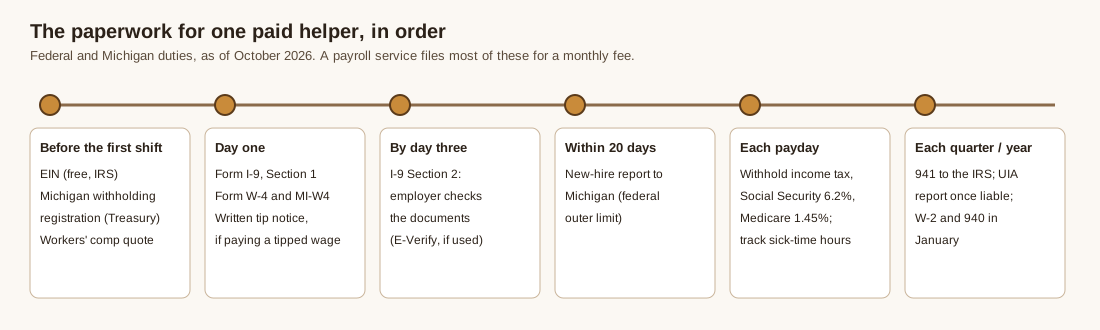
Before the first shift
| Step | What | Cost | Where |
|---|---|---|---|
| EIN | The business’s federal tax number. A sole proprietor with no employees may not need one; hiring an employee is one of the reasons the IRS gives for needing one. | Free. “You never have to pay a fee for an EIN.” | IRS online application; Setting Up the Business |
| Michigan withholding registration | A business that withholds Michigan income tax registers with the Department of Treasury for withholding. | Free | Michigan Treasury: withholding |
| Unemployment registration | Once the business is liable (below), it registers with the Unemployment Insurance Agency. | Free to register | UIA’s employer site |
| Workers’ compensation quote | Below the legal threshold it is optional; a quote costs nothing. | An agent; Insurance | |
| A written job description and pay rate | Not a legal form, but it is what separates an employee from a favour, and it is needed for the tipped-wage notice if one is used. |
Day one: Form I-9
Every employer completes Form I-9 for every person hired. “All U.S. employers must properly complete Form I-9 for every individual they hire for employment in the United States.” This includes family members on the payroll and a teenager on their first job.
| Part | Who | Deadline |
|---|---|---|
| Section 1 | The employee | By the first day of work for pay |
| Section 2 | The employer, after examining the employee’s original documents | Within 3 business days of the first day of work (USCIS) |
| Keep it | The employer | Three years after the date of hire, or one year after employment ends, whichever is later |
The current edition is dated 01/20/25. The form is not sent anywhere; it is kept and shown if asked for.
E-Verify is the federal online system that checks the I-9 details against government records. It is free and returns a result “within as little as three to five seconds”; an employer who uses it opens a case “no later than the third business day after the employee starts work for pay” (E-Verify). It is required of federal contractors and, in some states, of private employers. For a small private business in Michigan it is optional. A business that does enrol must use it for every new hire, not pick and choose.
Day one: Forms W-4 and MI-W4
Form W-4 tells the employer how much federal income tax to withhold; Michigan’s MI-W4 does the same for state income tax. The employee fills in both; the employer keeps them and withholds accordingly. A helper who claims exemption from withholding (a student earning little, for example) still fills in the form.
Within 20 days: the new-hire report
Every new employee is reported to the state, which matches the names against child-support orders. Federal law sets the outer limit at “not later than 20 days after the date the employer hires the employee” (42 U.S.C. 653a). Michigan takes reports through the Michigan New Hires Operation Center for the Office of Child Support, online at its new-hire reporting website or by phone at (800) 524-9846 (MDHHS). A payroll service usually files it automatically; check that it does.
Every payday
| Withhold from the helper | Pay as employer | Rate (2026) |
|---|---|---|
| Federal income tax | from the W-4 and IRS tables | |
| Michigan income tax | from the MI-W4 | |
| Social Security | Social Security | 6.2% each, on wages up to $184,500 (IRS Topic 751) |
| Medicare | Medicare | 1.45% each |
| Michigan unemployment, once liable | 2.7% for a new employer, on the first $9,000 of each person’s wages ($9,500 if behind on reports or payments) | |
| Federal unemployment (FUTA) | 0.6% on the first $7,000, after the state credit (IRS Topic 759) |
Withheld tax is the employee’s money held in trust, and the penalties for not depositing it are heavier than for most tax mistakes. Deposits go through the IRS’s EFTPS system on a schedule the IRS assigns.
A worked example. A helper works six hours at $13.73 at each of 30 market days in a season: 180 hours, $2,471 in wages. The employer’s share:
| Tax | Arithmetic | Cost |
|---|---|---|
| Social Security and Medicare | 2,471 × 7.65% | $189 |
| Michigan unemployment | 2,471 × 2.7% (all under $9,500) | $67 |
| FUTA | 2,471 × 0.6% | $15 |
| Total on top of wages | about $271, or 11% |
Add sick time (below), a payroll service at $35 to $41 a month, and workers’ compensation if bought. The “about ten percent on top of wages” rule on Opening a Coffee Shop holds for the taxes.
Each quarter and each year
- Form 941, the quarterly federal return for withheld income tax, Social Security and Medicare.
- Michigan withholding returns on the schedule Treasury assigns, and an annual reconciliation.
- The UIA quarterly wage report, once the business is liable.
- Form 940 for FUTA, annually. The IRS requires it once the business “paid wages of $1,500 or more to employees in any calendar quarter” or had an employee in any part of a day in 20 or more weeks.
- Form W-2 to each employee and the Social Security Administration by the end of January, and the state copy to Michigan Treasury (W-2 filing requirements).
When Michigan unemployment tax starts
A business becomes an employer under Michigan’s unemployment law when it has someone employed in 20 different weeks of a calendar year, or pays $1,000 of wages in a calendar year (MCL 421.41). A helper at $13.73 crosses $1,000 in about twelve six-hour market days. A new employer’s rate is 2.7% for the first two years under the statute’s tables (MCL 421.19), after which it follows the business’s own record of claims. The statute sets the taxable wage limit at $9,500 a person a year, reduced to $9,000 when the state’s trust fund is above $2.5 billion (MCL 421.44); for 2026 the UIA charges $9,000 to employers who are up to date with reports and payments, and $9,500 to delinquent ones (UIA).
Elsewhere in the US the triggers are similar (the federal FUTA trigger is the $1,500 quarter or 20 weeks), but each state sets its own new-employer rate and wage base, and a handful also tax the employee.
Payroll: a service or by hand
| Way | Cost (October 2026) | Good for | Watch |
|---|---|---|---|
| By hand | The time; IRS forms and EFTPS are free | Someone comfortable with tax forms, one helper, a short season | Every deadline is yours. A missed deposit draws penalties that a year of service fees would have paid for. |
| Square Payroll | $35 a month plus $6 per person paid; contractors only, $6 per person with no monthly fee (Square) | A stall already taking cards on Square | Pause it in the off-season if the plan allows; check before signing up |
| Other online services | Similar monthly-plus-per-person pricing | Comparing features: Michigan filings, new-hire reports, sick-time tracking | Confirm it files Michigan withholding, UIA and new-hire reports, not just federal |
| An accountant or bookkeeper | Hourly or monthly | A business with several kinds of income (honey, coffee, baking) | The best choice for the first year’s set-up, even if a service runs the payroll after |
For one helper the arithmetic is $41 a month; for a 30-week market season that is about $290 a year, roughly what the employer’s taxes come to. The Michigan SBDC gives free advice on setting it up (Setting Up the Business).
Minimum wage, and what a helper is paid
| Rate | 2026 | From 1 January 2027 | Source |
|---|---|---|---|
| General minimum | $13.73 | $15.00, then adjusted for inflation from 2028 | MCL 408.934 |
| Under 18 | $11.67 (85%) | $12.75 | MCL 408.934b |
| Training wage, under 20, first 90 days | $4.25 | $4.25 | MCL 408.934b; the employer may not cut another worker’s hours to use it |
| Tipped employees | $5.49 (40%) | $6.30 (42%) | Opening a Coffee Shop |
A correction to the usual reading: Michigan’s minimum-wage law does not cover every employer. The Improved Workforce Opportunity Wage Act defines an employer as one that “employs 2 or more employees at any 1 time within a calendar year,” and an employee as someone “not less than 16 years of age.” A stall whose only employee is one helper is outside the state act until a second person is on the payroll at the same time; from then on the business is covered for the rest of that calendar year.
That does not mean the helper can be paid less. The federal Fair Labor Standards Act covers a business through its sales (an enterprise doing at least $500,000 a year) or through the employee’s own work in interstate commerce, and a small stall may be covered either way or neither. The plain advice: pay at least the Michigan rate from the first hour. It is the rate every helper knows, the market competes at it, and it removes the question.
The training wage is legal and a poor idea. $4.25 an hour for a teenager’s first 90 days is what the statute permits; it is about a third of what the stall down the row pays.
Elsewhere in the US, the federal minimum is $7.25 and the state or city rate applies where it is higher. Several states have no small-employer exemption at all.
Paid sick time
Michigan’s Earned Sick Time Act covers small businesses, defined as an employer with “10 or fewer individuals” working for pay in a given week (MCL 408.962). Unlike the wage act, it has no two-employee threshold.
| Rule for a small business | Detail |
|---|---|
| Accrual | ”a minimum of 1 hour of paid earned sick time for every 30 hours worked” |
| Cap on use | The employer may limit use to 40 hours a year |
| The alternative | Give 40 hours at the start of the year instead of tracking accrual |
| Waiting period | A new employee may be made to wait 120 calendar days before using accrued time |
| Carry-over | Unused time carries over, up to 40 hours |
| In force | Small businesses have had to provide it since 1 October 2025 |
For a market-day helper working 180 hours a season, accrual is 6 hours: one market day’s pay, about $82. Track it in the payroll service; most do it automatically. A sick helper who stays home is also what the food code wants (below).
A teenager at the stall

Market stalls are a classic first job, and Michigan’s Youth Employment Standards Act sets the minimum age at 14 for work like this.
| Ages 14 and 15 | Ages 16 and 17 | |
|---|---|---|
| When | Outside school hours; 7 a.m. to 7 p.m., or to 9 p.m. from 1 June to Labor Day | Not between 10:30 p.m. and 6 a.m.; to 11:30 p.m. on Fridays, Saturdays and school vacations |
| Hours a day | 3 in a school week | 10 at most; an average of 8 a day over a week |
| Hours a week | 18 in a school week; 40 otherwise | 24 while school is in session; 48 otherwise; no more than 6 days |
| Breaks | 30 minutes after 5 hours | 30 minutes after 5 hours |
| Source | MCL 409.110 | MCL 409.111, 409.112 |
Work permits are changing hands in October 2026. For decades a Michigan employer kept a copy of a work permit issued by the minor’s school. A 2024 amendment (2024 PA 196, effective 2 April 2025) moves the job to the state: from 2 October 2026 (LEO’s date) the minor registers through the state’s Youth Employment Permit Portal (YEPP) with the Department of Labor and Economic Opportunity, the employer registers too, and the director has five days to decide whether the job complies with the act. If no answer comes in five days, the employer may start the minor the next day. LEO’s page also gives 1 October in one place (LEO). A minor already working legally keeps going under the old permit until they change employer, change their main work location, or turn 16. A 16- or 17-year-old who has graduated, or a 17-year-old with a GED, is outside the act (MCL 409.116).
A parent’s own business. The act does not apply to a minor working “in a business owned and operated by the parent or guardian”, but “operated” means the parent “devotes substantially all of his or her working hours” to it (MCL 409.119(1)(e)). A parent with another full-time job may not meet that test; ask LEO.
Ask LEO before the first shift: “My business is a farmers-market coffee stall; how do I register as an employer for a 15-year-old helper under the new system, and is it live?”
What a teenager may not do is set by the hazardous-occupation rules, federal and state. At a coffee stall the questions are hot water, pressure, propane and a vehicle. The federal rules for 14- and 15-year-olds (29 CFR 570.34) allow “wrapping, sealing, labeling, weighing, pricing, and stocking” and simple machines such as “milk shake blenders,” but bar “pressurized equipment” and handling equipment or liquids hotter than 100 °F when cleaning; they may ride in a work vehicle but not drive one. Keep under-16s on the cash box, the samples and the bags, and away from the boiler, the espresso machine, the propane and the van.
Elsewhere in the US each state has its own hours and permit rules, and the federal rules apply everywhere; where they differ the stricter applies.
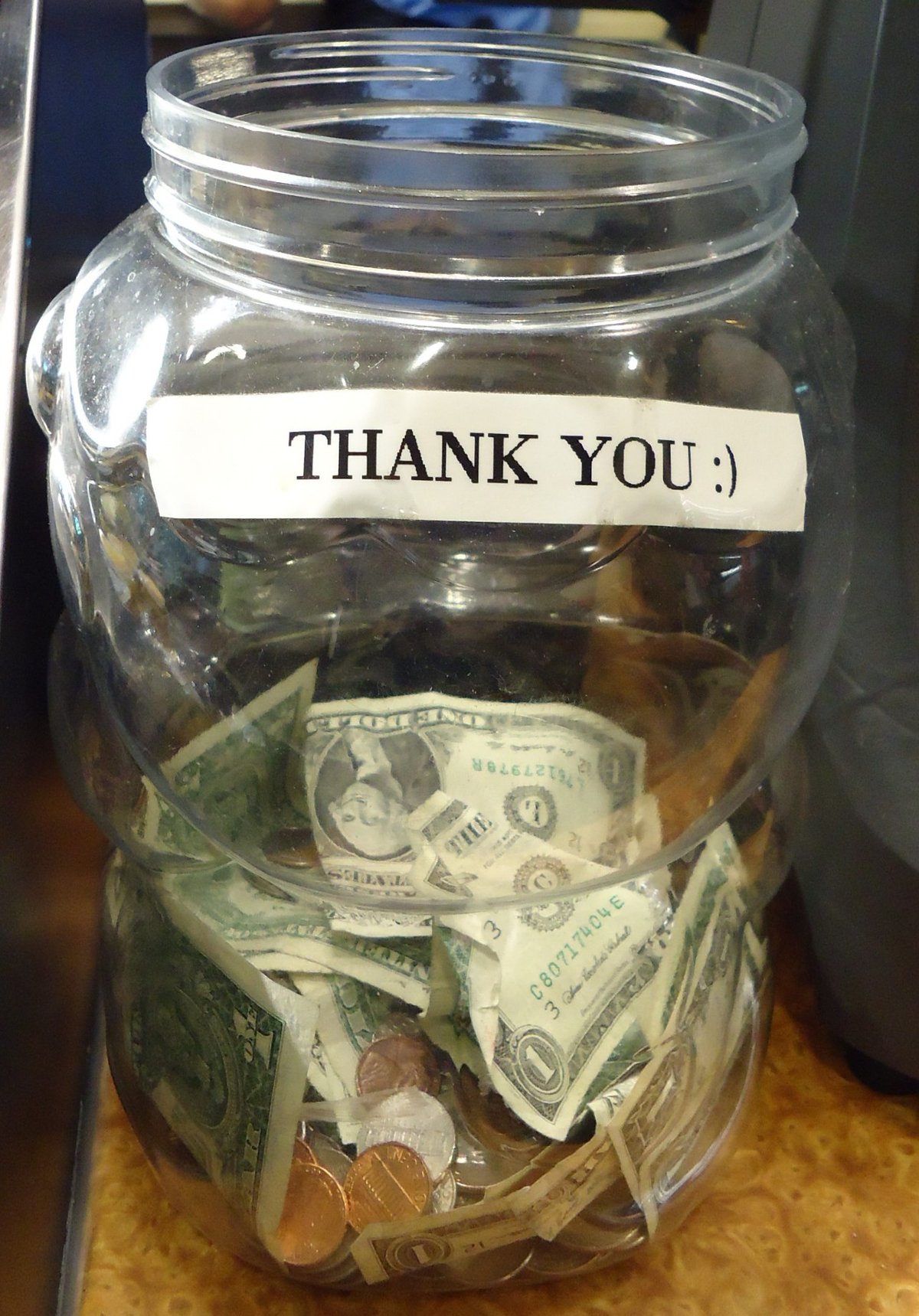
Tips and the tip jar
| Rule | Source |
|---|---|
| ”An employer may not keep tips received by its employees for any purposes, including allowing managers or supervisors to keep any portion of employees’ tips, regardless of whether or not the employer takes a tip credit.” | 29 U.S.C. 203(m)(2)(B) |
| A tip pool may include back-of-house staff such as a dishwasher only if everyone is paid the full minimum wage and no tip credit is taken; even then “An employer may not receive tips from such a tip pool and may not allow supervisors and managers to receive tips from the tip pool.” | 29 CFR 531.54 |
| Michigan’s tipped wage needs written notice and the employee’s written consent at hire, and the employer makes up any shortfall | Opening a Coffee Shop |
| Tips are wages for income tax, Social Security and Medicare, and must be reported | IRS |
What that means at a two-person stall:
- The owner working the table is the employer, so the owner may not take a share of the jar when an employee is working. When the owner works alone, the jar is the owner’s income.
- Card tips from the reader (Taking Cards) belong to the helper on the shift and are paid through payroll.
- Two helpers on a shift may share the jar equally, or by hours, as long as no owner or manager takes part.
- A tipped wage at a market stall is not worth the trouble. Coffee stall tips are small and irregular; if a slow market leaves the helper short of the full minimum, the stall pays the difference anyway, after a page of record-keeping. Pay the full rate and let the tips be a bonus.

Training the helper for food safety
A helper at a licensed booth is a food employee under the Michigan Modified Food Code, and the person in charge (usually the owner) answers for what the helper does. Food-Safety Certification covers the manager’s certificate; what a helper needs is shorter.
The first-shift briefing, written on one card at the booth:
- Sick means home. Vomiting, diarrhoea, jaundice, a sore throat with fever, or an infected cut on the hands: tell the person in charge before the shift, not during it. The food code makes this the employee’s duty and the person in charge’s duty to act on it.
- Hands. Wash at the hand-wash station on arrival, after money if the same hands then touch cups or lids, after the restroom, after eating, and after touching the face or phone. Sanitizer is not a substitute for washing.
- No bare hands on ready-to-eat food. Tongs or gloves for cookies and scones.
- Milk and cream in the cooler, at 41 °F or below, with a thermometer in it. Anything left out goes.
- Sanitizer strength. How to read the test strip for the sanitizing bucket.
- Allergens. Which items carry milk, nuts, wheat and eggs, and that “I don’t know” is the right answer, followed by asking.
- Hot water. Lids on, pour away from people, never hand a full cup over a child (Serving Hot Drinks Safely).
A free or cheap food-handler course is a good first-week task for a helper who will work all season; the ServSafe Food Handler course is described on the certification page. It is not the manager’s certificate, and Michigan does not require it of a helper.
Insurance
Workers’ compensation is set out above and on Insurance. Two other policies need a call to the agent once there is an employee: the general liability policy (does it cover the acts of employees, not only the named owner?) and the car (a helper who drives on stall business may not be covered by a personal policy).
The one-page checklist
Deciding
- Counted the lost line for three market days; tried batch brew and a shorter menu first.
- Worked out the helper’s cost per market day against The Numbers.
- Decided: family, a friend on payroll, or a hire.
Before the first shift
- EIN (free, IRS).
- Registered for Michigan withholding with Treasury.
- Payroll service chosen, or a by-hand calendar of every deposit and return.
- Workers’ compensation quote; liability policy checked for employees.
- For a minor: registration with LEO and the hours limits written into the schedule.
- Written pay rate; written tipped-wage notice only if paying a tipped wage.
Day one
- I-9 Section 1 signed by the employee.
- W-4 and MI-W4 completed.
- Food-safety briefing card read through together; hand-wash station shown.
Day three and day twenty
- I-9 Section 2 completed, documents seen (and E-Verify, if enrolled).
- New-hire report filed with Michigan, or confirmed filed by the service.
Every payday, quarter and year
- Withholding deposited on schedule; sick-time hours tracked.
- Form 941 quarterly; Michigan withholding returns; UIA reports once liable.
- W-2s and Form 940 in January.
- I-9s kept three years from hire or one year from leaving.
What is not known
- How many farmers-market vendors hire help, and what they pay. No survey of Michigan market vendors’ staffing has been published.
- Whether a parent with another job “operates” the business for the youth employment act’s family exemption. LEO is the one to ask.
- The exact day the new permit portal took over: LEO’s page says both 1 and 2 October 2026.
- Whether a particular small stall is covered by the federal FLSA. It depends on sales and on the work each employee does; most small stalls never need to settle it if they pay the Michigan rate.
Sources
- US Department of Labor: FLSA volunteers (eLaws); 29 U.S.C. 203 (definitions, tips, the $500,000 enterprise test); 29 CFR 531.54 (tip pools); 29 CFR 570.2 (parental exemption).
- IRS: Independent contractor or employee; Form SS-8; Get an EIN; Form W-4; Topic 751, Social Security and Medicare; Topic 759, FUTA; Tip recordkeeping and reporting; EFTPS.
- USCIS: Form I-9; Complete and correct Form I-9. E-Verify: what it is and the verification process.
- 42 U.S.C. 653a, new-hire reporting; Michigan’s new-hire reporting portal.
- Michigan statutes, at the Michigan Legislature: MCL 408.932, 408.934, 408.934b (wages); 408.962, 408.963 (earned sick time); 409.103, 409.104a, 409.110, 409.111, 409.112, 409.116 (youth employment); 421.19, 421.41, 421.43, 421.44 (unemployment); 418.115, 418.161 (workers’ compensation).
- Michigan Department of Treasury, withholding tax; Unemployment Insurance Agency; Michigan SBDC.
- Square Payroll pricing, read 6 October 2026.
- On this site: Start Here, The Numbers, Setting Up the Business, Insurance, Opening a Coffee Shop, Food-Safety Certification, Taking Cards and the glossary.
Comments (0)