Starting a Coffee Business · 1 of 39
A Truck or Trailer Instead of a Stall
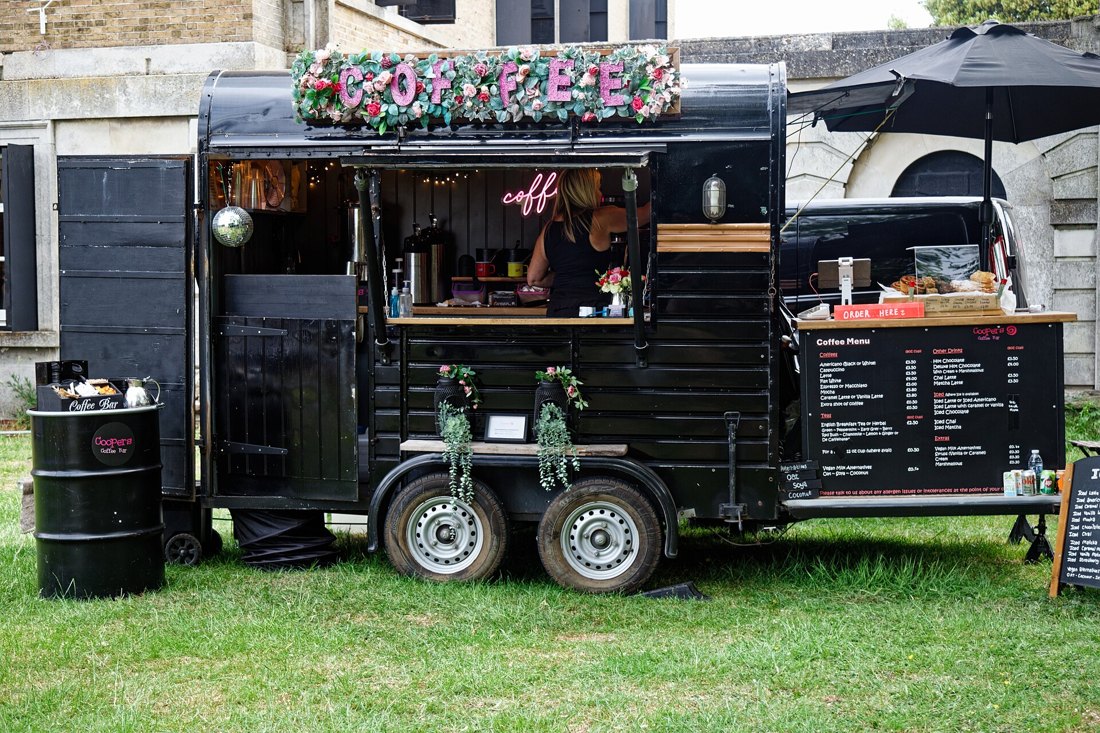
The other way to sell coffee at a market is from a vehicle. Most markets take a small number of food trucks, and a truck or trailer is a possibility I am looking at. It costs more than I have on hand, so it is not the first step. What follows is what a truck or trailer would change, what it would not, and where it fits in the plan. The Food Truck pages on this site cover trucks in general, at length.
The licence is the same one
In Michigan the vehicle does not create a new kind of licence. MDARD describes the Transitory Food Unit as “food trucks… trailers, pushcarts, vehicles, watercrafts, tents, or other non-fixed food service establishments.” A tent and a trailer are on the same list. What The Michigan Rules says about that licence applies to both:
- It is annual and good statewide, and the licence year runs from 1 May to 30 April.
- The first year needs a plan review, which includes “the menu and standard operating procedures.”
- It needs two paid inspections a year at $90 each. The licence itself is $155 in Shiawassee County and $165 in the Central Michigan District, and the first-year plan review is $688 in Shiawassee and $690 in the Mid-Michigan District (the plan review instructions, which also ask for scaled drawings and the maker’s sheet for every piece of equipment). The Numbers adds them up: about $1,205 in the first year, $335 after.
- Each local health department has to be told in writing “not less than 4 business days before any food is served” in its area.
- It needs a certified food protection manager, which a one-event temporary licence does not (Food-Safety Certification).
The other mobile licence, the Mobile Food Establishment, has to “return to a licensed commissary kitchen every 24 hours.” Whether a Transitory Food Unit selling only coffee needs a servicing base of any kind is a question for the plan review.
What a trailer changes
| At a canopy | In a trailer |
|---|---|
| Handwashing from an insulated jug on a table | A plumbed hand sink with hot water |
| Water carried in jugs, wastewater carried out in a sealed container | Fresh and waste tanks on board |
| A power station, or an outlet where the market has one | Its own power. East Lansing’s market bans generators “with the exception of Food Trucks parked in a designated spot.” |
| A canopy, tables and boxes to set up and take down, in whatever the weather is | Open the hatch |
| Coolers | A refrigerator |
| Hand-brewed coffee | Room for a batch brewer or an espresso machine, if the power is there |
| One market a week, one licence question per market | Markets, festivals and private events on one licence, with four business days’ notice to each health department |
The last row is the one that matters for money. The Numbers shows that cups at a weekly market only pay if the licence is not charged by the market day. A unit that can work three or four days a week is a different business from a Saturday table.
What it does not change
- The roasting question. Whether a licensed unit may brew beans roasted in a home kitchen is the same unanswered question in a trailer as under a tent.
- Ice, cold brew and syrup. Ice made at home, cold brew steeped at home and honey syrup mixed at home are home-prepared food in either case. A trailer with a refrigerator and a sink may be allowed to make them on board; that is for the plan review to say.
- The bags, the honey, the jam and the cookies. These are cottage foods wherever they are sold.
What it costs
No price for a coffee trailer specifically is published by a Michigan builder. The Food Truck pages work with these bands for any food unit:
| Format | Price band | Notes |
|---|---|---|
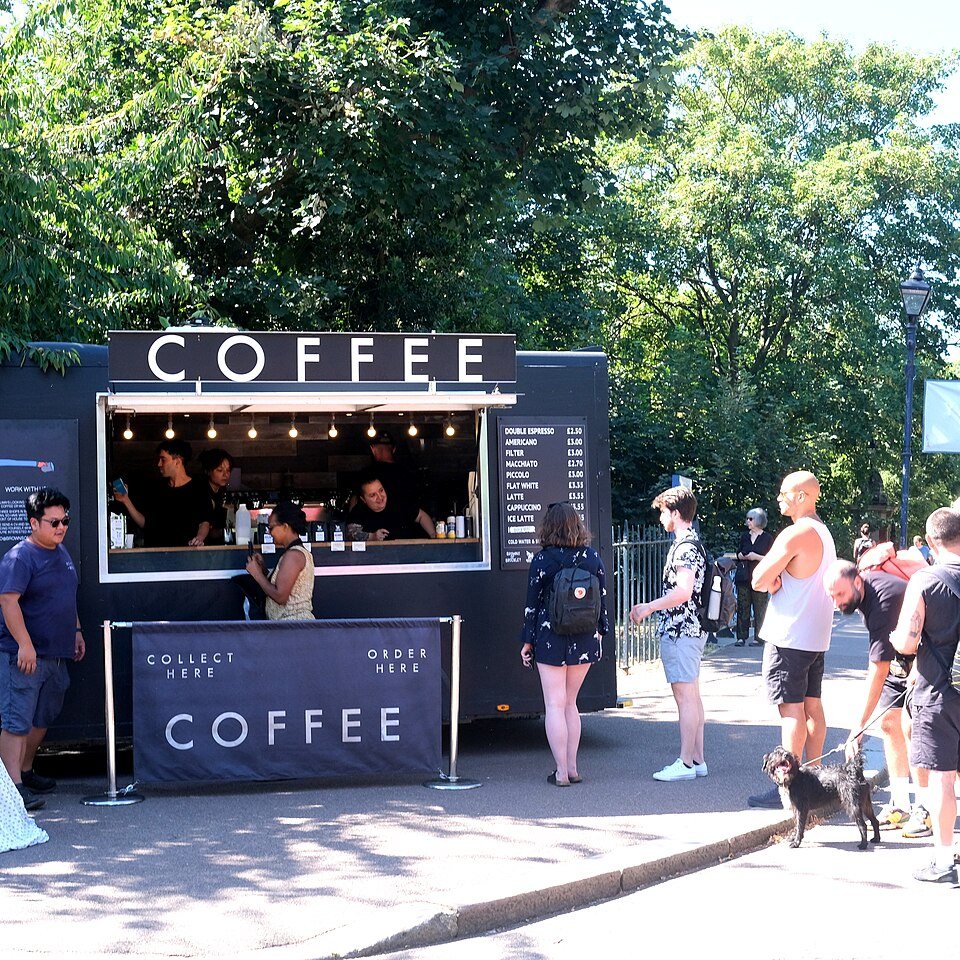
| Cart or stand | $3,000–$25,000 | One person, one product |
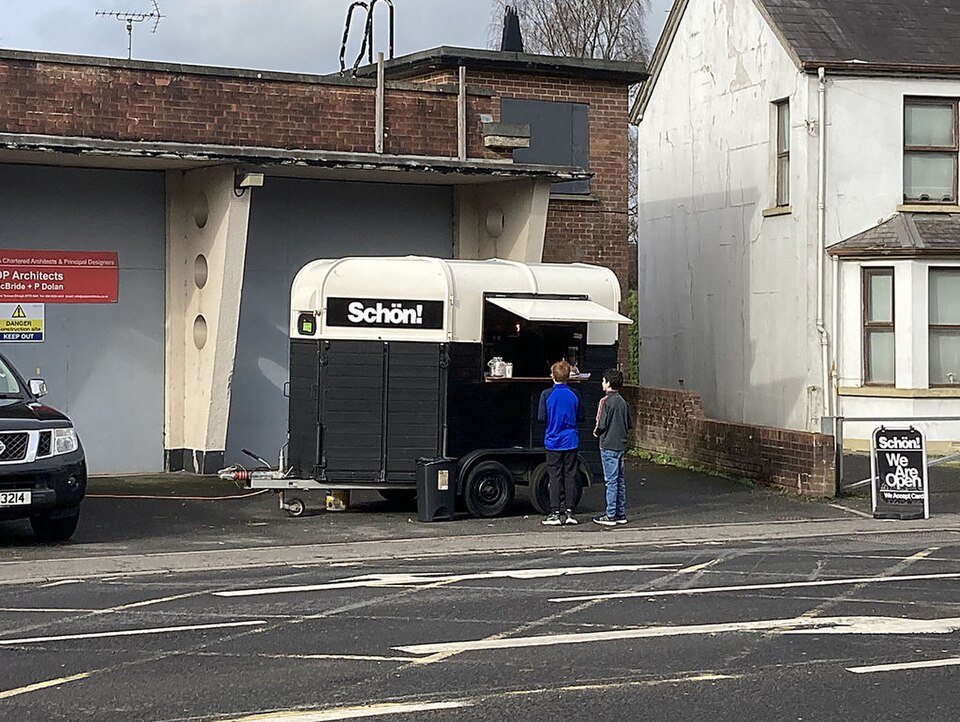
| Trailer | $15,000–$70,000 | The most working space for the money; needs a tow vehicle rated for it |
| Truck | $40,000–$150,000 and up | Drives itself; the engine and the kitchen share one fate |
One line in those pages’ start-up table may not apply to coffee. A hood with fire suppression is required for cooking that produces grease, and it is one of the largest costs in a food truck. A unit that only heats water and brews coffee does no such cooking. Whether the fire official agrees is a question to ask before buying a unit built for frying.
For comparison, the stall on these pages costs about $940 to $1,150 to start selling bags, and about $1,640 to $2,150 with brewed cups added, before the licence and without a roaster (The Numbers), and the production roaster $4,100 to $5,300. A unit also needs its own insurance (Insurance).
What markets charge a truck
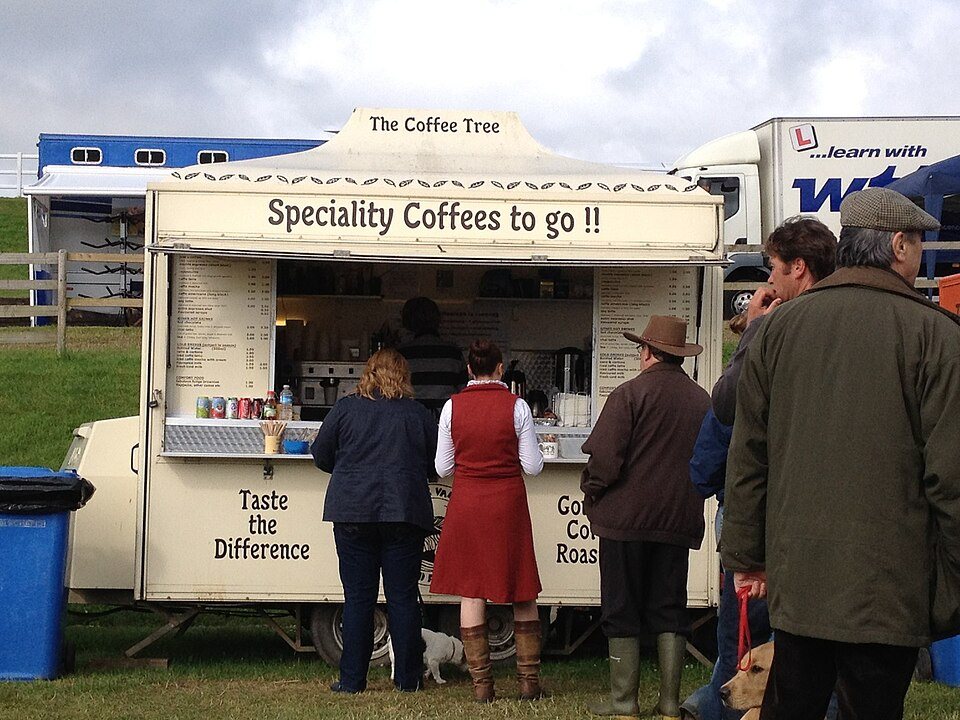
Where a market publishes a separate rate, a truck pays a little more than a table:
| Market | Table or tent | Food truck |
|---|---|---|
| Midland | $35 a day, $550 a season | $45 a day, $700 a season |
| Mount Pleasant | $25 a day outdoors | $40 a day |
| Ann Arbor | $35 a day | $35 a day, truck or cart |
| Owosso | $30 a day, $350 a season | $50 a day; “inquire” for a season |
None of these markets publishes how many trucks it accepts. Midland classes coffee by the cup with food trucks whatever it is served from. Among the smaller markets, Ovid’s application has a “Food Truck/Concession” box and asks for a “current inspection or certification”; Grand Ledge registers food trucks through its Chamber of Commerce; Bath Township’s policy does not mention trucks at all.
What a town charges a truck
A market’s fee is not the only one. A truck that parks anywhere in a town on its own, outside a market or a festival, usually needs the town’s permit as well as the health department’s licence. Four mid-Michigan towns and townships publish theirs, and they show the range:
| DeWitt Charter Township | East Lansing | Laingsburg | Owosso | |
|---|---|---|---|---|
| The rule | Ordinance 2022-01-01, drafted in a January 2022 memorandum | Mobile Food Vending Program, Ordinance 1534 | Ordinance 01-2021 | City code chapter 16.8, written in 2022 |
| Permit | One year | An annual licence, after a safety inspection; a separate special-event permit | By the day, bought between 90 days and 48 hours ahead; the city issues up to 15 a month | Six months at a time: May to October, or November to April |
| Fee | $600 a year, plus $25 for each event’s location review | Annual fee not stated on the page; the special-event application is free | Set by the city council; the amount is not published | On city property $300 for the summer term and $200 for the winter; on private property $150 and $100 |
| Insurance | Proof of vehicle insurance | Fire marshal and electrical inspections | $2 million, naming the city | $1 million, naming the city, when on city property |
| Where | Non-residential districts; residential and farm land for single-day events only | At the locations in the approved application | With 48 hours’ notice in city lots; not in the right of way without a licence | City parks, and named downtown lots: two units at City Hall, one at Main Street Plaza |
| Hours | 10 a.m. to 8 p.m., including set-up | As approved | 8 a.m. to 11 p.m. | 7 a.m. to 2 a.m. |
| At a market or festival | A $25 location review per event | Private events exempt, with ten business days’ notice to the clerk | Participants in city-sponsored events need no licence | ”Festivals/events take precedence”: the vendor deals with the event’s organiser |
Cautions. DeWitt’s figures are from the draft ordinance in its 2022 memorandum; before the draft, the township’s general peddler rule charged $50 a day, $250 a week or $800 a month, which its own staff called “cost prohibitive.” Owosso’s figures are from the application form the city posted in 2022; no later one is posted. And Laingsburg’s ordinance and its own fact sheet disagree on one line: the ordinance says a truck may not operate during a city-authorized fair or farmers’ market without the council’s permission, and the fact sheet says a truck may operate only during one. Ask the city which it means.
The health side is the county’s. In Shiawassee County the 2026 fee schedule lists a Transitory Food Unit licence at $155 and each inspection at $90, a mobile food service establishment at $300, and plan review from $688.
A cheaper first step: the trailer as a shop
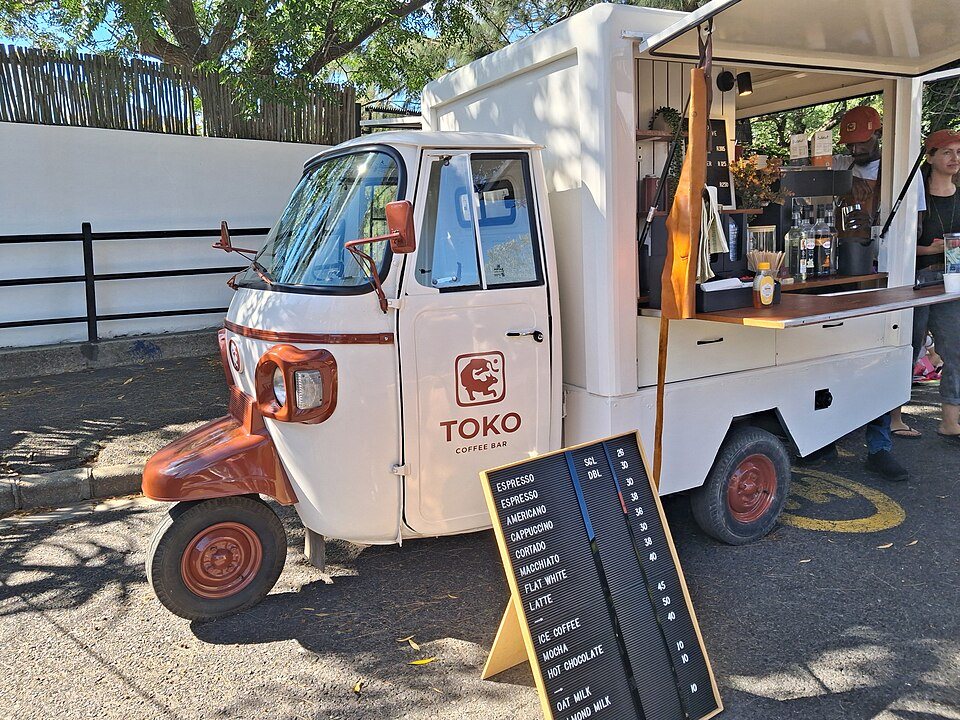
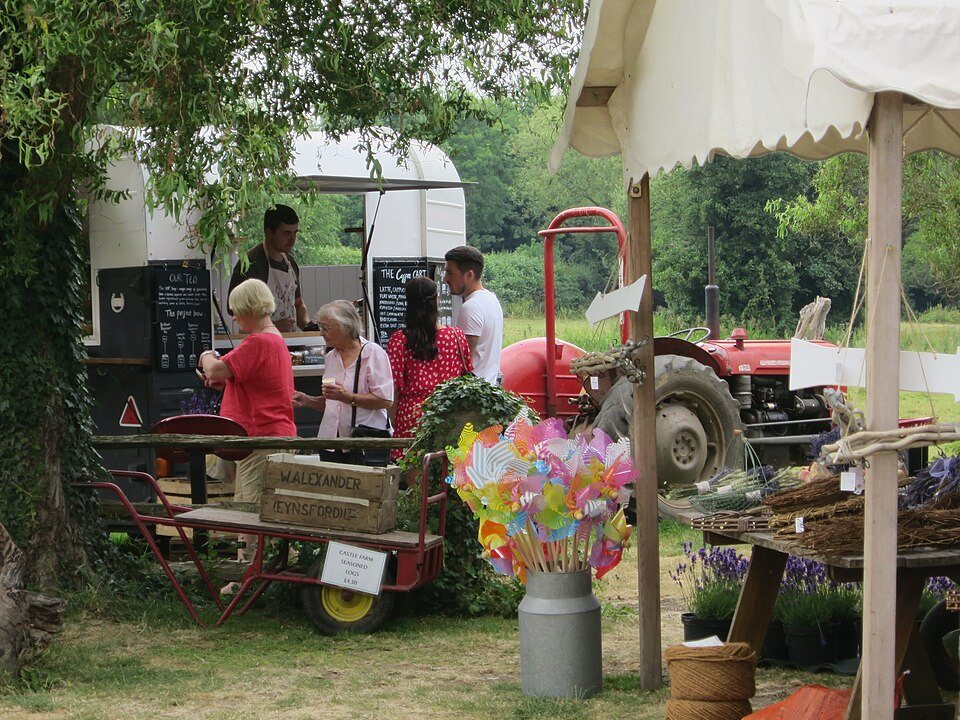
The Food Truck pages describe a “cottage-only” unit: a trailer with a sales window that sells only packaged cottage foods, with nothing prepared on board. It needs no food licence, because it is a market table with a roof. Bagged roasted coffee is a cottage food, and so are honey, jam and cookies. A small enclosed trailer fitted out as a shop would carry the whole of Stage 1 of the plan, keep it dry, and cut the setting up. Brewing could be added later under a licence, in the same trailer, if it was built with the sinks and tanks in mind.
Where it fits
On Start Here, a truck, cart or catering is stage 4 of six.
- The stall first. It answers whether people here buy the coffee, for about $940 to $1,150 with bags alone.
- The roaster next, when bags pass about ten pounds a week.
- Then a choice between a trailer and a shop. A trailer has no rent and can go where the customers are. A shop has seats, a kitchen that can be licensed for everything, and an address. 517 Coffee Company in Lansing sold at markets for seven years before it opened a shop. What the shop takes is on Opening a Coffee Shop.
The questions for the health department on the rules page are worth asking with a trailer in mind as well as a tent. The answers may differ.
Sources
- MDARD, Food Service Licenses, and its fee schedule; MCL 289.6137 (Transitory Food Unit evaluations, plan review and notice); MCL 289.2129 (certified manager); Central Michigan District Health Department fee schedule.
- Vendor rules of the East Lansing, Midland, Mount Pleasant, Ann Arbor, Owosso, Ovid and Bath Township farmers markets for 2026.
- DeWitt Charter Township, memorandum and draft Ordinance 2022-01-01 (24 January 2022); City of East Lansing, Mobile Food Vending Program; Mid-Michigan District Health Department, TFU plan review instructions.
- City of Owosso, proposed chapter 16.8, Mobile Food Vending (memorandum of 23 February 2022) and the city’s 2022 mobile food vending application; City of Laingsburg, Ordinance 01-2021 and its mobile food vending fact sheet (updated 12 April 2022), both linked from the Laingsburg Business Community Association.
- Shiawassee County Health Department, fee schedule effective 1 January 2026.
- This site’s Food Truck pages for the price bands, the hood requirement and the cottage-only unit.
Comments (0)