Starting a Coffee Business · 14 of 39
Hot Water and Power at a Market With No Outlet
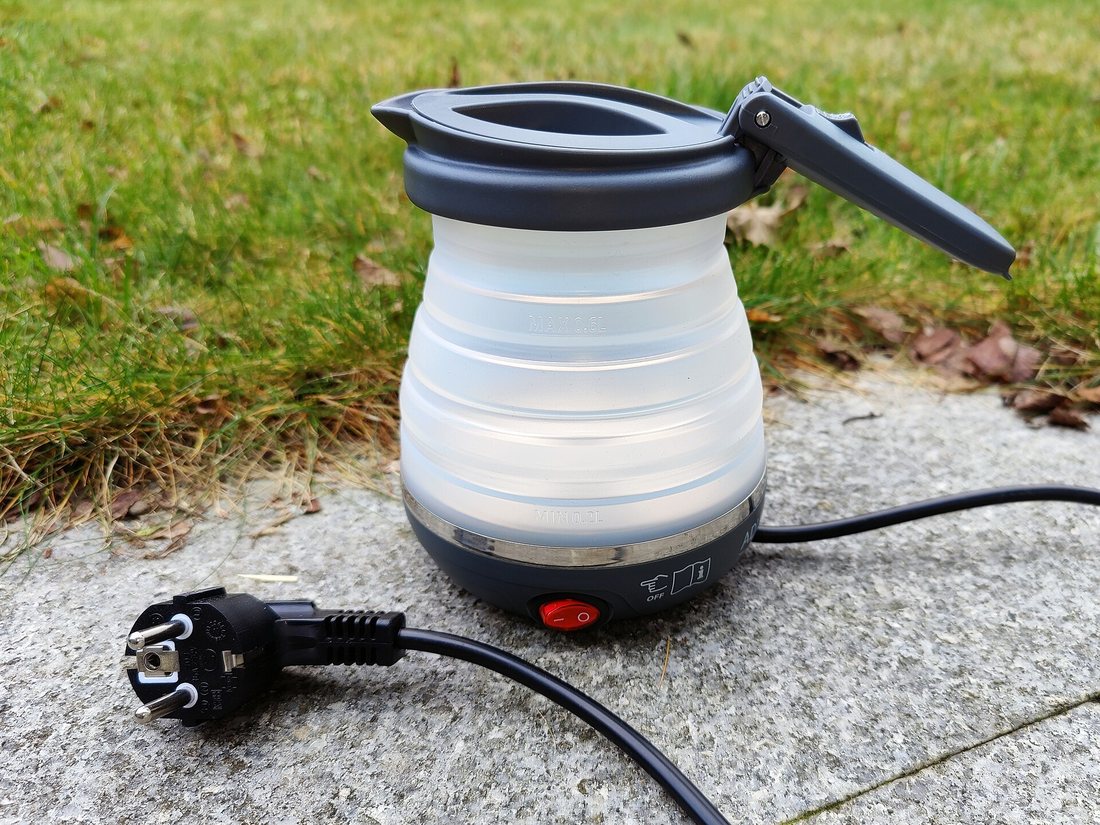
Brewing coffee is mostly heating water, and many farmers markets have no electricity. I like my electric temperature-controlled kettle, and I already have a power station and a solar panel from my overlanding build. Whether that is enough, and what the alternatives cost, is worked out below with the arithmetic shown.
The answer the numbers give: the battery cannot heat a market day’s water from cold, but it can easily keep already-hot water at brewing temperature. A full day needs about 48 litres of hot water, so the plan that needs nobody’s permission is to carry boiling water from home in vacuum airpots — enough of them — and use the battery only to hold and finish it. For the question of which kettles to buy, the answer further down is a water boiler to hold the hot water and two gooseneck kettles to pour it.
The short version
| What the market allows | What to bring | What it supports |
|---|---|---|
| No outlet, no flame, no generator | The 858 Wh power station, a water boiler arriving full and hot, four 3.8-litre airpots of boiling water | About 22 litres: roughly 25 hot cups, 20 iced drinks and 100 tastes. Half a full day. |
| No outlet, no flame, no generator, a full day | The same, with twelve airpots | About 50 litres: the full day of 60 hot cups, 40 iced and 200 tastes |
| Propane, approved by the market and the fire official | A burner, a stovetop gooseneck, two 1 lb cylinders, 50 litres of water in jugs | The full day |
| An outlet | The boiler and the kettles on the outlet, one heating at a time | The full day |
| A quiet inverter generator | The generator and an electric kettle | The full day |
The arithmetic is below. Which water to carry — a home well, city water, filtered or not — is on Water.
How much energy a cup takes
Heating one litre of water from 60 °F to 205 °F takes 93.7 watt-hours. (The rise is 80.6 kelvin; 4.186 kJ per kilogram per kelvin times 80.6 is 337 kJ, which is 93.7 Wh.)
A 12 oz pour-over uses about 360 g of brewing water, plus roughly 100 g to rinse the filter and warm the cup. That is 0.46 litre, or 43 Wh in the water for each cup.
What the power station can do
The power station is an EcoFlow River 3 Max Plus: 858 Wh of battery behind a 600-watt inverter (the inverter turns the battery’s direct current into household alternating current). EcoFlow’s product page gives the output as “600W total (Surge 1200W, X-Boost 1200W).”
| Litres from cold | 12 oz pour-overs | |
|---|---|---|
| In theory, no losses | 9.2 | 20 |
| Allowing 15% loss in the inverter | 7.8 | 17 |
| Allowing 15% in the inverter and 15% in the kettle | 6.6 | 14 (18 if the filter is not rinsed) |
The two loss figures are assumptions; EcoFlow does not publish its inverter efficiency. On any of them, a full battery makes about fourteen to eighteen cups from cold water. That is an hour of a good market.
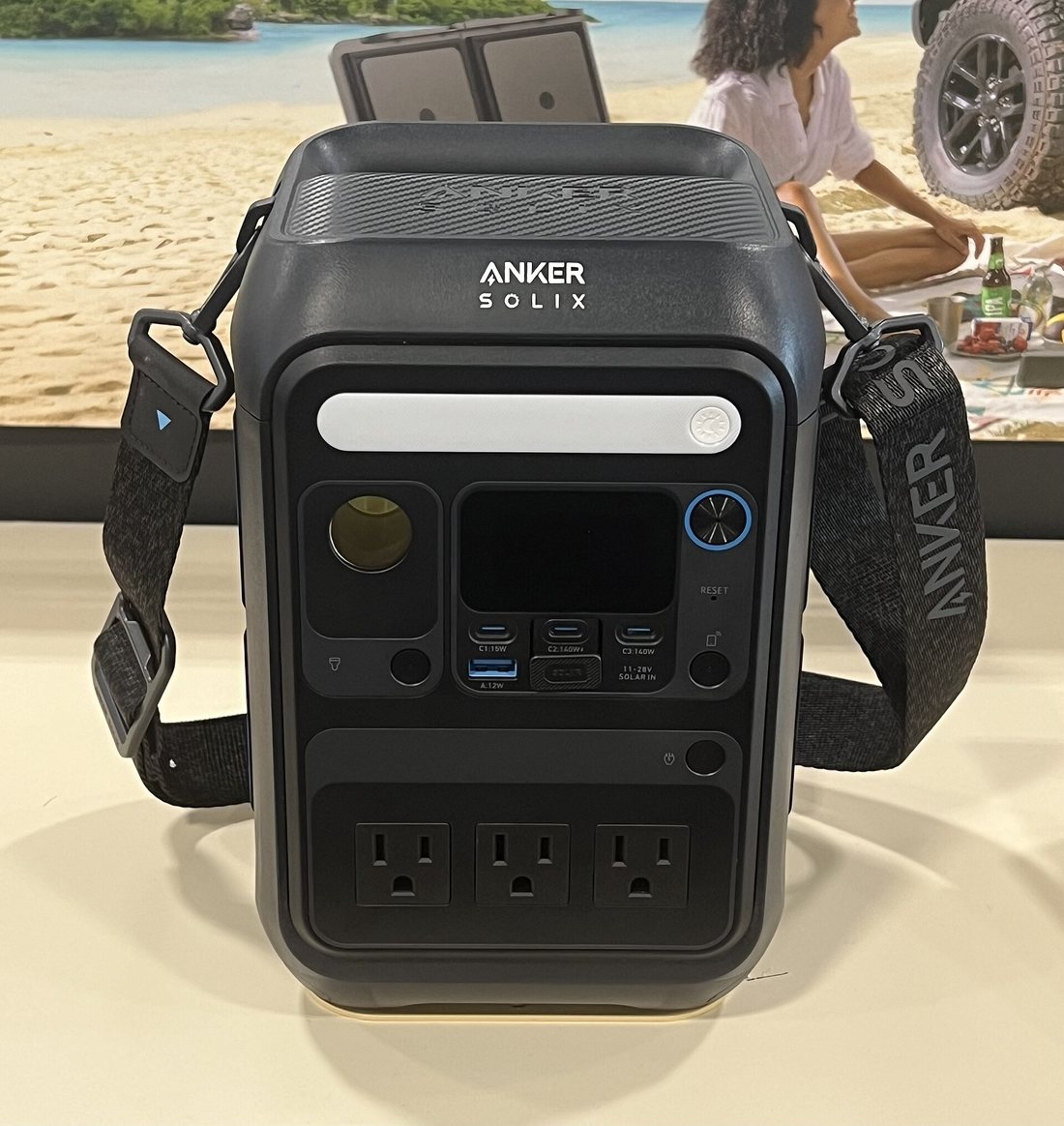
The kettle may not run at full speed, or at all. X-Boost, EcoFlow’s name for the trick, lets the station drive a heating appliance rated up to 1,200 W by lowering the voltage, so the element draws about 600 W. A kettle that boils 0.9 litre in five minutes on the wall takes about ten on the station. EcoFlow’s cautions, in its own words: “X-Boost is not available to use when your EcoFlow portable power station is charging,” and “Please conduct a full test with your devices before usage.” A temperature-controlled kettle has electronics in its base, which is the case that needs testing.
What decides it is the wattage on the plate under the kettle:
| Kettle rating | On this power station |
|---|---|
| 600 W or less | Runs at full speed |
| 601 to 1,200 W | Runs at about half speed under X-Boost, if its controller tolerates the lower voltage |
| Over 1,200 W | Will not run |
For reference, a Fellow Stagg EKG is rated 1,000 to 1,200 W, the Bonavita 1,000 W, and retailers list the Brewista and Hario gooseneck kettles at about 1,000 W and the OXO adjustable kettle at 1,500 W. No temperature-controlled gooseneck kettle on the US market is rated at 600 W or less.
The test to run at home: fill the kettle with cold water, plug it into the fully charged station with nothing else connected and the solar panel unplugged, and time it to 205 °F. Note the percentage of battery used. That one test answers whether the kettle I already own will work.
| Test | Water | Start temperature | Time to 205 °F | Battery used | Notes |
|---|---|---|---|---|---|
| My kettle, on the wall | 0.9 L | — | |||
| My kettle, on the station (X-Boost) | 0.9 L | ||||
| My kettle, topping up airpot water | 0.9 L | ||||
| An airpot filled at a boil, left 4 hours on a cool porch | 3.8 L | boiling | — | — | temperature after 4 h: |
Solar. The 200 W panel feeds a 220 W input. At an assumed 65% of its rating for five hours it gives about 650 Wh, which is three-quarters of a battery. Whether X-Boost works while the panel is charging the station is not stated; EcoFlow’s sentence about charging may rule it out.
The plan that works: hot water from home, topped up on the battery
A good vacuum airpot holds heat for hours. Zojirushi publishes figures for its 3.8-litre SR-AG38 airpot (an airpot is a vacuum-insulated jug with a pump lever in the lid): water put in hot is 174 °F after ten hours and 154 °F after 24, at room temperature. Fitting a cooling curve to those figures gives an estimate, not a specification:
| Hours after filling at a boil | Estimated temperature |
|---|---|
| 2 | about 197 °F |
| 4 | about 191 °F |
| 6 | about 185 °F |
| 8 | about 179 °F |
Every pump of the lever and every degree of cold morning air makes it worse, and no maker states how long its pot stays above 195 °F. On a 40 °F October morning expect the pots to fall faster than the table: keep them in a closed cooler or wrapped in a blanket until each is needed, and open the coldest-looking one last. Holding hot is for quality; what temperature to serve at, and why lower is safer, is on Serving Hot Drinks Safely.
The saving is in the top-up. Raising a litre from 185 °F back to 205 °F takes 12.9 Wh, not 93.7. On the same battery and the same assumed losses, that is enough to finish about 48 litres. From 175 °F it is 32 litres.
So:
- Fill the vacuum airpots at a rolling boil just before leaving (water only; coffee is brewed at the stall — the rules). Check the airpot’s own manual first: some commercial airpots (Newco’s KK, for one) say not to pour in boiling water, and water just off the boil does the same job.
- At the stall, pour from an airpot into the kettle and let the kettle bring it the last ten or twenty degrees.
- Use the first two hours’ water straight from the pot for methods that want cooler water anyway (below).
A 3.8-litre Zojirushi airpot is about $100; plain stainless-lined airpots run $28 to $80 and publish no heat figures. Four pots is 15 litres — about a third of a full day. How many pots a day actually takes is worked out below.
Methods that want cooler water. AeroPress’s own instructions call for 185 °F water. That is the one brewer that works straight out of a four-hour-old airpot with no top-up. Immersion and slow-drip methods, such as a French press, a Clever dripper or a phin, are generally more forgiving of water a little under 200 °F than a fast pour-over is, though that is experience and not a sourced figure. Espresso on a manual lever is the opposite case: it wants 195–205 °F water and a preheated chamber, and how to get both from the airpots is on The Espresso Machine: a History, and Espresso Without Power.
Which kettles for the booth
I have one temperature-controlled kettle and I like it. One is not enough for a booth: a 0.9-litre kettle holds water for two 12 oz pour-overs, and while it is being refilled and reheated nothing can be brewed. The usual answer is to buy a second kettle like the first. The specifications point to a different one: a water boiler as the reservoir, and the kettles as pouring tools.
The reservoir: a water boiler and warmer
A water boiler is an insulated electric pot of four or five litres that boils water and then holds it at a set temperature, with a dispensing spout on the front. It needs no plumbing. What makes it the right tool for a market is how little power it takes to hold water that is already hot. From Zojirushi’s own manuals and product pages (CV-JAC, CD-WHC, CD-LTC):
| Model | Size | Heater | Average power holding 208 °F | Holds at | Price | Listed for |
|---|---|---|---|---|---|---|
| Zojirushi CV-JAC40 / CV-JAC50 (vacuum-insulated) | 4.0 / 5.0 L | 930 W | 28 W / 29 W | 160, 175, 195, 208 °F, or unpowered | $304.99 on Zojirushi’s shop | Household |
| Zojirushi CD-WHC40 | 4.0 L | 700 W | 48 W | 160, 175, 195, 208 °F | $219.99 on Zojirushi’s shop | Household |
| Zojirushi CD-LTC50 “Commercial” | 5.0 L | 800 W | not listed here | 175, 195, 208 °F | $192.49 at a restaurant supplier | Commercial (UL 197) |
The holding figures are Zojirushi’s, for a full pot in a 73 °F room. A cool morning outdoors will take more.
What those numbers mean at a stall:
- Five hours at 208 °F costs about 140 Wh on the vacuum-insulated model and 240 Wh on the plain one. Allowing the same 15% inverter loss as above, that is roughly a fifth, or a third, of the 858 Wh battery. Heating the same four litres from cold would cost about 380 Wh once, and take half an hour on a wall socket.
- So it should arrive full of boiling water, not cold. It is then refilled through the morning from the airpots. Bringing four litres of 190 °F airpot water back up to 208 °F takes about 47 Wh.
- The heater is over the power station’s 600 W. At 700 to 930 W it falls in the X-Boost band, like the kettle, and needs the same test at home. The 700 W model is the closest to the inverter’s rating.
- The vacuum model’s unpowered mode is not a substitute for power. Zojirushi gives about 2 hours 50 minutes for a full pot to fall from boiling to 175 °F with the heater off. An airpot does much better than that. The vacuum insulation earns its price by halving the holding power, not by replacing it.
- Two of the three are household appliances. Their manuals say so in as many words. The CD-LTC50 is the one Zojirushi sells as commercial, listed to UL 197 (Underwriters Laboratories’ safety standard for commercial electric cooking appliances). If a licence is needed to brew at the market (the rules page), ask the health department whether it wants commercial-listed equipment before buying.
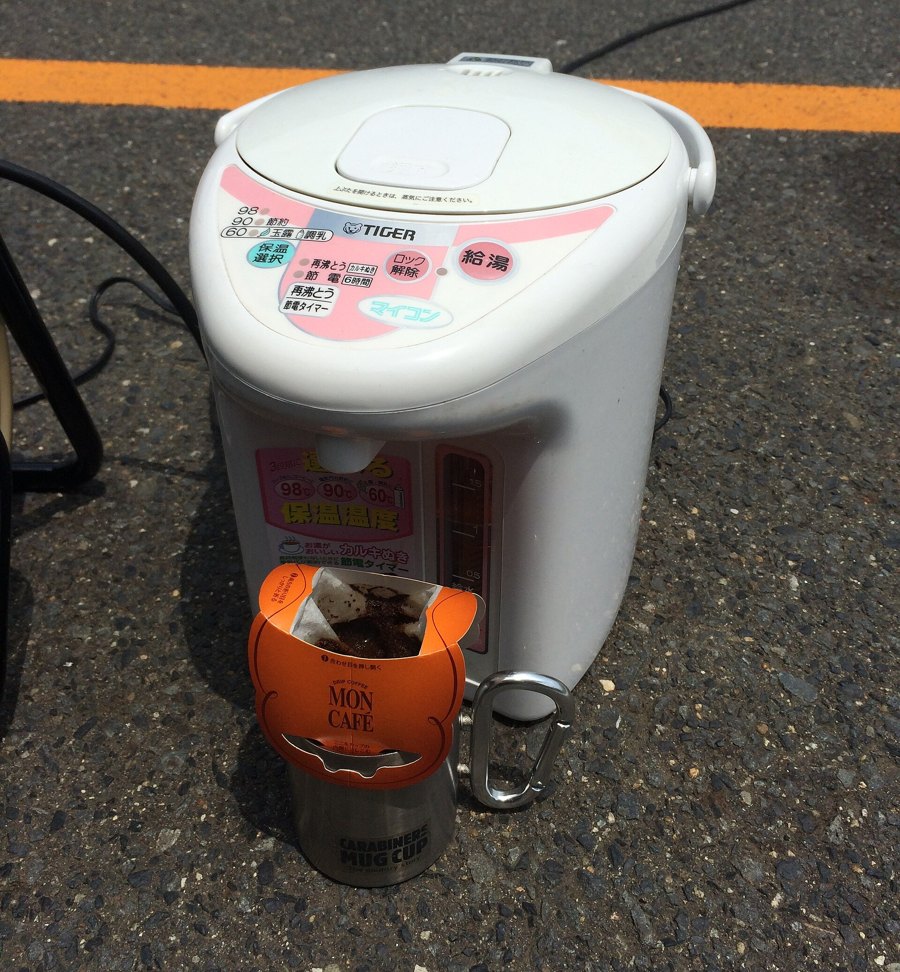
With a boiler on the table, the French press, the phin, the AeroPress and the egg coffee can be filled straight from its spout, at 208 °F or 195 °F. Only pour-over needs a kettle.
The pouring kettles
A pour-over kettle at a stall does not have to heat water. It has to hold a litre at temperature and pour it slowly. Filled from the boiler at 208 °F and set to hold 205 °F, its element hardly runs.
| Kettle | Size | Power | Temperature control | Price |
|---|---|---|---|---|
| Fellow Stagg EKG Pro (gooseneck; the current Stagg EKG) | 0.9 L | 1,000–1,200 W | To half a degree; hold, schedule, altitude setting | $199.95; the earlier Stagg EKG is $132 refurbished from Fellow |
| Fellow Corvo EKG (plain spout) | 0.9 L | not published | Temperature control; an all-purpose spout for filling a press or an AeroPress | $199.95 |
| Bonavita 1.0 L variable-temperature gooseneck | 1.0 L | 1,000 W | To the degree, 140–212 °F; holds for up to 60 minutes; six presets | $89.99 (on backorder) |
| OXO adjustable-temperature pour-over kettle (gooseneck) | 1.0 L | 1,500 W (retailers) | 104–212 °F; holds for 30 minutes | varies by retailer |
| Fellow Clyde | 1.5 L | 1,500 W | None: boil only | $99.95 |
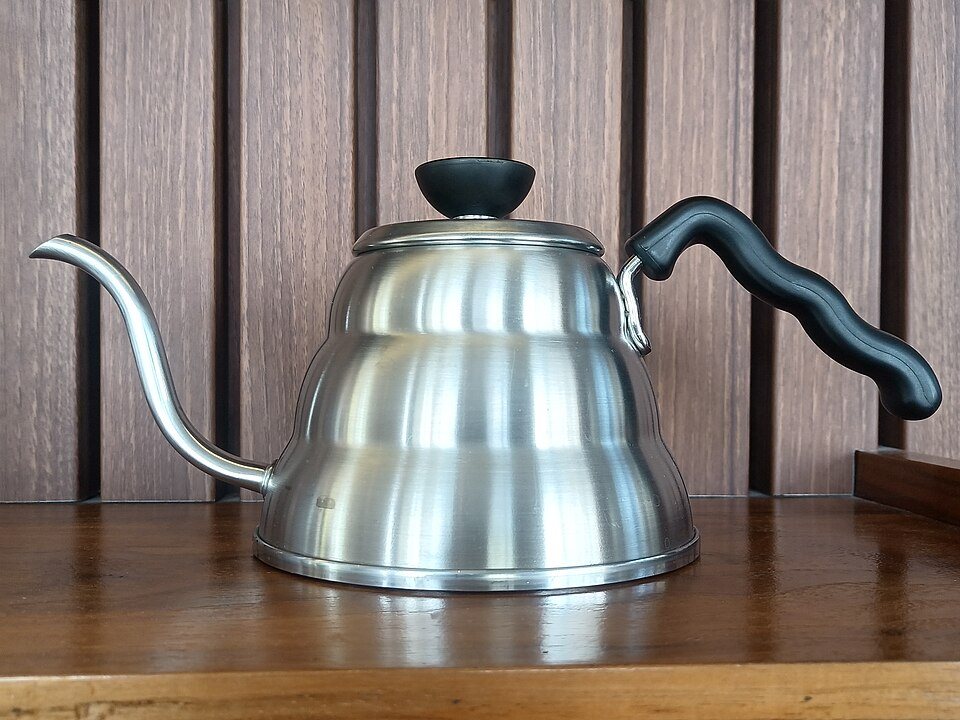
| Stovetop gooseneck, stainless | about 1 L | none | A thermometer in the lid | $22 |
Prices are the makers’ own (Fellow, 5 October 2026) and a restaurant supplier’s. The Bonavita line is from Bonavita’s product page, which lists a “Commercial and Household UL Rating”; it is the only kettle here whose maker claims a commercial listing, and at 1,000 W it is also the lowest-powered. The OXO line is from OXO’s instruction booklet. Brewista, Hario and Cosori kettles are sold through retailers, whose listings give about 1,000 W; they are left out of the table because their makers publish no specification to check against. The same prices are on The Equipment List. Kettles for a kitchen at home are on A Home Coffee Kit.
How many. Two gooseneck kettles with a hold setting: the one I own and one more. One is always full and at temperature while the other is being refilled, and two people can pour at once. A 1.5-litre boil-only kettle is the wrong second kettle. It draws 1,500 W, it has no temperature setting, and the boiler already does its job.
One more, for the days with a burner. A $22 stovetop gooseneck works on propane where a market allows it, and costs nothing to keep in the box.
What can be plugged in together
| Supply | Limit | What it will run |
|---|---|---|
| The power station I own | 600 W (X-Boost for heaters up to 1,200 W) | One heating appliance at a time, at about half speed. The boiler holding temperature, or a kettle topping up, but the two will sometimes ask for power together. This needs the home test before it is relied on. |
| A 1,500–1,800 W power station | 1,500–1,800 W | The boiler and one kettle together, with room for a grinder. |
| A market outlet | 1,800 W on a 15-amp circuit, and usually shared | The boiler (930 W) and one kettle (1,200 W) add up to 2,130 W if both heat at once, and two kettles to 2,400 W. Either can trip a breaker that other vendors are also using. |
The way round all three is the same: nothing at the stall heats water from cold. The boiler arrives hot, the kettles are filled from it, and each element only tops up.
The order to buy in
- Run the home test on the kettle I have and the power station, as described above. It costs nothing.
- A water boiler. The CD-WHC40 if the 600 W power station is all there is, because its heater is the smallest. The vacuum-insulated CV-JAC if a bigger power station or an outlet is certain, because it holds temperature on half the power. The CD-LTC50 if the health department asks for commercial equipment.
- A second gooseneck kettle with a hold setting.
- A stovetop gooseneck, for propane days.
- Then the second power station in the table below, which lets the boiler and a kettle run together.
A hot-water tower of the kind a café has (two to five gallons, $700 to $1,300, 1,440 to 1,850 W) is a purchase for the shop. So is a large urn-style boiler: an 8-litre one is $68 and a 19-litre one $89, but at 1,300 to 1,500 W they are for a wall socket.
Propane
A one-pound propane cylinder holds about 6,300 Wh of heat (21,548 BTU per pound), about 7.3 times the battery. On a 10,000 BTU single burner at an assumed 45% efficiency outdoors, it heats a litre in a little over four minutes and something like 27 to 34 litres per cylinder, so two cylinders cover a full 48-litre day. A tank-top burner is about $60. On energy alone, propane wins easily.
The obstacle is permission. The International Fire Code’s tent chapter, as reproduced in a Saginaw Township fire department handout, says open flame is not permitted inside or within 20 feet of a tent open to the public “unless approved by the fire code official,” and that LP-gas containers “shall be located outside,” with at least 10 feet between a portable cylinder and the structure. MDARD’s temporary-food guidance says propane stoves “may require approval from the local Fire Marshall.” A single 10-by-10 canopy may fall below the size that needs a tent permit, so how much of that applies is a local question.
Propane is worth asking about at each market, and worth having for the ones that say yes. It cannot be the plan for every market.
A propane tankless “camp shower” heater is not a brewing heater: the common models cut out at about 176 °F. Its honest use at a stall is warm handwashing water.
A generator
| Output | Noise | Price | |
|---|---|---|---|
| Honda EU2200i | 1,800 W running | 48–57 dB(A) | about $1,100–$1,200 (retailers) |
| Champion 2,500 W dual fuel | 1,850 W on gasoline, 1,665 W on propane | 53 dBA at 23 feet | about $400–$600 |
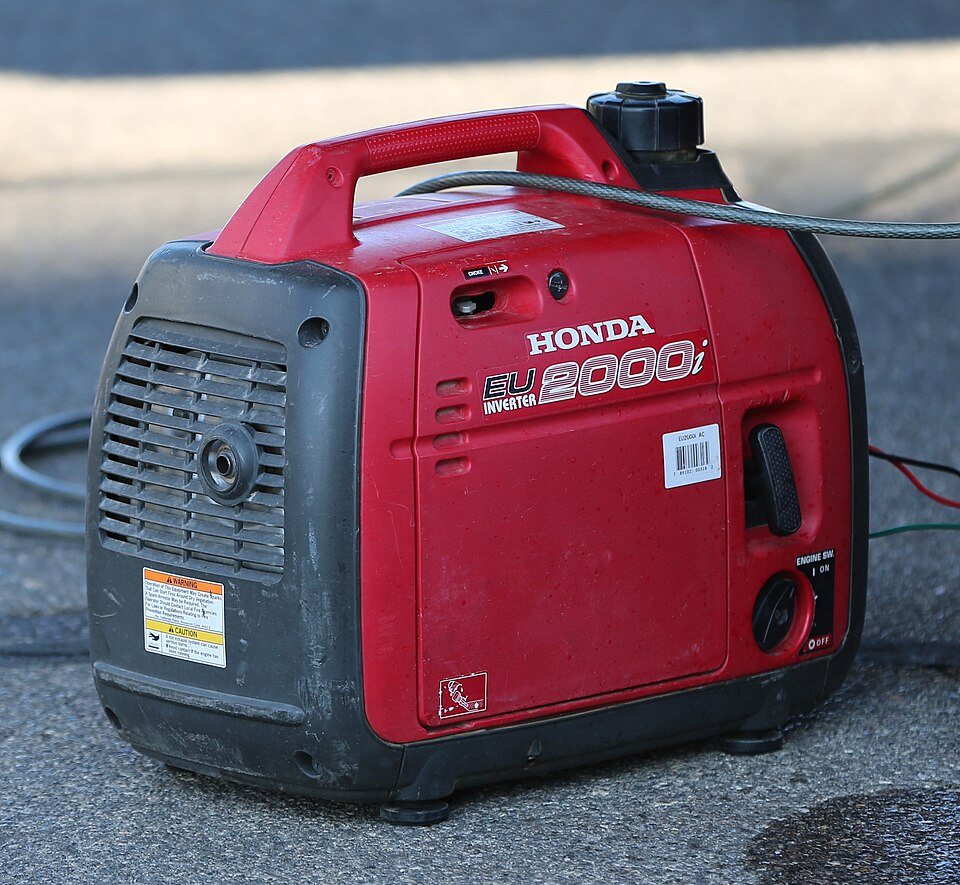
Either runs a full-power kettle. The costs are noise, exhaust, fuel and the market’s rules. East Lansing’s market bans combustion generators. Midland, which has no power at all, requires a “silent” inverter generator of 70 dB or less. Mount Pleasant decides case by case.
A bigger battery
| Power station | Battery | Inverter | Weight | Price |
|---|---|---|---|---|
| EcoFlow River 3 Max Plus (owned) | 858 Wh | 600 W | about 24 lb | owned |
| EcoFlow Delta 3 Plus | 1,024 Wh | 1,800 W | $669 | |
| Jackery Explorer 1000 v2 | 1,070 Wh | 1,500 W | 24 lb | $559 |
| Jackery Explorer 2000 Plus | 2,042 Wh | 3,000 W | 62 lb | about $2,500 |
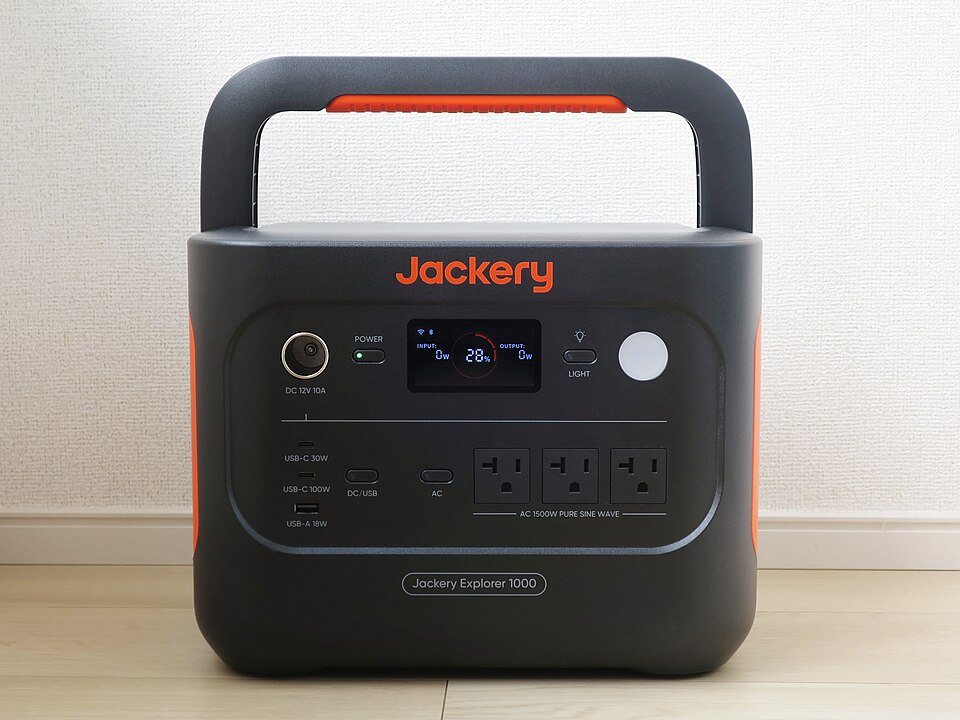
A 1,500 W inverter runs any of the kettles at full speed, and a shop grinder too. The battery is still only about a kilowatt-hour, so it does not change the arithmetic on heating from cold: about eight or nine litres more. A second station in the $560 to $670 class buys full-speed heating and a spare, and is a better first purchase than a generator — but it does not close the gap on its own: added to the four-airpot plan below, it brings the day to about 30 litres, not 48.
A day’s water, and what each plan supplies
An estimate for a full day of 60 hot cups, 40 iced drinks and 200 samples (the day The Numbers and Sampling work from):
| Use | Litres |
|---|---|
| Hot cups, with rinse water | 27.6 |
| Iced drinks (the hot half of a flash brew) | 8.8 |
| Samples at 2 oz each | 12 |
| Handwashing, 5 gallons | 18.9 |
| Wiping and utility, 2 gallons | 7.6 |
| Total | about 75 litres, or 20 gallons |
That is 165 lb of water before the ice. The water has to come from an approved supply, and wastewater has to be carried away in a sealed container (the rules page).
Of that, 48.4 litres has to be hot: the hot cups (27.6), the hot half of the iced drinks (8.8) and the tasting coffee (12). Per item that is 0.46 litre a hot cup, 0.22 litre an iced drink and 0.06 litre a 2 oz taste.
What the battery can give the water. 858 Wh, less 15% in the inverter and 15% in the heating element, is about 620 Wh delivered to the water. Heating from cold costs 93.7 Wh a litre; topping up from 185 °F to 205 °F costs 12.9.
Plan A: the boiler and four airpots (no permission needed).
| Step | Litres | Battery used |
|---|---|---|
| Boiler (CV-JAC40) arrives full and boiling | 4.0 | — |
| Four airpots arrive at a boil | 15.2 | — |
| Boiler holds 208 °F for five hours: 140 Wh, plus inverter loss | — | 165 Wh |
| Top up all 15.2 L of airpot water from 185 to 205 °F: 196 Wh to the water | — | 271 Wh |
| What is left (422 Wh, or 305 Wh at the water) heats water from cold | 3.3 | 422 Wh |
| Total hot water | about 22.5 | 858 Wh |
That is a little under half the day: about 25 hot cups, 20 iced drinks and 100 tastes (25 × 0.46 + 20 × 0.22 + 100 × 0.06 = 21.9 litres).
Plan B: the boiler and twelve airpots (still no permission needed).
| Step | Litres | Battery used |
|---|---|---|
| Boiler arrives full and boiling | 4.0 | — |
| Twelve airpots arrive at a boil | 45.6 | — |
| Boiler holds for five hours | — | 165 Wh |
| The first four pots are used in the first two hours, still near 197 °F, straight from the pot | — | — |
| The other eight pots (30.4 L) topped up from 185 to 205 °F: 392 Wh to the water | — | 543 Wh |
| Total hot water | about 49.6 | 708 Wh, with 150 to spare |
That covers the full day. The costs are eight more airpots ($224 to $800 at $28 to $100 each), the room to carry twelve, and the weight: the water is the same 50 kg it would be in jugs, plus about 2 kg of pot each. If the pots are not filled until just before leaving and are kept wrapped, the 185 °F assumption holds for about six hours on Zojirushi’s figures; on a cold morning plan on the pots falling faster.
Plan C: propane, where allowed. Two 1 lb cylinders heat 54 to 68 litres from cold, more than the 48.4 needed, and the water travels cold in jugs. Only the market and the fire official can say yes.
Plan D: an outlet or a generator. No practical limit; the boiler and one kettle, not both heating at once on a shared 15-amp circuit.
| Option | Hot water for the day | What it needs |
|---|---|---|
| Battery kettle, water from cold | 6.6–7.8 litres (14–18 cups) | Nothing, but it is not enough |
| A: boiler and four airpots, battery top-up | about 22 litres — half a day | Four airpots; the kettle test passed |
| B: boiler and twelve airpots, battery top-up | about 50 litres — a full day | Twelve airpots and the room to carry them |
| A, plus a second 1 kWh power station | about 30 litres | $559–$669 |
| C: propane burner and stovetop kettle | 27–34 litres per 1 lb cylinder; two for a day | Approval from the market and the fire official |
| D: inverter generator or an outlet | No practical limit | $400–$1,200 and a market that allows it; or an outlet at $1 to $10 a day (Prices and Customers) |
The recommendation: start the first season on Plan A with a smaller menu — the day it supports is close to what a new stall sells anyway — and buy airpots toward Plan B as the cups grow. Ask every market about propane and power; a yes to either ends the problem.
Grinding takes almost no power
Grinding a 12 oz bag takes 6 to 8 Wh, less than a tenth of what one litre of hot water costs. The limit for a grinder is the inverter’s wattage, not the battery. That is covered on Grinders.
Related pages
Sampling (how much tasting coffee a day takes), The Stall (where the hot water sits), The Equipment List (prices for everything here), The Numbers (the market day these litres serve), Water (which water to carry), Catering and Event Coffee Carts (airpots and venue power at an event), and Cleaning and Descaling (kettles, boilers and airpots).
Sources
- EcoFlow: X-Boost page; the River 3 Max Plus product page (output figures); Delta 3 Plus page. Jackery: Explorer 1000 v2 and Explorer 2000 Plus.
- Zojirushi SR-AG38 airpot specifications. The cooling curve is fitted to its published points.
- Water boilers: Zojirushi product pages for the CV-JAC40/50, CD-WHC40 and CD-LTC50, and the instruction manuals for the first two (heater rating, average keep-warm power, boiling and cooling times, “household” use); Zojirushi’s online shop and WebstaurantStore for prices.
- Kettles: Fellow’s Stagg EKG page and kettle collection (5 October 2026); Bonavita; OXO’s instruction booklet; retailer listings for the Brewista, Hario, Cosori and OXO wattages; WebstaurantStore for stovetop kettles, urn boilers and plumbed dispensers.
- AeroPress, “How to use”.
- Propane: trade figure of 21,548 BTU per pound; Stansport single-burner stove.
- Fire-code text: International Fire Code chapter 31 as reproduced in a Saginaw Township fire department handout; MDARD temporary food establishment guidance.
- Generators: Champion’s product page; Honda figures as reported by retailers.
- Market rules: East Lansing, Midland and Mount Pleasant vendor rules, linked on The Michigan Rules.
- The 15-amp circuit figure is 15 A at 120 V. The 15% loss figures, the 45% burner efficiency and the 65% solar output are assumptions, stated where used.
Comments (0)