Starting a Coffee Business · 23 of 39
Roast Logs, Quality Control and Blending
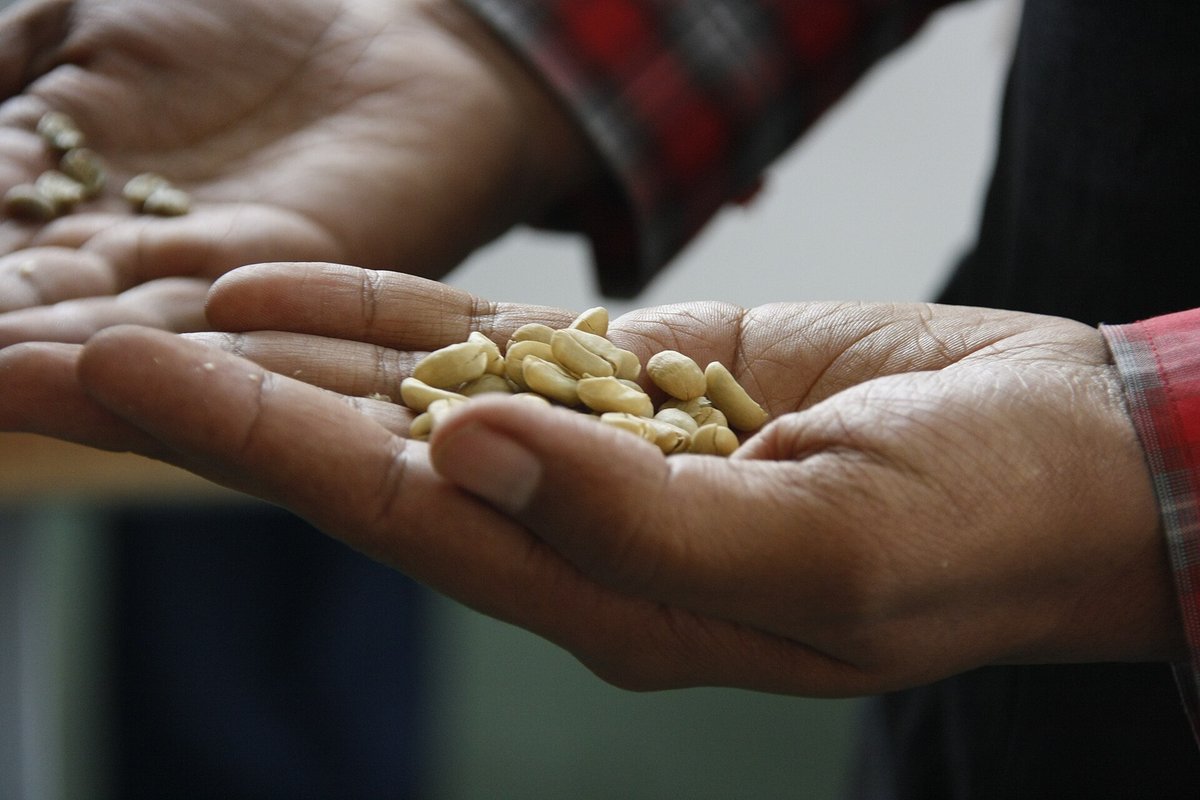
Roasting a batch that tastes good is a skill. Roasting the same batch again next Tuesday, and the Tuesday after that, is a different skill, and it is the one a business is built on. A customer who liked the Guatemala in September expects the Guatemala in October to be the same coffee. I have roasted by home methods, in a popper and a skillet, and I own no roasting machine yet; the roaster plan is on Choosing a Roaster. What follows is the routine I plan to keep from the first batch I sell: a written log, a few checks on every roast, a reference to taste against, and, later, a house blend that stays the same while the beans in it change.
The short version
| Question | Answer |
|---|---|
| What is a roast log? | A record of each batch: the coffee, the weights, the temperatures and times at each stage, the weight lost, the colour, and how it tasted. |
| The five numbers that matter most | Charge weight, time to first crack, drop time, drop temperature, and weight lost. With those, a roast can be repeated. |
| Software or paper? | Paper works for a Behmor, which has no bean-temperature reading. Artisan is free and logs most machines with probes. RoasTime comes with an Aillio Bullet. Cropster is the trade’s paid system. |
| Rate of rise | How fast the bean temperature is climbing, in degrees per minute. It should fall steadily through the roast. |
| Cheapest useful check | Weigh the beans in and out. Weight lost tracks roast degree closely and costs nothing. |
| Roast-colour meter | Optional at the start. Handheld near-infrared meters that read on the Agtron scale cost from about $900 (DiFluid Omni, as of October 2026). |
| Green moisture and density | Check each new sack. A green-coffee meter is $330; a kitchen scale and a measuring jug give density for nothing. |
| Tasting | Cup every new coffee and a sample of every roast day against a kept reference (Cupping). |
| Blending | Roast each coffee on its own and blend after roasting, by weight, at the start. |
| Lot codes | Put a roast date and a batch number on every bag. It costs nothing and makes a recall possible. |
What a roast log records
The phases of a roast, and why each matters, are on How Coffee Is Roasted. The log is those phases written down with a time and a temperature beside each.
| Entry | What it is | Why it is logged |
|---|---|---|
| Coffee and lot | The origin, the farm or co-op, the importer’s lot number | Two sacks of “Colombia” are not the same coffee |
| Green moisture | Water in the green bean, as a percentage | Wetter beans take longer to dry and lose more weight |
| Charge weight | Grams of green coffee loaded | The profile only repeats at the same weight |
| Charge temperature | The drum or air temperature when the beans go in | Sets how much heat the beans take in the first minute |
| Turning point | The lowest bean-probe reading, a minute or so in, before it starts to climb | A cold charge or a slow machine shows here first |
| Dry end (yellowing) | When the beans turn from green to yellow and smell of hay and bread | Marks the end of drying |
| First crack: time and temperature | The first audible pops, around 390–410 °F | The main landmark; everything after it is development |
| Development time and ratio | Time from first crack to drop; and that time as a share of the whole roast | Commonly 15–25%; a check, not a target (Roasting) |
| Drop temperature and total time | Bean temperature and clock time when the batch leaves the drum | Together they fix how dark the roast is |
| Roasted weight and weight loss | Grams out; and (in − out) ÷ in × 100 | The cheapest measure of roast degree there is |
| Colour | A meter reading or a tile match, on ground coffee | A second, independent check of roast degree |
| Cup notes | How it tasted after resting | The only entry the customer cares about |
| Ambient | Room temperature, and anything odd (a cold garage, a draught) | Explains a roast that ran slow for no visible reason |
Development ratio is worked out as (drop time − first-crack time) ÷ drop time × 100. A roast that hits first crack at 8:30 and drops at 10:15 has 1:45 of development, which is 17% of the whole.
Weight loss for whole-bean coffee runs from about 11% for a light roast to about 16% for a dark one (Roasting Your Own). Within one coffee on one machine it moves in step with roast degree, so a batch that lost 13.8% when the last three lost 13.0% was roasted darker, whatever it looks like.
A log sheet to print
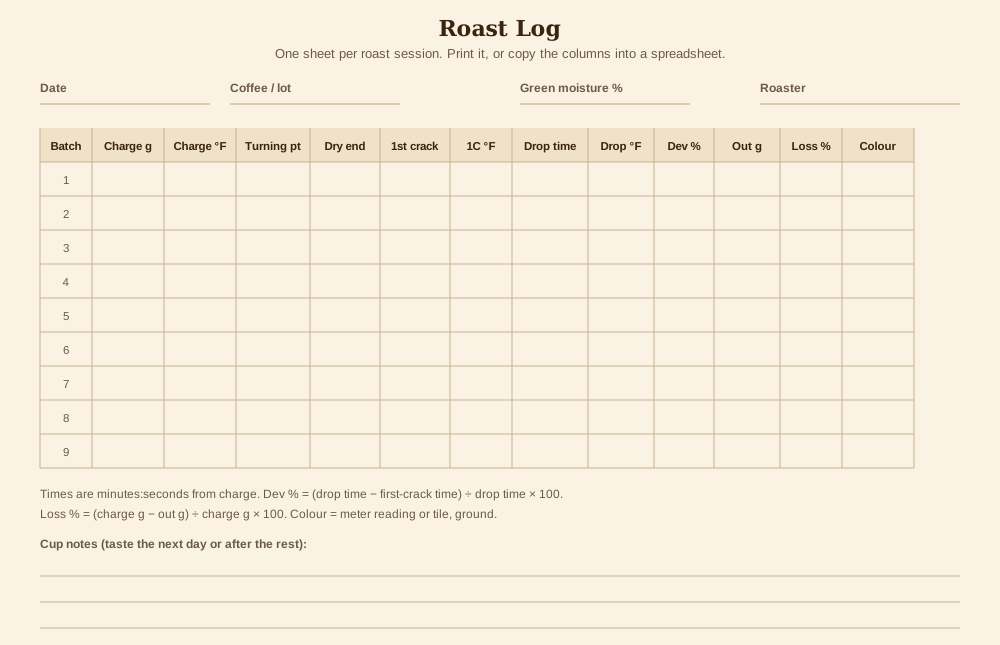
On a machine with no bean probe, such as the Behmor, the temperature columns stay empty and the times, the weights and the colour carry the log. That is enough to repeat a roast. The Behmor’s manual says outright that its displayed temperatures are the exhaust and the chamber, and “Never gauge degree of roast based on these temps” (Choosing a Roaster).
Logging software
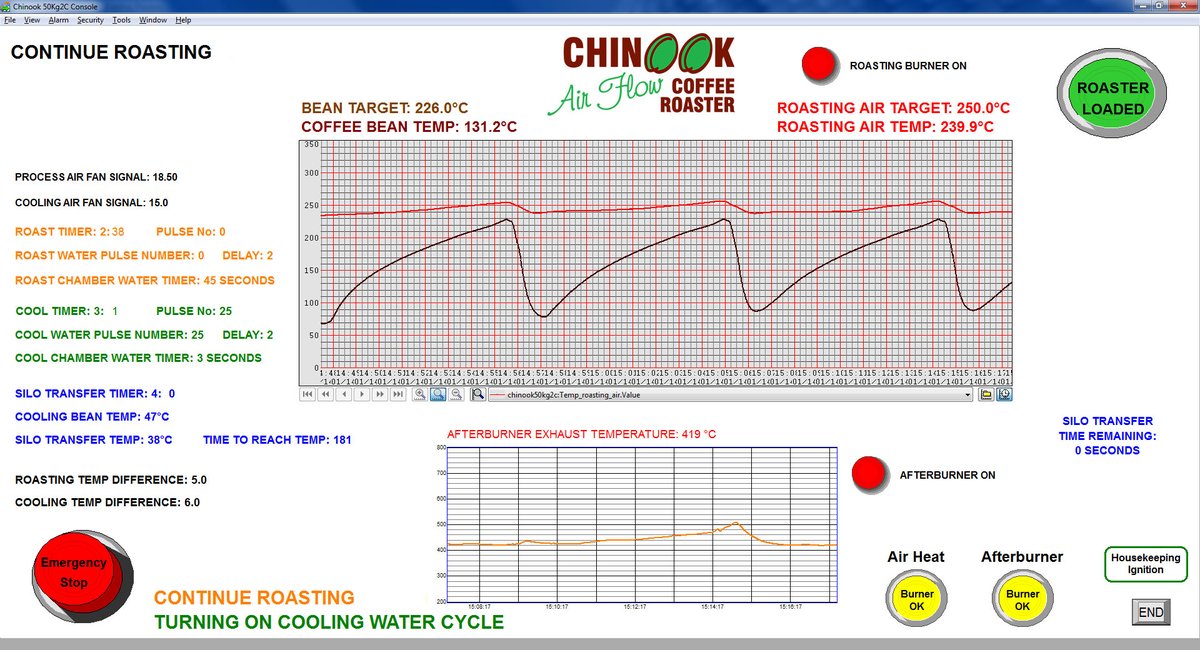
| Software | Cost (as of October 2026) | Works with | What it does well | Limit |
|---|---|---|---|---|
| Paper and a timer | A clipboard | Anything, including a Behmor or a popper | Nothing to break; forces the roaster to look | No curve; no rate of rise |
| Artisan | Free, open source | Over 200 machines and 50 measuring devices, by its own count; the Aillio Bullet R1 and R2 by USB | Live curve, rate of rise, event marks, a past roast as a background to follow, alarms, even machine control | Set-up takes an afternoon; a machine without probes needs a thermocouple fitted |
| Aillio RoasTime | Free with a Bullet | Aillio Bullets | ”Advanced logging, analysis, and automation tools for Mac, Windows, and Linux,” and profile sharing on Roast.World | One maker’s machines only |
| Cropster | A free Starter tier for machines up to 6 kg; paid plans start at €95 a month, rising with volume | Production roasters | Roast logs tied to green inventory, cupping scores and sales | The cost of a production system; the free tier’s monthly roast allowance is stated two ways on the maker’s page |
Artisan’s own page warns that running it at the same time as RoasTime on one Bullet “might lead to instabilities and crashes.” Pick one per roast.
The machines between a Behmor and a Bullet, and which of them feed Artisan, are on Roasting Machines.
Rate of rise, in plain words
The bean probe gives a temperature. Rate of rise (RoR) is how fast that temperature is going up: if the beans read 350 °F now and 365 °F a minute from now, the rate of rise is 15 °F a minute. Software draws it as a second line under the temperature curve.
In a good roast that second line slopes down the whole way: quick early, slower and slower, never flat and never turning back up. Three shapes go wrong:
| What the RoR line does | What it means | What it tastes like |
|---|---|---|
| Goes flat or nearly flat | The beans have stalled; heat is not going in | Baked: flat, papery, no sweetness |
| Drops sharply at first crack, then jumps back up | The “crash and flick”: the roaster added heat to rescue a crash | Hollow, harsh, ashy |
| Rises in the middle of the roast | Heat added late to make up time | Scorched edges, bitter |
The fuller account, and why the flick happens, is on How Coffee Is Roasted. A Behmor cannot show any of this, which is one reason the log on that machine relies on weight and colour.
Quality control
Quality control at this scale is four checks: what comes in (the green), what goes in the drum (the weight), what comes out (weight and colour), and how it tastes.
Cupping your own roasts
Cupping is the trade’s way of tasting coffee side by side: the same dose of grounds, the same water, steeped in bowls and tasted from a spoon. The protocol, and how to run one at home, is on Cupping.
The routine I plan to follow:
- Cup every new green coffee before buying more than a sample of it.
- Cup one sample from each roast day, after the coffee has rested (two to five days for filter roasts; Keeping Coffee).
- Cup it beside the reference roast (below), not alone. Memory is a poor ruler.
- Write the notes on the log line for that batch, so taste and numbers sit together.
- When a batch tastes wrong, look at its line first: weight loss, time to first crack, drop temperature. The number that moved is usually the cause.
Roast colour
A roast-colour meter shines near-infrared light on a sample of ground (or whole) coffee and gives one number. The numbers follow the Agtron scale, where a higher number is a lighter roast; the scale, the eight colour tiles and the cupping roast of Agtron 63 are explained on How Coffee Is Roasted.
| Tool | Price, as of October 2026 | What it reads | Note |
|---|---|---|---|
| The eye, against the roast photographs | Free | Rough stage | Home Roasting, Step by Step has the stage photographs |
| Agtron/SCA colour tiles | Not posted; sold by enquiry | Eight reference disks, 25 to 95 | Agtron’s own figure for matching by eye is within about 2½ to 6 points |
| Lighttells CM-100 | Not posted; sold by enquiry from Taiwan | ”Same as Agtron measurements using ‘Gourmet’ scale,” 5–110; whole bean or ground | Battery, portable; stores 100 readings |
| DiFluid Omni | $899.99 on its product page; $1,079.99–$1,129.99 in bundles | 0–150 on an Agtron-equivalent scale; also grind particle size | 15–17 g whole bean or 3–5 g ground per reading; maker claims ±0.1 precision |
| ColorTrack and other handheld meters | Varies | Agtron-style readings | Several makers sell to small roasters |
| An Agtron analyzer | By quotation | The reference instrument | Laboratory equipment |
Three rules make a colour reading worth having:
- Read ground coffee, ground the same way each time. Whole-bean and ground readings differ, and the gap between them shows how evenly the bean roasted through.
- Read at the same rest, for example the morning after roasting.
- Compare a meter with itself. Two makes of meter may not agree with each other, or with an Agtron, to the point. The value is in watching one meter’s number for one coffee stay put.
Green coffee: moisture and density
Green coffee leaves the mill at about 10–12% moisture (The Bean); Sweet Maria’s puts normal arrival moisture at 10.5 to 11% (Green Coffee and the Line-Up). A wetter lot takes longer to dry in the drum and loses more weight, so a profile written for one sack may run long on the next.
| Method | Cost | What it gives |
|---|---|---|
| Ask the importer | Free | Most importers’ sample sheets list moisture and grade |
| Weigh a measured volume | A kitchen scale and a 1-litre jug | Free-settled density in grams per litre: pour the beans in loosely, level, weigh. Compare lots with each other, not with a book number |
| DiFluid CoffMeter M1 | $329.99 | Moisture (±0.2%) and density (±1 g/L), about 150 g per reading, calibrated by the user |
| DiFluid Omix | $1,899.99 | A fuller green-coffee analyzer from the same maker |
Density matters because denser beans, usually grown higher, take heat more slowly and stand more of it (The Bean). Two coffees of very different density roasted together in one drum will not finish together, which is the main argument in the blending section below.
Defect sorting
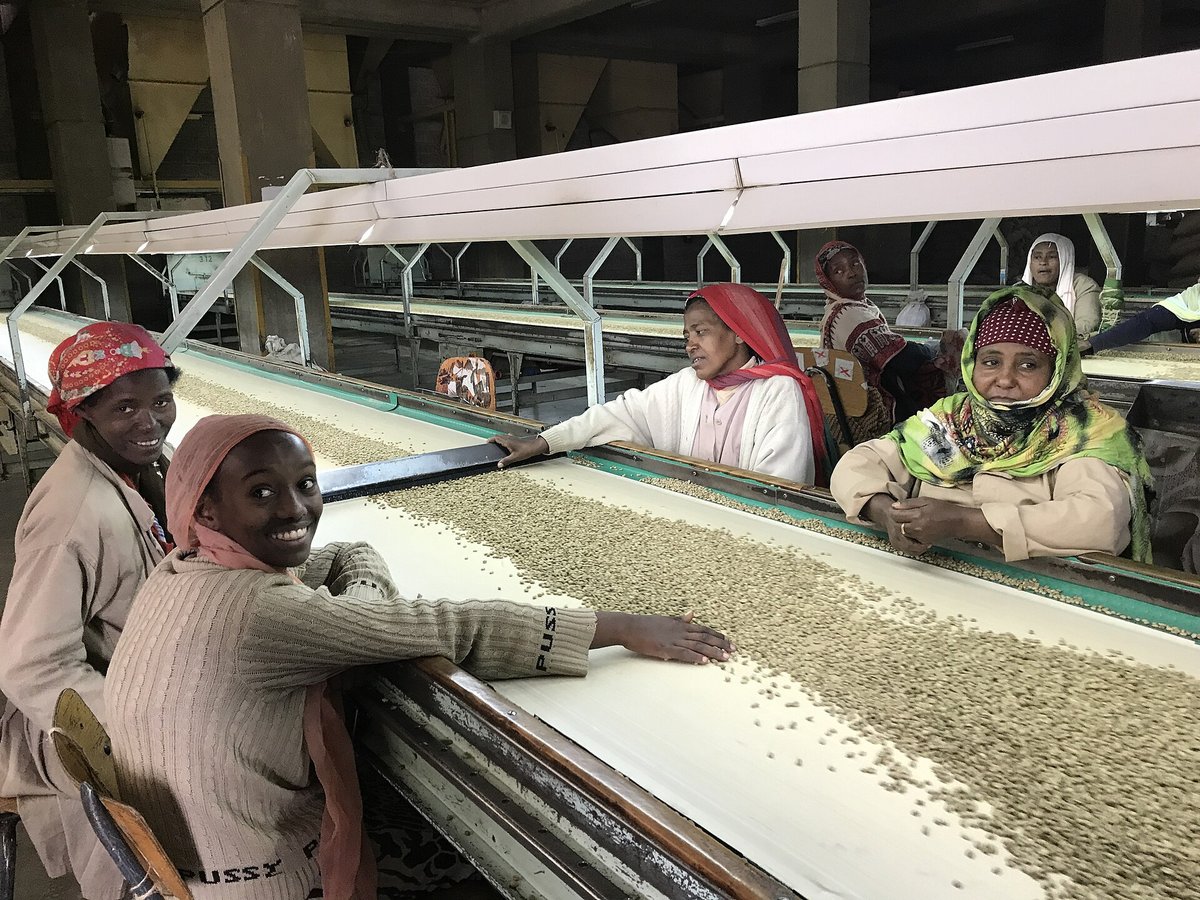
The trade’s grading counts defects in a 350 g sample of green coffee: black and sour beans, insect damage, broken beans, shells and stones (The Bean). Specialty-grade coffee arrives already well sorted, and a quick sort still pays:
- Spread each new sack’s first batch on a tray and pull stones, sticks and black beans before roasting. A stone in a burr grinder is an expensive noise.
- After roasting, pull quakers: pale beans that never browned. They are unripe cherries, they taste of cardboard and peanuts, and roasting cannot fix them (How Coffee Is Roasted).
- Count them now and then. A lot that suddenly throws twice as many quakers is worth a word with the importer.
The reference roast
A reference roast is a bag of the house’s best batch of a coffee, kept aside to taste against.
- When a roast of a coffee comes out right, mark that batch’s log line REFERENCE.
- Keep 100 to 200 g of it sealed, in portions, in the freezer (freeze once, do not refreeze; Keeping Coffee).
- At each cupping, thaw one portion unopened and cup it beside the new batch.
- Replace the reference when the green lot changes, and log the change.
Consistency targets
No published standard says how close one batch of the same coffee must be to the last. These are working targets I plan to start with on a small drum roaster and tighten as the log fills up:
| Measure | Working target between batches of one coffee |
|---|---|
| Charge weight | Within 5 g |
| Time to first crack | Within 15 seconds |
| Drop temperature | Within 2 °F |
| Weight loss | Within 0.5 percentage points |
| Colour, ground, one meter | Within 2 points |
| Cup | Indistinguishable from the reference at a cupping |
The last line outranks the others. A batch that matches every number and tastes different still goes back to the log to find out why.
Blending
A blend is two or more coffees sold as one. A house blend is the one a business keeps on the shelf all year, the bag regular customers buy without reading the label.
What a house blend is for
| Purpose | What it means at a market stall |
|---|---|
| Consistency | Single-origin lots run out; a blend can carry on when one component is replaced |
| Balance | One coffee for body, another for brightness, a third for sweetness |
| Cost | A good, cheaper base coffee carries a smaller share of an expensive one |
| A name | The house blend is the coffee that becomes “theirs” to a customer |
Blend before or after roasting
| Pre-roast blending (mix the green, roast together) | Post-roast blending (roast each, mix after) | |
|---|---|---|
| Work | One roast | One roast per component |
| Control | Every component gets the same roast, whatever its density or size | Each coffee gets its own profile |
| Risk | A soft, low-grown coffee goes dark while a dense one is still underdeveloped | Mixing errors; components must be weighed |
| Even colour in the bag | Uneven if the beans differ | Even within each component |
| Best for | Coffees chosen to roast alike | Coffees that differ in density, size or process |
At small batch sizes, roasting each component on its own and mixing by weight is the simpler way to get a repeatable blend, and it is the one the log can check: each component has its own log line.
Designing one
- Decide what the blend is for. A drip and French-press coffee for the airpot, a dark blend for the phin, or an espresso blend for someone else’s machine. The line-up is where the stall’s coffees are chosen.
- Start with a base of half or more: a dependable, sweet, medium-bodied coffee that is easy to rebuy (a washed Central American or a Brazil are the usual choices).
- Add one accent at a time, 10 to 30%, for what the base lacks.
- Cup the components alone, then mixed at two or three ratios, the same day, beside each other.
- Write the recipe as weights of roasted coffee (for example 600 g base, 300 g second, 100 g accent) and note each component’s roast.
- Brew it the way customers will. A blend chosen on the cupping table can taste different in a French press.
Keeping it the same as the greens change
- Before a component sack runs out, buy a sample of its replacement.
- Cup the replacement in the blend, at the usual ratio, beside the reference blend.
- Adjust the ratio, not the roast, first. Change one component at a time.
- Log the change with a date, and print the new component on the bag if the label lists origins.
- If the blend cannot be matched, say so on the shelf card (“new crop, a little brighter this month”). Customers notice the change either way.
Lot tracking, and being ready for a recall
A lot code ties a bag on someone’s shelf to the batch it came from. On a home roaster it can be as simple as the roast date and the batch number from the log: 2026-11-03-2.
| Situation | What the rules say | What to do anyway |
|---|---|---|
| Bagged coffee sold under Michigan’s cottage food exemption | No lot code is required by the exemption; the label rules are on The Michigan Rules | Print the roast date and batch number on the label |
| A licensed food establishment selling mainly to its own customers | Retail food establishments and restaurants are among the facilities that need not register with the FDA (21 CFR 1.226) | Keep the log and the green-coffee invoices together, by lot |
| A wholesale roaster selling mainly to other businesses | Generally must register as a food facility with the FDA and renew every other year; ask MDARD what applies (Wholesale) | Write a one-page recall plan |
| The FDA’s food traceability rule | Coffee is not on the Food Traceability List, so its extra records do not apply | Nothing extra |
Roasted coffee is very rarely recalled, but the reasons it can be — a foreign object, a labelling error, an undeclared flavouring — are exactly the ones a log answers. The recall plan for a one-person roaster fits on a page:
- The log line for every batch: green lot, date, roasted weight, number of bags.
- Where those bags went: market dates, wholesale accounts, online orders.
- Who to call: the county health department or MDARD, and the insurer (Insurance).
- The words for the shelf card and the website, written in advance.
What is not known
- How close is close enough. No standard sets a tolerance between batches of one coffee; the targets above are working targets, not a rule.
- Whether two makes of colour meter agree. Handheld meters claim Agtron-equivalent scales, and no independent comparison of them against an Agtron is published.
- Which blend ratio “works.” Blending is decided on the cupping table; no formula predicts it.
Related pages
How Coffee Is Roasted · Roasting Machines · Choosing a Roaster · Cupping · Green Coffee and the Line-Up · Toll Roasting, Private Label and Shared Roasteries · Smoke, Air Permits and the Neighbours · A Coffee Glossary
Sources
- Artisan, roasting software home page and Aillio machine notes.
- Aillio, Welcome to RoasTime.
- Cropster, packages and pricing.
- DiFluid, Omni roast-colour and particle analyzer, CoffMeter M1, and product catalogue.
- Lighttells, CM-100 coffee roast analyzer.
- US Food and Drug Administration, Food Traceability List.
- 21 CFR 1.226, facilities not required to register.
- On this site: How Coffee Is Roasted (phases, rate of rise, development ratio, Agtron); Roasting Your Own (weight loss); The Bean (moisture, density, grading); Choosing a Roaster (the Behmor manual).
Comments (0)