How Coffee Is Roasted
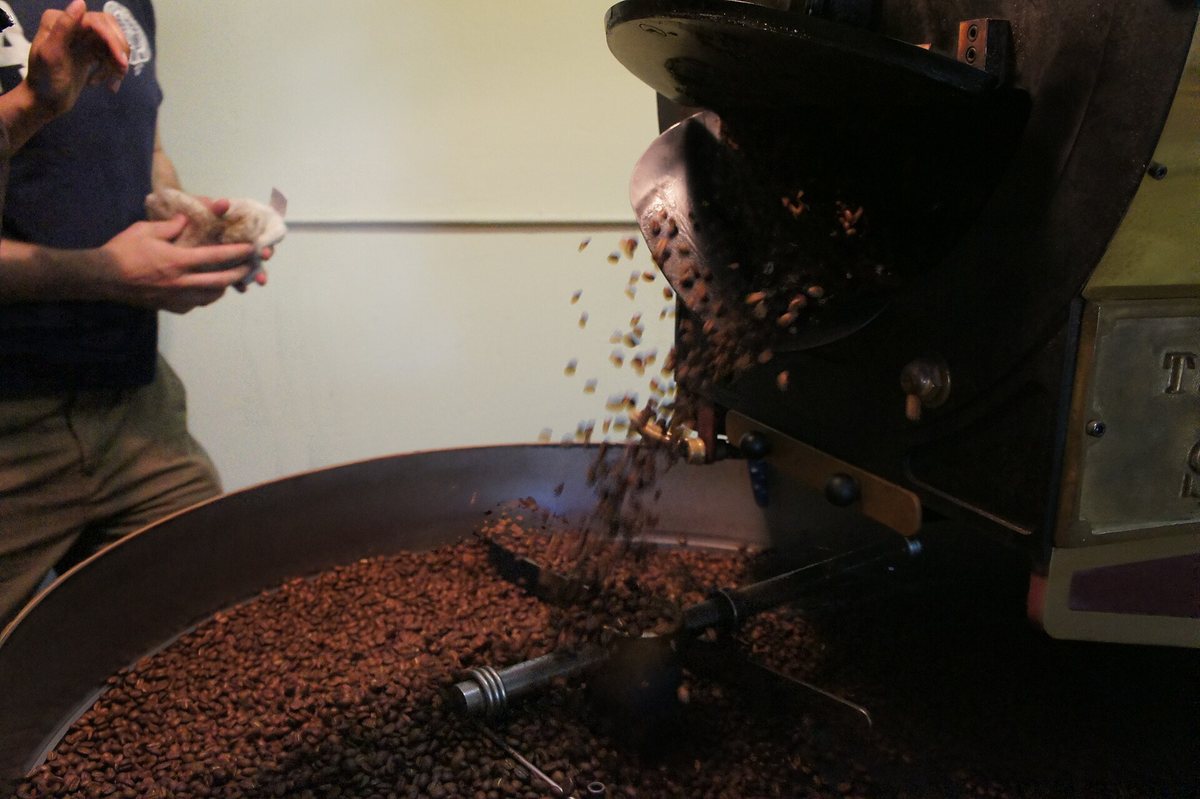
Here’s what took me embarrassingly long to internalize: roasting coffee is the same job as baking bread and smoking a brisket. Not metaphorically — literally the same chemistry on a different substrate. You apply a controlled heat curve to a wet, sugar-and-protein-bearing thing, drive the water out of it, and push it through browning reactions that manufacture hundreds of aroma compounds that were not there before. A crust, a bark, a roasted bean. Same reactions, same instincts, same failure modes when you rush it. Once I saw that, roasting stopped being mysterious. This page is the what and why; the how-to-do-it-yourself is on roasting your own, and the machines are on roasters.
What green coffee actually is
If you’ve never handled green coffee, get some — it corrects a lot of assumptions. A green bean is pale sage and hard as a pebble (you cannot bite it; don’t try), and it smells vegetal and hay-like. Brew it and you get something between grass clippings and weak tea. There is essentially no coffee flavor in coffee before roasting.
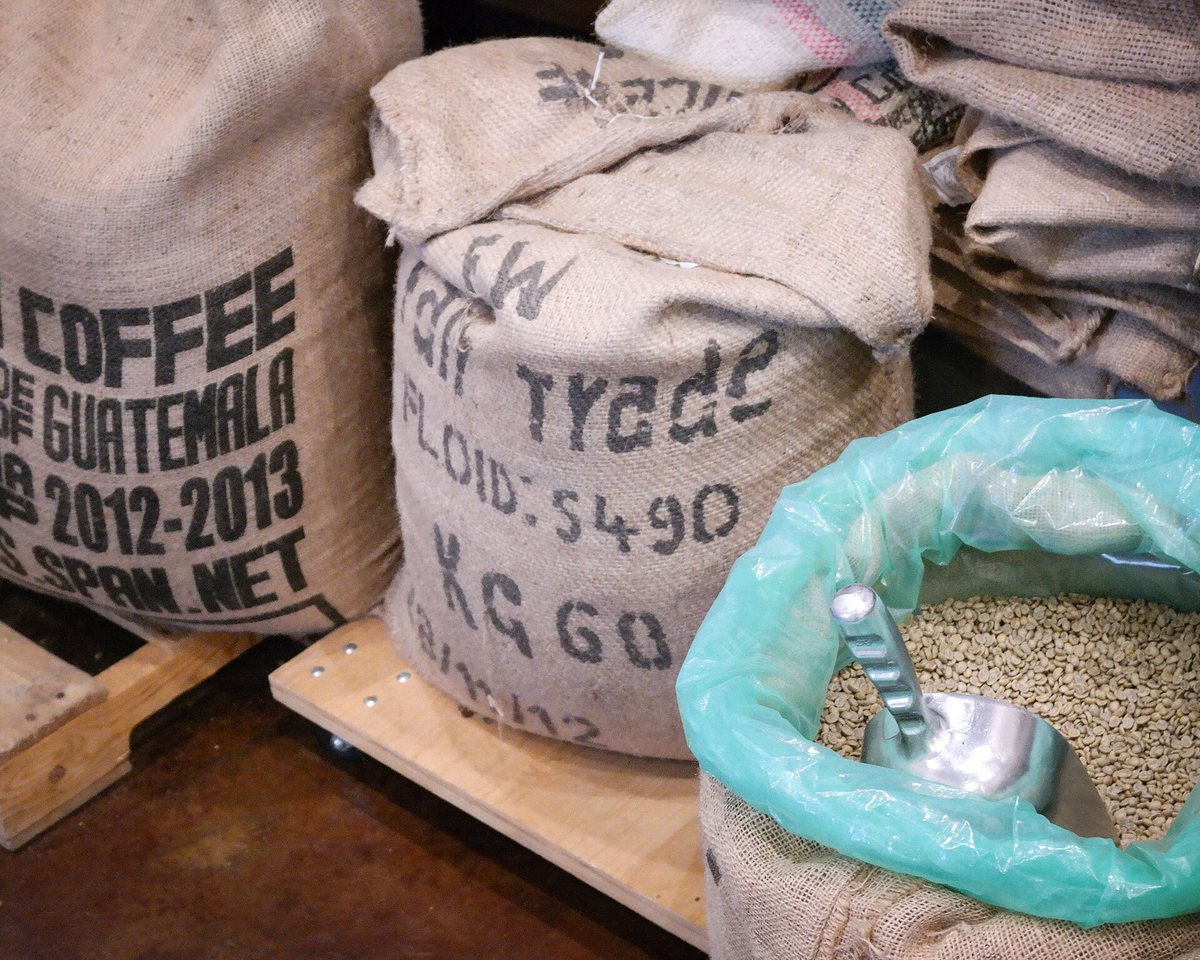
What’s in there is potential: roughly 8–12% moisture, plus sucrose and other sugars, chlorogenic acids, proteins and free amino acids, lipids, trigonelline, and caffeine. Those are the reagents. Roasting turns that inventory into the many hundreds of volatile aromatic compounds in roasted coffee — counts commonly cited run from around 800 to over 1,000 depending on who’s counting, which tells you something in itself. Whatever the number: almost every molecule you smell in a cup was created by heat. It did not come off the farm. The farm decided what heat would have to work with — that’s origins — but the roaster builds the flavor. Which is why I’m allergic to anyone who talks about origin and won’t tell you a roast date.
The chemistry, in bread-and-brisket terms
Three reaction families do the work, and if you bake or smoke you already know two of them.
Maillard. Amino acids plus reducing sugars plus heat, kicking off meaningfully around 140–165°C (285–330°F) and accelerating from there. It’s not one reaction but a cascade, producing melanoidins (the brown pigments and much of the body) and a huge population of aroma compounds: nutty, malty, bready, roasted, chocolatey. This is the crust on a loaf. This is the sear on a steak. This is a big slice of what bark is. In coffee, Maillard is where nearly all the “coffee smells like coffee” character gets manufactured — and the duration you spend in Maillard territory matters more than almost anything else you control.
Caramelization. Sugars breaking down on their own, no amino acids required, starting higher — sucrose gets going around 160°C (320°F) and up. Sweetness, caramel and toffee notes, more browning. Smaller than Maillard in coffee, but it’s why a well-developed roast tastes sweet despite having essentially no sugar left by the end — it’s all been consumed into other compounds.
Strecker degradation. A sub-branch of Maillard that earns its own name. Amino acids react with the dicarbonyls Maillard throws off, shed their carboxyl group as CO₂, and become Strecker aldehydes — intensely aromatic at vanishingly small concentrations. Much of coffee’s specific, recognizable top-note smell lives here: malty, honeyed, floral, chocolate. It also produces a big share of the CO₂ trapped in the bean, which matters enormously later.
Alongside them: pyrolysis, the outright thermal decomposition of the bean’s structure at high temperature. Pyrolysis is what makes dark roasts taste dark — smoke, carbon, char, bitterness. A little is roast character. A lot is ash. It’s the same line I walk on a smoker between good bark and an acrid crust I’d be embarrassed to serve.
The bread analogy runs deeper than the reactions. In a loaf, the crust browns because that’s where it’s dry enough to exceed 100°C, while the crumb sits at the boiling point until it’s done. A coffee bean does that inside itself — the outside browns while the interior still drives off steam — which is exactly why an uneven roast gives you a bean that’s dark outside and raw in the middle, and tastes burnt and grassy at once.
The phases of a roast
Every roast on every machine moves through the same sequence. What separates roasters is the timing and shape of the transitions, not the sequence.
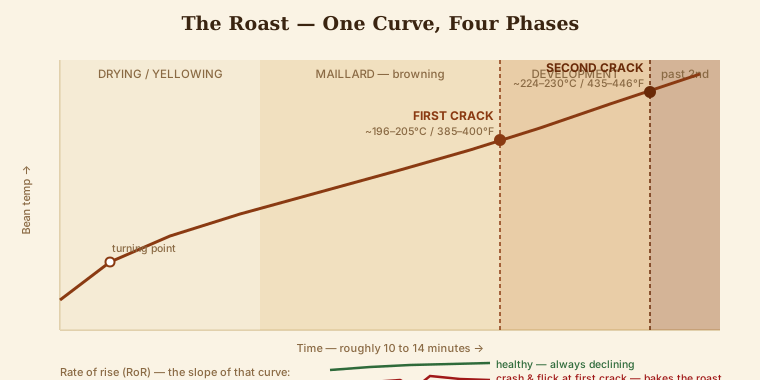
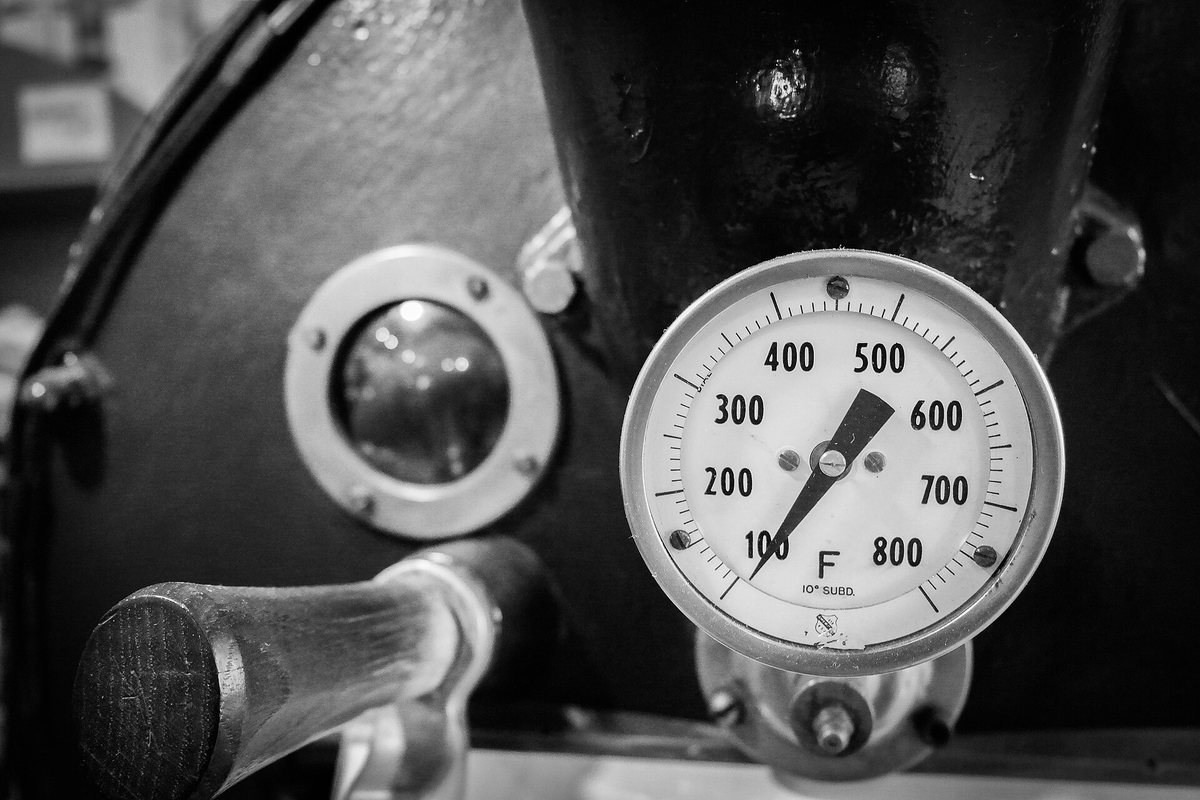
Charge. You drop green beans into a preheated drum. Charge temperature sets the entire trajectory, because it decides how much energy the beans absorb in the first minute. Too hot and you scorch the surface; too cool and you spend the whole roast behind and end up baking it. The bean probe then plummets as the cold mass soaks up heat, bottoms out at the turning point (often around a minute in), and starts climbing. Everything after is the climb.
Drying / yellowing — roughly the first 40–50% of the roast. Free water is driven off. This phase is endothermic: the beans soak up energy, and most of it goes into evaporating water rather than raising temperature, exactly like the plateau on a brisket where surface evaporation holds the meat at a wall. Sage → pale straw → yellow, and the room goes from grassy to something like toast or basmati rice. Nothing that tastes like coffee has happened yet. Rush this and you drive the outside past the inside; drag it and you bore the flavor out before Maillard ever gets a turn.
Maillard / browning. Yellow → tan → light brown. The bean smells like bread, then nuts, then coffee. Aroma compounds build furiously. The bean expands as internal steam pressure stretches the cell structure, and the papery silverskin — chaff — loosens and blows off.
First crack (~196–205°C / 385–400°F). The moment, and it’s audible across the room. Water inside flashes to steam, pressure exceeds what the cell walls hold, and the bean fractures and pops — sharp and brittle, like popcorn but drier. The bean nearly doubles in volume, goes porous, and dumps most of its remaining moisture. The exact temperature varies by machine, probe placement and bean, which is why every roaster quotes a slightly different number and all of them are right about their own drum. First crack is also where the reaction turns exothermic — the bean starts generating its own heat, and if you don’t cut power to compensate, it runs away from you.
Anything before first crack isn’t drinkable. Anything after is a choice.
Development. The part that matters most and gets discussed least. The window between first crack and drop is where the acids built earlier get moderated, the sugars finish, the body fills in, and the roast either becomes balanced or doesn’t. Too short and it’s sour, grassy, thin, vegetal — “underdeveloped,” the most common defect of the current light-roast wave. Too long and origin character burns off. This is the whole decision.
Second crack (~224–230°C / 435–446°F). A different sound — quieter, faster, more of a snap or a rice-krispie fizz than a pop. This is cell walls fracturing outright as the structure gives way, and it’s when oils migrate to the surface and the bean shines. Past it you’re in dark-roast territory, heading for pyrolysis and char.
Past that. Ash — and genuine fire risk. Roasters do catch fire. It’s a real reason the machines look the way they do.
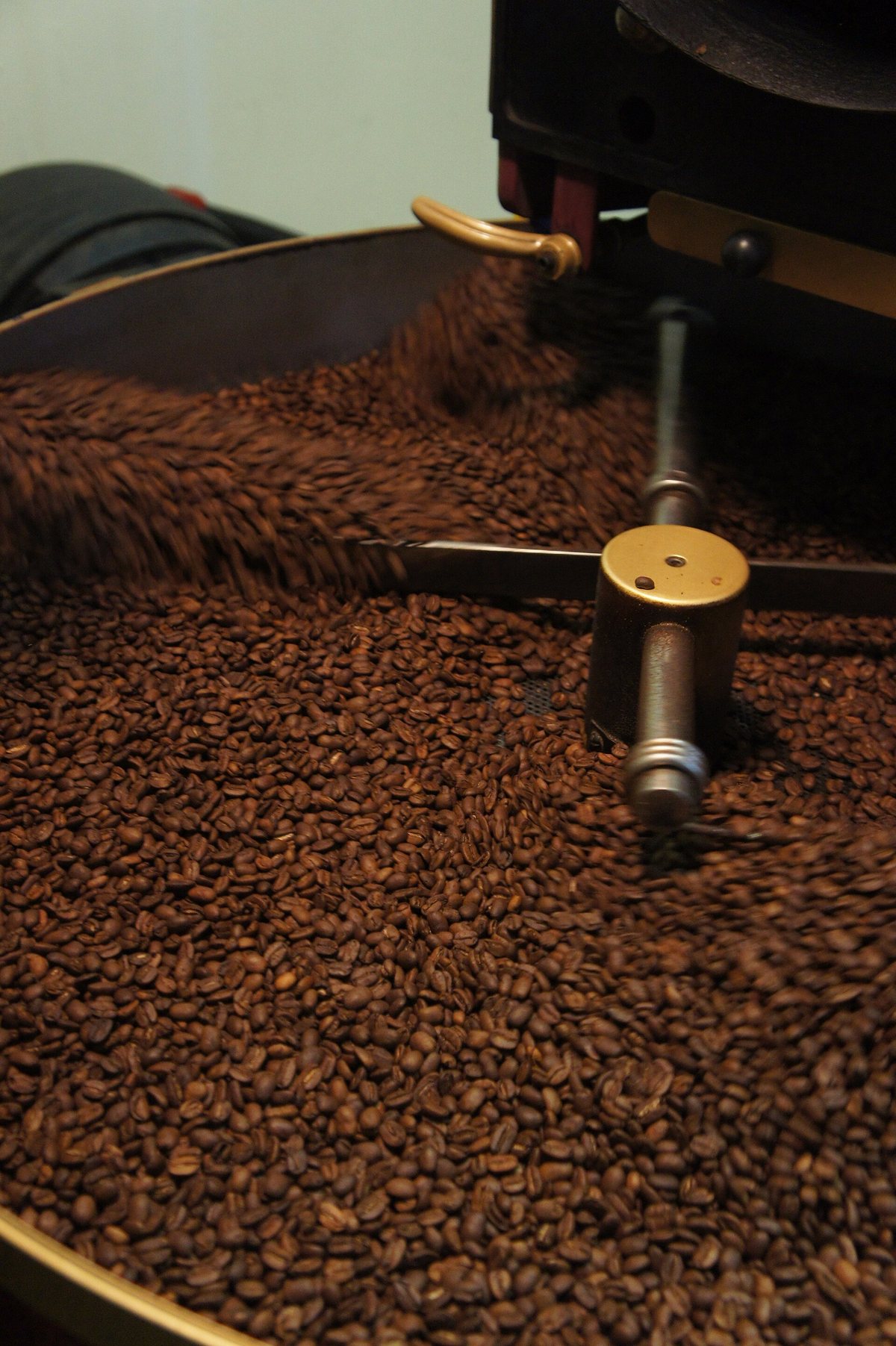
Roast levels, honestly
The names have never been standardized. One roaster’s “Full City” is another’s “Vienna,” and the American and European vocabularies don’t line up. Here’s the map I use, keyed to the phase landmarks, which are the only objective thing in the room:
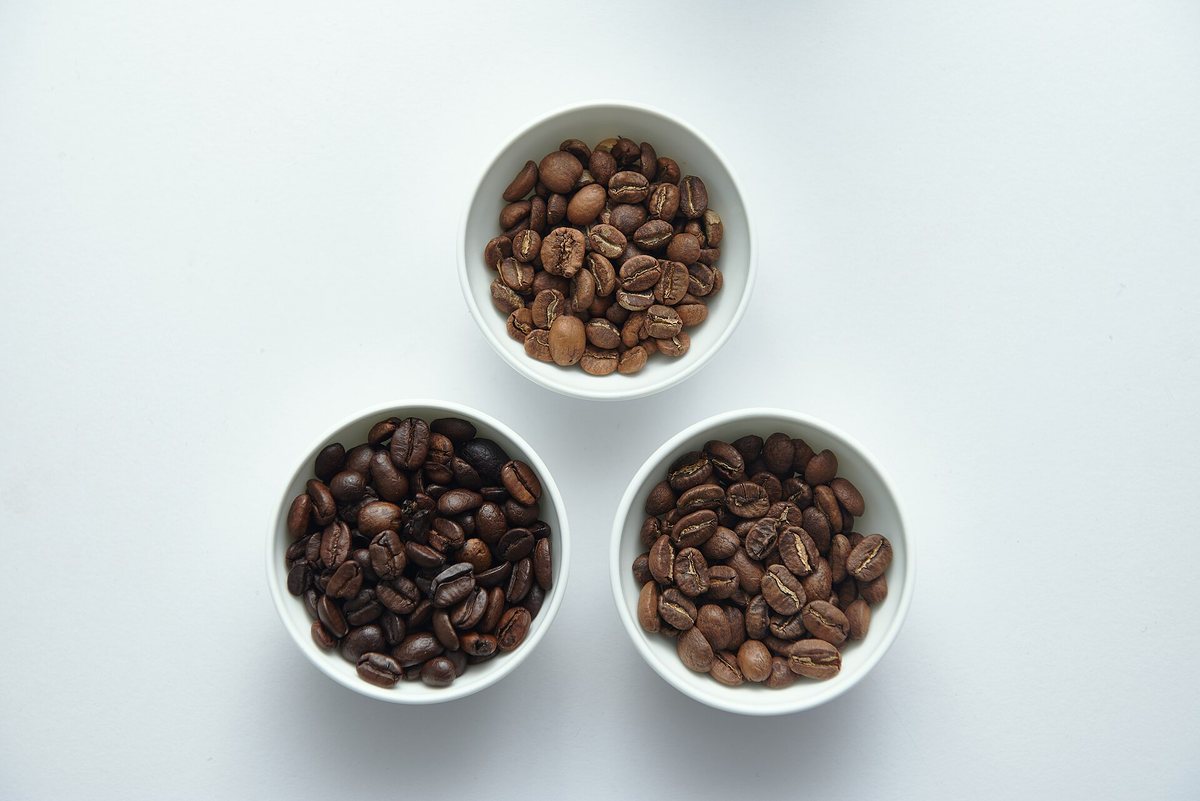
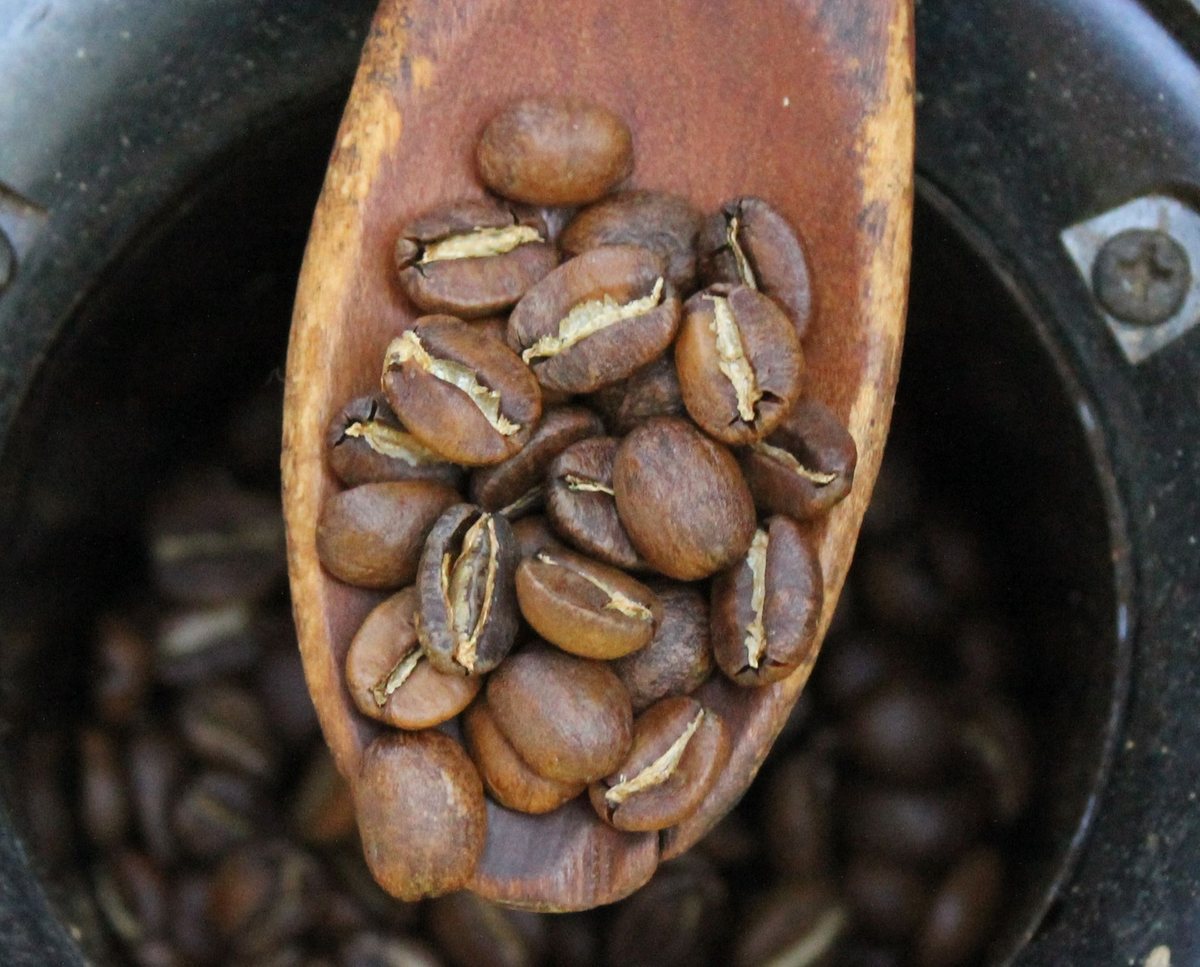
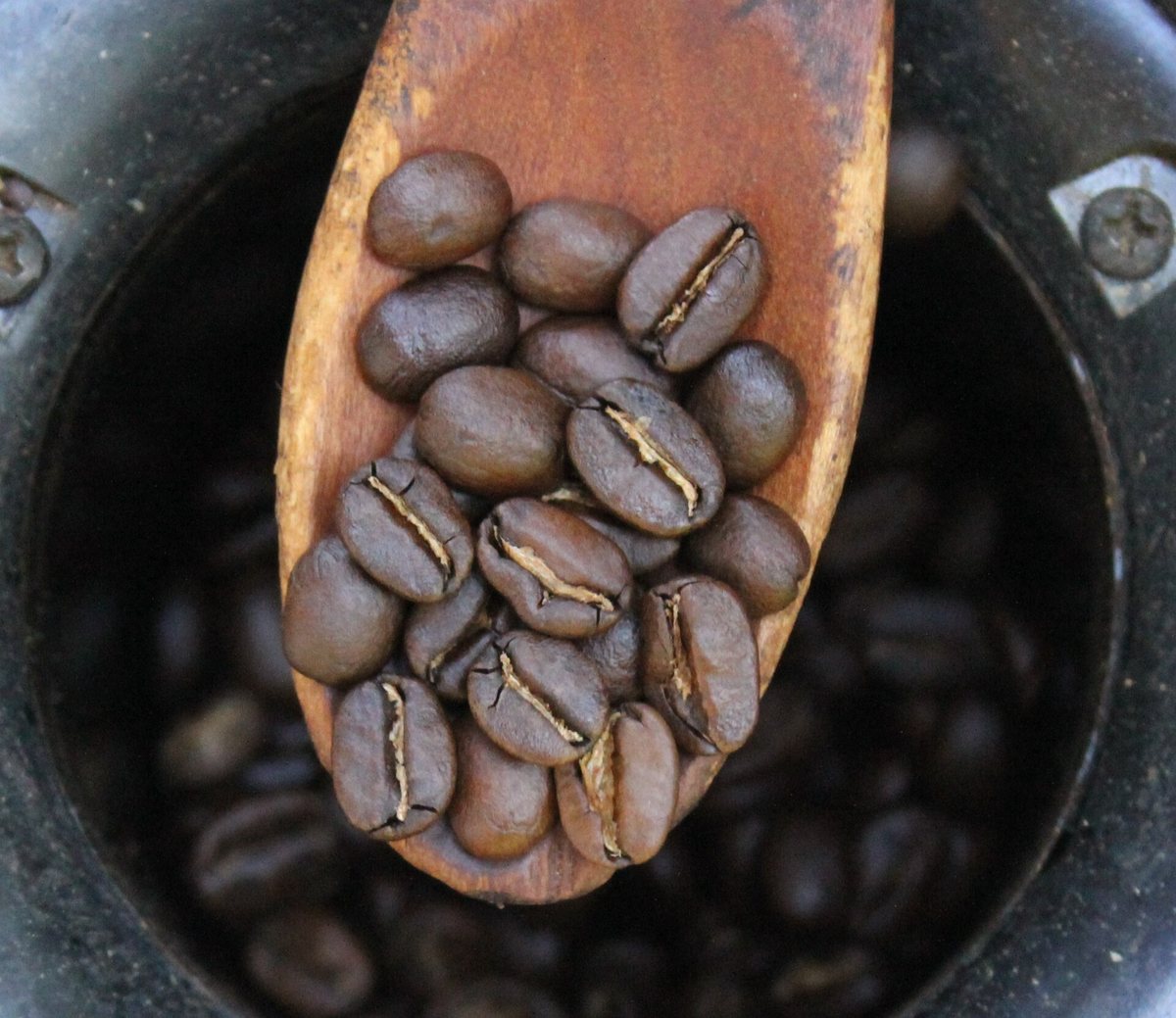
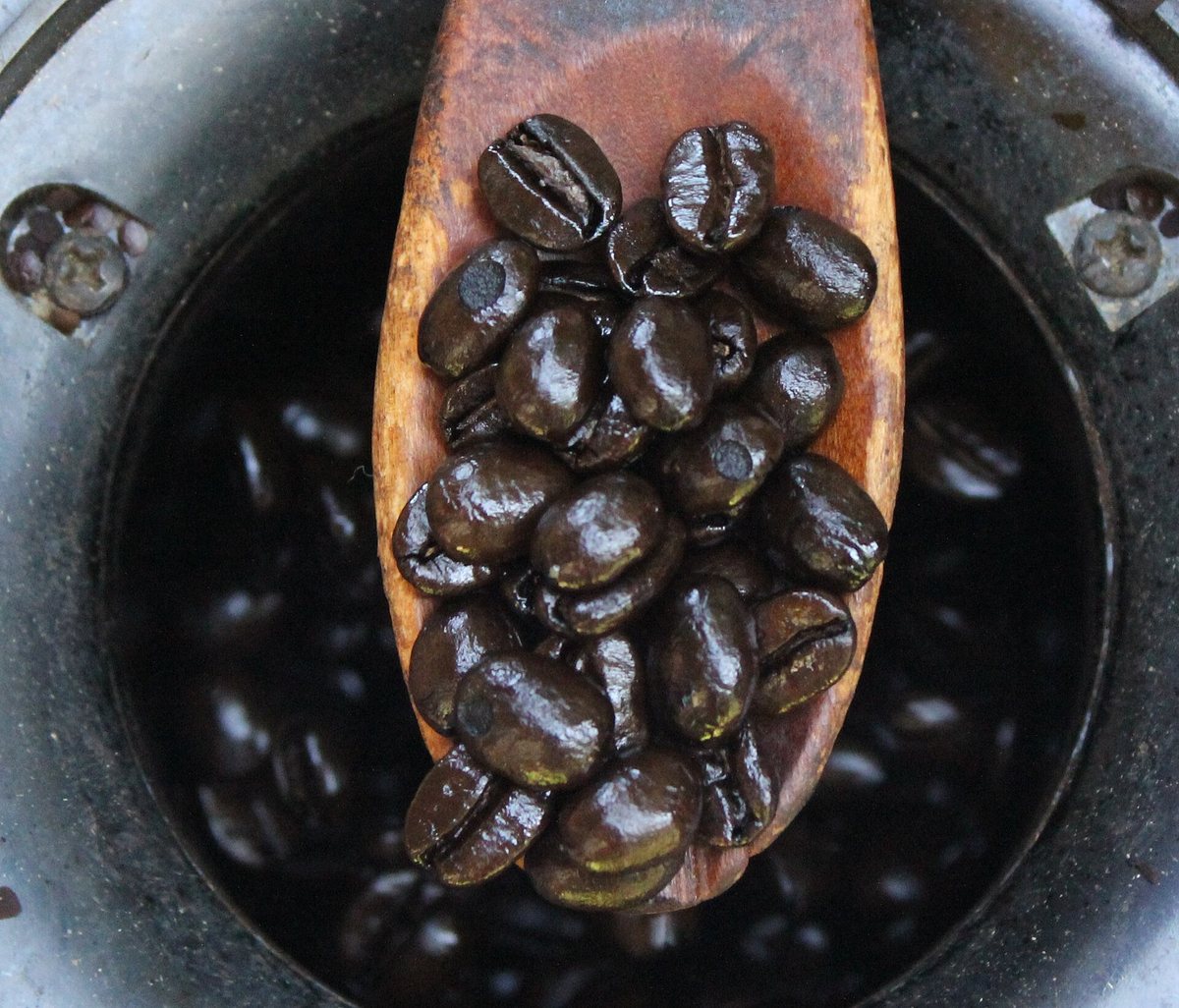
| Level | Landmark | Surface | Tastes like |
|---|---|---|---|
| Light / Cinnamon | At or just after first crack | Pale, matte, dry | Sour-bright, grassy, tea-like; often underdeveloped |
| Medium / City | Solidly through first crack | Medium brown, dry | Origin-forward, high acidity, floral/fruit, light body |
| City+ / Full City | End of first crack toward second | Deeper brown, first sheen | The balance point — sweetness, acidity and body all present |
| Full City+ / Vienna | Into early second crack | Dark, patchy oil | Bittersweet, chocolate, body up, acidity fading, roast arriving |
| French | Through second crack | Dark, oily | Smoky, bittersweet, heavy body, origin largely gone |
| Italian | Well past second crack | Very dark, wet-looking | Carbon, char, ash. Origin fully gone |
The principle underneath: as you roast darker you trade origin character for roast character. Light preserves the acids and aromatics the farm gave you; dark converts them into roast-derived compounds. At the dark end, you taste the roast, not the bean — which is why paying Gesha prices for a French roast is setting money on fire, and equally why nobody should apologize for a dark blend built on inexpensive Brazilian and Sumatran. That’s not a compromise, that’s correct engineering. Same reason I don’t put my best rub on meat I’m going to smoke into oblivion.
The unpopular half: specialty’s drift toward ever-lighter roasting has gone past useful. A lot of “modern light roast” is just underdeveloped — dropped ninety seconds after first crack, sour and cereal-y, described as “bright” by people being polite. Light roasting done well is a high-wire act. Light roasting as a fashion statement is a defect with good branding.
Kill the myth: dark roast is not stronger
This one won’t die, so let’s kill it precisely.
By weight, dark and light roasts of the same coffee have roughly the same caffeine. Caffeine is remarkably heat-stable; it doesn’t meaningfully burn off at roasting temperatures. There’s a small loss at the dark end, swamped by every other variable.
The confusion comes from a genuinely interesting bit of physics. Roasting drives out water and puffs the bean up, so beans lose mass and gain volume as they darken — a dark bean is less dense. So:
- By weight (grams — what I do, and what you should do): light and dark come out about the same.
- By scoop (volume): the dark scoop holds fewer beans by mass, so it can deliver slightly less caffeine.
The folk wisdom is exactly backwards, and it’s backwards because dark roast tastes bolder — more bitter, more smoky, more assertive. Bitter is not caffeine. Perceived strength in the cup is overwhelmingly about dose and brew ratio, which is a brewing decision. Want strong coffee? See brewing. Roast level is the wrong lever.
What separates roasters from people who burn beans
Rate of rise (RoR). The most important number on the screen — how fast bean temperature is climbing, in degrees per minute. The craft consensus, and it broadly is one, is that a healthy roast has a continuously declining RoR: fast early, gradually slowing, never flat, never climbing back up. Smooth and monotonic downward. The failure modes on either side are both bad:
- A stalling or flatlining RoR means you’ve stopped adding energy fast enough. The bean sits at temperature without progressing. That’s the recipe for baking.
- A crashing RoR means the bean lost momentum, usually at first crack, and the reactions stumble.
- An RoR that rises mid-roast means you dumped energy in to fix a stall — and now you’re scorching.
The crash-and-flick. Watch first crack and you’ll see the classic pathology. The bean absorbs a burst of energy flashing all that water to steam — RoR crashes. The roaster panics and adds heat. Then the exothermic turn kicks in, the bean makes its own heat, the added gas lands on top of it — RoR flicks back up. Crash, then flick. In the cup it’s widely described as flat, hollow, ashy, with a strange baked-and-scorched double personality. Avoiding it means easing energy down before first crack rather than reacting after. If you’ve ever managed a stall on a smoker by adjusting the fire before the plateau instead of after, this is the identical instinct.
Development time ratio (DTR). First crack to drop, as a percentage of total roast time. Commonly cited around 15–25%, with plenty of good roasters landing outside it on purpose — it’s a diagnostic, not a target, and treating it as a target is how you get people chasing a number instead of tasting the coffee. 8% warns of underdevelopment; 35% probably means you baked it. Between those, taste it.
Heat transfer modes. Every roaster is a mix of three: conduction (bean touching hot metal — aggressive, direct, uneven; too much gives scorching and tipping), convection (hot air through the bean mass — even, gentle, controllable, dominant in fluid-bed roasters and most modern drums, which is why airflow is a control input and not an afterthought), and a little radiation off the drum walls. That mix is why two machines at the same “temperature” make completely different coffee, and why a profile doesn’t transfer between machines without translation.
Endothermic → exothermic. The conceptual pivot of the whole roast: for the first two-thirds the bean is a heat sink, soaking up everything you give it; around first crack it becomes a heat source. Roasting well means recognizing that your job changes at that moment from pushing to steering.
The defect vocabulary — learn it, because naming a flaw is most of fixing it:
- Baked — too long in the middle, not enough momentum. Flat, hollow, papery, cardboard; no sweetness, no acidity. The flavor of nothing. Caused by a stalled RoR or a dragged-out roast.
- Scorched — dark burn marks and blisters from contact with an over-hot drum. Harsh, acrid.
- Tipped — small burnt spots at the bean’s ends, where density is lowest and heat gets in fastest. Too much heat too early.
- Faced — a burnt, darkened flat face on the bean. Same cause, bigger.
- Underdeveloped — dropped too soon after first crack. Sour, grassy, peanutty, thin.
- Quakers — pale beans that never brown, because the cherry was underripe. Not a roasting error; a picking error that roasting reveals. They taste like cardboard and peanuts, and a careful roaster picks them out by hand.
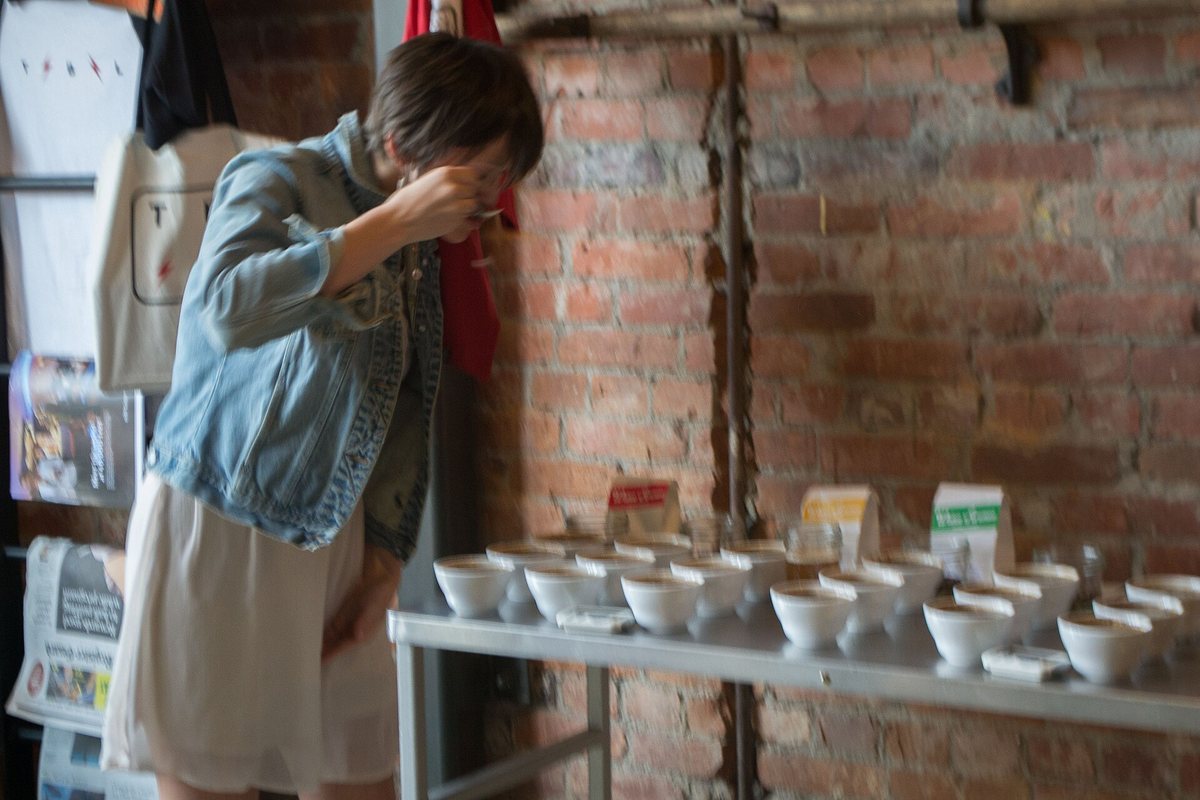
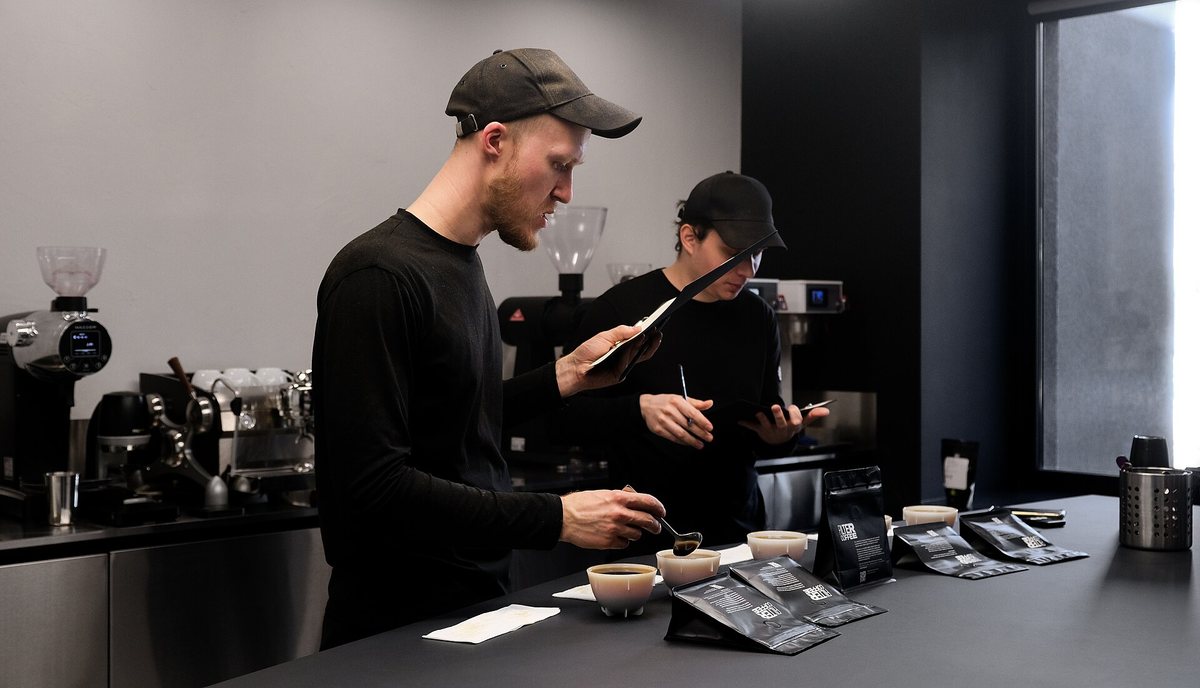
And this is how every one of those defects actually gets caught — not on a screen, but on a cupping table, out loud, with a spoon.
Degassing, freshness, and the truth about storage
The roast isn’t over when the beans hit the cooling tray, and this next part is the piece you control at home.
CO₂ off-gassing. All that carbon dioxide manufactured during Strecker degradation and the rest of the cascade? A meaningful fraction stays trapped in the porous bean at drop, and works its way out over the following days and weeks. That’s degassing — not a nuisance, a clock. It’s why:
- Bloom happens. Pour hot water on fresh grounds and the bed foams and domes. That’s trapped CO₂ released by heat and wetting — a free freshness test with every pour-over. Big vigorous bloom means fresh; a flat dead bed means stale. And you wait 30–45 seconds for a real reason: CO₂ physically repels water and keeps it from wetting the grounds evenly, so too-fresh coffee extracts unevenly.
- Espresso wants rest. People fight me on this and it’s straightforwardly true. Espresso forces water through a tight puck at ~9 bar, and excess CO₂ makes the shot gush, channel, spurt, and taste sharp and sour behind a showy crema that collapses fast. Coffee wants roughly 5–14 days off roast before it pulls right — darker beans are more porous and degas faster, so they need less; light roasts often want longer. Day-of-roast espresso is a rookie flex that makes bad shots. Drip and pour-over are far more forgiving and are lovely from about day 3.
- Then it declines. Rest a few days to two weeks, drink through about three to four weeks, and after that it flattens into paper no matter what you do. Once ground, that timeline collapses from weeks to minutes — surface area is the enemy. “Buy whole bean” isn’t snobbery, it’s arithmetic.
Why oily dark beans go stale faster. Two reasons stack. Those surface oils are lipids exposed to air, and lipids oxidize — they go rancid, a smell you know from old nuts. And a dark bean is more porous and more fractured, so it offgasses faster and lets oxygen in faster. The dark, glossy, dramatic-looking bag has the shortest life. That gorgeous sheen is the bean bleeding out.
Storage, honestly — accurate rather than received:
- Airtight, opaque, cool, dark. Oxygen is the main enemy, then heat, then light, then moisture. A sealed canister beats the bag it came in.
- The one-way valve on a good bag is doing real work — letting the bean’s CO₂ out without letting oxygen in. It’s why a fresh bag puffs. Don’t dismiss it as packaging.
- Not the fridge. Genuinely bad advice that will not die. A fridge is humid, full of odors, and not cold enough to stop anything; coffee is porous and hygroscopic and will pull in moisture and last night’s leftovers, and condenses every time you take it out. Don’t.
- The freezer is actually fine — with a condition. This is where a lot of well-meaning advice is simply wrong. Freezing works well if the coffee is genuinely, properly airtight; there’s real research behind it and plenty of serious competition baristas do it. The rule that makes it work: freeze in small, sealed, single-use portions, and grind straight from frozen without thawing. Never open a cold container in a warm room — condensation lands on the beans and ruins them — and never refreeze. Done properly, you’ve paused the clock. Done half-heartedly with a folded-over bag you open every morning, you’ve built a moisture pump. The condition is the whole thing.
- Simplest answer: buy two weeks at a time from a roaster who dates the bag, keep it sealed on the counter, skip the question.
Where roasting shows up in my kitchen
I care about this because roast level is an ingredient decision, and it goes well beyond a mug. Deep-roasted coffee is one of my favorite savory tools — those pyrolysis and Maillard compounds read as smoke, char and bittersweet depth, which is exactly what beef wants. That’s the whole idea behind a coffee-mocha rub for beef, doing on the surface of a roast what a good bark does. It’s the backbone of a red-eye barbecue sauce, and it’s the entire point of the old Appalachian trick of deglazing a ham pan with black coffee for red-eye gravy — bitterness cutting salt and fat, a trade older than our vocabulary for it.
On the sweet side, roast character is why coffee and chocolate are such a reliable partnership: they’re both roasted products sharing whole families of Maillard-derived compounds, so they taste like they were designed together. That’s tiramisu; that’s sourdough discard espresso chocolate cookies, which is delightfully three fermentation-and-browning obsessions in one dough; and that’s why a classic breakfast coffee cake always knew what it was sitting next to. There’s a whole page on it at cooking with coffee.
Where to go from here
The short version: roasting is browning chemistry on a timer. Drive off the water, get into Maillard and stay there long enough to build something, turn the corner at first crack without crashing, develop it enough to be sweet but not so much that you erase the farm, then respect the clock afterward. If you’ve ever chased a temperature curve on a smoker or read a crust to decide whether a loaf is done, you already have the instincts. The vocabulary is new; the job isn’t.
Green coffee is cheap, keeps for a year, and the barrier to entry is absurdly low — roasting your own walks the whole thing, and roasters covers the machines from a popcorn popper to a real drum. A step back is beans and origins. And what roasting at a business’s volume actually asks of you — spoiler: it’s a second full-time trade — is in the coffee program.
Comments (0)