Coffee · 32 of 64
How Coffee Is Processed: Washed, Natural, Honey and the New Fermentations
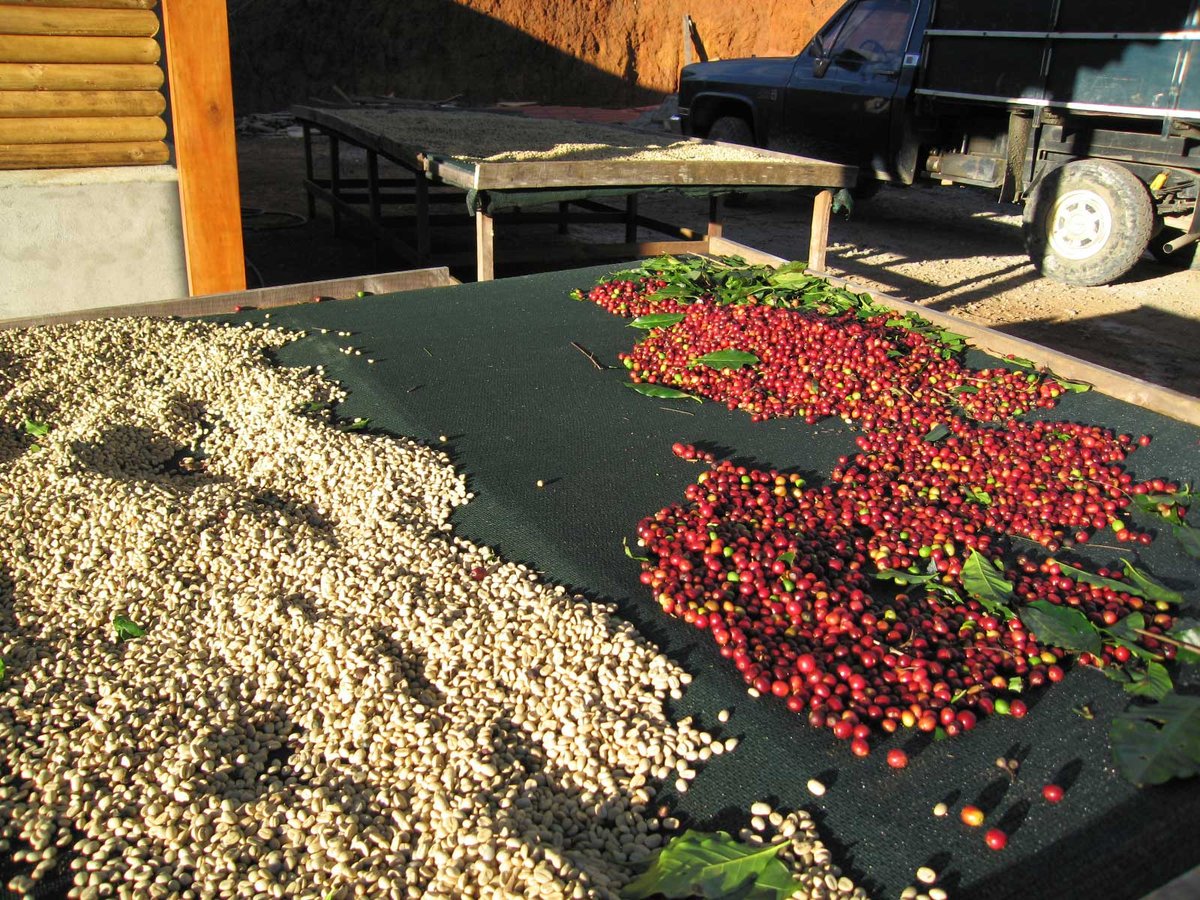
A coffee bean is the seed of a red fruit. Between the tree and the sack of green coffee that a roaster buys, the fruit has to come off and the seed has to be dried from about 60 percent water to about 11. How that is done is called processing, and after the plant and the place it is the biggest single influence on how the coffee tastes. It is also the word printed most often on a bag after the country: washed, natural, honey, anaerobic.
There are only two basic ways to do it. Take the fruit off first and dry the seed (washed), or dry the whole fruit and take it off afterwards (natural). Everything else is a point between those two, or a variation on the fermentation that happens along the way.
The short version
| Question | Answer |
|---|---|
| What is processing? | Everything between picking the cherry and bagging green coffee: sorting, removing the fruit, fermenting, washing, drying, resting, hulling and grading. |
| Washed? | Skin and pulp removed, the sticky mucilage fermented or scrubbed off, the seed washed and dried in its parchment. Clean, clear, acidic cups. Uses the most water. |
| Natural? | The whole cherry dried in the sun, then the dried husk milled off. The oldest method. Heavier body, fruitier, and more risk of mould and fermented flavours if the drying is badly managed. |
| Honey or pulped natural? | Skin off, some or all of the mucilage left on, dried like that. Between the two in taste. The colour names (yellow, red, black honey) have no standard. |
| Wet-hulled? | Indonesia’s method: the parchment is stripped while the seed is still at 35 to 45 percent moisture, then dried as bare green coffee. The source of the classic Sumatran cup. |
| Anaerobic, carbonic, thermal shock, co-fermented? | Experimental fermentations, mostly since 2015. Some are controlled and disclosed; some add fruit or flavourings, which several competitions now ban. |
| Are naturals sweeter because the fruit sugar soaks in? | Not shown. The measured differences come largely from the seed’s own metabolism while it is processed, and sucrose, the main sugar, does not change. |
| What should a roaster print? | The importer’s process term, word for word, and what was added if anything was. |
The steps, cherry to green bean
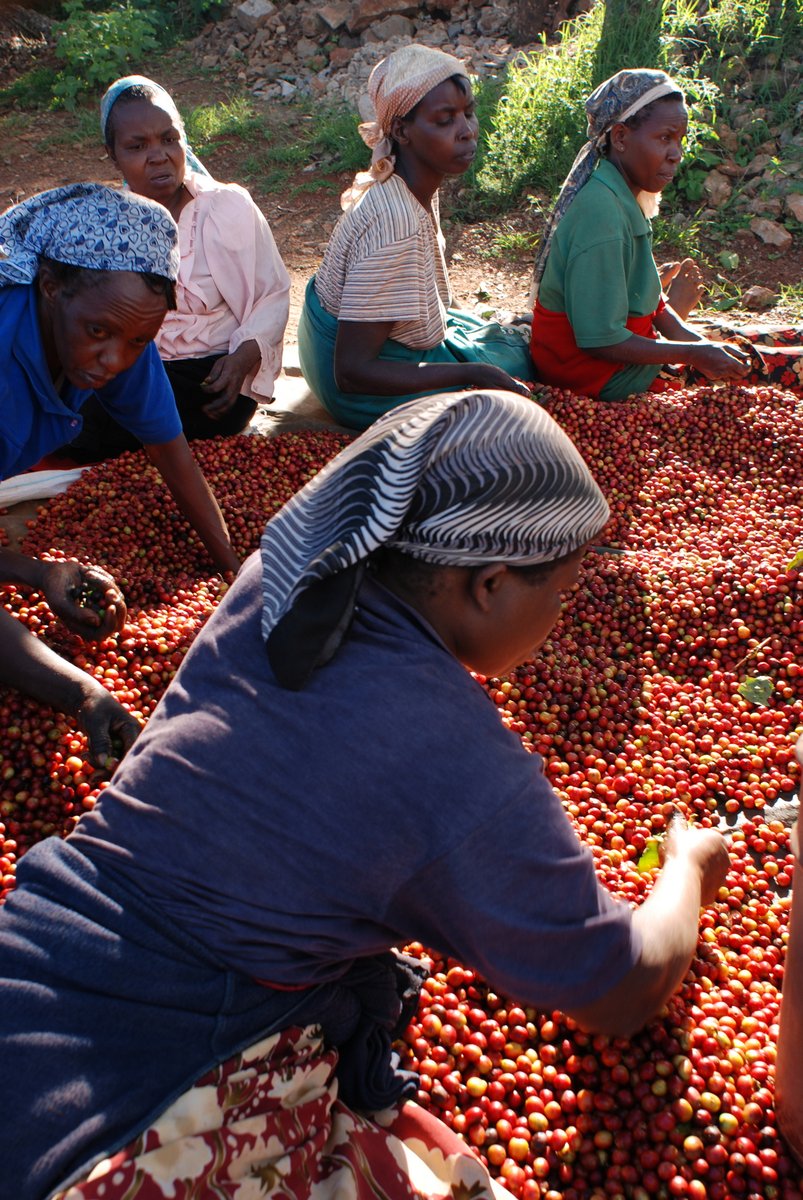
Every method uses some of these steps; none uses all of them.
- Picking. Selective hand-picking takes only ripe cherries and goes over each tree several times. Strip-picking and machine harvesting take everything at once and sort afterwards. In a 2019 survey of Brazilian producers, about a quarter used mechanised harvesting (Revista Cultivar).
- Sorting and floating. Cherries go into water. Dense, ripe fruit sinks; under-ripe, dried and insect-bored fruit floats and is skimmed off as “floaters”.
- Pulping. A pulper squeezes the seeds out of the skin. The pulp is a waste stream, usually composted.
- Removing the mucilage. A sticky layer of sugar and pectin clings to the parchment. It is fermented off in a tank for 12 to 72 hours, scrubbed off in a machine called a demucilager, or left on (honey).
- Washing and grading in channels, where the heavier seeds settle and the lighter ones are drawn off.
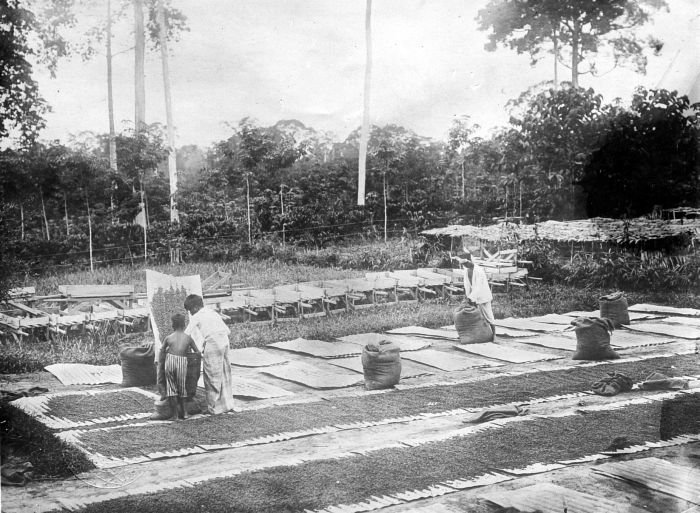
- Drying on patios, raised beds, racks or in mechanical dryers, to roughly 11 to 12 percent moisture.
- Resting in parchment for weeks before milling, a widespread trade practice.
- Hulling. The parchment (or, for a natural, the whole dried husk) is milled off. Some mills polish off the thin silverskin too.
- Grading by screen size, density, colour and hand-picking, with a defect count on a 350 g sample (SCA forms).
- Bagging, often in jute with a hermetic plastic liner.
Washed (wet) process
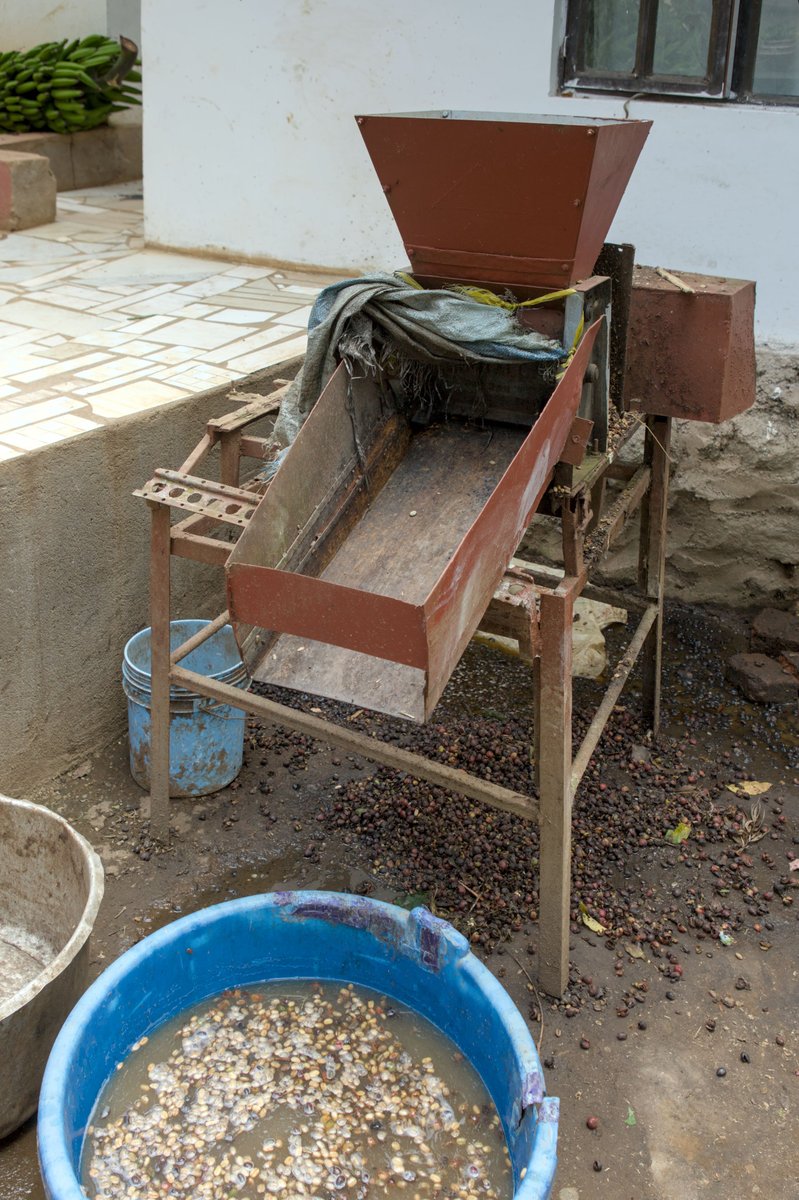
What happens. The cherry is pulped, the mucilage is removed, and the seed is washed and dried in its parchment. The fermentation step is mostly about loosening the mucilage so it washes away, but it also changes the coffee. In a controlled trial in Yunnan, China, “the fermentation duration had the greatest impact on the green coffee bean compositions and the cup quality”, and “a long fermentation duration resulted in a fruitier and more acidic cup” (Zhang and others, Frontiers in Microbiology, 2019). The same trial found that coffee scrubbed clean by a machine, with no fermentation at all, “produced a beverage quality comparable” to fermented coffee. The microbes in a fermentation tank are lactic acid bacteria and yeasts that come in from the surroundings, and the authors call them “highly variable and difficult to predict”.
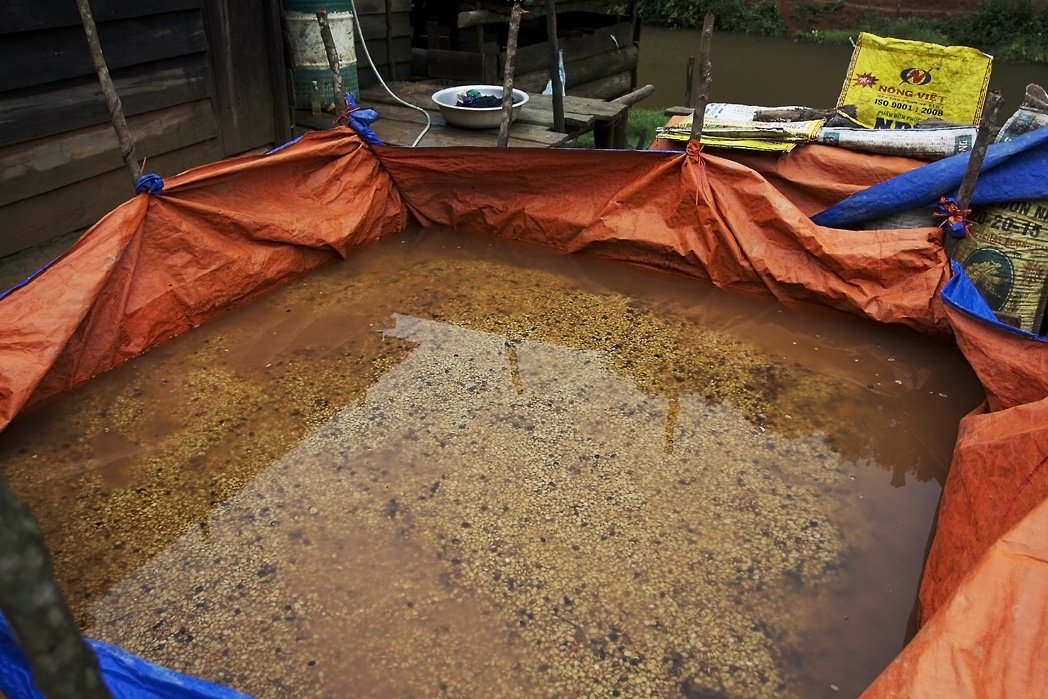
Where it came from. The earliest documented description of washing coffee is in P. J. Laborie’s The Coffee Planter of Saint Domingo (London, 1798), whose plate of a plantation layout marks a “bason to wash the coffee” next to the mill house and the drying platforms (Library Company of Philadelphia). The story that the Dutch invented washing in Java has no source behind it, and the usual explanation, that washing was adopted because humid climates made drying whole fruit difficult, has no written evidence either. Kenneth Davids at Coffee Review writes that the wet process was “not fully refined until the nineteenth century”, and that in Ethiopia, now famous for washed coffees, “the washed process was not instituted until the 1970s” (Coffee Review).
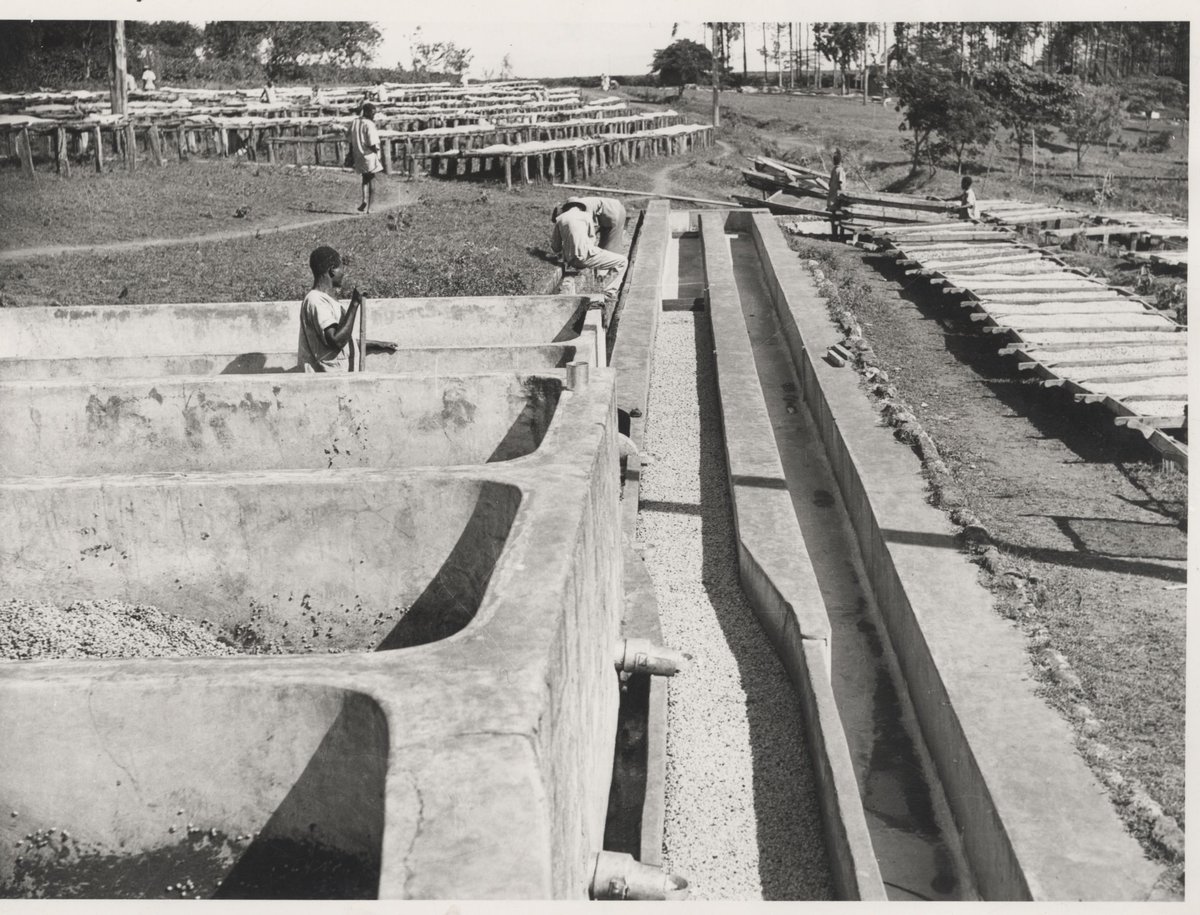
Water and pollution. Washing uses water, and the water leaves acidic and loaded with organic matter. Colombia’s coffee research centre, Cenicafé, gives the old figure as more than 40 litres per kilogram of dry parchment; its Becolsub mill uses 0.7 to 1.0 litres and avoids “more than 90%” of the pollution load (Cenicafé). Raw coffee wastewater can carry a chemical oxygen demand as high as 50 g per litre at about pH 4 (Coffee wastewater), against a legal discharge limit of under 0.2 g per litre in Nicaragua. In southern Ethiopia, villagers along rivers below wet mills told TechnoServe “When the animals drank from [the river], they died”; the project routed the wastewater of 49 mills on the Kola and Malebo rivers into vetiver-grass wetlands, and 71 mills by 2017 (TechnoServe).
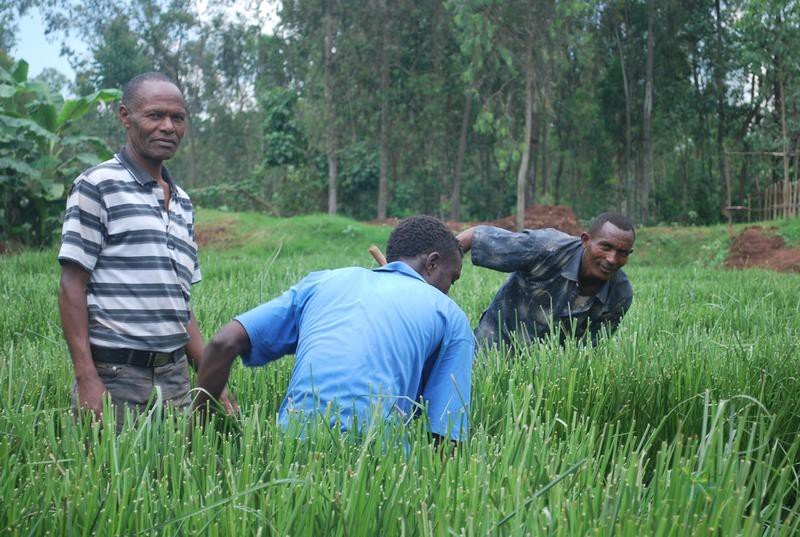
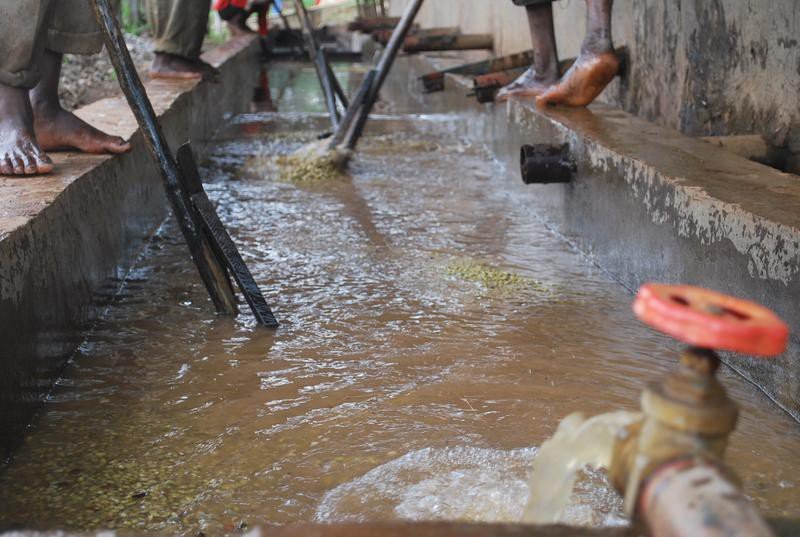
Water figures come in two units that are easy to confuse: litres per kilogram of dry parchment (the Colombian figures) and cubic metres per tonne of cherry (most other studies). About five kilograms of cherry make one of dry parchment, so the two are not interchangeable.
Natural (dry) process
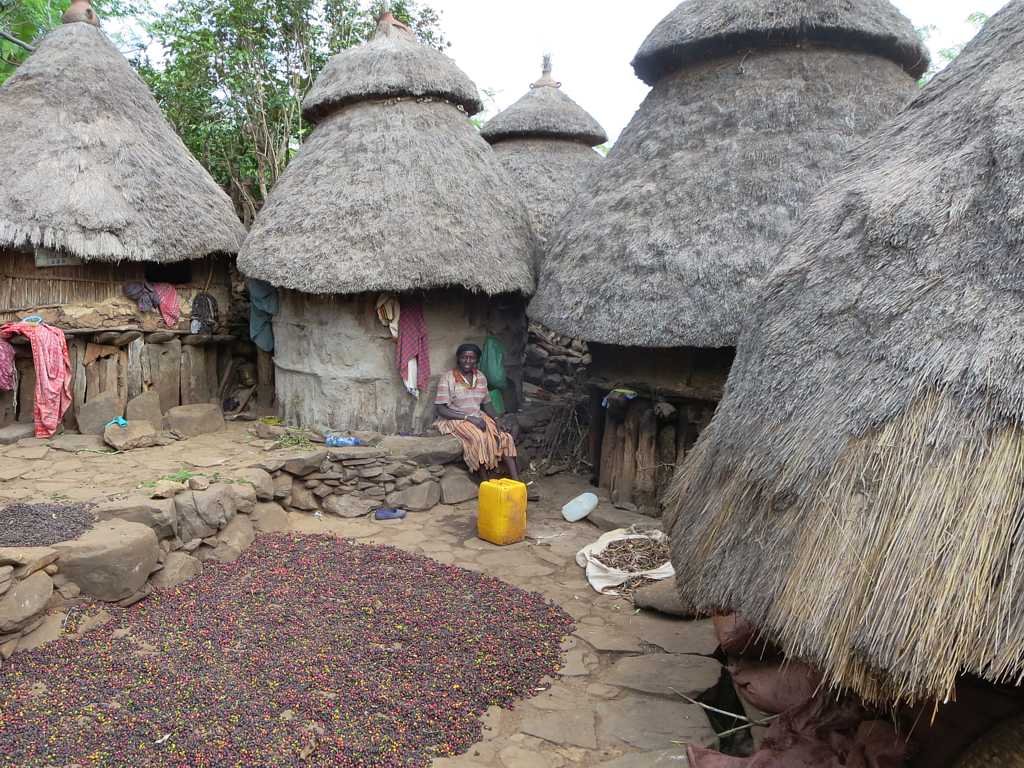
What happens. The whole cherry is spread out in the sun, raked several times a day, and dried for two to four weeks until it rattles. The dried husk is milled off later. “Drying in the fruit is as old as the beverage coffee itself” (Davids, Coffee Review). Yemen and Ethiopia dried their coffee this way for centuries, and so does most of Brazil today. How much of Brazil’s output is natural is not published by volume; the best figure is a survey of the 2019 harvest that found the method used on about 85 percent of Brazilian coffee farms (Notícias Agrícolas).
The risk is in the drying. A cherry is a wet, sugary fruit, and the first three to five days of drying are when it can mould or over-ferment. The EU puts it plainly: “Ochratoxin A is formed during sun drying and storage of crops. The formation can be prevented by applying good drying and storage practices” (Regulation 2022/1370). The EU’s limits since 1 January 2023 are 3.0 µg/kg for roasted coffee and 5.0 µg/kg for instant (Regulation 2023/915, Annex I, 1.2.14–15); it sets no limit for green coffee. FAO’s guidance is that drying and storage are the critical stages for washed and natural coffee alike (FAO), so ochratoxin is not a natural-process problem only.
What changed. For most of the twentieth century “natural” in the trade meant cheap and rough. That changed in the 2000s, when carefully dried Ethiopian naturals reached North American retail; Davids dates Starbucks’s Sherkina Sun-Dried Sidamo to around 2005. A well-made natural tastes of berries and wine; a badly made one tastes of vinegar and compost.
Drying: patios, beds and racks
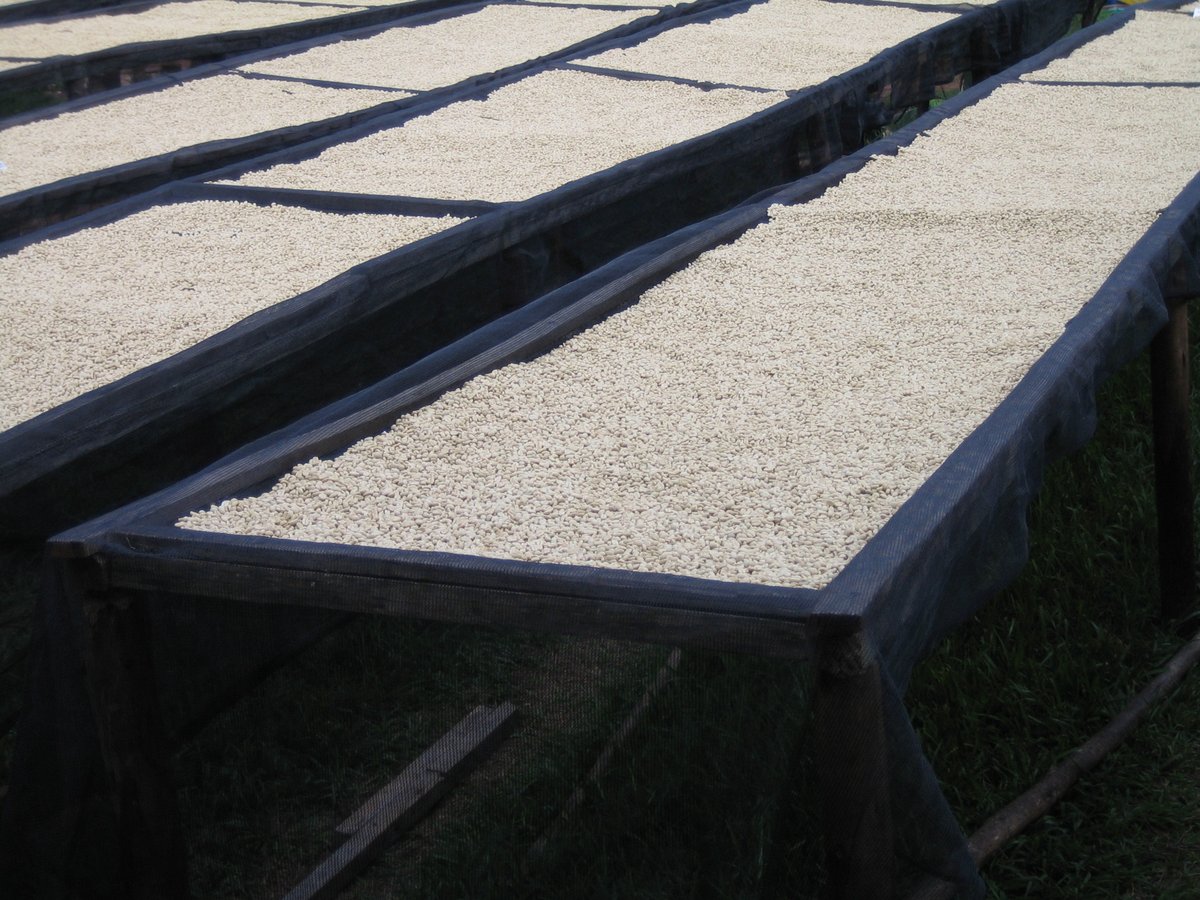
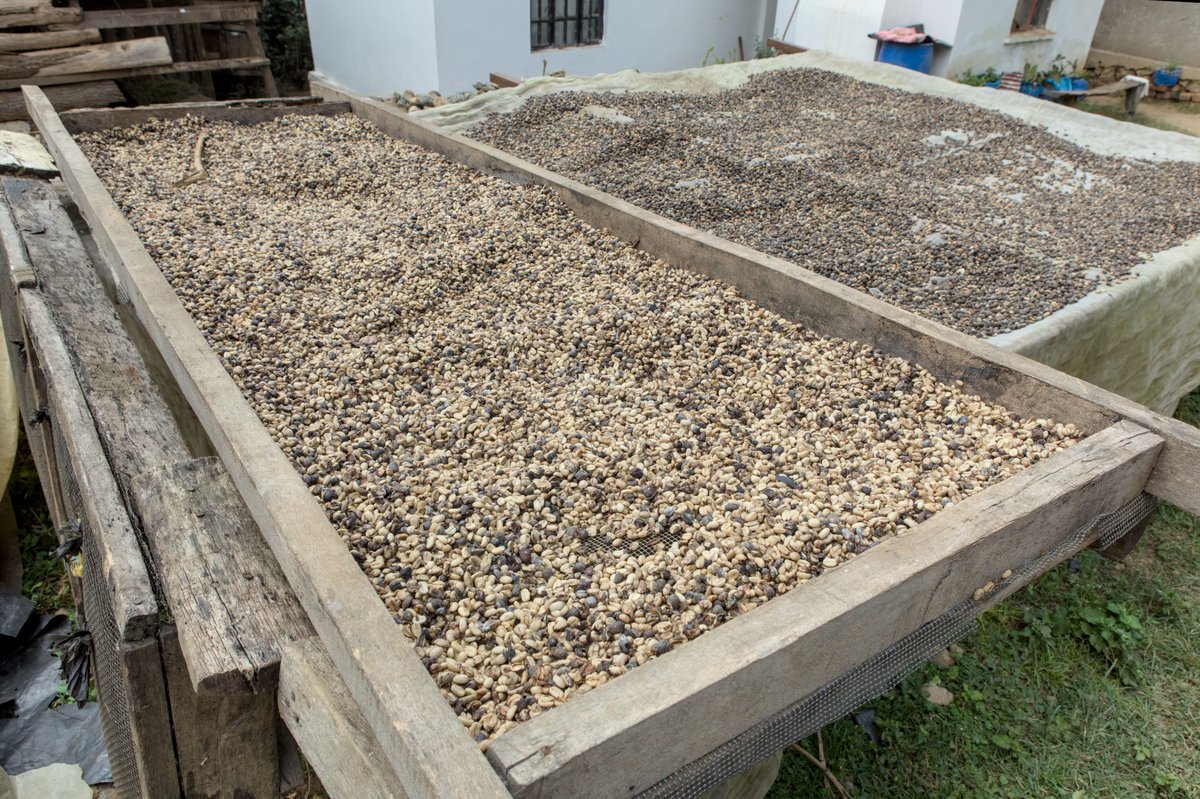
Coffee dries on patios (terreiros in Brazil, concrete or brick), on raised beds of mesh on wooden frames (“African beds”, now used far beyond Africa), on Indonesia’s para-para racks, in covered or roofed dryers, and in rotating mechanical dryers where the weather will not allow sun-drying. Raised beds let air reach the coffee from underneath and keep it off the soil; they are also popular on hilly farms because they avoid levelling ground for a patio. Both explanations are sensible; no paired trial comparing drying time and mould on beds and patios has been published.
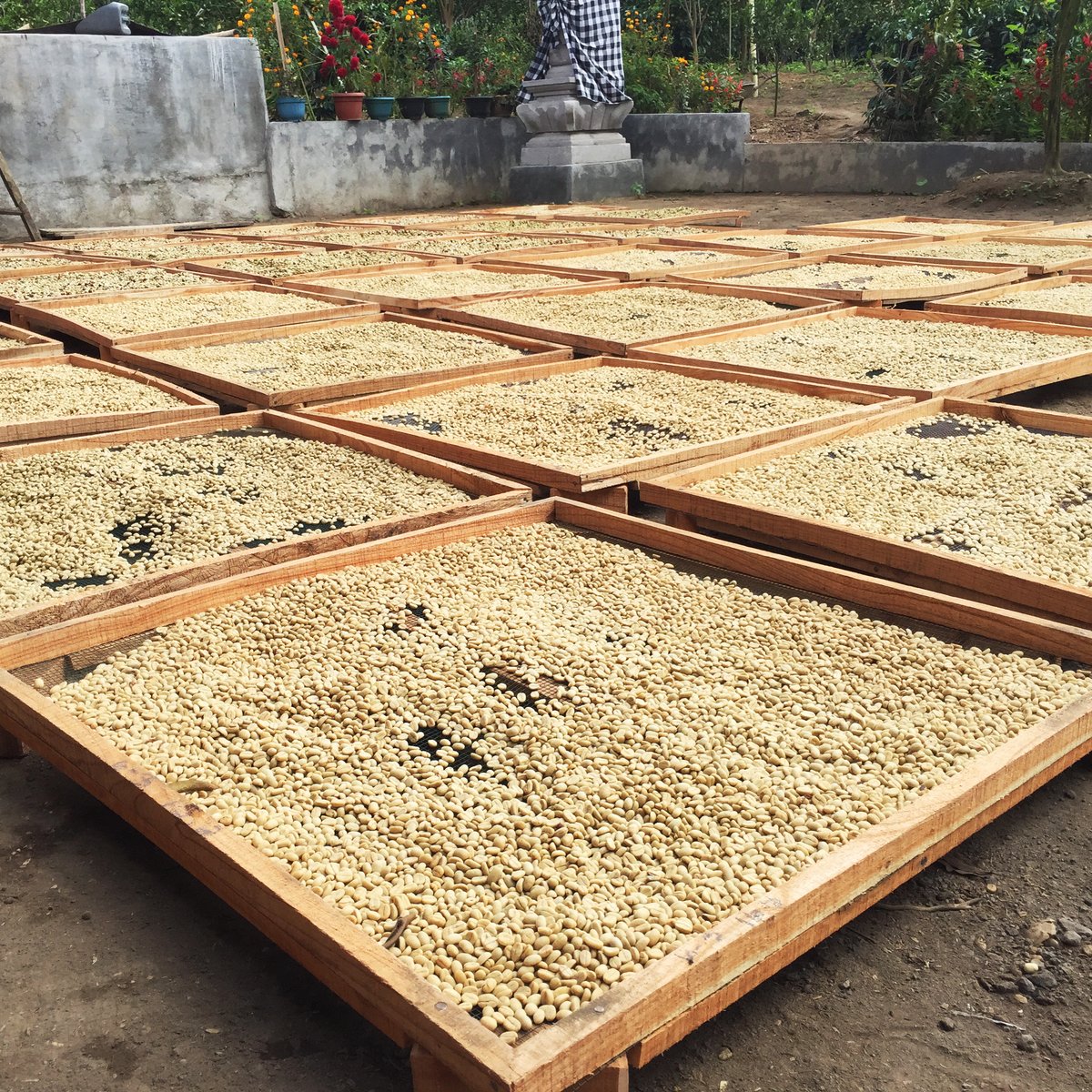
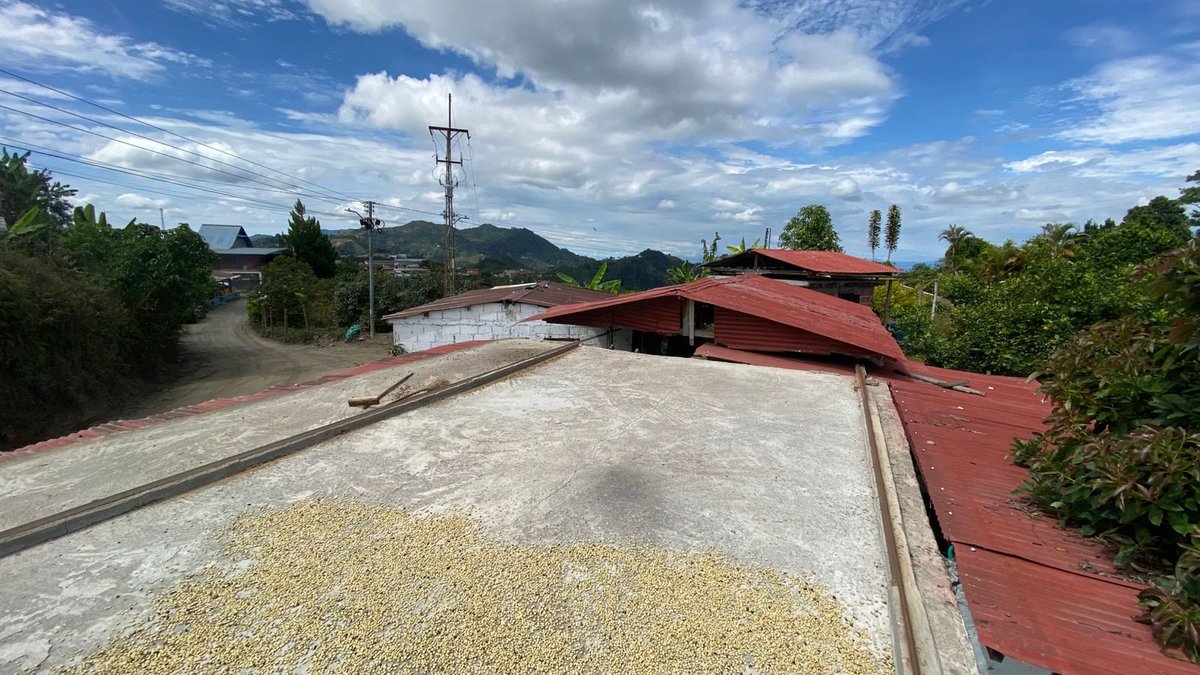
The target is about 11 to 12 percent moisture. Standards differ: the International Trade Centre recommends 11 to 12 percent, the ICO’s export range is 8 to 12.5, and FAO says dry to 12. Moisture is measured by mass lost at 105 °C (ISO 6673, current edition 2025). Many buyers also measure water activity; the SCA’s specialty grade is below 0.70, and contracts often ask for 0.45 to 0.60 (Daily Coffee News). Too wet and the coffee moulds in the sack; too dry and it tastes flat and roasts unevenly.
Pulped natural and honey
What happens. The skin is pulped off, but the mucilage stays on the parchment while it dries. The result sits between washed and natural: more body and sweetness than washed, cleaner than natural.
Two names for related methods. Brazil’s cereja descascado (“peeled cherry”, pulped natural) grew out of research at the Instituto Agronômico de Campinas from the mid-1960s, reportedly found almost by accident when a rejected lot of hulled seed coffee cupped exceptionally well; it became commercial only in the early 1990s, when a Brazilian equipment maker made separating ripe cherry economical (IEA São Paulo; Embrapa). The word honey comes from Costa Rica, where small farms began buying compact processing equipment instead of selling cherries to big mills, and named their sticky, mucilage-on lots after the feel of the coffee as it dried (Coffee Review). Accounts of when that began disagree, and no birth year holds up.
The colours mean less than they seem. White, yellow, red and black honey are usually explained as how much mucilage is left (from a little to all of it), but percentages vary by source, and some producers leave all the mucilage on every time and get the colour from how fast and how shaded the coffee dries (Origin Coffee). There is no standard; a “red honey” from one farm says nothing exact about a “red honey” from the next.
Wet-hulled (giling basah)
Indonesia, and Sumatra especially, does something no one else does on any scale. Farmers pulp and ferment the coffee, dry it for only a day or so, and sell the wet parchment to collectors. A mill then strips the parchment off at 35 to 45 percent moisture, on a screw huller “of Dutch colonial design” fitted with a rubber strip, and the bare green coffee is dried the rest of the way (FAO trial report, 2006). Normal hulling is done at 11 to 14 percent. The reasons usually given are the rain and humidity, and farmers’ need to be paid quickly.
The result is the heavy-bodied, low-acid, earthy cup sold as Sumatra or Mandheling, a name the FAO report traces to “a Japanese coffee buyer who returned to Medan in 1969 seeking a coffee that he had tasted during his WWII service in Sumatra”. Mandailing is a people and a place, not a process. The FAO trial is the best work on the method, and it is frank: “The origins of the Mandheling character are not understood.” The same Sumatran cherries dried conventionally in parchment gave “clean, acidic coffee”; holding wet parchment for days increased musty flavours; and rapid wet hulling after washing “gives the best chance of producing Mandheling character”. The popular explanation, that the earthiness comes from drying beans on bare soil, is unproven. Wet-hulled coffee has its own defect, a split bean called kuku kambing (“goat’s hoof”).
Why washed and natural taste different
The obvious explanation is that sugar and flavour from the fruit soak into the bean of a natural. The research points somewhere else: the seed is alive, and it reacts to how it is processed.
A German group led by Dirk Selmar processed identical cherries side by side by both methods and found the differences persisted, so “the differences must be created by metabolic processes in the coffee beans themselves”. Germination begins in the seed during ordinary processing, peaking about two days into wet processing and about a week into dry (Plant Biology, 2006; Annals of Botany, 2007). Washed beans end up with much less glucose and fructose than naturals, but sucrose, the main sugar, is not significantly affected (Knopp and others, 2006), and the loss in washed beans is due “at least in part” to the seed’s own metabolism, “not related to the leaching of sugars into the process water” (Kleinwächter and Selmar, 2010).
So “naturals are sweeter because the fruit soaks in” is not shown. Reviews of fermentation say microbial flavour compounds “are believed to migrate inside coffee seeds” (Elhalis and others, 2023); how much does, and how much survives roasting, has not been measured.
The new fermentations
Since about 2015 producers have experimented with fermentation the way winemakers do. The names on bags are not regulated, and the same word can mean different things at different farms.
- Anaerobic. Cherries or pulped coffee fermented in sealed tanks or barrels. Sealed does not mean controlled: a 2023 study of a sealed farm tank in Brazil found the fermentation dominated by enterobacteria and moulds, with few lactic acid bacteria or yeasts (Foods, 2023).
- Carbonic maceration. Whole cherries sealed in tanks flushed with carbon dioxide, borrowed from Beaujolais winemaking. It became famous when Saša Šestić of Australia won the 2015 World Barista Championship in Seattle with a carbonic-macerated Colombian Sudan Rume, developed with the producer Camilo Merizalde (World Barista Championship; Barista Magazine). In wine the term means fermentation inside unbroken grapes; whether that happens inside coffee cherries has not been shown.
- Yeast and bacteria inoculation. Adding selected cultures, as a brewer does. Brazilian researchers showed in 2014 that selected yeasts can change a dry-processed coffee’s cup (Evangelista and others, Food Research International); commercial coffee yeasts are now sold.
- Thermal shock. A protocol associated with Diego Bermúdez of Finca El Paraíso in Cauca, Colombia: long fermentations with added cultures, then a hot rinse and a cold one that is said to make the beans absorb fermentation flavours. That claim is untested.
- Co-fermented and infused. Fruit, spices, juice or flavourings added during fermentation. There are no agreed definitions; “infused”, “flavoured” and “co-fermented” are used interchangeably (Perfect Daily Grind, 2024).
The argument. Competitions have drawn lines. The World Barista Championship’s rules since 2024 forbid any additive “after it reaches the ‘green coffee’ stage”, which still allows additions during processing (Perfect Daily Grind). Cup of Excellence allows experimental lots only where the producer uses no additives “other than water” (rules updated 23 October 2023). The Specialty Coffee Association of Panama disqualified co-fermented and infused entries from Best of Panama in 2024; its president called them “altered from their natural DNA expression” and the terms “co-fermented” and “thermal shock” “deceptive” (Sprudge). Claims that laboratory tests found propylene glycol in co-fermented coffees have been made by an exporter and on a forum, but not published in a journal, and critics point out that glycols can come from fermentation itself.
Defects that start in processing
- Sour and fermented beans come from over-ripe cherries, over-long fermentation or slow drying. A full sour bean counts as a primary (Category 1) defect in SCA grading.
- Mouldy beans and ochratoxin come from slow drying and damp storage.
- Musty flavours come from wet parchment held too long, as in the Sumatran trial.
- “Rio” taste, a medicinal, iodine-like flavour once common in Brazilian coffee, is caused by 2,4,6-trichloroanisole (TCA, the same compound behind corked wine), which can be tasted at 1 to 2 parts per trillion in the cup and is less than half destroyed by roasting (Spadone and others, 1990). How it forms in the bean is not established.
Defects are counted on green coffee and tasted at the cupping table; see Cupping and Beans.
Processing in the roaster
Process changes how coffee roasts. An importer’s roasting notes say naturals “take on color more quickly due to their residual sugars and fruit compounds”, while washed coffees “take on heat well, allowing for a longer development time” (Royal Coffee). The practical rule is to roast a natural to the same end colour as a washed coffee, not for the same time, and to expect it to look a little darker or blotchier at the same degree of roast. More on reading roast colour is on Roasting.
Reading a bag, and writing one
Green-coffee sellers put the process in the name: Sweet Maria’s lists coffees as “Dry Process”, “Honey”, “Wet Hulled” or “Giling Basah”; Burman Coffee Traders names a “Lychee Co-Ferment” and a “Supernatural Anaerobic” in a sampler. Mislabels happen: one 2026 listing was titled “washed” while its description called the same coffee “natural processed” (Happy Mug). For a small roaster writing a label:
- Copy the importer’s process term word for word.
- If a coffee was co-fermented or infused, say what was added.
- Do not call a wet-hulled Sumatra “washed”.
- Treat honey colours as the producer’s own words, not a grade.
- “Natural” on a coffee bag describes the process, not a health or organic claim.
More on green coffee for a small roaster is on Green Coffee and the Line-up and on labels on Labels and Certifications.
Taste it for yourself
The cleanest way to taste processing is a washed and a natural of the same lot, roasted and cupped side by side. Same-lot pairs are rare. On 8 October 2026 no US green-coffee seller had one in 1 lb bags, but Burman Coffee Traders had two Yirgacheffe Grade 1 coffees: a washed Halo Beriti at $9.99 a pound and a natural from Idedo at $8.99 on sale. They come from the same zone but different stations, so part of any difference is the station and not the process. The seller’s “Exotic Selection” sampler (six half-pound bags, $26.99 on sale) adds a lychee co-ferment, an anaerobic natural, a black honey and a wet-hulled Sumatra.
- Roast both on the same day, the same batch size, to the same end colour.
- Rest them 24 hours.
- Cup them side by side with the same dose and water (Cupping), blind if someone else can label the cups.
- Note clarity and acidity, fruit and body, and any fermented edge.
Because the Selmar group found differences even between identical cherries processed two ways, a true same-lot pair is the experiment worth asking a seller for.
Related pages
- Origins: which countries use which methods.
- Monsooned Malabar and Aged Coffees: India’s exposure to monsoon winds after processing.
- Qishr: the dried husk that natural processing leaves behind, as a drink.
- Café HAG, Sanka and the Story of Decaf and Decaf for a Small Roaster: decaffeination, another processing step done to green coffee.
What is not known
- What makes a wet-hulled Sumatra taste “Sumatran”. The FAO trial says the mechanism is not clear.
- Whether fermentation flavours migrate into the seed in meaningful amounts, and which survive roasting.
- Whether carbonic maceration in coffee works inside the cherry as it does inside a grape.
- The share of Brazilian and world coffee by process, by volume.
- When and where washing began, before Laborie’s 1798 description.
- Who first called coffee “honey”, and when.
- The carbon footprint of washed against natural. Published estimates for processing run from 0.3 to 14.7 kg CO₂e per kg of green coffee, and many leave out wastewater (WWF).
- Raised beds against patios, measured: no paired trial of drying time and mould.
- What is actually in infused and co-fermented lots. No peer-reviewed survey exists.
Sources
- FAO, Storage of wet Arabica parchment prior to wet hulling: origins of Mandheling coffee character (project GCP/INT/743/CFC, 2006).
- FAO, Coffee processing and ochratoxin A; Codex, Code of practice for the prevention and reduction of ochratoxin A in coffee (CAC/RCP 69-2009).
- European Union, Regulation (EU) 2023/915 and Regulation (EU) 2022/1370.
- Zhang, De Bruyn, Pothakos and others, Influence of various processing parameters on the microbial community dynamics, metabolomic profiles, and cup quality during wet coffee processing, Frontiers in Microbiology 10:2621 (2019).
- Selmar, Bytof, Knopp and Breitenstein, Germination of coffee seeds and its significance for coffee quality, Plant Biology 8 (2006); Bytof and others, Annals of Botany (2007).
- Knopp, Bytof and Selmar, Influence of processing on the content of sugars in green Arabica coffee beans, European Food Research and Technology 223 (2006); Kleinwächter and Selmar, Food Chemistry (2010).
- Elhalis, Cox and Zhao, Coffee fermentation: expedition from traditional to controlled process, Applied Food Research (2023).
- da Silva Vale and others, Understanding the effects of self-induced anaerobic fermentation on coffee beans quality, Foods 12:37 (2023).
- Evangelista and others, Improvement of coffee beverage quality by using selected yeasts strains during the fermentation in dry process, Food Research International 61 (2014).
- Spadone, Takeoka and Liardon, Analytical investigation of Rio off-flavor in green coffee, Journal of Agricultural and Food Chemistry (1990).
- Cenicafé, Becolsub and water use in wet processing; Wikipedia, Coffee wastewater.
- TechnoServe, Clean rivers and profitable farms in Ethiopia’s coffee country (2016); Alexander Sehmer, How We Get To Next (2014).
- Library Company of Philadelphia, plate from Laborie, The Coffee Planter of Saint Domingo (1798).
- IEA São Paulo, cereja descascado history; Embrapa, Comunicado Técnico 108.
- Kenneth Davids, Dried in the fruit, Coffee Review (2013).
- Origin Coffee, Black, red, white: Costa Rica’s honey process.
- Barista Magazine, Understanding the process: carbonic maceration (2023); Perfect Daily Grind on infused coffees, WBC 2024 rules and Cup of Excellence rules; Sprudge, Best of Panama and co-fermentation (2024).
- Daily Coffee News, An introduction to water activity in green coffee (2021).
- Royal Coffee, roasting notes on processing; Sweet Maria’s, green coffee; Burman Coffee Traders, African coffees (prices 8 October 2026).
- WWF, Greenhouse gas emissions of coffee.
Comments (0)