Coffee · 18 of 35
Growing Oyster Mushrooms on Spent Grounds and Chaff
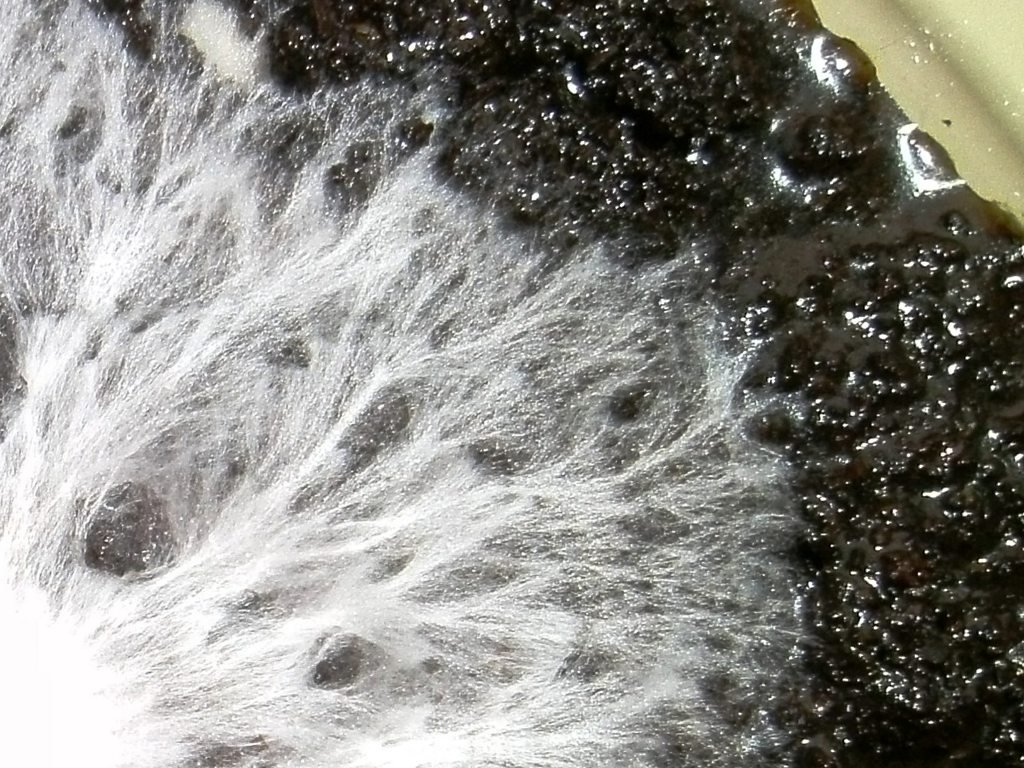
A café throws away its grounds by the bucket. Oyster mushrooms grow on them. That much is true and has been shown many times. The popular version adds that the grounds come out of the brewer ready to use, that they can be the whole of the growing mix, and that a kitchen can turn its waste into a crop. The research is more careful: grounds work best as a part of the mix, not the whole of it; they spoil within a day; and at the scale of one bucket the main enemy is green mould. This page has the method, the yields that have actually been measured, what is known about caffeine in the mushrooms, what to do with roaster’s chaff, and where the spent block goes afterwards.
The mushrooms themselves, and how to cook them, are in the Mushrooms section of this site; What a Mushroom Is explains the fungus behind the fruit. The compost and garden use of grounds is on Cooking with Coffee, and what a market stall does with its waste is on Compostable, PFAS and Waste.
The short version
| Question | Answer |
|---|---|
| Do oyster mushrooms grow on coffee grounds? | Yes. Peer-reviewed trials on several continents have grown them on grounds, alone and in mixes. |
| Are the grounds sterile from the brewer? | Hot from the brewer they have just been heated. A day later, no: wet grounds are colonised by other moulds fast. Use them within 24 hours. The controlled trials pasteurised or sterilised them again anyway. |
| Grounds alone, or mixed? | Mixed. Grounds are rich in nitrogen and pack tight. In one controlled trial, mixes with 17% and 33% grounds yielded nearly as well as straw alone; 66% grounds never fully colonised. Keep grounds to a third of the mix or less for a first try. |
| What else goes in? | Pasteurised chopped straw is the tested partner. Hardwood sawdust and other plant wastes have also been used. |
| How much spawn? | 5 to 10% of the wet weight of the mix. |
| How long? | About 2 to 3 weeks in the dark to colonise, pins at about 3 to 4 weeks, first harvest a week later. |
| How much will it make? | Published biological efficiency runs from about 45% to 106% on grounds mixes. In plain terms, roughly half a kilo to a kilo of fresh mushrooms for every kilo of dry mix, at best. |
| Is there caffeine in the mushrooms? | Traces. The best measurement put it at about 250 kg of fresh oyster mushrooms for the caffeine in one espresso. |
| Chaff? | No yield trial of oyster mushrooms on chaff alone exists. It is dry, light and fibrous: a little of it lightens a wet mix, the rest goes in the compost. |
| The spent block? | Compost it first. Fresh grounds dug straight into soil hold back plant growth. |
| Biggest risk? | Green mould (Trichoderma), which loves the same warm, wet, rich mix. A green patch means the bag is lost. |
Why spent grounds work, and where they fall short
An oyster mushroom (Pleurotus) is a white-rot fungus: in the wild it digests dead wood, breaking down cellulose and lignin, the tough structural material of plants. A cultivated oyster will eat almost any plant fibre that has been cleaned of competitors: straw, sawdust, corn cobs, cardboard, coffee husk and coffee grounds.
Spent grounds bring three things to that table.
- They have already been heated. Brewing water is close to boiling, and a puck from an espresso machine has just had water at about 200 °F forced through it. This is the basis of the claim, repeated on growing sites such as GroCycle, that “the grounds are already pasteurised by the brewing process.” It is half true. The heat does knock down what was there; but the grounds are then wet, warm, full of sugars and open to the air, and other moulds land on them at once. GroCycle’s own rule is to use them within 24 hours of brewing, and a 2026 review in Molecules says wet, fresh grounds “require rapid stabilization, refrigeration, drying, or immediate processing to prevent microbial spoilage.” The brewing is a head start, not a guarantee.
- They are rich in nitrogen. Spent grounds hold about 1.2 to 4% nitrogen, with a carbon-to-nitrogen ratio of roughly 15:1 to 22:1 (the same review). Wheat straw, the standard oyster substrate, is far leaner, about 69:1 in one trial. Oysters do best between about 20:1 and 50:1. So a little coffee feeds a straw mix; a lot of coffee over-feeds it.
- They are fine and heavy. Wet grounds pack into a dense, airless mass. Fungal threads need air spaces to run through. Straw opens the mix up.
And they bring two things the fungus has to deal with: caffeine and tannins. Caffeine slows oyster mycelium. In laboratory work, growth slows noticeably above about 100 mg of caffeine per litre and stops entirely at about 2,500 mg per litre, and one species’ growth fell from about 0.5 cm a day to 0.2 cm a day in a medium with 40% grounds (Piotrowicz and others, 2026). The fungus does fight back: it breaks caffeine down to theophylline and other related compounds (Carrasco-Cabrera, Bell and Kertesz, 2019), and in a 1991 study Pleurotus sajor-caju broke down up to 87% of the tannins in spent grounds in 32 days (Wong and Wang).
How much grounds: the studies disagree, and why
| Study | Grounds in the mix | Partner | Result |
|---|---|---|---|
| Abou Fayssal and others, PLoS One, 2021 | 0%, 17%, 33%, 66% | Wheat straw and olive prunings | 0%: 105% BE. 17%: 101.7%. 33%: 95.3%. 66%: only half colonised, no crop. |
| Job, Revista Iberoamericana de Micología, 2004 | 17.8% to 55% | Not given in the summary | Up to 55% with no loss of yield |
| Review of trials (Piotrowicz and others, 2026) | 50% | Grasses | Up to 106.6% BE; above about 30% “may retard colonization or inhibit fruiting” where the mix lacks structure |
| Carrasco-Cabrera and others, 2019 (commercial scale, Australia) | Rising shares | Sawdust | More grounds “delayed mycelial growth and delayed or prevented fruiting” |
| Hnydiuk-Stefan and others, Scientific Reports, 2024 | 100% | None | Fully colonised in 14 days at 20 °C and fruited; no yield reported |
The disagreement is mostly about structure and strain. Grounds alone can work, with the right strain and a mix that is not packed too wet. Grounds as a third of a straw mix work reliably. For a first bag, the second is the one to try.
Biological efficiency, and what yield to expect
Mushroom growers measure yield as biological efficiency (BE): the weight of fresh mushrooms picked, divided by the weight of the dry substrate, times 100. A BE of 100% means a kilo of fresh mushrooms from a kilo of dry mix, over all the flushes. Because fresh mushrooms are mostly water, figures near 100% are normal for oysters on straw.
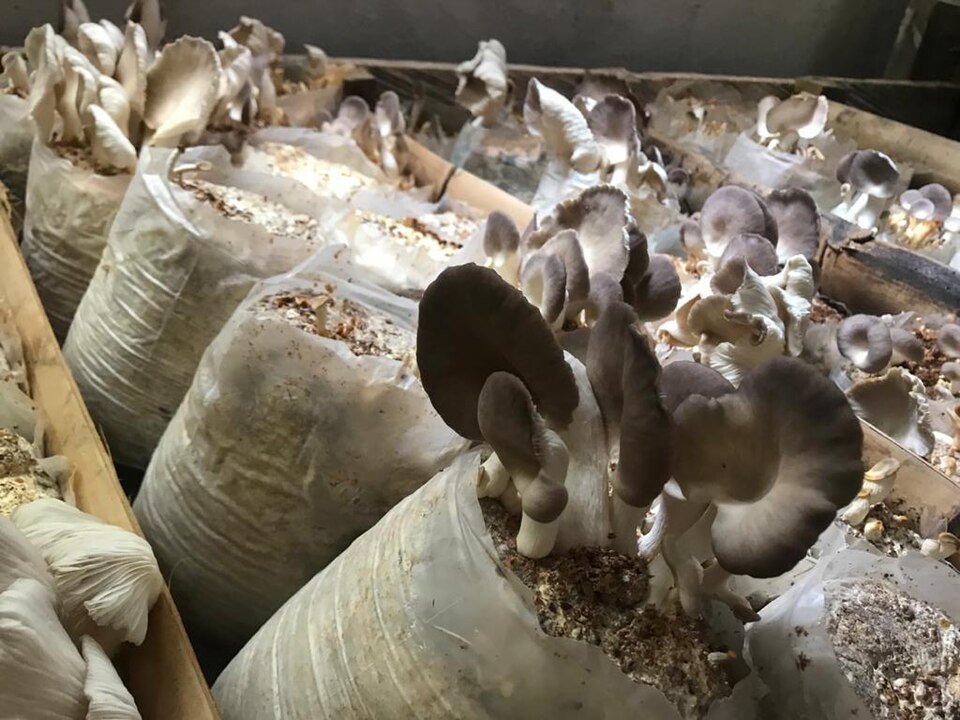
| Substrate | Species | Sterilised or pasteurised | BE |
|---|---|---|---|
| Wheat straw alone (control) | P. ostreatus | Hot water, 60–65 °C, 8 h | 105.0% |
| Straw with 17% grounds and 17% olive prunings | P. ostreatus | Same | 101.7% |
| Straw with 33% grounds and 33% olive prunings | P. ostreatus | Same | 95.3% |
| Straw with 10–20% grounds and potato peel (Torres-Martínez and others, Foods, 2024) | P. ostreatus | Autoclaved, 121 °C, 1 h | 50–58% (straw control 46%) |
| Composted coffee husk, with cow dung and gypsum (Dissasa, International Journal of Microbiology, 2022) | P. ostreatus | Autoclaved, 121 °C, 30 min | 61.9% |
| Coffee parchment (Ukii and others, Journal of Fungi, 2026) | P. ostreatus | Fully sterilised | 83.0% |
These numbers cannot be lined up against each other: different strains, different partners, different ways of killing the competition. What they show together is that a coffee mix gives somewhere between half and all of what straw alone gives.
Two published figures from outside the journals run by wet weight of grounds, not dry weight of mix, and so are not BE:
- Gunter Pauli’s Blue Economy site says “100,000 tonnes of spent coffee grounds become 10,000 tonnes of mushrooms.” That is 10% of the wet grounds’ weight in fresh mushrooms.
- GroCycle reports one coffee-grounds operation turning “75,000 kg of coffee grounds” into “20 tonnes of mushrooms”: about 27%.
For a home bag: GroCycle’s recipe is 3 kg of fresh grounds, 600 g of pasteurised straw and 300 g of spawn. By those two figures, 3 kg of grounds would give somewhere between 300 and 800 g of fresh mushrooms across its flushes. That is arithmetic on stated claims, not a measurement; a first bag, with a first attempt’s losses, should be expected toward the low end.
Gunter Pauli and ZERI: the claim, tested
The idea’s best-known promoter is Gunter Pauli, the entrepreneur who founded the Zero Emissions Research Initiative (ZERI) in 1994 and later wrote The Blue Economy (Wikipedia). His own site credits the method to the mushroom scientist Shuting Chang and its spread to Chido Govera, a Zimbabwean grower whose first mushroom course, at the age of eleven, ZERI paid for. Govera received the Specialty Coffee Association of America’s Sustainability Award in 2009 “for her sustainable project of reusing organic waste from the coffee industry to cultivate mushrooms” (Wikipedia). ZERI’s site also describes shiitake grown on coffee prunings in Colombia.
What holds up, and what does not:
| Claim | Verdict |
|---|---|
| Oyster mushrooms grow on spent coffee grounds | True. Many peer-reviewed trials. |
| 100,000 t of grounds → 10,000 t of mushrooms | Plausible: 10% of wet weight is modest, and inside what the trials show. No published accounts stand behind the number. |
| The same grounds → “50,000 tonnes of feed for chickens, and 1,000 to 2,000 jobs” | Not tested in any published study. |
| Grounds need no preparation | Overstated. Fresh, yes; but the controlled trials pasteurised or sterilised, and the best yields came from mixes, not grounds alone. |
GroCycle says plainly that Pauli was “promoting the idea… as a great example of a circular economy business model.” It works. It is a farm, though, not a free lunch.
The oyster to grow
| Oyster | Species | On coffee waste | Notes |
|---|---|---|---|
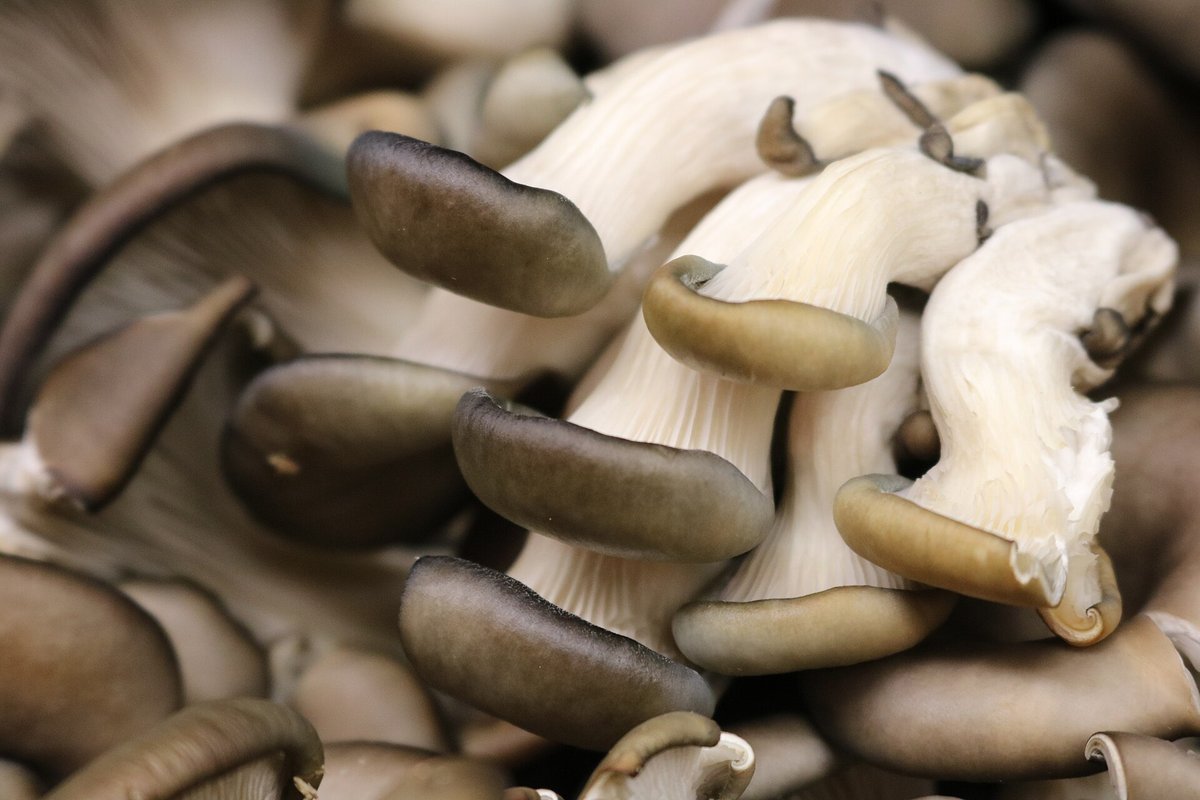
| Grey or pearl oyster | Pleurotus ostreatus | Grounds, husk, parchment, pulp | The species in nearly every grounds study; fruited at 16 °C (61 °F) in the Abou Fayssal trial. Grows wild in Michigan. Start here. |
| Phoenix oyster | P. pulmonarius | Coffee pulp (Salmones, 2005) | A close relative of the grey. |
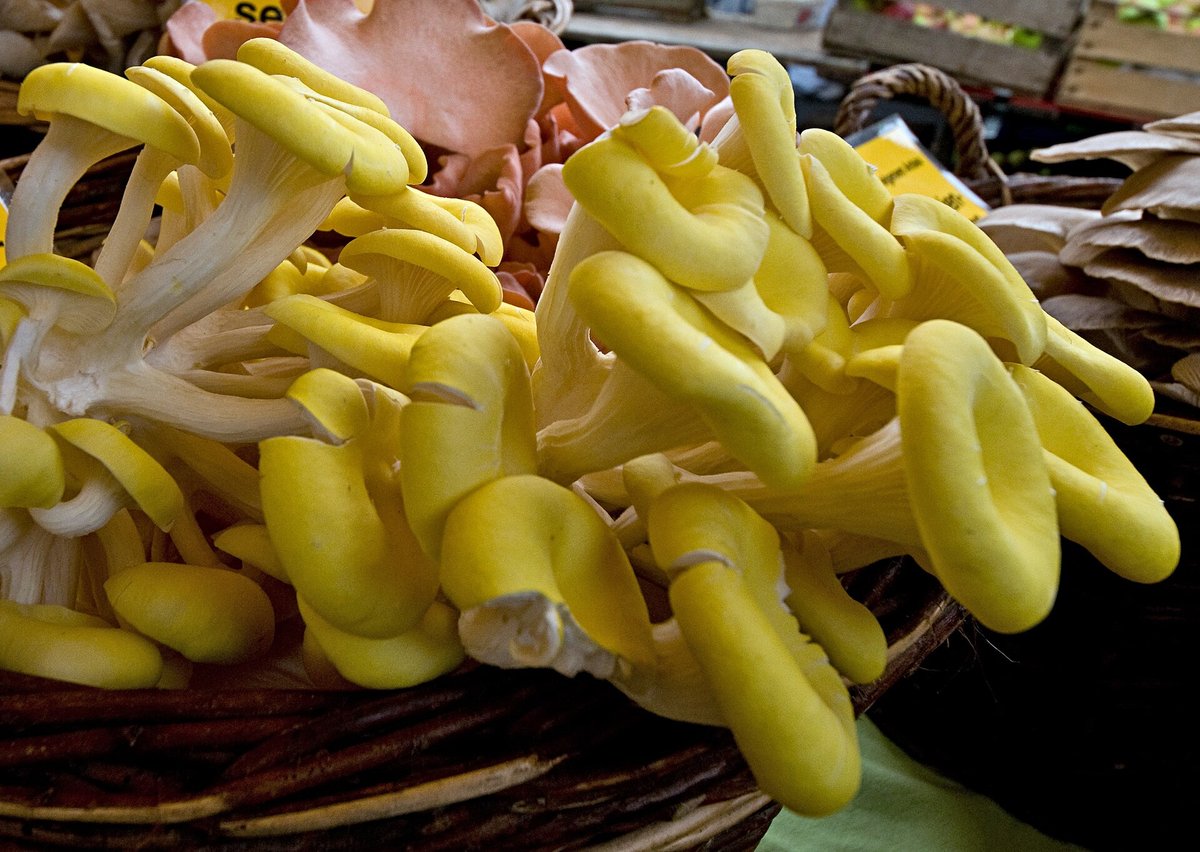
| Golden oyster | P. citrinopileatus | Grounds (Freitas, 2018: 25.1% yield by weight); husk | Invasive in North America: see below. |
| Pink oyster | P. djamor | Coffee pulp (Salmones, 2005) | A tropical species. |
| King oyster | P. eryngii | Coffee husk (Dissasa, 2022) | Slowest of the four in that trial: 19–20 days to colonise. |
Leave the golden oyster alone outdoors. It is native to eastern Asia, was imported to North America in the early 2000s, is sold in popular growing kits, escaped into the woods around 2010, and was found in 25 states and one Canadian province by 2025. Where it grows in dead elm, the number of native fungal species in the wood falls significantly (Veerabahu and others, Current Biology, 2025). A golden oyster block dumped on a compost heap or a woodpile is a way to help it spread. Grow a grey oyster, which already grows wild in Michigan (Michigan).
The method, step by step
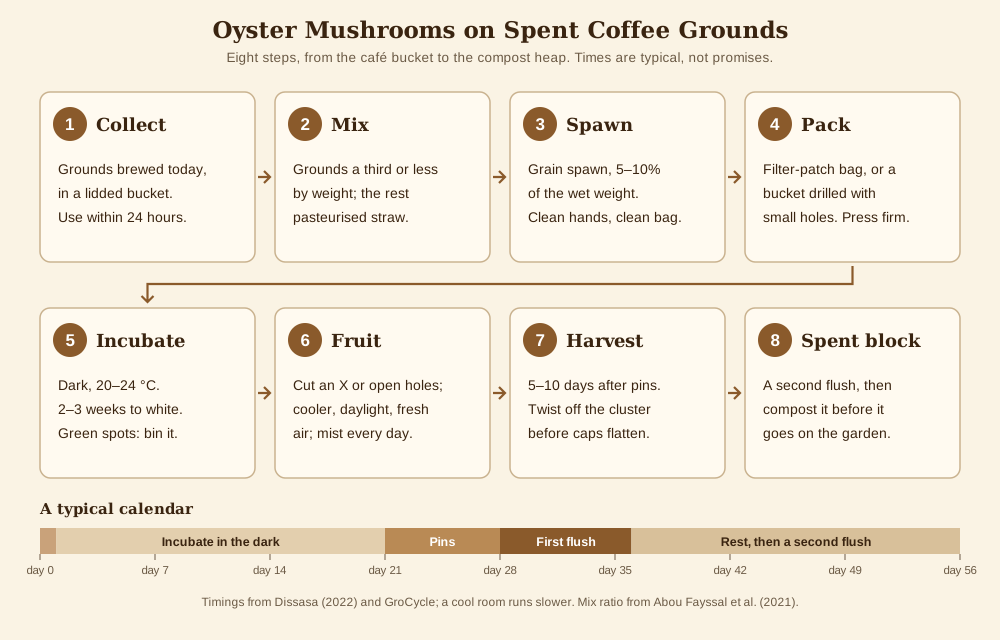
What you need
- Spawn. Oyster mushroom grain spawn: grain the fungus has already grown through, sold by mushroom suppliers by the pound or the bag. Buy grey oyster for a first try.
- Fresh grounds. Brewed that day, from a home brewer or a café.
- Straw. Chopped wheat straw, from a farm or feed store. Not hay, which is full of seeds.
- A container. A mushroom grow bag with a filter patch, a clear plastic bag, or a food-grade bucket with a lid and small holes drilled through the sides.
- A big pot or a cooler to pasteurise the straw, and a thermometer.
- Clean hands, a clean table, rubbing alcohol for both.
- A kitchen scale.
1. Collect the grounds the same day
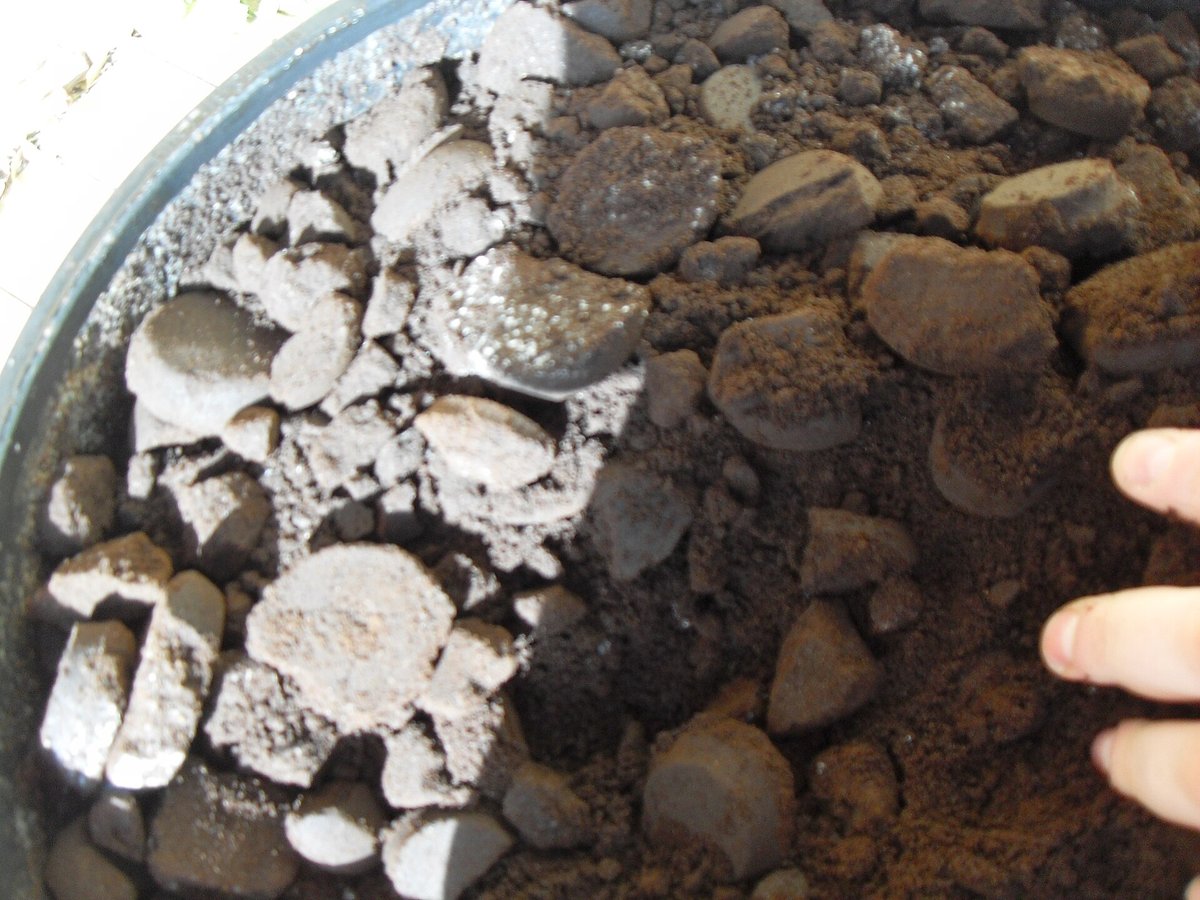
Fill a lidded bucket with grounds as they come out of the brewer: espresso pucks, filter cones, French press grounds. Paper filters can go in torn up. Use them within 24 hours. If they cannot be used that day, they go in the compost, not the bag.
2. Pasteurise the straw
Grounds are clean for a day; straw is not. Pasteurising heats it enough to kill most competitors without cooking it to a sterile mush. The Abou Fayssal trial held its whole substrate in hot water at 60–65 °C (140–149 °F) for eight hours: a big pot on the lowest heat, or a cooler topped up from a kettle, with a thermometer in it. Drain the straw until it no longer drips when squeezed: damp, not wet.
3. Mix
Weigh it. For a first bag, grounds no more than a third of the total, by wet weight; the rest straw. GroCycle’s heavier recipe (3 kg grounds to 600 g straw) runs much more coffee than that, and the trials say why it can fail. A third is the safer start.
4. Add spawn
Break up the spawn and mix it through at 5 to 10% of the wet weight of the mix: 5% in the Abou Fayssal trial, about 10% in GroCycle’s recipe and in the Torres-Martínez study. More spawn colonises faster and gives moulds less time to start. Work quickly, with clean hands.
5. Pack
Pack the mix firmly into the bag or bucket, without crushing it into a brick. Squeeze out the air and close the bag. A plain plastic bag needs a few small cuts or pin holes for air; a filter-patch bag does not.
6. Incubate in the dark
Put it somewhere dark and warm, about 20–24 °C (68–75 °F), for two to three weeks. Watch the mix turn white as the mycelium runs through it. In the Ethiopian trial, P. ostreatus finished colonising in 14 to 15 days; the king oyster took 19 to 20. A cool basement takes longer. Do not open the bag to look.
Green, black, orange or pink patches are mould, not mushroom. See Contamination below.
7. Fruit
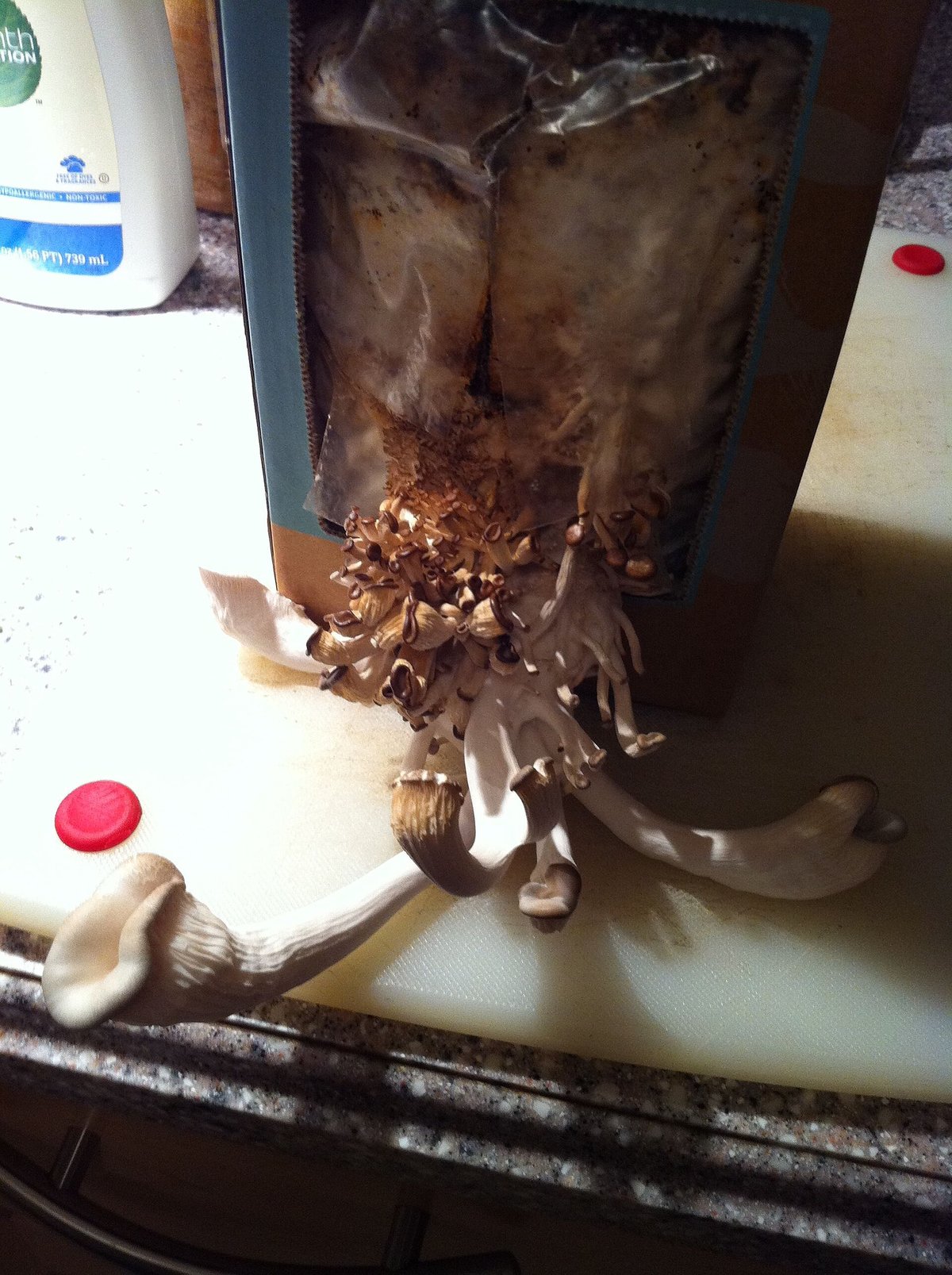
When the bag is white all through, move it to fruiting conditions: cooler, with daylight, and fresh air. The Abou Fayssal trial dropped the temperature to 16 °C (61 °F), gave 12 hours of light a day, and kept carbon dioxide low. At home that means a cool room, a window with indirect light, not a sealed cupboard. Cut an X or open the holes, and mist the openings every day with water. GroCycle finds mushrooms appear 5 to 10 days after the holes are cut.
8. Harvest
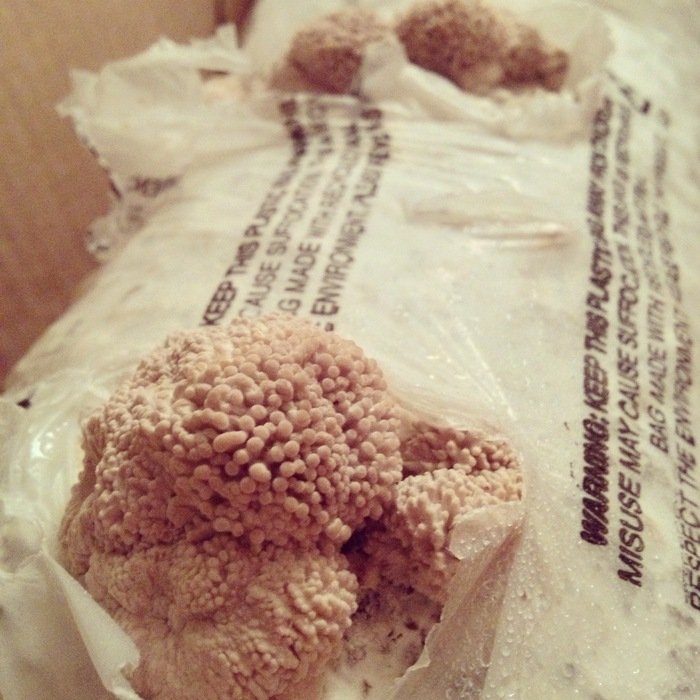
The mushrooms grow fast: 5 to 7 days from pins to picking in GroCycle’s account, 7 to 8 in the Ethiopian trial. Pick before the caps flatten and curl up at the edges, by twisting off the whole cluster at its base. Then:
- Rest the bag, keep misting it, and it may give a second, smaller flush.
- Mushrooms that stop growing and stay tiny or wilt (“aborts”) are best not eaten; pull them off.
Cooking oyster mushrooms is on Cooking Mushrooms, and keeping a glut on Preserving.
Contamination: green mould
At home scale this decides most outcomes. The mix that suits an oyster mushroom, warm, wet and rich, suits other moulds just as well, and coffee grounds are richer than straw.
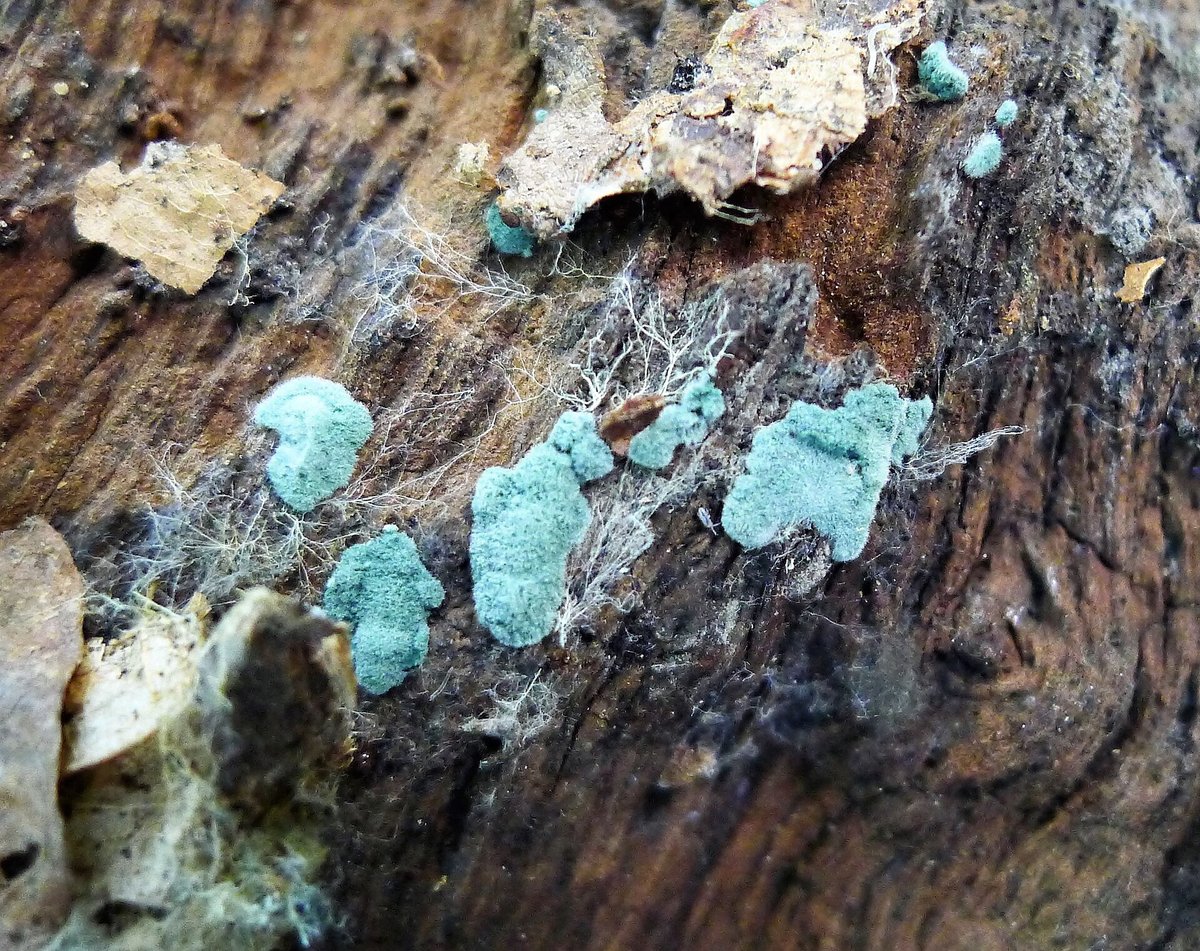
Trichoderma is the classic one. It grows “in shades of green or yellow or less frequently white” and is “typically fast-growing at 25–30 °C (77–86 °F)” (Wikipedia), just above where an oyster bag incubates. It infects oyster, button and shiitake crops, and an infected substrate gives lower yields and malformed mushrooms. Some species of Trichoderma feed on other fungi.
What to do about it:
| Do | Why |
|---|---|
| Use grounds within 24 hours | Old grounds are already colonised |
| Pasteurise the straw; keep the mix damp, not wet | Pooled water is where moulds start |
| Spawn at 10% rather than 5% | The oyster claims the bag faster |
| Keep incubation at 20–24 °C, not warmer | Trichoderma likes 25–30 °C |
| Clean hands, table and tools with alcohol | Spores arrive on everything |
| A green patch means the bag is finished | Seal it in a bin bag and take it outside. Do not open it indoors. |
A bag that turns slimy or smells sour or rotten is lost too.
Spores and lungs. Oyster mushrooms drop spores as the caps open. Mushroom-farm workers have developed hypersensitivity pneumonitis, an allergic lung inflammation, from Pleurotus spores (a published case was a worker in a king oyster factory: Saikai and others, 2002). A bag or two in a kitchen is far smaller exposure than a farm, but fruit it out of a bedroom, and pick before the caps flatten.
Is there caffeine in the mushrooms?
Some, in traces. The studies, in order:
| Study | Substrate | Finding |
|---|---|---|
| Job, 2004 | Up to 55% grounds | No caffeine found in the mushrooms; caffeine in the substrate fell |
| Nieto Ramírez and others, 2007 | Coffee pulp (about 1.3% caffeine dry) | P. sajor-caju took caffeine into the mushroom unchanged |
| Salmones and others, 2005 | Coffee pulp | Caffeine in the pulp fell during fruiting, “which could mean that some caffeine accumulates in the fruiting bodies” |
| Carrasco-Cabrera, Bell and Kertesz, 2019 | Grounds and sawdust, commercial scale | Caffeine and its breakdown products found in the mushrooms; “it would be necessary to consume ~250 kg of fresh oyster mushrooms to obtain the amount of caffeine equivalent to one cup of espresso coffee” |
Coffee pulp, the fruit around the bean, is a different substrate from spent grounds, which have already given much of their caffeine to the cup. On grounds, the only measurement puts the caffeine in an oyster mushroom at a negligible level. Caffeine itself is covered on Caffeine and Health.
Two other things go in the mushroom with whatever is in the substrate. A mushroom takes up minerals, and metals, from what it grows on; the Polish trial measured chromium, nickel, lead and others in mushrooms on grounds. Grounds from a café are food waste, so this matters less than for a substrate of unknown origin, but it is one more reason to use grounds from brewing, not from anywhere.
Chaff
Chaff is the papery silver skin that comes off coffee beans in the roaster. Anyone who roasts at home, as I have, ends up with a bowl of it after every batch: it is the “silverskin” of the scientific papers. It is light, dry, and flammable, which is why a roaster’s chaff tray is emptied every roast (Roasting Your Own).
As a mushroom substrate:
- It has been heated. It comes out of a roaster at roasting temperatures and stays bone dry, so it does not spoil the way wet grounds do.
- It is mostly fibre. Silverskin is up to 72% dietary fibre, with 10–24% cellulose (Piotrowicz and others, 2026). That is food for a white-rot fungus.
- It is very light. A bag of chaff is mostly air.
No published trial measures oyster mushroom yield on chaff, alone or mixed. The one published study that uses it with mushroom mycelium is a 2024 one making mycelium building materials, not food: 20% spent grounds, 10% chaff, with hay, hemp dust and grain (Barta and others, Materials, 2024).
The sensible use, then, is as a dry ingredient in a wet mix: a handful or two in a bag of grounds and straw takes up excess water and opens the structure. It needs moistening first, and pasteurising with the straw if it has sat around. Kept to about a tenth of the mix, it cannot do much harm. The rest goes in the compost as dry “brown” material, or under mulch, where it blows away unless covered (Compostable, PFAS and Waste).
Coffee husk and parchment, the dried fruit and inner shell removed at the mill, are a different thing from chaff, and are proven oyster substrates (61.9% and 83% BE above). They are a byproduct of coffee-growing countries and rarely reach a roaster in Michigan.
The spent block
When a bag has stopped fruiting, the white, crumbly block that is left is spent mushroom substrate: partly digested straw and grounds, laced with mycelium.
- Compost it. It is a good addition to the heap. A 2026 review lists composting, organic fertiliser and bioenergy as the uses of spent substrate from coffee systems.
- Do not dig it straight into beds as fresh grounds. Applying fresh spent grounds directly to urban garden soils “greatly reduces plant growth” (Hardgrove and Livesley, 2016), while composted grounds have improved the growth of crops (Morikawa and Saigusa, 2008); both are quoted by Khan and others, 2023. Uncomposted grounds also tie up nitrogen as soil microbes break them down. A spent block is part-way to compost already; finishing it in the heap is safer.
- Or break it into a shady garden bed under mulch, and a grey oyster may give one last flush outdoors. Never do this with a golden oyster.
- A green-moulded bag goes in the trash, sealed, not the compost heap.
Grounds’ value in compost, the 20% rule and the acid myth are on Cooking with Coffee.
Getting grounds from a café
A single home brewer makes a few dozen grams of grounds a day: not enough for a bag in one day. A café makes kilos.
- Ask at a quiet time, and bring your own lidded bucket. Many cafés already bag grounds for gardeners.
- Ask for that morning’s grounds, and collect them the same day. A bucket that has sat behind the counter since yesterday is for the compost.
- No milk, no sugar, no flavoured coffee. Ask that nothing but grounds and paper filters go in the bucket.
- Espresso pucks are ideal: compact, and fresh from hot water.
A market coffee stall makes grounds too, but under a food licence they are waste from the booth and go home in a closed bin (the inspector’s list). A closed bucket of that morning’s grounds, home by early afternoon, is a bag’s worth.
Selling the mushrooms
Michigan’s wild-mushroom certification, run with Midwest American Mycological Information, covers wild-foraged mushrooms; it is on Michigan: The Law, the Seasons and the Morel Towns. Cultivated oyster mushrooms are a farm product, not a wild one. Before selling them at a market, ask MDARD’s Food and Dairy Division two questions:
- “Are cultivated oyster mushrooms, sold fresh and whole, treated as a raw agricultural product at a farmers market, with no food licence needed?”
- “Does growing them on spent coffee grounds from a café change that?”
The honest limits
- It is slow. Six to eight weeks from bucket to second flush, for a few hundred grams of mushrooms.
- It fails often at first. One green bag in a first batch is normal. The trials were run in clean rooms with lab-grown spawn and an autoclave; a kitchen has none of that.
- It does not use up much coffee. One bag takes a few kilos of grounds. A café makes that in a morning.
- It needs space with the right climate twice over: warm and dark for weeks, then cool and bright with fresh air.
- It costs something. Spawn, bags and straw are bought. A first bag is a project, not a saving; it is also a good use for grounds that would otherwise be thrown away.
What is not known
- Oyster mushroom yield on roaster’s chaff, alone or in a mix.
- A tested best share of spent grounds in a straw mix for home growers: the controlled results run from 17% to 100%, with different strains and partners.
- Whether brewing alone leaves grounds clean enough to skip pasteurising, measured against the same grounds pasteurised.
- The accounts behind the Blue Economy’s 100,000-tonne figure.
- How Michigan treats cultivated mushrooms grown on café waste and sold at a market.
Sources
- Abou Fayssal, S., and others, “Combined effect of olive pruning residues and spent coffee grounds on Pleurotus ostreatus production, composition, and nutritional value,” PLoS One 16 (2021) e0255794.
- Torres-Martínez, B. M., and others, “Bio-Valorization of Spent Coffee Grounds and Potato Peel as Substrates for Pleurotus ostreatus Growth,” Foods 13 (2024) 3774.
- Dissasa, G., “Cultivation of Different Oyster Mushroom (Pleurotus species) on Coffee Waste and Determination of Their Relative Biological Efficiency and Pectinase Enzyme Production, Ethiopia,” International Journal of Microbiology (2022) 5219939.
- Ukii, B. M., and others, “Oyster Mushroom Cultivation on Coffee Parchment and Cenchrus fungigraminus: A Comparison of Disinfection Methods,” Journal of Fungi 12 (2026) 432.
- Hnydiuk-Stefan, A., and others, “Impact of bottom ash addition on Pleurotus ostreatus cultivation on coffee ground substrate,” Scientific Reports (2024).
- Job, D., “Use of coffee grounds for production of Pleurotus ostreatus,” Revista Iberoamericana de Micología (2004).
- Carrasco-Cabrera, C. P., Bell, T. L., and Kertesz, M. A., “Caffeine metabolism during cultivation of oyster mushroom (Pleurotus ostreatus) with spent coffee grounds,” Applied Microbiology and Biotechnology (2019).
- Nieto Ramírez, I. J., Chegwin Angarita, C., and Osorio Zuloaga, H. J., “Incorporation of caffeine into the macromicete fungus Pleurotus sajor-caju growing on coffee pulp,” Revista Iberoamericana de Micología (2007).
- Salmones, D., Mata, G., and Waliszewski, K. N., “Comparative culturing of Pleurotus spp. on coffee pulp and wheat straw,” Bioresource Technology (2005).
- Wong, Y. S., and Wang, X., “Degradation of tannins in spent coffee grounds by Pleurotus sajor-caju,” World Journal of Microbiology and Biotechnology (1991).
- Freitas, A. C., and others, “Use of coffee by-products for the cultivation of Pleurotus citrinopileatus and Pleurotus salmoneo-stramineus,” International Journal of Food Science and Technology (2018).
- Piotrowicz and others, “The Use of Coffee Residues as Sustainable Cultivation Substrates in Microbial Biotechnology,” Molecules 31 (2026) 2382.
- Barta, D. G., and others, “Mycelium-Based Composites as a Sustainable Solution for Waste Management and Circular Economy,” Materials 17 (2024) 404.
- Veerabahu, A., and others, “Invasive golden oyster mushrooms are disrupting native fungal communities as they spread throughout North America,” Current Biology (2025).
- Saikai, T., and others, “Hypersensitivity pneumonitis induced by the spore of Pleurotus eryngii,” Internal Medicine 41 (2002).
- Khan, M. O., and others, “Short-term impact of different doses of spent coffee grounds, salt, and sand on soil chemical and hydrological properties in an urban soil,” Environmental Science and Pollution Research (2023), quoting Hardgrove and Livesley (2016) and Morikawa and Saigusa (2008).
- GroCycle, “Growing Mushrooms in Coffee Grounds”.
- Gunter Pauli: The Blue Economy and ZERI, read 5 October 2026; Wikipedia on Gunter Pauli, Chido Govera and Trichoderma.
- Yield arithmetic for a home bag is worked out on this page from the Blue Economy and GroCycle figures.
Comments (0)