Coffee · 21 of 64
Coffeehouses in History: from Mecca to Vienna
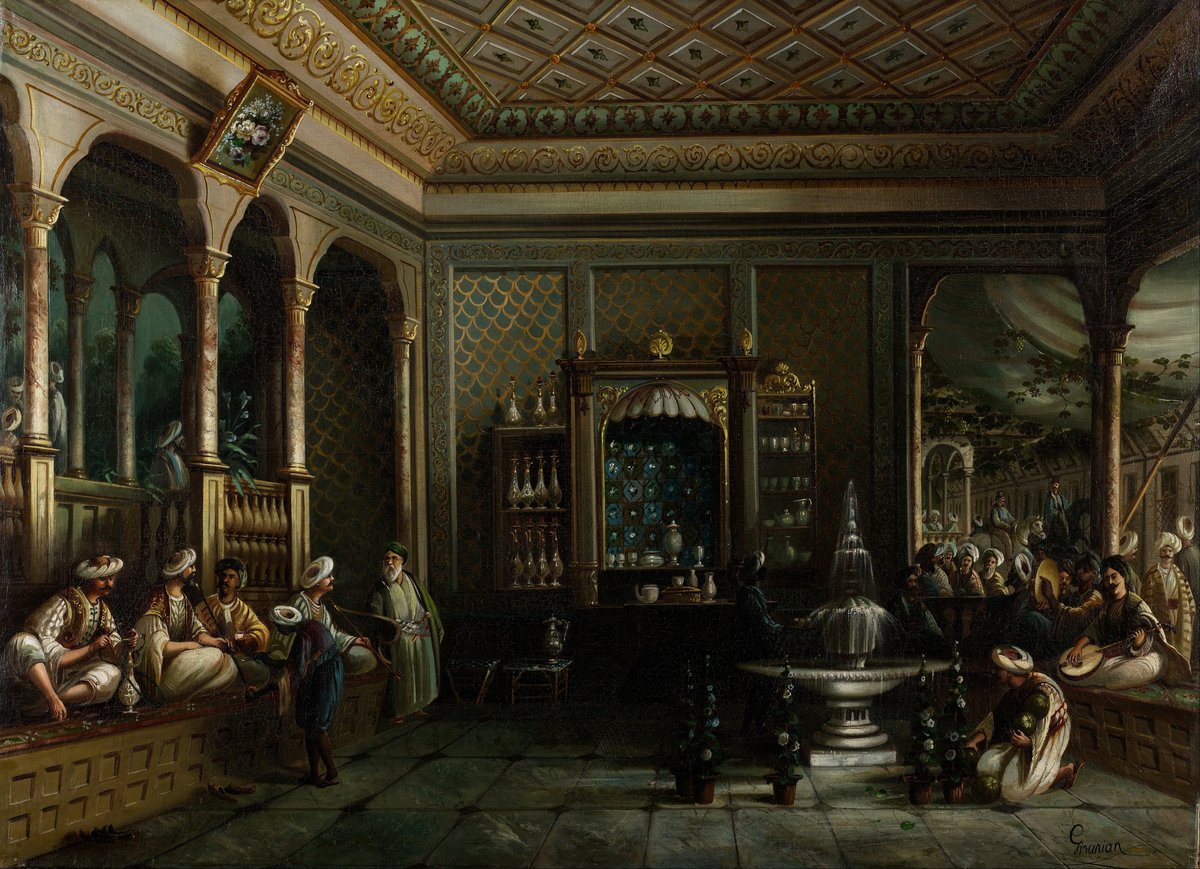
Coffee changed how people met before it changed how they ate. A tavern sold drink that made people drunk; a coffeehouse sold drink that kept them awake and talking, and for the price of a cup anyone could sit, read the news and argue. From Mecca in 1511 to London in 1675, rulers tried to shut them for exactly that reason. Insurance, stock exchanges, newspapers and at least one revolution were organised over coffee.
The coffeehouse also collected legends faster than almost any other institution: the market inspector executed for banning coffee, the sultan beheading coffee drinkers in disguise, the Polish spy who opened Vienna’s first café with the Turks’ abandoned beans. Most of them do not survive a look at the sources. The short version is on History; this page is the long one.
The short version
| Question | Answer |
|---|---|
| Where were the first coffeehouses? | In the Hijaz, Cairo and Damascus in the early sixteenth century, growing out of Sufi night prayers in Yemen. Istanbul’s first opened in 1554–55. |
| Was coffee banned? | Many times. Mecca in 1511; Istanbul repeatedly, last and hardest under Murad IV in 1633; England’s Charles II tried in 1675 and gave up in days. Every ban failed. |
| England’s first? | Jacob’s, at the Angel in Oxford, 1650 or 1651. London’s was Pasqua Rosée’s in St Michael’s Alley, usually dated 1652. |
| Were they “penny universities”? | The idea is in print by 1667; the set phrase came later. |
| What came out of them? | Lloyd’s of London, the London Stock Exchange (named in a coffeehouse in 1773), the Royal Society’s informal meetings, The Tatler and The Spectator. |
| Paris? | Le Procope, 1686. The original café closed in 1872; the restaurant there dates from 1957. |
| Vienna? | The first licence went to the Armenian Johannes Diodato in 1685. The Kolschitzky story is legend. |
| Can I make coffeehouse coffee? | Yes: Seventeenth-Century Coffee-House Coffee, Wiener Melange, Einspänner. |
Mecca, Cairo and the Sufis
Coffee as a social drink began among Sufi orders in Yemen, who drank it to stay awake through night-time devotions, the dhikr. The sixteenth-century writer ʿAbd al-Qādir al-Jazīrī describes a leader ladling coffee from a red clay vessel and passing it to the right while the gathering recited the profession of faith (al-Jazīrī, ʿUmdat al-ṣafwa, 1558, as translated by Ralph Hattox in Coffee and Coffeehouses, 1985). From Yemen it spread to Mecca, Medina and Cairo, and out of the devotional gathering grew a commercial one: the coffeehouse. Hattox’s argument, now the standard one, is that the trouble that followed was less about the drink than about people gathering to drink it (ArabLit).
Mecca, 1509 and 1511. In 1509 Mecca’s chief Shāfiʿī judge ruled coffee permissible, and the Mamluk governor had the sellers arrested anyway (Reda Asaad Sharif, Darah journal, via Medievalists.net). In June 1511 Khāʾir Beg, the city’s muḥtasib or market inspector, saw men drinking coffee at night by the mosque, convened jurists and two physicians who declared it harmful, and had coffee banned and burned in the streets, citing people gathering in coffeehouses “in a manner similar to taverns”. The 1842 Encyclopaedia Britannica says the Mamluk sultan “immediately after removed the prohibition” (Britannica, 1842). The story that Khāʾir Beg was executed for banning coffee has no scholarly source.
Istanbul and the Ottoman coffeehouse
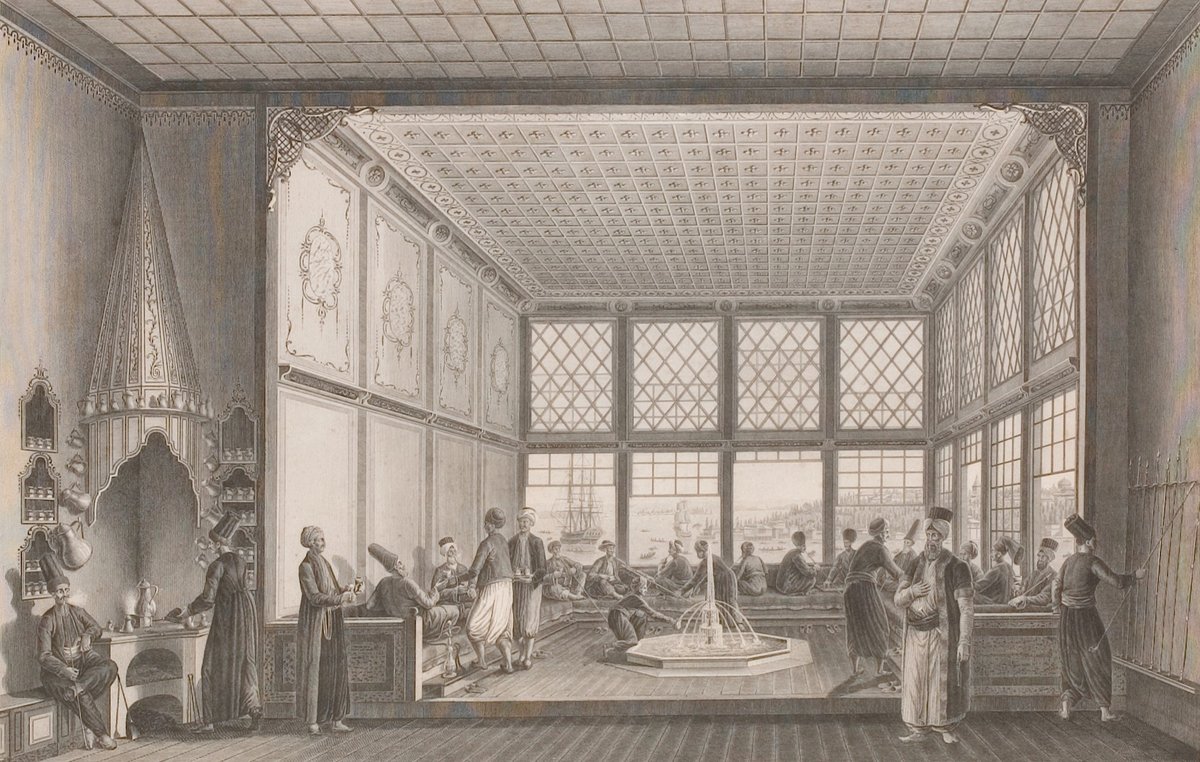
The chronicler İbrahim Peçevi, writing in the 1640s, says the first coffeehouses in Istanbul were opened in 962 AH (1554–55) in Tahtakale by two men from Syria, Hakem of Aleppo and Şems of Damascus; the historian Mustafa Âlî gives 1553 (TDV İslâm Ansiklopedisi, “Kahvehane”). Peçevi describes gatherings of twenty or thirty, some reading, some playing backgammon and chess, some reciting new poems. The seventeenth-century scholar Kâtib Çelebi called them mekteb-i irfân, “schools of the learned”. The city’s registers counted 1,631 coffeehouses in 1792 and 2,076 in 1821 (TDV). Shadow-puppet plays (Karagöz), storytellers (meddah) and minstrels performed in them, especially on Ramadan nights (UNIMA). The “Kiva Han” of 1475, often called the world’s first coffeehouse, has no documentation.
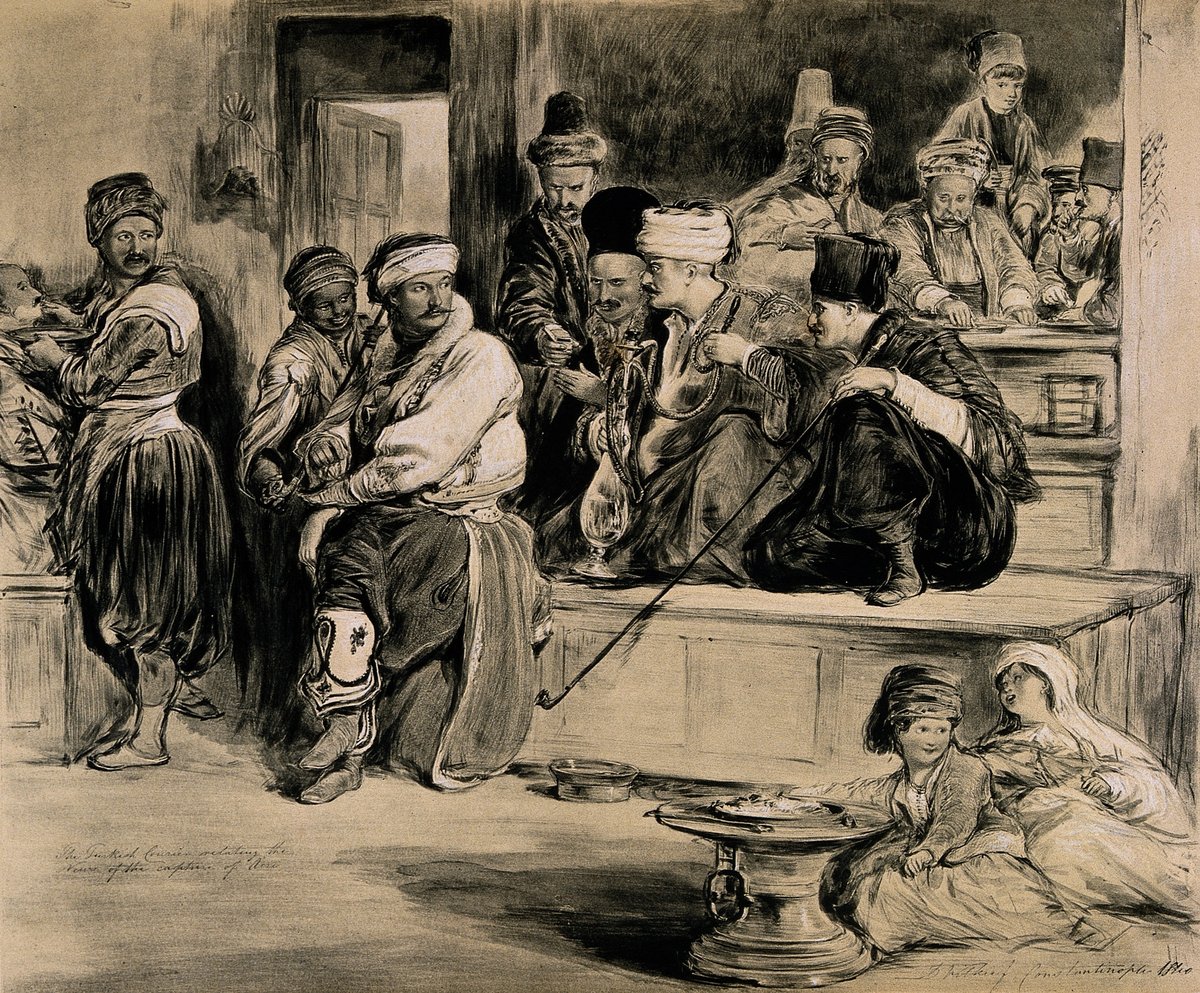
The bans. Orders to close coffeehouses went out late in Süleyman’s reign and again in 1583; a later chief jurist, Bostanzâde Mehmed Efendi, ruled coffee itself lawful, separating the drink from the place (TDV). The hardest closure came under Murad IV in 1633, usually linked to the great fire of that September and to fear of the janissaries, who had murdered his brother Osman II in 1622. TDV calls it the last closure decree; afterwards the state regulated coffeehouses and sent spies into them. About 42 percent of Muslim-owned coffeehouses belonged to janissaries, some marked with their regiment’s insignia, and they were political meeting places until the corps was abolished in 1826 (Ottoman coffeehouse, citing Cengiz Kırlı). Murad IV’s executions of tobacco smokers are well attested; the story of the sultan prowling in disguise to behead coffee drinkers, and totals of “10,000 to 100,000” executed, have no traceable source.
England
Oxford. Anthony Wood recorded that “Jacob a Jew opened a coffey house at the Angel” in the parish of St Peter-in-the-East. The historian Brian Cowan dates it to 1650; Wood’s editor guessed March 1651, and Markman Ellis notes the date lacks firm evidence (English coffeehouses). In 1654 Cirques Jobson, from the Levant, sold coffee “between Edmund Hall and Queen College corner”; the Queen’s Lane Coffee House claims to be that house and the oldest continuously serving coffeehouse in Europe, a claim that is its own.
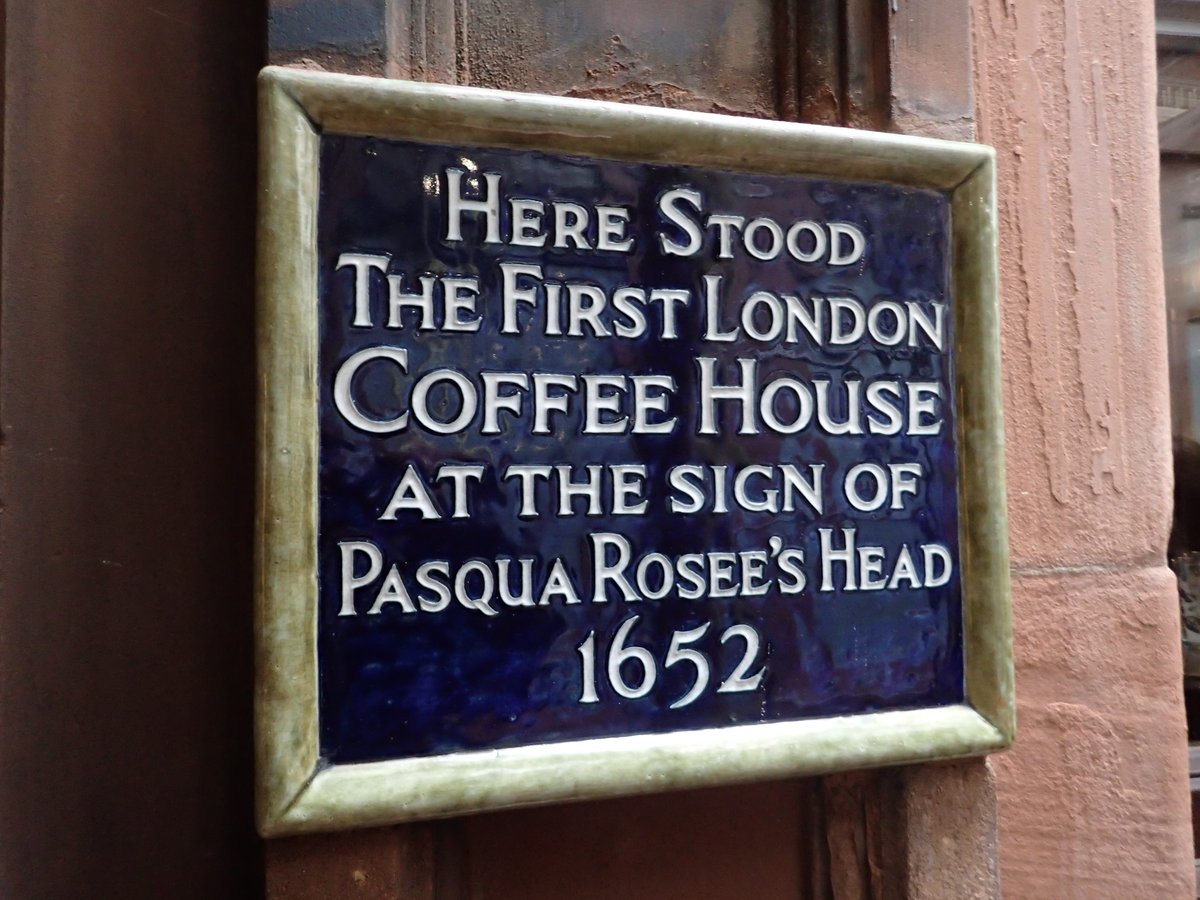
London. Pasqua Rosée, the servant of Daniel Edwards, a Levant Company merchant who had lived in Smyrna, set up first in a shed in St Michael’s churchyard and then in a house across the alley, “at the Signe of his own Head” (Pasqua Rosée). His handbill calls coffee “a simple innocent thing, composed into a drink, by being dry-ed in an Oven, and ground to Powder, and boiled up with Spring water”, “to be taken as hot as possibly can be endured”, and claims it prevents drowsiness and helps against dropsy, gout and scurvy (Oxford Text Archive). The house is usually dated 1652, though the surviving copy of the handbill is catalogued as printed around 1670–80. London’s second coffeehouse was James Farr’s Rainbow at Temple Bar, 1657. Cowan’s point is a useful brake on the usual story: coffeehouses were not widely popular in London until the mid-1660s.
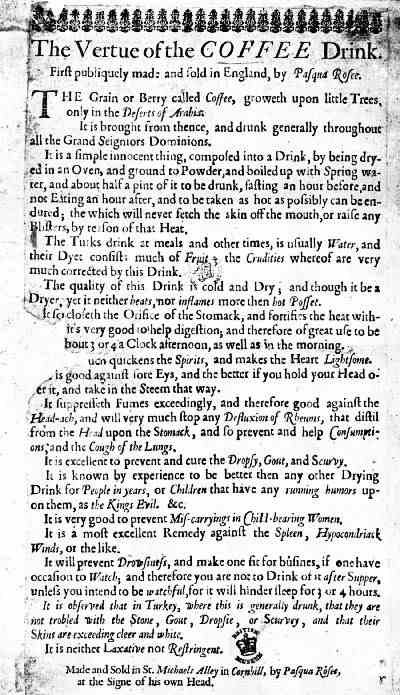
Pasqua Rosée’s handbill, The Vertue of the COFFEE Drink.
The penny university. A broadside of 1667, News from the Coffee-House, put the idea in verse: “So great a Universitie / I think there ne’re was any; / In which you may a Schoolar be / For spending of a Penny” (English Broadside Ballad Archive). The author is unknown. “Penny university” as a set name for coffeehouses is not found in seventeenth- or eighteenth-century print and looks like a later label built on lines like these.
The coffeehouses that became institutions.
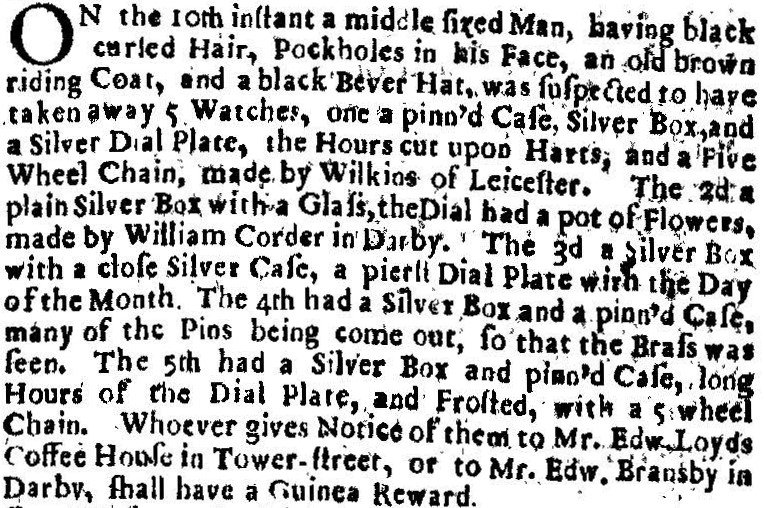
- Lloyd’s. Edward Lloyd’s coffeehouse first appears in the London Gazette of 18–21 February 1688, in Tower Street, in a notice offering a reward for stolen watches. It moved to Lombard Street in 1691. Lloyd published a short-lived Lloyd’s News in 1696–97 and died in 1713; Lloyd’s List began in 1734 under the coffeehouse’s master Thomas Jemson (Lloyd’s).
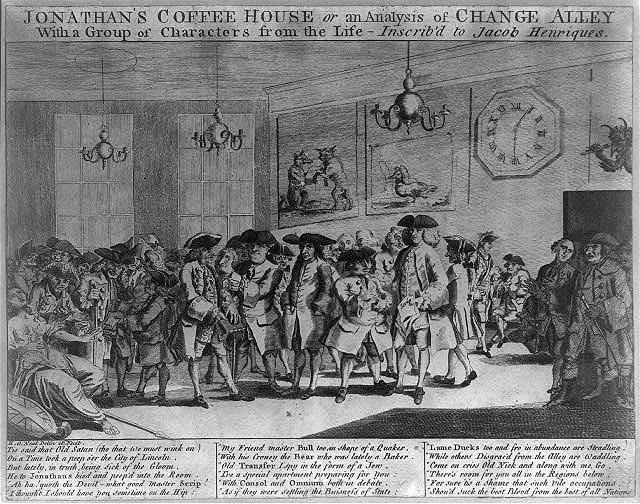
- Jonathan’s, in Exchange Alley, where John Castaing posted The Course of the Exchange from 1698. Brokers thrown out of the Royal Exchange for rowdiness traded there and at Garraway’s, and in July 1773, in new premises called New Jonathan’s, they voted to call the building “The Stock Exchange” (Jonathan’s Coffee-House).
- Garraway’s, where Thomas Garway sold some of the first tea in London and the Hudson’s Bay Company held its first fur sale in 1671. The first English tea advertisement, though, was for the Sultaness Head coffeehouse, in Mercurius Politicus in September 1658 (Garraway’s).
- The Royal Society’s coffeehouses. Robert Hooke’s diary for the 1670s records near-daily visits to Garraway’s, Jonathan’s and Man’s, where he talked science and drew maps (Nature, 1935). The Grecian, off the Strand, was where Newton, Sloane and Halley went after meetings in the early eighteenth century.
- The wits. Dryden held court at Will’s in Covent Garden; after his death in 1700 they moved across the street to Button’s, where Addison’s Guardian took contributions through a carved lion’s-head letterbox.
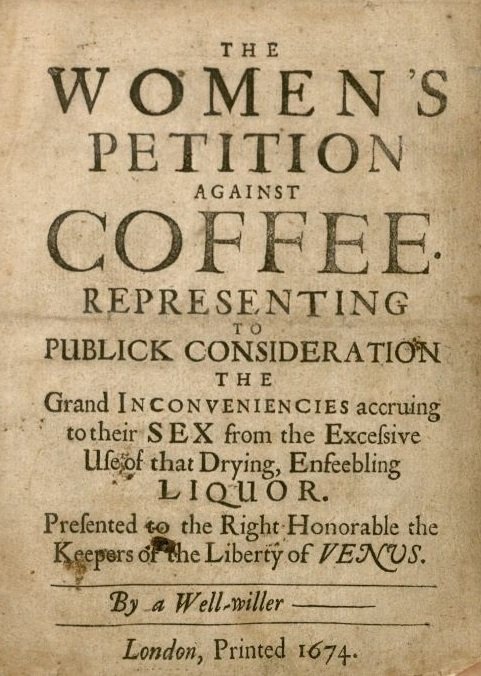
Women. Women were not ordinary customers, but they kept coffeehouses: Anne Rochford, and Moll King, whose Tom King’s in Covent Garden appears in Hogarth’s Morning (1738) (Cowan, The Social Life of Coffee, 2005). The Women’s Petition Against Coffee (1674), “by a Well-willer”, complained that coffee made men impotent, “as unfruitful as those Desarts whence that unhappy Berry is said to be brought”; The Mens Answer replied that it “collects and settles the Spirits”. Both are anonymous, and most historians, Steve Pincus among them, read the petition as political satire against the coffeehouses written by men, not by women (Wikisource).
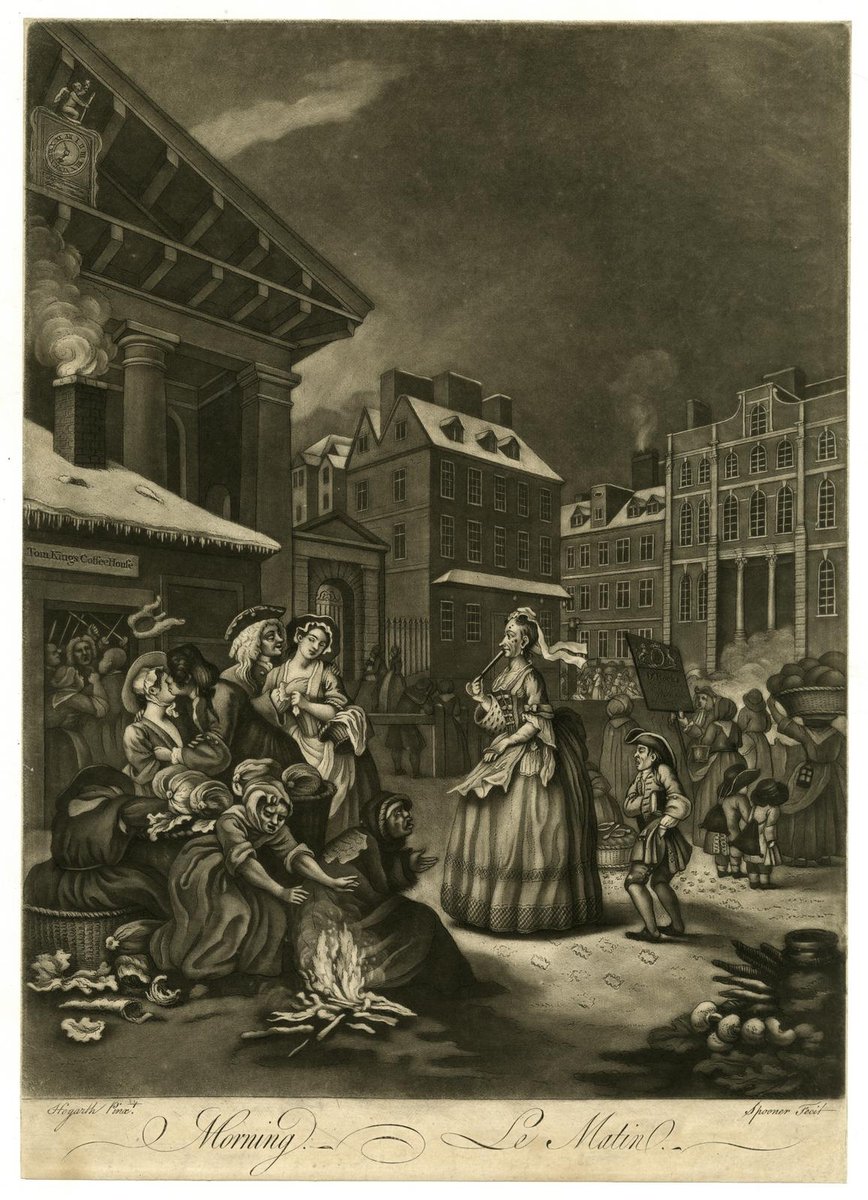
Charles II tries to close them. A royal proclamation signed on 23 December 1675 and published on 29 December ordered all coffeehouses closed from 10 January 1676, for harbouring “Idle and disaffected persons” spreading “false, malitious and scandalous Reports” (London Gazette). It banned the retail of “Coffee, Chocolet, Sherbett or Tea”, not the drinks themselves. A second proclamation on 8 January put the deadline off to 24 June, and the matter was quietly dropped (Royal Philatelic Society London).
Paris
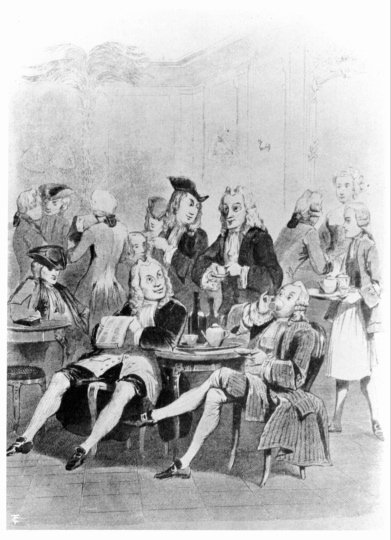
Le Procope. The Sicilian Francesco Procopio dei Coltelli opened his café in 1686 on the rue des Fossés-Saint-Germain, now 13 rue de l’Ancienne-Comédie, fitted with mirrors, chandeliers and marble tables; when the Comédie-Française opened opposite in 1689 it became the café of actors and writers. He gallicised his name to Procope in 1702 (Café Procope). Voltaire is the best attested of the famous regulars; that the Encyclopédie was conceived there is only “said”. The café closed in 1872; the restaurant at the address opened in 1957, so it is not the oldest café in Paris in continuous service. The hat said to have been left by Napoleon as a pledge is the restaurant’s own story.
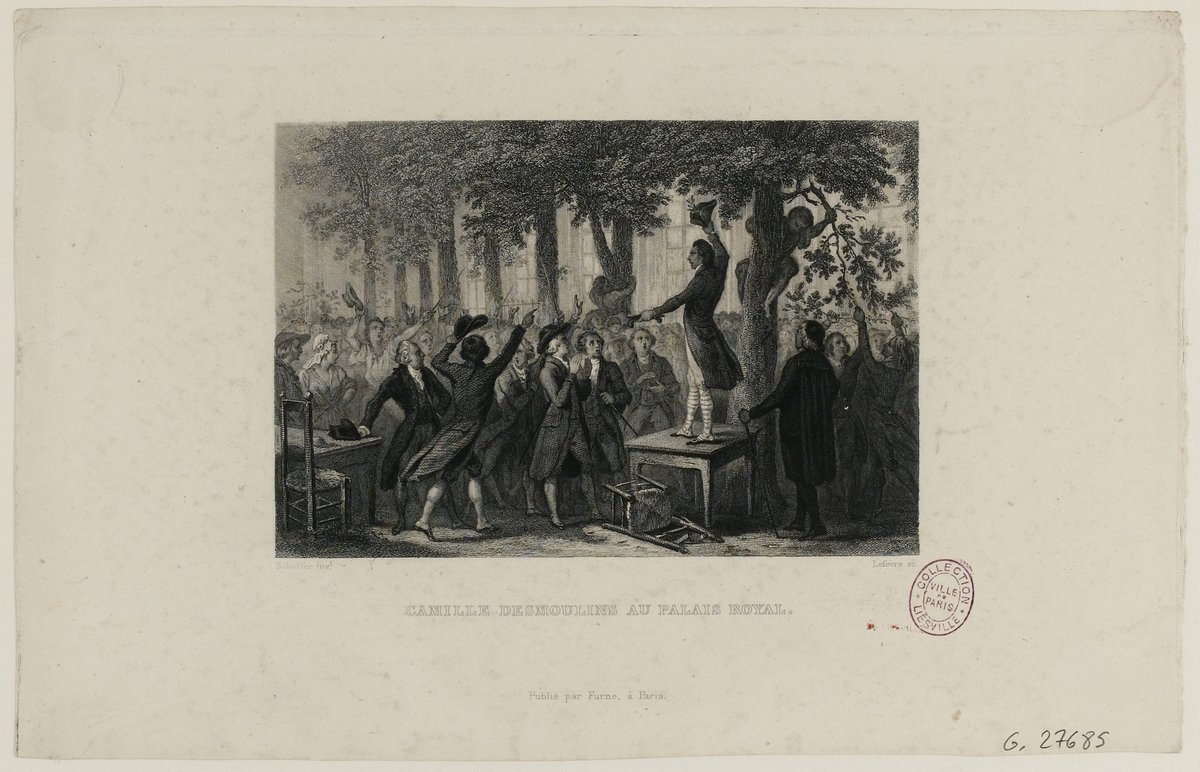
Café de Foy, 12 July 1789. The day after Louis XVI dismissed Necker, the journalist Camille Desmoulins stood on a table outside the Café de Foy in the Palais-Royal and called the crowd to arms, proposing a green cockade of chestnut leaves; the Bastille fell two days later (Camille Desmoulins). His exact words differ between versions.
Vienna
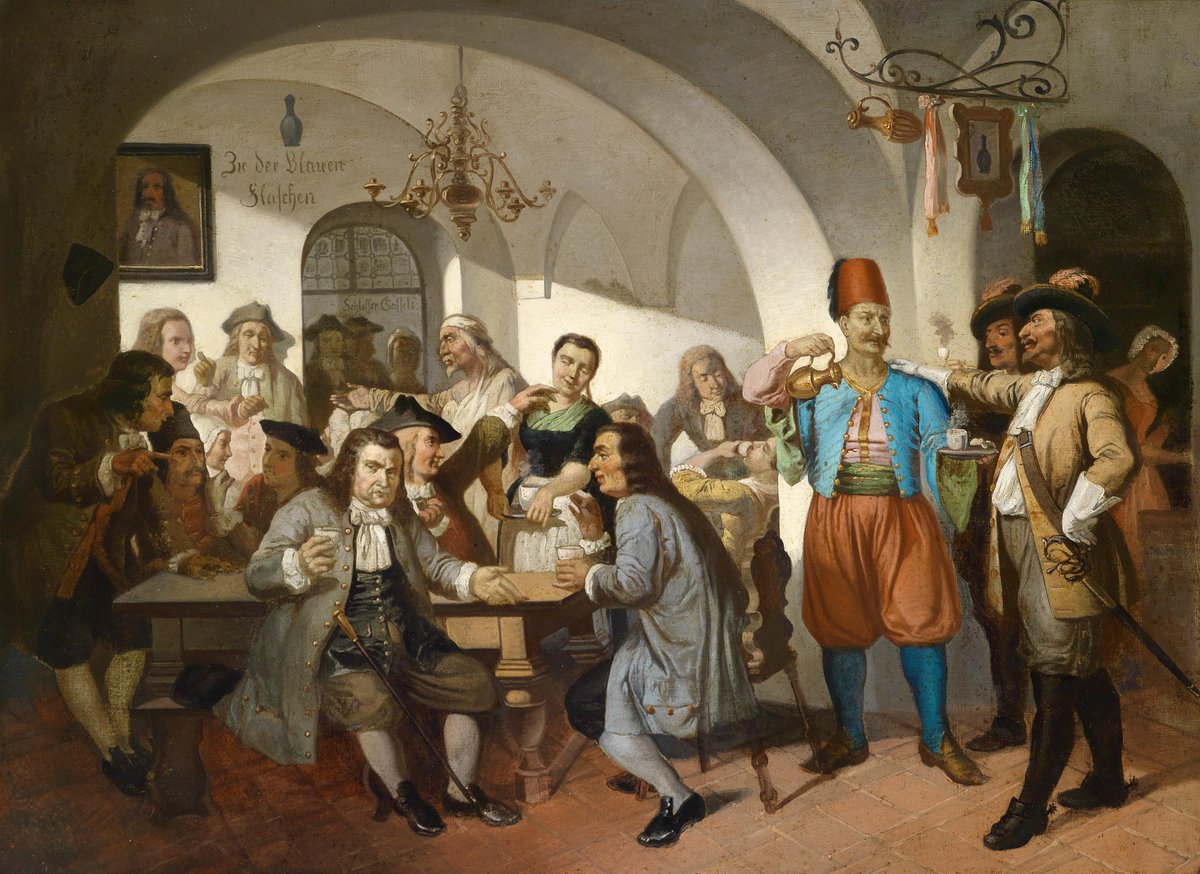
The legend. After the Ottoman siege of 1683, the story goes, the scout Georg Franz Kolschitzky was rewarded with the sacks of coffee the Turks left behind, opened Vienna’s first coffeehouse, Zur Blauen Flasche, and invented coffee with milk. The historian Karl Teply showed this to be an unverified tradition that attached itself to Kolschitzky because the Blue Bottle lasted so long (Neue Deutsche Biographie). The record: the Armenian Johannes Diodato received a twenty-year court privilege to serve coffee in 1685, the first recorded licence; another Armenian, Isaak de Luca, became a citizen in 1697 and opened Zur Blauen Flasche in 1703. Café Kramer on the Graben offered newspapers from 1720 (Austrian Commission for UNESCO). The cappuccino-and-the-siege story is dealt with on Milk Drinks.
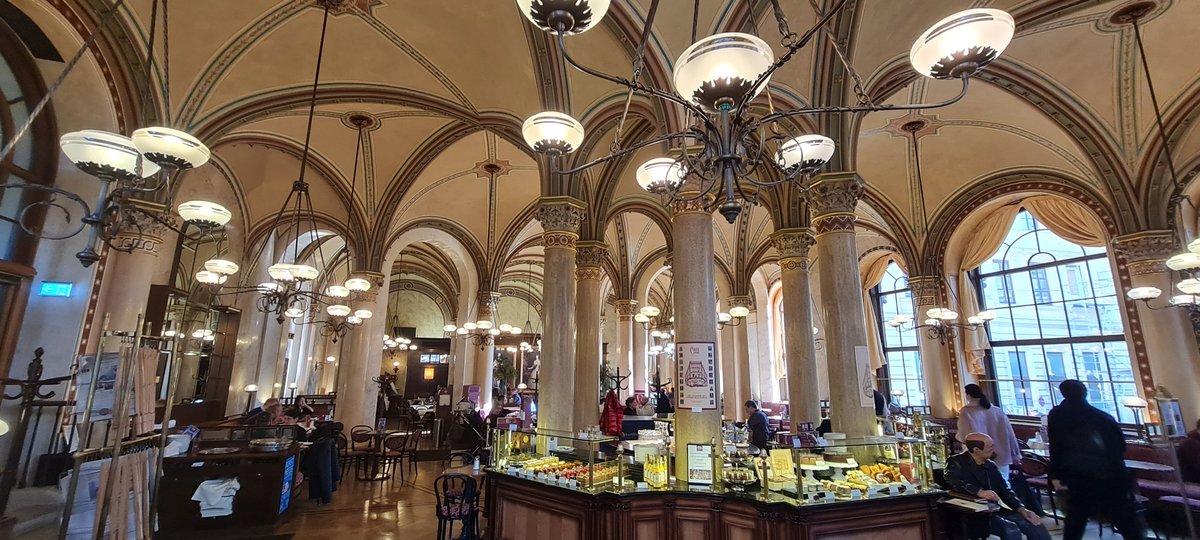
The Viennese coffee house. Marble-topped tables, Thonet chairs, newspapers on wooden holders, a glass of water with every coffee, and a place, in the words of its heritage entry, “where time and space are consumed, but only the coffee is found on the bill”. Viennese coffee house culture was added to Austria’s national inventory of intangible cultural heritage in 2011; it is not on UNESCO’s international list. Café Central opened in the Palais Ferstel in 1876, and its regulars included Peter Altenberg, Adolf Loos and Leon Trotsky (Café Central). Café Hawelka was taken over by Leopold and Josefine Hawelka in May 1939 and is known for her Buchteln (Café Hawelka). The Melange and the Einspänner are in the recipes.
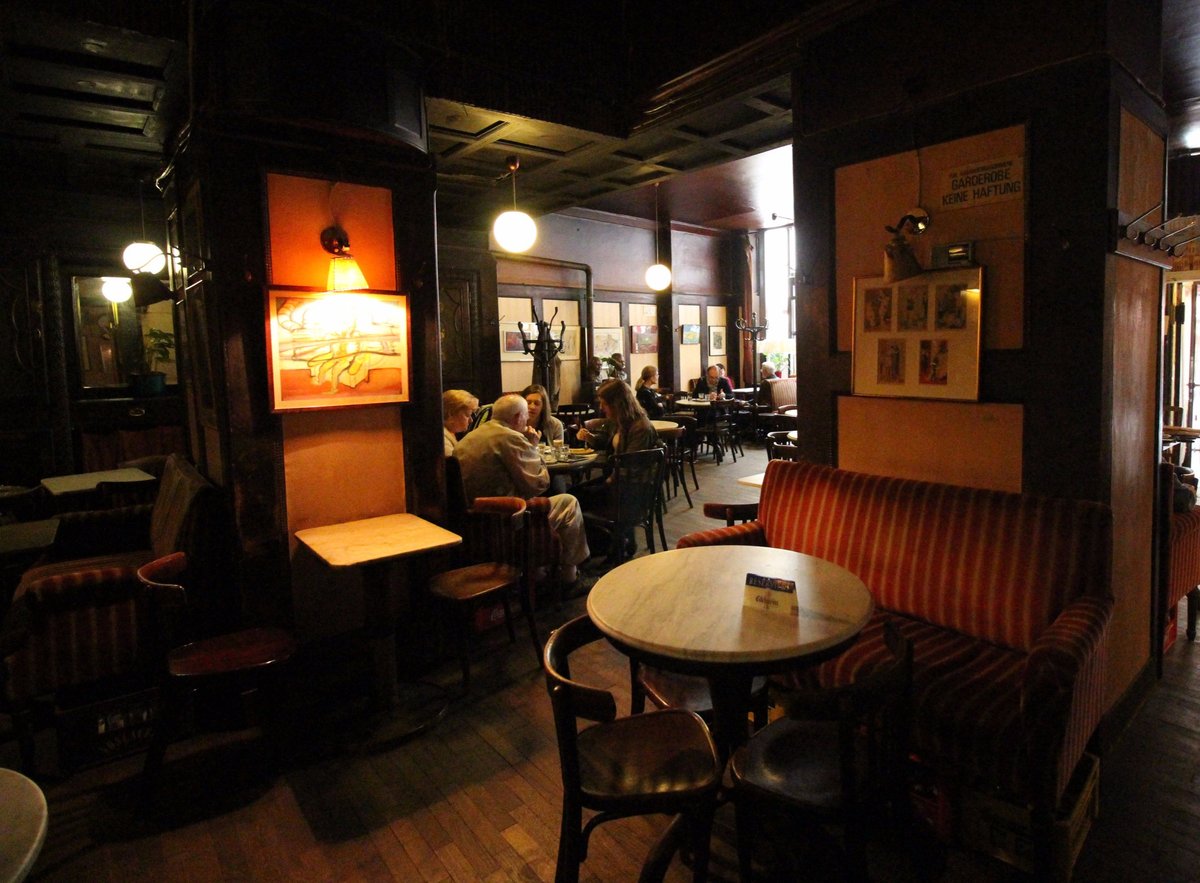
Germany
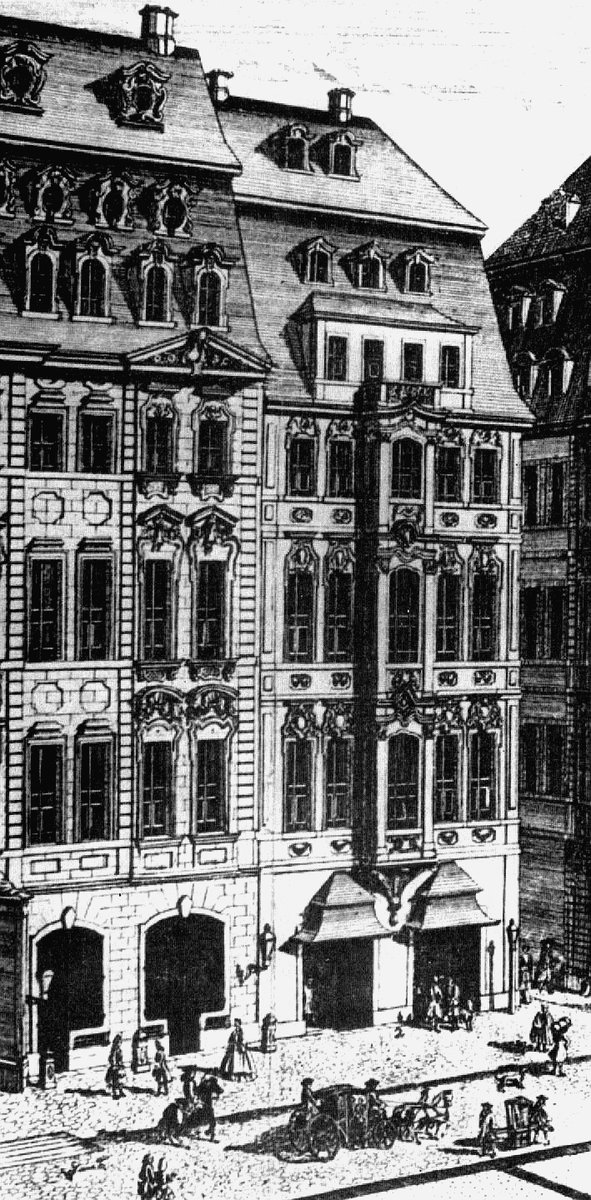
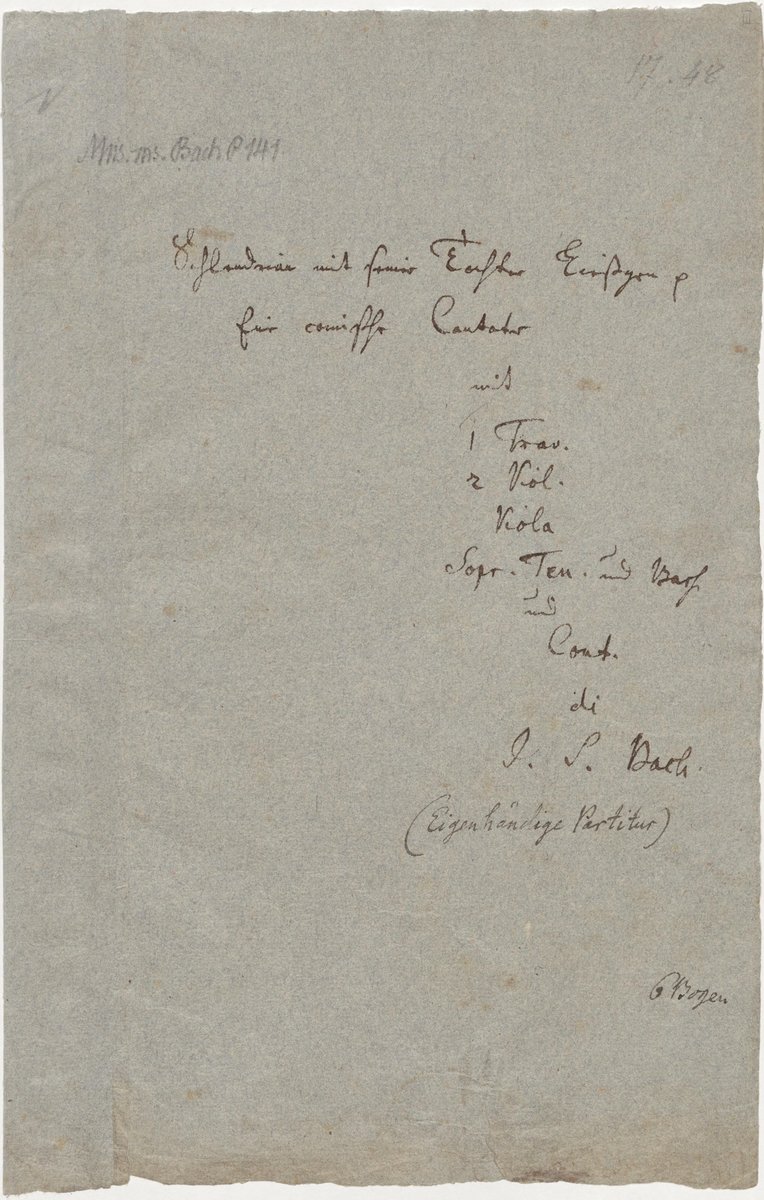
Bach’s Coffee Cantata. Schweigt stille, plaudert nicht (BWV 211) sets Picander’s comic text, printed in 1732, about a father who cannot stop his daughter drinking coffee. Bach set it around 1734 for his Collegium Musicum, which played weekly at Gottfried Zimmermann’s coffee house in Leipzig, in the coffee garden in summer (Library of Congress). The building was destroyed in an air raid in December 1943.
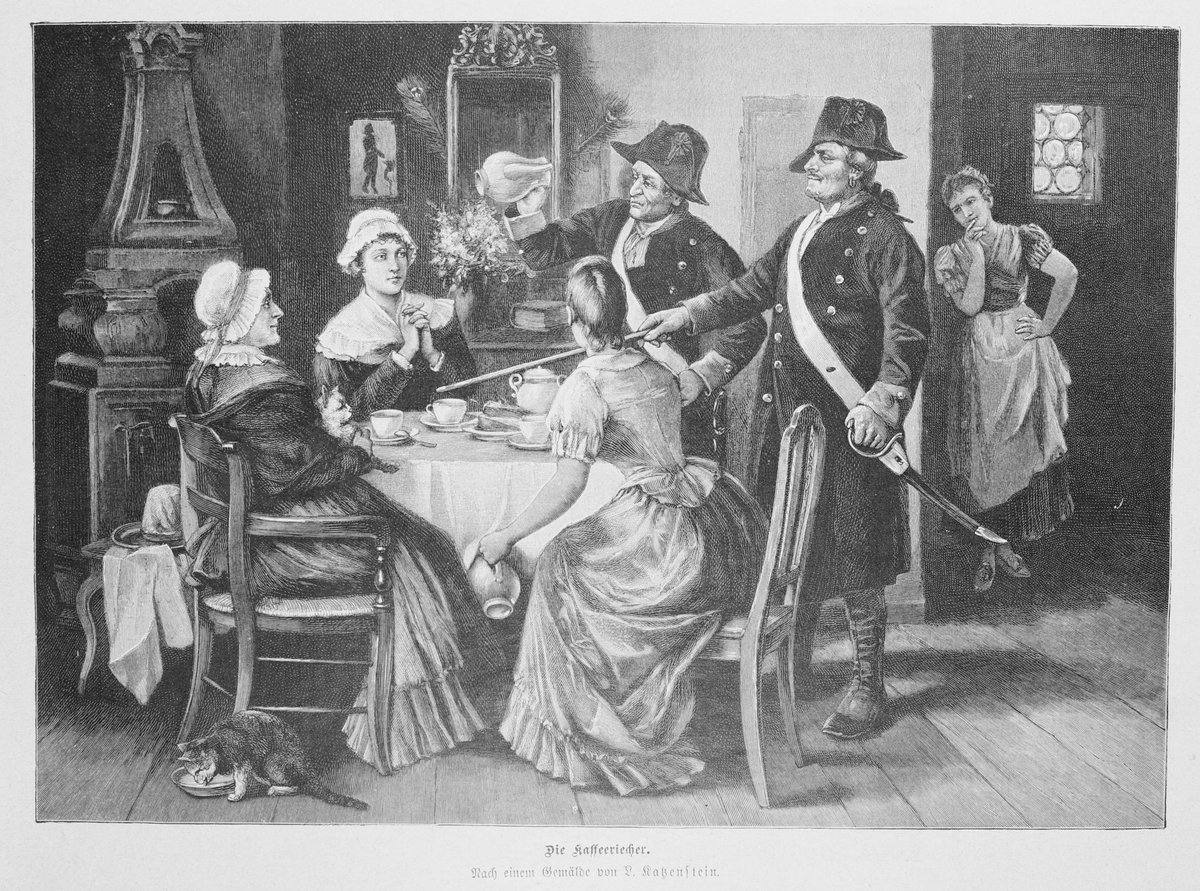
Frederick the Great. In 1781 Prussia made roasting a royal monopoly, licensed private roasting only for nobles, clergy and officers, and employed several hundred disabled veterans as Kaffeeriecher, “coffee sniffers”, to smell out illegal roasting (Mental Floss). The often-quoted 1777 declaration that “my people must drink beer” reaches English readers through William Ukers’s All About Coffee (1922); its original text has not been traced.
America
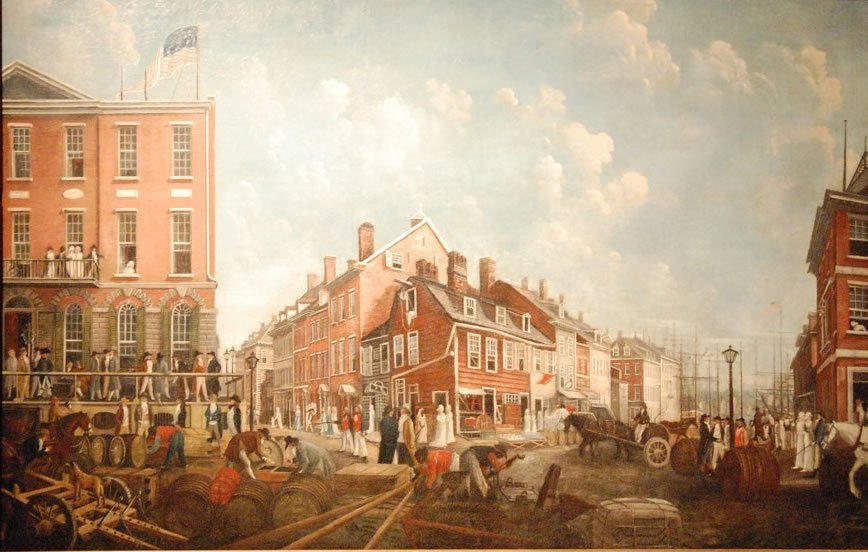
In New York the merchants met at coffeehouses on Wall Street. The non-importation agreement against the Stamp Act was signed at Burns’ Coffee House on 31 October 1765. The brokers who signed the Buttonwood Agreement on 17 May 1792 began trading in the new Tontine Coffee House at Wall and Water Streets, built in 1792–93, the start of what became the New York Stock Exchange (Buttonwood Agreement). Boston’s Green Dragon, the Sons of Liberty’s meeting place, was a tavern; no source calls it a coffeehouse. Why Americans switched from tea is on History.
The twentieth century, and Michigan
London’s Moka Bar at 29 Frith Street, Soho, opened in 1953 with a Gaggia machine, served over a thousand cups a day and started the city’s espresso-bar craze; it closed on 30 October 1972 (The Great Wen). The claim that Gina Lollobrigida opened it has no source. The second and third waves are on History.
In Detroit the Chessmate on Livernois began as a chess coffeehouse and had live music from 1963 until 1973; Joni Mitchell, who played there with Chuck Mitchell, called it “really a proving ground for me” (jonimitchell.com). No nineteenth-century Michigan coffeehouse is documented, but Michigan inventors patented thirteen home coffee roasters between 1867 and 1882, seven of them in Ypsilanti (Ann Arbor Chronicle, 2011).
Coffeehouse coffee
For most of this history a coffeehouse did not make anything like modern coffee. London houses boiled ground coffee in large pots over the fire and served it in small handleless dishes, as a drawing of about 1690–1700 in the British Museum shows (its “1668” inscription is false). An English household recipe of 1659–72 boils one spoonful of powder in a pint of water for a quarter of an hour (recipe). Vienna’s coffee houses developed a whole vocabulary of milk and cream: the Melange, coffee with hot milk and foam, and the Einspänner, strong black coffee in a glass under whipped cream.
What is not known
- What became of Khāʾir Beg after the 1511 ban.
- The date of the first coffeehouse in Cairo.
- Whether Murad IV’s 1633 decree carried a death penalty for coffee as distinct from tobacco.
- Jacob’s exact year in Oxford, 1650 or 1651, and whether Queen’s Lane is Jobson’s house.
- When Rosée’s handbill was first printed.
- When “penny university” first appeared in print, and who wrote the 1667 verse.
- Who wrote the Women’s Petition.
- Where the Buttonwood brokers signed, the Merchants’ or the Tontine.
- Venice’s first coffee shop: 1683 is the usual date, without a primary document.
- Whether Kolschitzky ever kept a coffee house at all.
- Frederick II’s 1777 declaration in its original German.
- The earliest coffeehouse in Michigan.
Sources
- Ralph S. Hattox, Coffee and Coffeehouses: The Origins of a Social Beverage in the Medieval Near East (1985); Brian Cowan, The Social Life of Coffee (2005); Markman Ellis, The Coffee-House: A Cultural History (2004).
- Medievalists.net, Brewing controversy (2025, after Reda Asaad Sharif in Darah); Encyclopaedia Britannica, 7th edition, Coffee (1842); ArabLit, Arabic literature and the politics of coffee.
- TDV İslâm Ansiklopedisi, Kahvehane; UNIMA, Karagöz; Wikipedia, Ottoman coffeehouse.
- Wikipedia: English coffeehouses in the 17th and 18th centuries, Pasqua Rosée, Jonathan’s Coffee-House, Garraway’s, Café Procope, Camille Desmoulins, Café Central, Café Hawelka, Buttonwood Agreement.
- Oxford Text Archive, The Vertue of the Coffee Drink; English Broadside Ballad Archive, News from the Coffee-House (1667); Wikisource, The Women’s Petition Against Coffee (1674).
- Lloyd’s, Coffee and commerce; Nature, Hooke and the coffee-houses (1935).
- London Gazette, proclamation for the suppression of coffee-houses (1675); Royal Philatelic Society London, London coffee houses display.
- Karl Teply, Kolschitzky, Neue Deutsche Biographie; Austrian Commission for UNESCO, Viennese coffee house culture.
- Library of Congress, Bach and the Coffee Cantata (2019); Mental Floss, When coffee was banned in Prussia.
- The Great Wen, The strange demise of London’s first espresso bar (2011); jonimitchell.com, the Chessmate; Laura Bien, As the coffee grinder turns, Ann Arbor Chronicle (2011).
Comments (0)