Origins, Regions & Climate
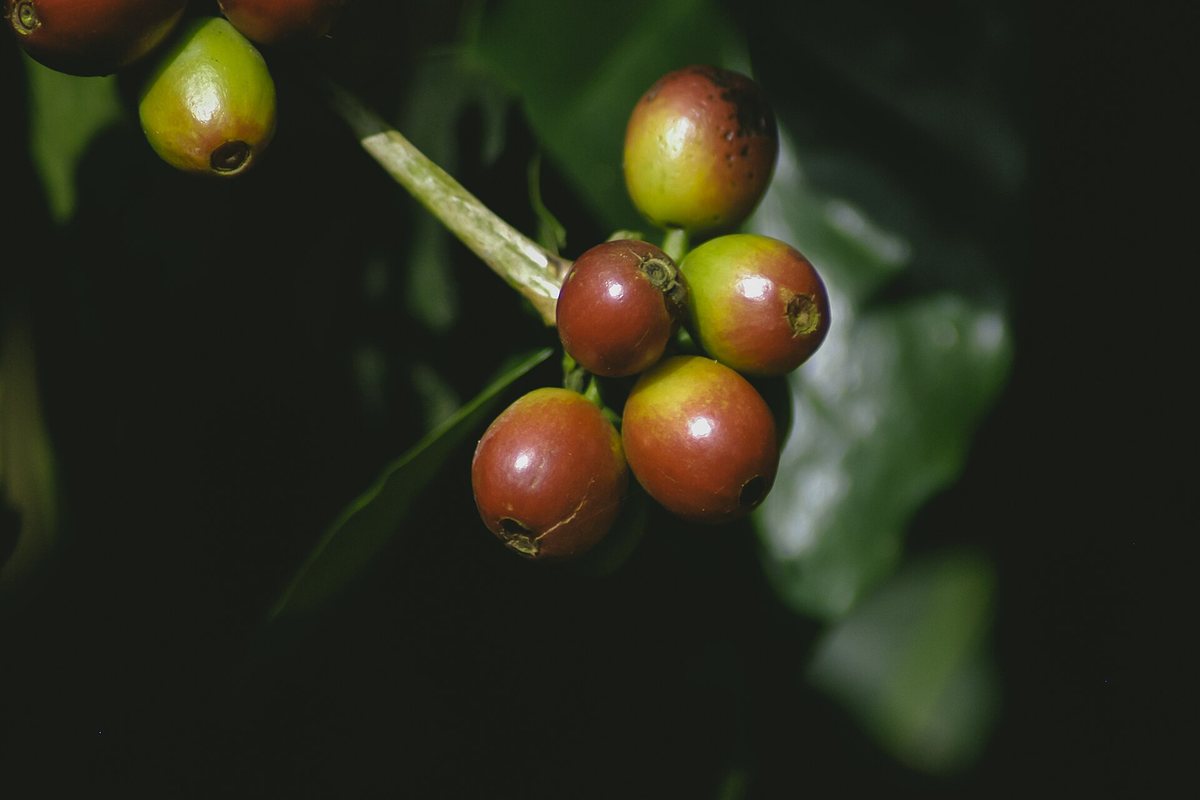
Coffee is an agricultural product before it’s anything else, and that’s the thing most people skip past. We argue about grinders and brew ratios — and those matter — but the ceiling on your cup was set a year earlier by a tree on a hillside between the Tropics: by how high that hillside was, how much rain fell on it, and whether whoever picked the cherry picked it ripe. Everything after is preservation or damage. So: where coffee comes from, and why a Kenyan bean and a Sumatran one taste like they came from different planets.
The Bean Belt
Draw a band around the globe from about 25°N to 25°S and you’ve drawn essentially every coffee farm on Earth. The Bean Belt isn’t marketing — it’s just where the plant’s requirements are met. Coffea is a tropical understory shrub that evolved in the forests of East Africa and never got over it.
- No frost. Ever. One frost burns the leaves and can kill young trees outright — Brazil’s periodic frosts have moved the world coffee price by themselves. Frost is why the belt has edges.
- Temperature. Arabica broadly wants a mean around 15–24°C (60–75°F); robusta takes more heat, roughly 22–30°C (72–86°F). Sources put those ranges a little differently depending on who’s measuring, so treat them as the agreed-on middle, not a spec. Push arabica above its band and it stresses, ripens too fast, and goes thin and flat in the cup.
- Rain — commonly quoted around 1,500–2,500 mm a year — but organized rain: a wet season and a distinct dry stretch.
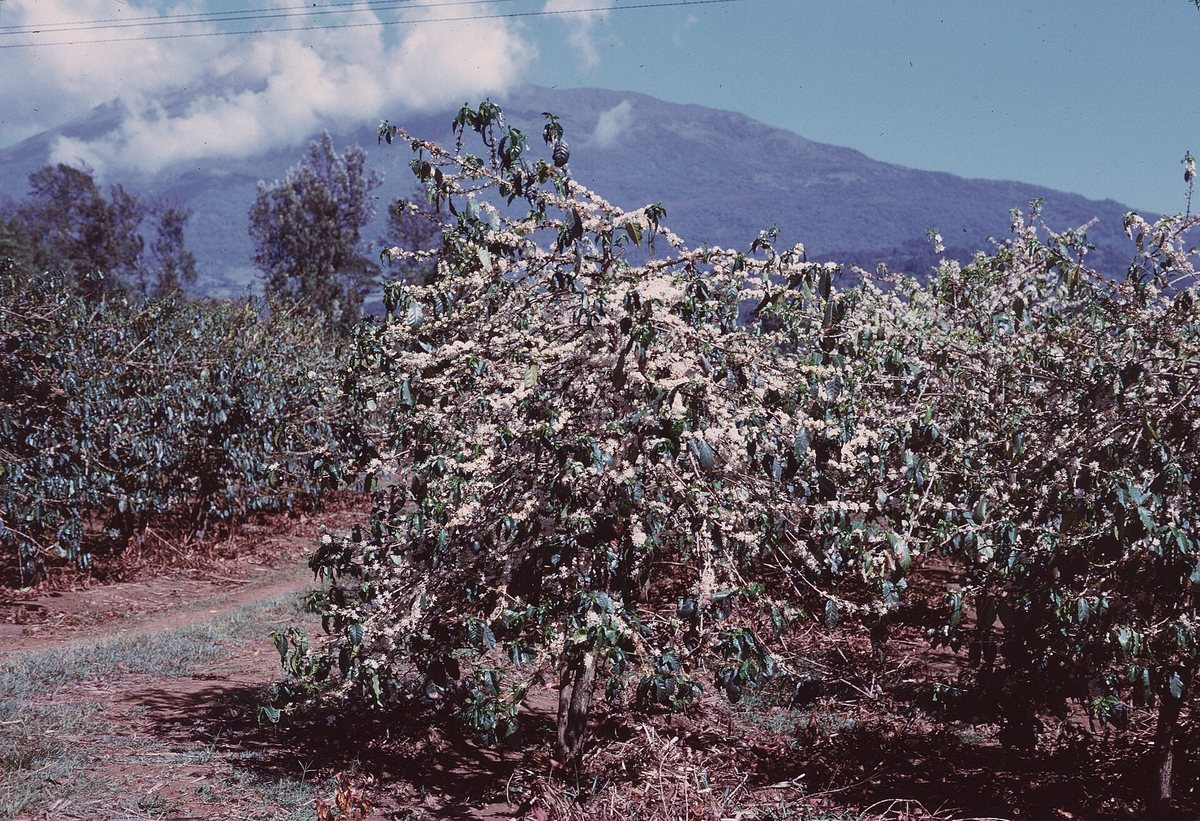
- A dry season that ends. The elegant part. Coffee holds its flowering until the dry spell breaks; the first serious rain triggers a synchronized bloom across the whole farm, white blossoms smelling like jasmine, and the cherries set and ripen together. Where rain dribbles year-round you get staggered flowering — several ripenesses on one branch — which is a picking nightmare and a quality problem, because underripe cherry in the lot tastes like underripe cherry in the cup.
Everything else — elevation, shade, volcanic soil — is refinement on top of those non-negotiables.
Altitude, and why it’s the biggest lever
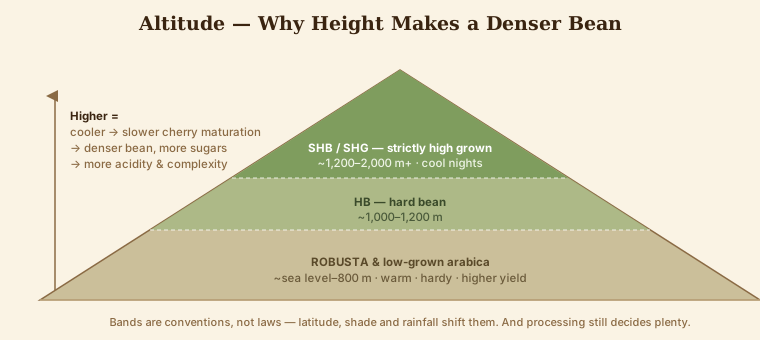
If you remember one agronomic fact about coffee, make it this: altitude buys you time.
Higher up it’s cooler, especially at night, so the cherry matures slowly. A slow cherry accumulates more sugars and organic acids and packs the seed tighter — a denser, harder bean with more dissolved-solids potential and more of the acidity and complexity specialty coffee is built on. Low-grown coffee ripens fast and comes out softer, rounder, nuttier, blunter. Neither is morally superior; they’re different tools. But the bright, layered, “wait, is that blackcurrant?” cup essentially only comes from altitude.
Which is why the American grading systems are literally elevation labels — SHB (Strictly Hard Bean, roughly above 1,350 m in Guatemala and Costa Rica), SHG (Strictly High Grown, same idea in Honduras, Mexico, Nicaragua), then HB and the lower tiers.
Note what those grades do and don’t tell you. They certify where the tree stood — a proxy for density, a proxy for potential. They don’t certify that anyone picked ripe, fermented carefully, dried evenly, or roasted well. An SHG bean handled sloppily is worse than a mid-altitude bean handled by someone who cares. The grade is a starting hand, not the pot.
There’s a ceiling too: too high and it’s too cold to ripen, or frost creeps in. Every origin has a band — and those bands are exactly what climate change is now moving.
Shade, sun, soil — and an honest word about terroir
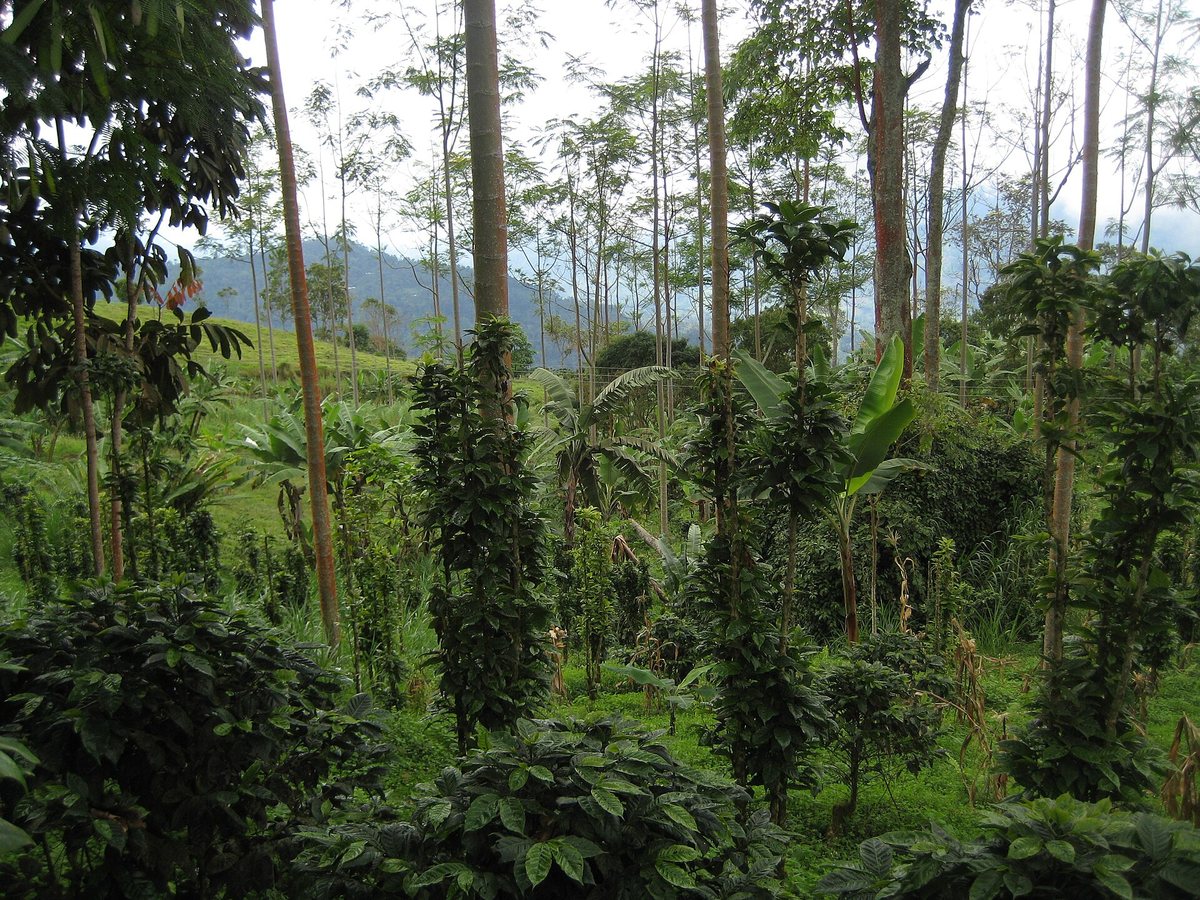
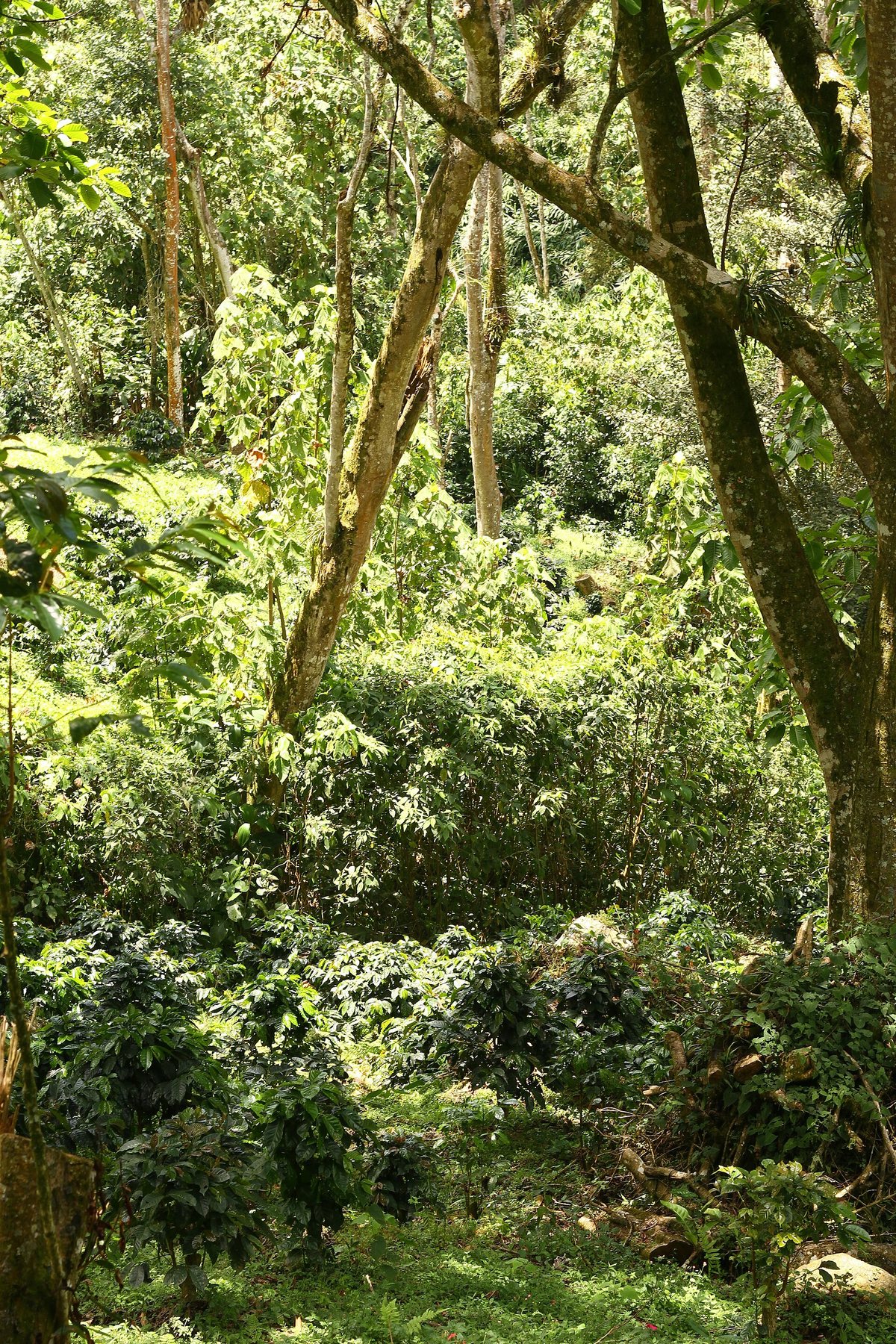
Shade vs. sun is the trade-off people romanticize most and understand least. Coffee evolved under a canopy, and growing it that way — under taller trees, often nitrogen-fixing legumes or fruit trees — buffers temperature, slows ripening (there’s the time lever again), cycles leaf litter into the soil, and supports serious biodiversity. Shade farms are famous habitat for migratory songbirds; that’s what “bird-friendly” certification is about.
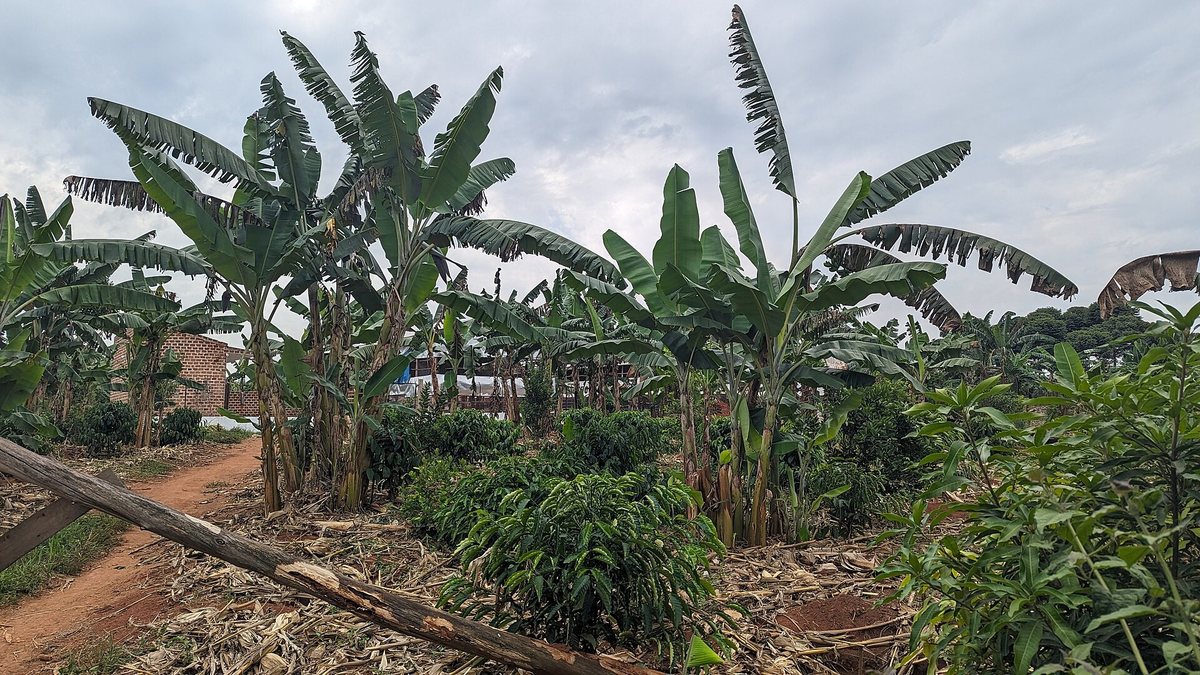
Then much of Latin America converted to full-sun plantings of compact, high-yielding cultivars. Honestly? It worked, on its own terms. Sun coffee yields more per hectare, sometimes dramatically — not nothing when you’re feeding a family on a commodity price you don’t control. The costs are real too: more fertilizer and agrochemicals, more erosion, faster soil exhaustion, less habitat, and generally a faster-ripened, less interesting cup. So the honest framing isn’t “shade good, sun bad.” It’s yield versus everything else, and which side a farmer can afford depends on what buyers will pay. If you want more shade coffee in the world, the mechanism is price, not scolding.
Soil gets a lot of billing — Antigua, the Kona slopes, Costa Rica’s Central Valley. Volcanic ground is genuinely good: deep, well-drained, mineral-rich, slightly acidic. Fair enough. But here’s where I slow the terroir talk down, and I say this as someone who takes provenance seriously everywhere else in my kitchen: the terroir story in coffee is real but routinely oversold. Origin sets a range. Within it, variety, processing and roast do at least as much work — often more. The same Ethiopian lot processed washed and processed natural lands in two different flavor universes, and no soil chemistry crosses that gap. When a bag tells you about mineral-rich volcanic slopes and says nothing about variety, process, or roast date, you’re reading poetry, not information.
The way I think about it: origin is the raw material, processing is the recipe, roast is the cook. I care about all three — in that order of romance, and the reverse order of how easily they’ll ruin your morning.
A tour of the regions
What follows are generalizations, and I want that word in bold. Every one of these origins produces coffee that breaks its own stereotype. Country-level profiles are a useful first approximation and a terrible final answer — use them like “California Cabernet”: a direction, not a promise.
Africa
Ethiopia is the birthplace, full stop — the wild origin of Coffea arabica, with a genetic diversity nothing else touches. “Heirloom” on a bag is shorthand admitting there are thousands of local landraces nobody has fully catalogued. Yirgacheffe is the poster child: washed, it’s floral, citrus-and-bergamot, tea-like, almost perfumed — the coffee that converts people. Sidamo covers similar ground, often fuller and berry-leaning. Harrar is traditionally dry-processed, wilder, blueberry and winey.
That washed/natural split is the whole ballgame. Washed strips the fruit off before drying and gives clarity, florals, clean acidity. Natural dries the cherry whole around the seed and the fruit bleeds in — big berry, jammy, sometimes boozy, and done badly, funky in ways you didn’t want. Ethiopian naturals done well are among the most spectacular coffees there are.
Kenya is my pick for the most distinctive cup in the world, and it isn’t close. The signature is blackcurrant — savory-sweet, almost tomato-adjacent — riding a searing, structured acidity. Much of that traces to the SL28 and SL34 varieties selected at Scott Laboratories in the 1930s, plus altitude and unusually rigorous processing. Kenya runs a weekly auction in Nairobi where lots are cupped, graded (AA, AB — those are screen sizes, i.e. bean size, not quality, though they correlate loosely) and bid on. It draws plenty of criticism about how much price gets back to the farmer, and a direct-trade channel runs alongside it. Both things are true: it’s real price discovery, and transparency at the auction isn’t equity at the farm.
Rwanda and Burundi are the quiet stars — mostly Bourbon, mostly washed, smallholders delivering cherry to shared washing stations. At their best: clean, elegant, silky, red fruit and florals, sitting between Ethiopian delicacy and Kenyan structure. Both built their specialty sectors recently and under hard circumstances, which is worth knowing while you drink them. Uganda is the other side of the coin — a major producer, big in robusta, which grows there natively. Mostly a commodity story, and it matters enormously to the volume the world actually drinks.
The Americas
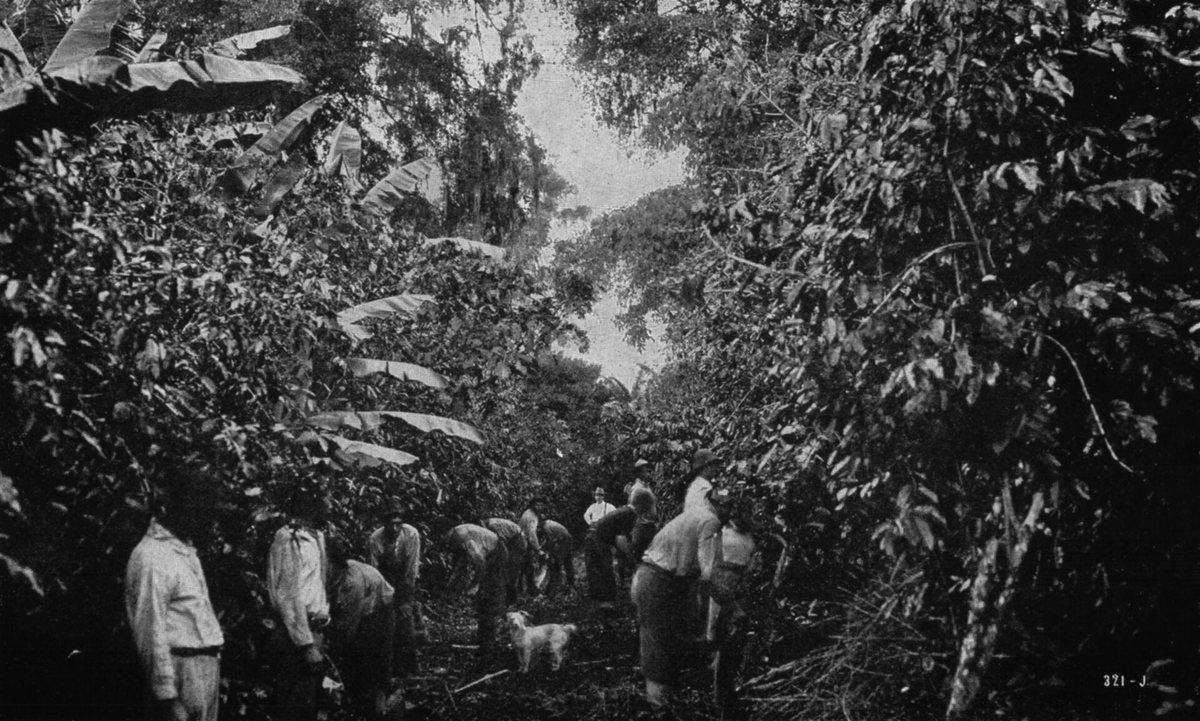
Colombia is the balanced one — the coffee that made “smooth” a category. Medium-bodied, caramel-sweet, cleanly acidic, remarkably consistent across that much mountain. It’s also the origin that branded itself: the Federación Nacional de Cafeteros, a grower-owned federation founded in 1927, invented Juan Valdez and his mule in the late 1950s to sell Colombian coffee as a named thing rather than an anonymous input. It worked so well that most Americans could name exactly one coffee country for forty years. Whatever you think of the marketing, the research behind it — including the rust-resistant varieties that saved a lot of farms — is serious.
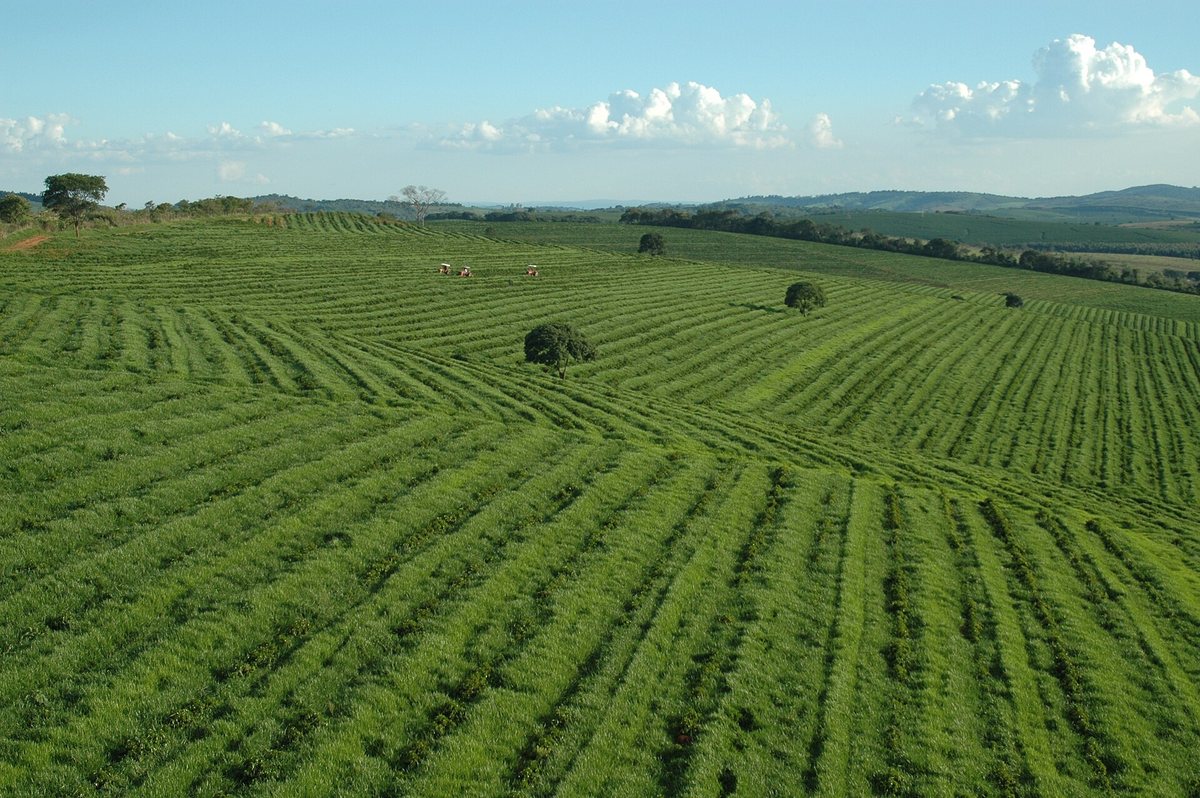
Brazil is the giant, the largest producer for well over a century and not by a little. The profile follows the geography: much of it grows at low elevation on forgiving terrain, much of it mechanically harvested, much of it natural or pulped-natural in a reliably dry climate. Result: low-acid, nutty, chocolatey, heavy-bodied. That sounds like faint praise until you notice it’s exactly what you want at the base of an espresso blend — body, sweetness, chocolate, crema, no sharp edges to fight the milk. Half the espresso you’ve loved stood on Brazilian shoulders.
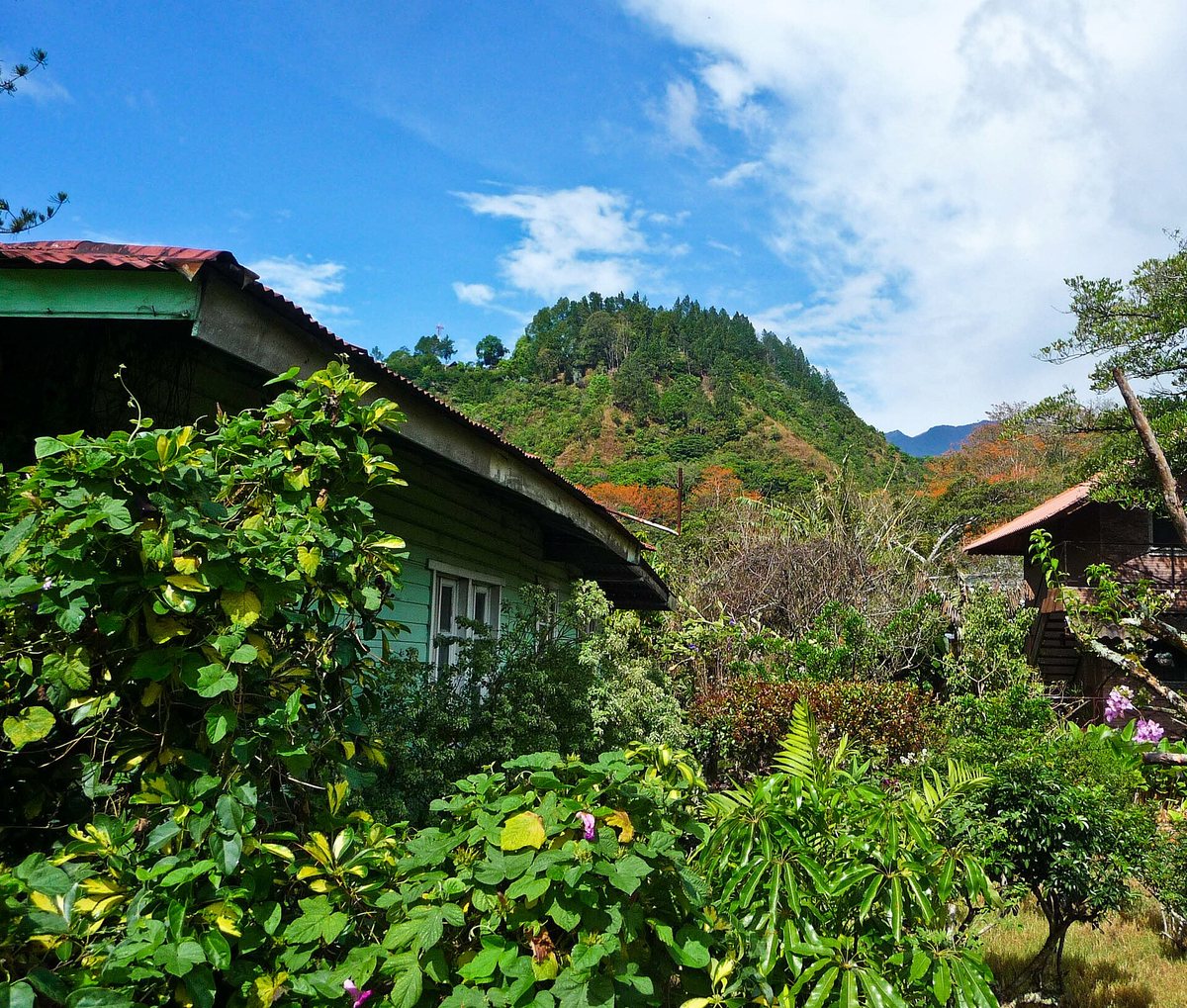
Costa Rica and Panama. Costa Rica banned robusta planting for decades in a deliberate bet on quality, and it’s the home of honey process — skin off, some sticky mucilage left on during drying (white/yellow/red/black honey, roughly by how much stays and how long it dries). Honey lands between washed clarity and natural fruit: sweet, syrupy, round. Panama delivered specialty’s biggest shock when Hacienda La Esmeralda put Gesha (from Ethiopian material) on the auction block in the mid-2000s — a jasmine-and-bergamot cup so unlike anything else it reset expectations and launched two decades of record prices, hundreds of dollars a pound and recently well over a thousand. Worth it? At that level you’re buying a trophy in a scarce market, not a beverage. It’s also one of the most extraordinary things I’ve ever tasted.
Guatemala is volcanic-slope coffee, and Antigua — a high valley ringed by volcanoes — is the famous name: full-bodied, cocoa-and-spice, fine acidity, and a smoky depth that has nothing to do with the roast. Huehuetenango, Atitlán and Cobán each have their own character, which makes Guatemala a good place to learn that regional names inside a country mean more than the country name does. Honduras is now one of Central America’s biggest producers and has climbed hard on quality — mostly smallholder SHG, and where a careful buyer finds value. Mexico — Chiapas, Oaxaca, Veracruz — leans gentle, nutty and mild, a stronghold of organic and shade cultivation, and underrated.
Jamaica Blue Mountain and Hawaii Kona get a paragraph because somebody has to say it. Both grow genuinely good coffee in genuinely good conditions. Both are also priced far beyond what the cup justifies, on scarcity, tourism, and eighty years of reputation. And both have long-running blending and fraud problems: “Blue Mountain blend” or “Kona blend” has historically meant a token percentage of the real thing padded with cheap coffee, and Hawaii has seen actual litigation over falsely labeled Kona. If you’re paying Kona money, buy 100%, from a named farm. Plenty of $22 Guatemalan will beat it blind.
Asia and the Pacific
Sumatra produces the most polarizing coffee in the world, and the reason is a process, not a place. It’s typically wet-hulled — giling basah — and the mechanism matters. Normally a bean dries slowly to about 10–12% moisture inside its protective parchment, and only then gets hulled. In wet-hulling, smallholders pulp, ferment briefly, and hull the parchment off while the bean is still soft and wet — somewhere around 30–50% moisture — then finish drying it naked. It’s an adaptation to a climate that’s humid essentially always, and to farmers who need cash faster than a week of patio drying allows.
The consequences are direct: the bean spends time exposed and vulnerable at high moisture, takes on a blue-green cast and a swollen look, and that extended damp phase drives the reactions that strip acidity and build earthiness. Hence the cup — earthy, herbal, cedar-and-tobacco, mushroom, low-acid, syrup-bodied. That profile is a processing artifact, not a soil one. People who love Sumatra love it hard; people who don’t call it dirty; both describe the same thing.
Java is the historic one — Dutch colonial estates, and half of “mocha java,” the oldest blend name in the trade; estate Java is often washed and cleaner than its Sumatran neighbors, with a firm body. Sulawesi (Toraja) sits between: some wet-hulled earthiness, but more clarity and spice.
Vietnam is the story people miss. In a single generation — since the Đổi Mới reforms of the late 1980s — Vietnam went from marginal to the world’s second-largest producer, almost entirely on robusta, mostly around Buôn Ma Thuột in the Central Highlands. That one fact quietly shapes the global market: Vietnam is why instant coffee and cheap blends cost what they cost.
It also shapes the cup, which is where I met it. In Vietnam I drank cà phê sữa đá every morning — dark, coarse robusta packed into a little metal phin balanced on the glass, hot water dripping through far too slowly while you sit there, sweetened condensed milk waiting underneath, then stirred and poured over ice. That drink is a consequence of the agriculture. Robusta is aggressive, bitter, roughly twice the caffeine of arabica, heavy-bodied — so you roast it dark, brew it brutally concentrated in the phin, and answer it with condensed milk, the shelf-stable dairy a colonial supply chain actually delivered to a tropical country. Bitter, sweet, cold, strong: nothing about it is an accident, and it’s one of the best coffee drinks on earth. The specialty world’s long sneer at robusta always looked silly from a plastic stool in Buôn Ma Thuột. What the condensed milk is doing in there is over on additions.
India grows both species in the Western Ghats, much of it shade-grown under pepper and cardamom — exactly as good an idea as it sounds. Its signature oddity is monsooned Malabar: green beans deliberately exposed to humid monsoon winds in open-sided warehouses for weeks, swelling and bleaching pale gold. It started as an accident — beans arriving in Europe after months in a damp ship’s hold had transformed, the trade liked it, and India reproduced it on purpose once faster shipping “fixed” the problem. Nearly acid-free, thick, musty-sweet, unlike anything else.
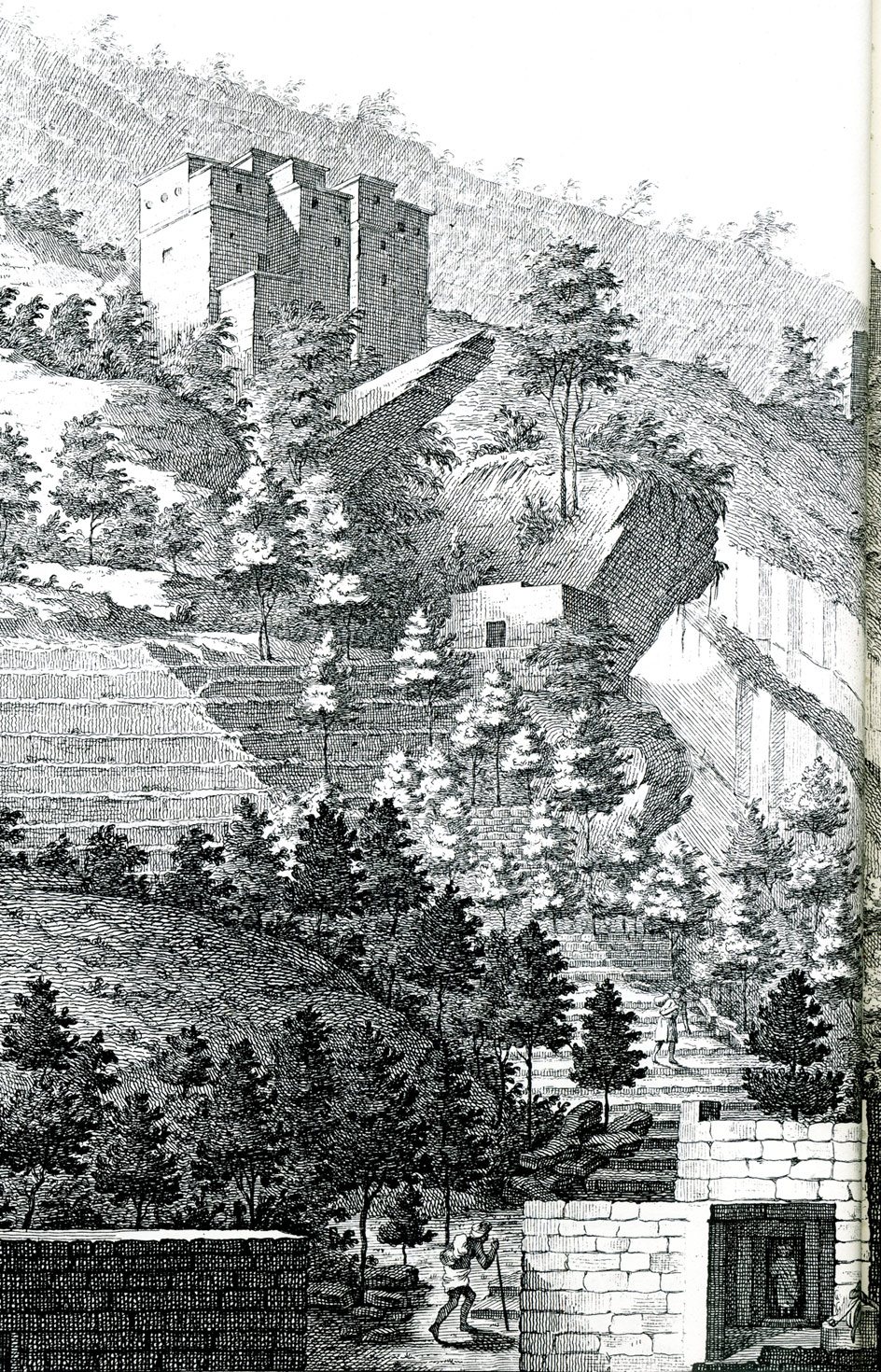
Papua New Guinea grows mostly Typica-descended arabica in highland “garden” plots — clean, sweet, fruit-forward, underappreciated. Yemen is the historical hinge: the port of Mokha is why we say “mocha,” and it’s where coffee was first commercially cultivated after leaving Ethiopia. Still grown on ancient terraces, dry-processed — wild, winey, spiced, utterly distinctive, and expensive and inconsistent for reasons that have nothing to do with farming. The full arc is on history.
Climate change, honestly
This is the part I’d rather not write, and it belongs here anyway.
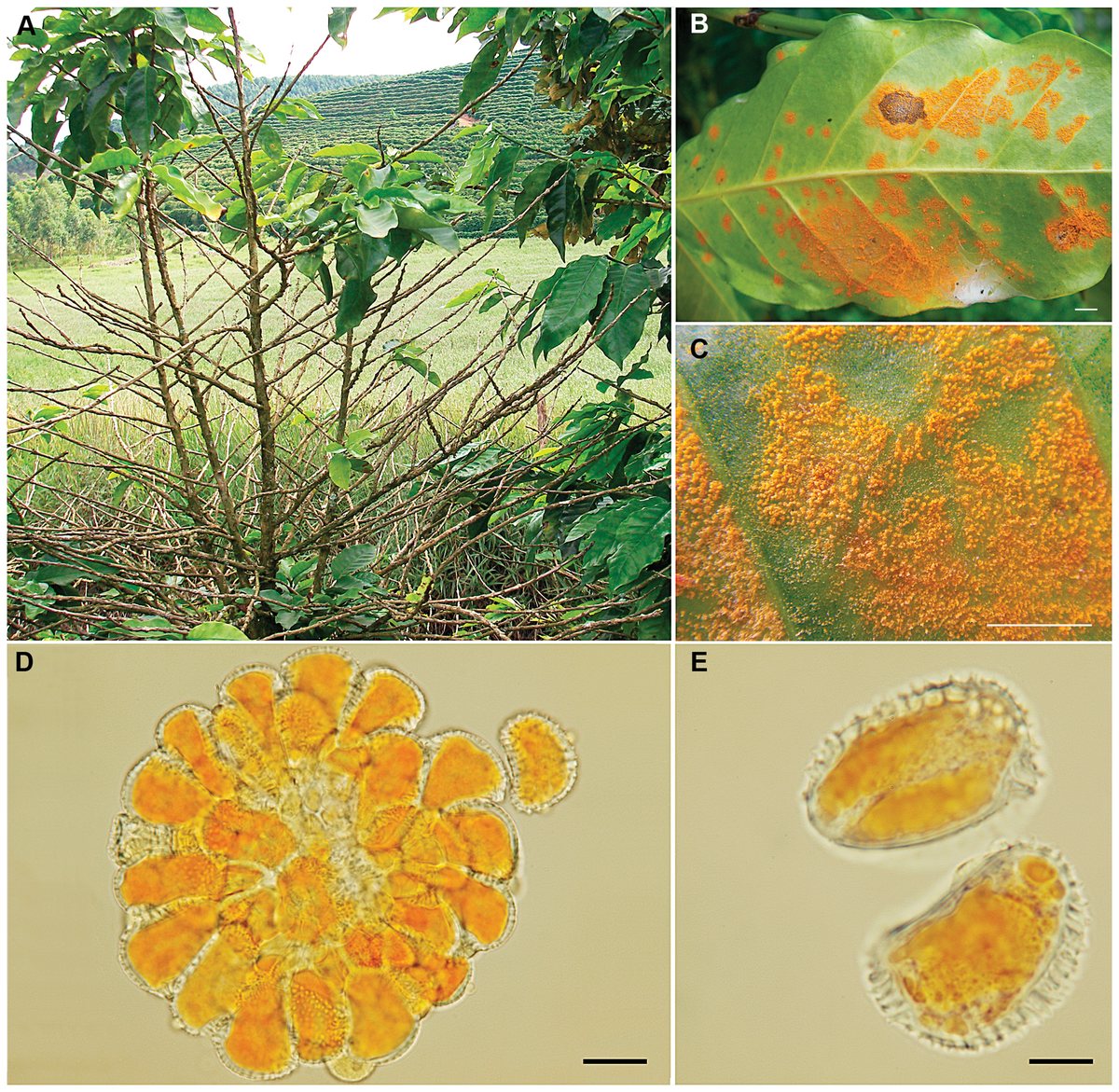
Leaf rust (la roya, Hemileia vastatrix) is a fungus that’s been chewing arabica for a century and a half — it’s what destroyed Ceylon’s coffee industry in the 1800s and turned Sri Lanka into a tea country. The Central American epidemic that began around 2012 gutted harvests across the region and put a lot of people off their land. Rust does better warm and wet, and it’s now reaching altitudes that used to be safe.
That’s the shape of the problem: the bands are moving up. Arabica’s window is narrow, and as the low end of a region warms past it, the viable zone climbs the mountain — except mountains have summits, and the land higher up is often forest, park, or somebody else’s. Published projections have suggested a large share of today’s arabica land could become unsuitable by mid-century, commonly landing near the “roughly half” mark — but that depends heavily on which model and emissions pathway you pick, and I’d treat any single confident figure with suspicion. The direction isn’t in dispute; the magnitude is. Add erratic rainfall — which scrambles the flowering trigger — and the coffee berry borer moving upslope, and the plant is under real squeeze.
What’s being done: breeding (rust-resistant hybrids and F1 crosses — Castillo, the Sarchimor and Catimor families, Centroamericano — trading some cup quality for survival; the gap has narrowed, and older Catimors earned a bad reputation newer material doesn’t fully deserve); rethinking robusta (heat-tolerant, rust-resistant, and now getting a genuine re-appraisal — “fine robusta” grading exists, and Vietnam and Brazil were ahead of everyone); other species (liberica, and especially stenophylla, a West African species rediscovered in the wild in 2018 that reportedly cups like arabica while tolerating markedly warmer conditions — early days, promising); and agroforestry, which is to say shade, again. Canopy cools the understory by several degrees. The old way turns out to be an adaptation strategy.
How I’d actually shop for beans
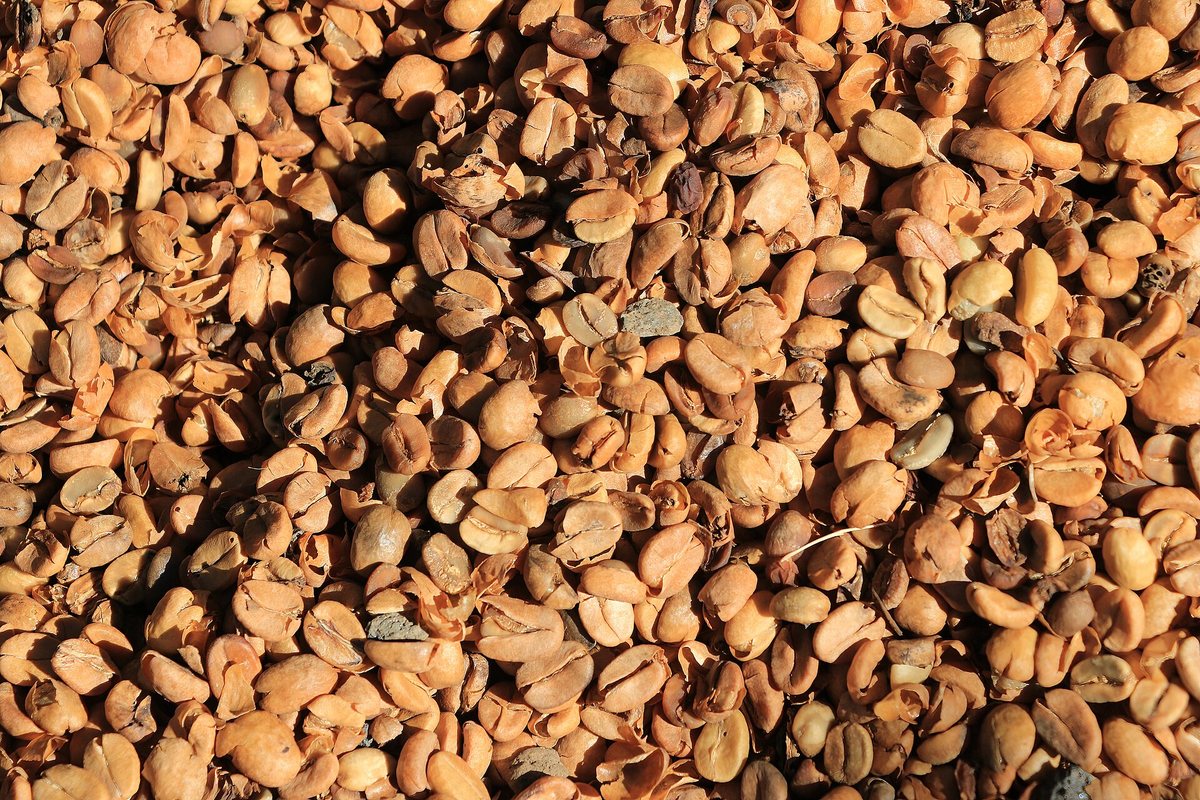
Here’s what I do at the shelf, and it’s shorter than you’d expect:
- Look for a roast date, not a “best by” date. No roast date means they don’t want you to know. Put it down. This one rule eliminates most bad coffee purchases.
- Buy whole bean. Non-negotiable — grind matters more than origin does, and pre-ground is stale before you open it. See brewing.
- Read for specifics. Country, region, farm or co-op, variety, process, altitude. A bag saying “Ethiopia, Yirgacheffe, Kochere, heirloom, washed, 1,900 m” is from someone who knows what they bought. “Mountain Grown Arabica” is from someone who doesn’t want to tell you.
- Pick by process as much as by country. Bright and floral → washed Africans. Fruit bomb → naturals. Earthy and low-acid → wet-hulled Indonesia. Process is more predictive than the flag.
- Match origin to brewer. Light, high-grown, washed single origins for pour-over. Brazil-based blends for espresso. Sumatra and dark blends for the styles built for punch and milk.
- Buy small and buy often. Two weeks’ worth. Coffee is produce, not pantry.
- Find one roaster you trust and let them teach you. Their seasonal list is a free education in what’s arriving when — because these are crops, with harvest seasons, and “fresh crop” is real.
Point all of this next at what happens after the bean leaves the farm. Green coffee is hard and grassy and tastes like nothing; every flavor above is potential until somebody applies heat to it correctly. That’s roasting — the same browning chemistry I chase in a bread crust and a brisket bark — and when you’re ready to do it yourself, it’s in roasting your own on the gear from roasters. Sideways instead: the long strange trip on history, or the bean-level detail on beans. And for how a shop sources this at volume, the coffee program has the business end.
Comments (0)