Coffee · 57 of 64
The Milk Drinks: Latte, Cappuccino, Flat White, Cortado and Macchiato
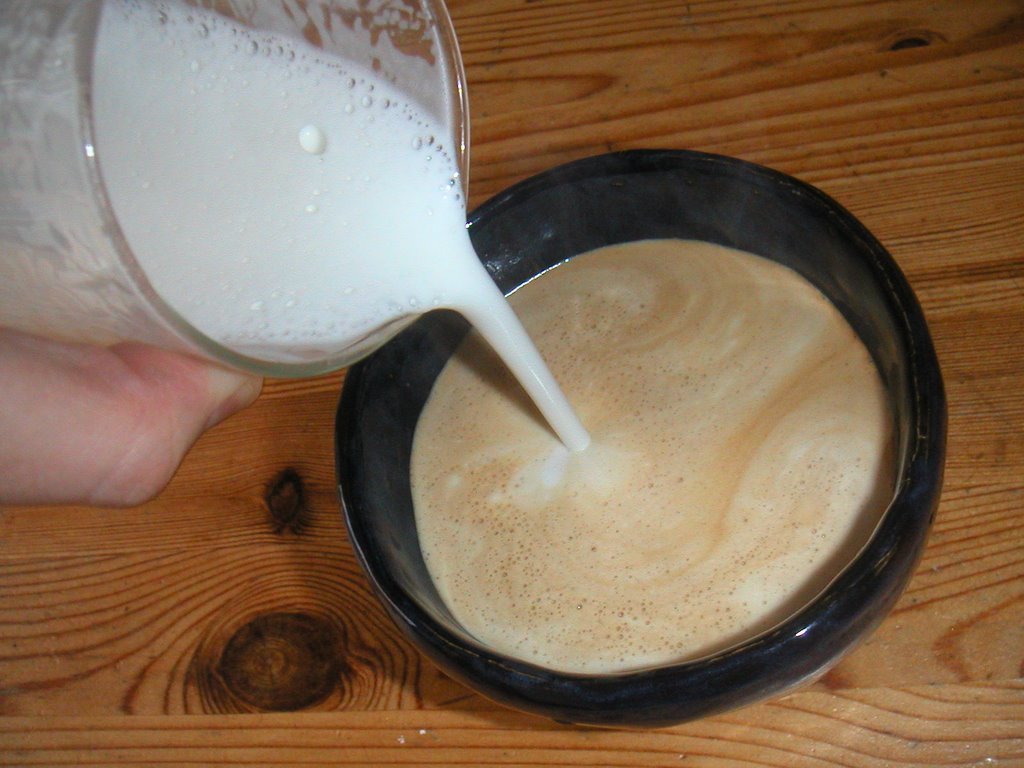
Five drinks share one recipe: a shot of espresso and milk heated with steam. What separates them is the size of the cup, the share of milk, and the depth of foam on top, and the names mean different things in Milan, Madrid, Melbourne and a Starbucks. Below is what each one is, with the numbers, where each name came from, why milk foams and when it stops foaming, and how to make something close to each without a steam wand or an espresso machine. The last section asks which of them fit a market stall. How espresso itself is pulled is on Espresso, and what milk does to coffee’s taste is on What People Put In It.
The short version
| Question | Answer |
|---|---|
| What separates the five? | Cup size, milk-to-coffee ratio and foam depth. The shot is the same. |
| Smallest to largest | Macchiato (about 40 ml) → cortado (about 120 ml) → cappuccino (150–180 ml) → flat white (about 175–200 ml) → latte (230 ml in Italy, 355 ml or more in a US “tall”) |
| Most foam | Cappuccino: at least 1 cm by the World Barista Championship’s rule |
| Least foam | Cortado and flat white: a thin layer of fine microfoam |
| ”Macchiato” at Starbucks? | A caramel macchiato is a vanilla latte with the espresso poured on last. An Italian macchiato is a shot with a spoonful of foam. |
| Hottest the milk should get | 55–65 °C (130–150 °F); never past 70 °C (160 °F) (Additions) |
| Without a steam wand | Heat the milk, then froth it: a French press pumped like a plunger frother, a battery whisk, or a shaken jar heated in the microwave |
| Without an espresso machine | A moka pot or a strong AeroPress makes a concentrate that stands in for the shot. It is not espresso, and the drink should not be sold as one. |
| At a market stall | Iced versions with cold milk need no heat at all; hot ones need milk kept at 41 °F or below and a way to heat it (The Michigan Rules) |
The five drinks, side by side
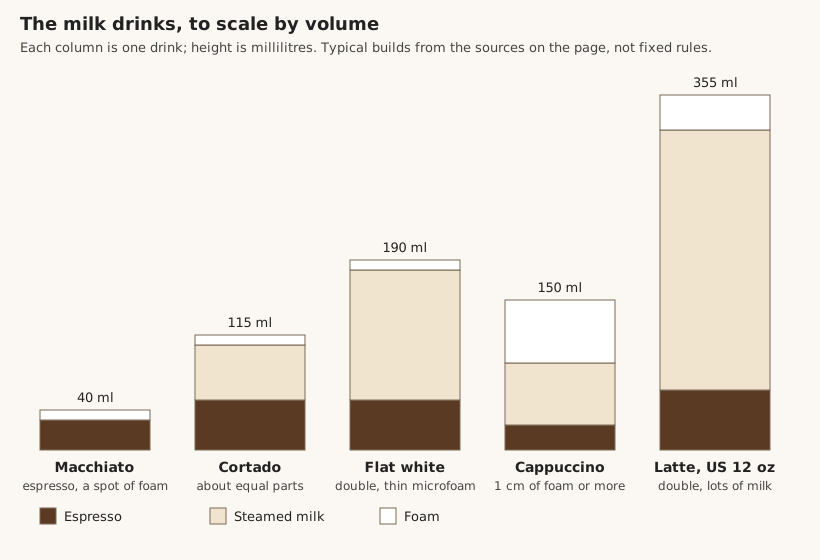
| Drink | Coffee | Milk | Foam | Cup | Where the name is from |
|---|---|---|---|---|---|
| Caffè macchiato | One shot, about 25–30 ml | 5–10 g, a teaspoon or two | The milk is mostly foam | Espresso cup, 60–90 ml | Italian macchiato, “stained” or “marked” |
| Cortado | One or two shots | About equal to the coffee, warm, not frothed | Little or none | Small glass, 120–135 ml | Spanish cortar, “to cut” |
| Flat white | Double, about 50 ml | About 130 ml | About 5 mm of microfoam | Cup of 175–200 ml | Australia or New Zealand, 1980s (disputed) |
| Cappuccino | One shot, about 25 ml | Equal parts milk and foam fill the cup | 1 cm or more | Cup of 150–180 ml, with a handle | The brown habits of the Capuchin friars |
| Latte | One or two shots | Most of the drink | About 1 cm, thin | Glass or cup, 230–300 ml in Italy; 12–20 oz in the US | Italian caffè e latte, “coffee and milk” |
| Latte macchiato | One shot, poured in last | A glass of steamed milk | A cap of foam | Tall glass | Milk “stained” by the coffee |
The figures come from three places that agree closely: the World Barista Championship’s rules for a cappuccino, Anette Moldvaer’s Coffee Obsession (DK, 2014) for the flat white and the macchiato, and Tourism New Zealand for the flat white’s cup. Cafés vary all of them. A cortado in Barcelona and one in Brooklyn can differ by a whole shot.
Ratio, in plain terms. By liquid volume the macchiato is nearly all coffee, the cortado about half, the flat white about a quarter, the cappuccino about a sixth by volume but with a third of its height in foam, and a 12 oz American latte about a sixth or less. Strength in the mouth follows that order: the flat white tastes of coffee because a double shot goes into a small cup, not because anything different is in it.
Cappuccino
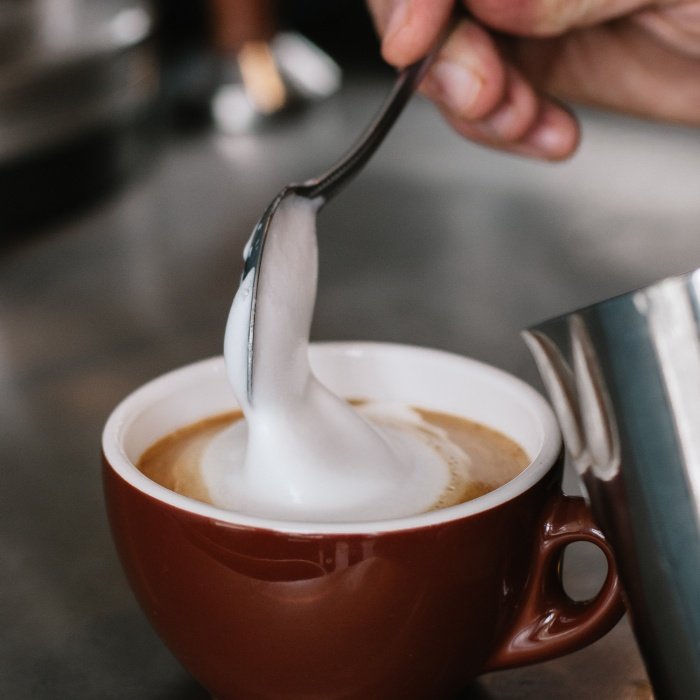
What it is. One shot of espresso in a cup of 150 to 180 ml, the rest filled with steamed milk and foam in about equal parts. The World Barista Championship rules define it as a single shot, “textured milk and foam,” “a minimum of 1 centimeter of foam depth,” and “a beverage between 150 ml and 180 ml in total volume.” In Italy the shot is about 25 ml. The often-quoted rule of thirds (a third espresso, a third milk, a third foam) describes how the drink looks in a small cup; by volume a 25 ml shot in a 150 ml cup is about a sixth. Chocolate dusted on top is usual in Australia, Argentina and Brazil; cinnamon is the American habit.
The name. It is the colour, not the hood. In the Habsburg cafés of the late 1700s a Kapuziner was black coffee with a few drops of cream, the same brown as the habits of the Capuchin friars, and a Franziskaner had more cream and was the lighter brown of the Franciscans. The drink and its name reached northern Italy through the Austrian-ruled cities, Trieste above all, and Italian writing of the 19th century describes cappuccino as “black coffee with a few drops of milk or cream which give it the color the tunic of the Capuchins.” The cap of steamed foam came later, with the espresso machine in the 20th century.
A correction. The story that the drink was named after the Capuchin friar Marco d’Aviano, who rallied the army at the siege of Vienna in 1683, is a legend with no evidence behind it. The colour explanation is the documented one.
In America. New York’s Caffe Reggio, open since 1927, claims to have brought the cappuccino to the United States, and San Francisco’s Caffe Trieste (1956) claims the West Coast. The drink spread nationally with the coffee boom of the 1990s, and grew: chains sell 12 to 20 oz “cappuccinos” that hold two or three times the cup the WBC allows. In Italy it is a breakfast drink, and ordering one after lunch is a well-known tourist tell; that is custom, not law.
Flat white
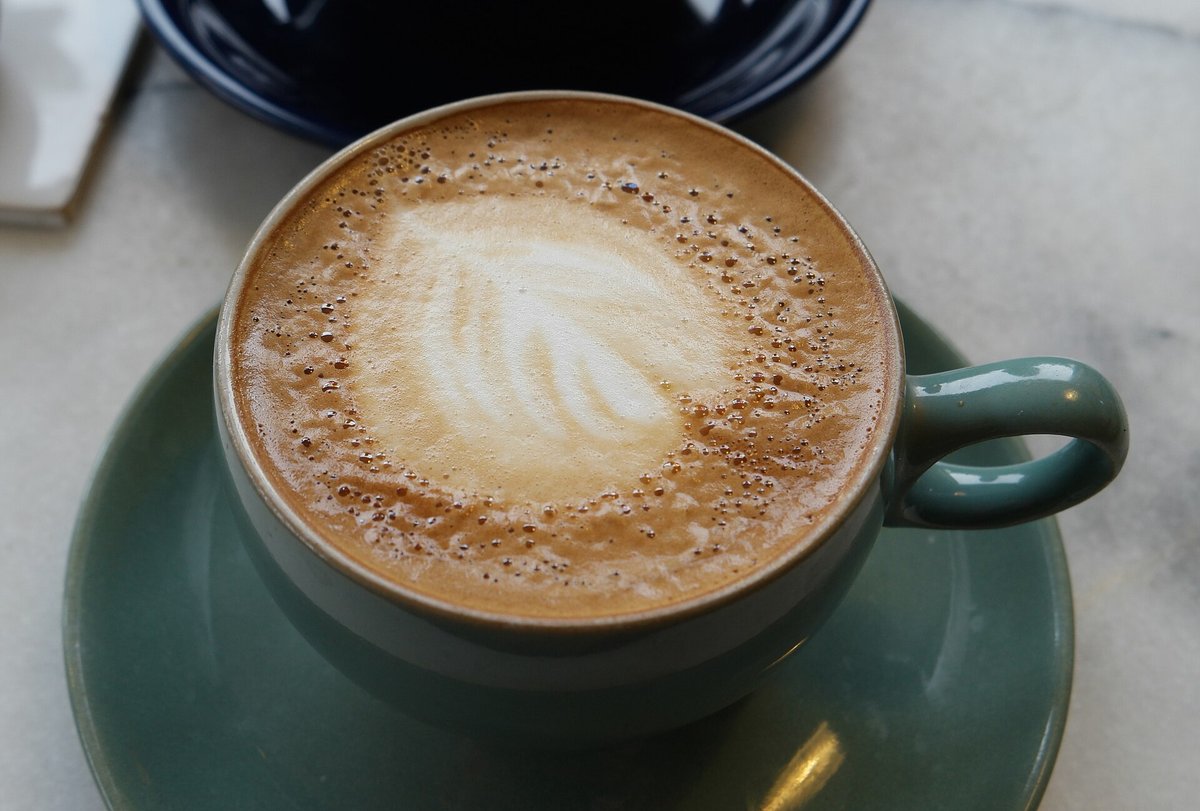
What it is. A double shot in a small cup topped with steamed milk that holds only fine microfoam, so the surface is “flat.” Moldvaer gives a double espresso of about 50 ml, about 130 ml of milk and a 5 mm layer of microfoam. Tourism New Zealand puts it in a cup of about 175 ml against about 225 ml for a latte, so the same shot in less milk tastes stronger. Against a latte the difference is the cup and the depth of foam; against a cappuccino it is the foam’s texture and depth.
Where it came from: a dispute nobody has settled. Both countries claim it, and the record supports parts of each story:
| Year | Claim | Place |
|---|---|---|
| 1963 | A character orders a “flat white” in an espresso bar in the British film Danger by My Side | England |
| 1971 | The term appears in print | England |
| 1983 | A review of the café Miller’s Treat mentions its “flat white coffee” | Sydney |
| January 1985 | The Parliament House cafeteria posts “flat white only” while seasonal milk will not froth | Canberra |
| 1985 | Alan Preston puts it on the permanent menu at Moors Espresso Bar, saying he brought it from far north Queensland | Sydney |
| mid-1980s | Café DKD’s founders say they learned the name from a friend who worked in Sydney | Auckland |
| 1989 | A “failed cappuccino” at Bar Bodega on Willis Street | Wellington |
The coffee historian Ian Bersten thought it probably began in England in the 1950s. What is certain is that Australian and New Zealand cafés made it a standard drink in the 1980s, and that it was exported back to Britain by 2005 and was on Starbucks menus there by 2010. The Canberra sign is the most telling line in the table: a flat white is what a café sells when the milk will not hold a cappuccino’s foam.
Cortado
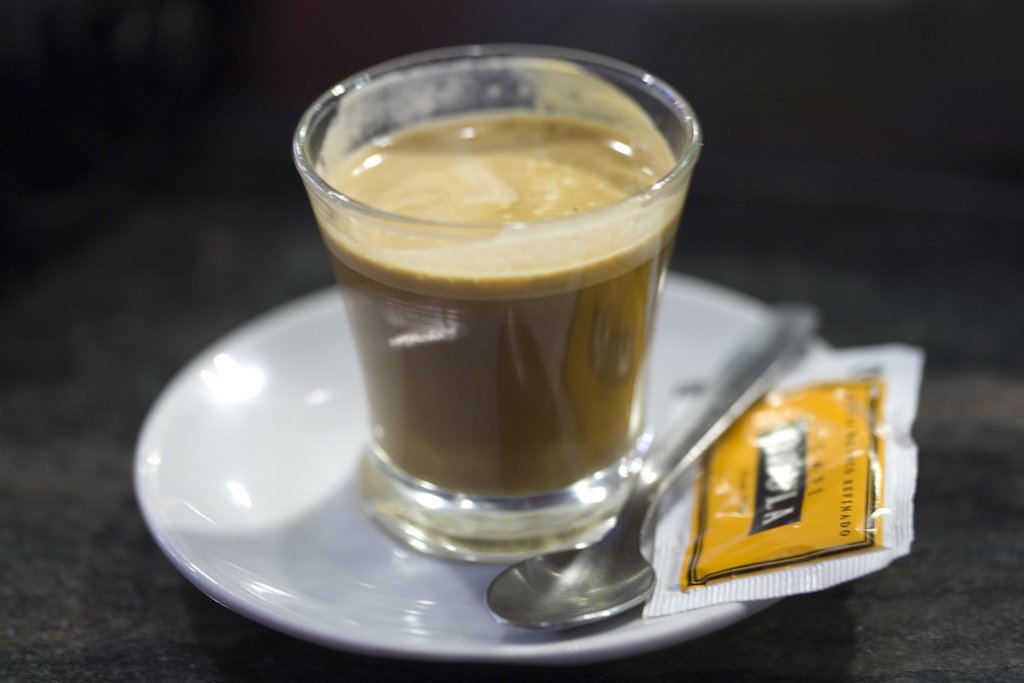
What it is. Espresso “cut” with a roughly equal amount of warm milk, steamed but not frothed into a foam. The word is the past participle of the Spanish cortar, to cut, in the sense of diluting. In Spain it is an everyday order, served in a small glass on a saucer; Catalan calls it a tallat. It sits close to the Italian macchiato and the French noisette, with more milk than either.
Relatives.
| Name | Where | What changes |
|---|---|---|
| Cortadito | Cuba; Miami’s Little Havana since the 1960s | The milk is heated sweetened condensed milk; served in a small glass |
| Bombón | Spain | Espresso layered over condensed milk, not mixed |
| Gibraltar | San Francisco | A cortado named after the 4½ oz Libbey “Gibraltar” glass Blue Bottle served it in: about 2 oz of double espresso and 2½ oz of steamed milk |
| Piccolo | Australia | A single ristretto in a small glass, topped with latte-style milk |
| Galão | Portugal | About one part coffee to three of milk, in a tall glass |
A cortado made with condensed milk is the nearest European relative of cà phê sữa đá: strong coffee and sweet, thick milk in a glass. The Miami cafecito that comes through a walk-up window is the black, sugared version (Cafecito).
Macchiato, and the caramel macchiato
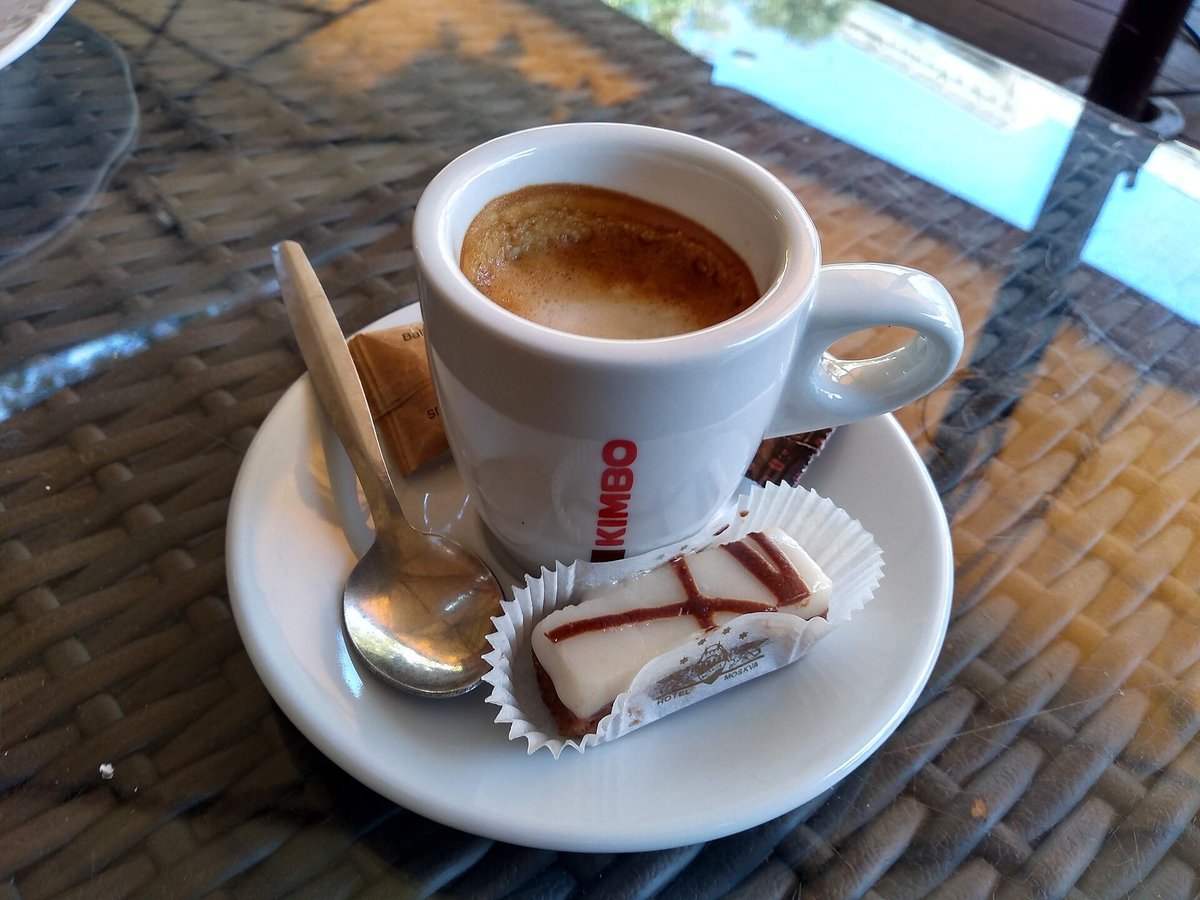
The Italian drink. Caffè macchiato is an espresso “stained” with a little milk, usually foamed: Moldvaer gives 5 to 10 g, one or two teaspoons, heated to 60–66 °C (140–150 °F). It has the highest ratio of coffee to milk of any drink here, and the point of the milk is to soften the shot, not to fill the cup. The Portuguese name says the same thing, café pingado, “coffee with a drop.”
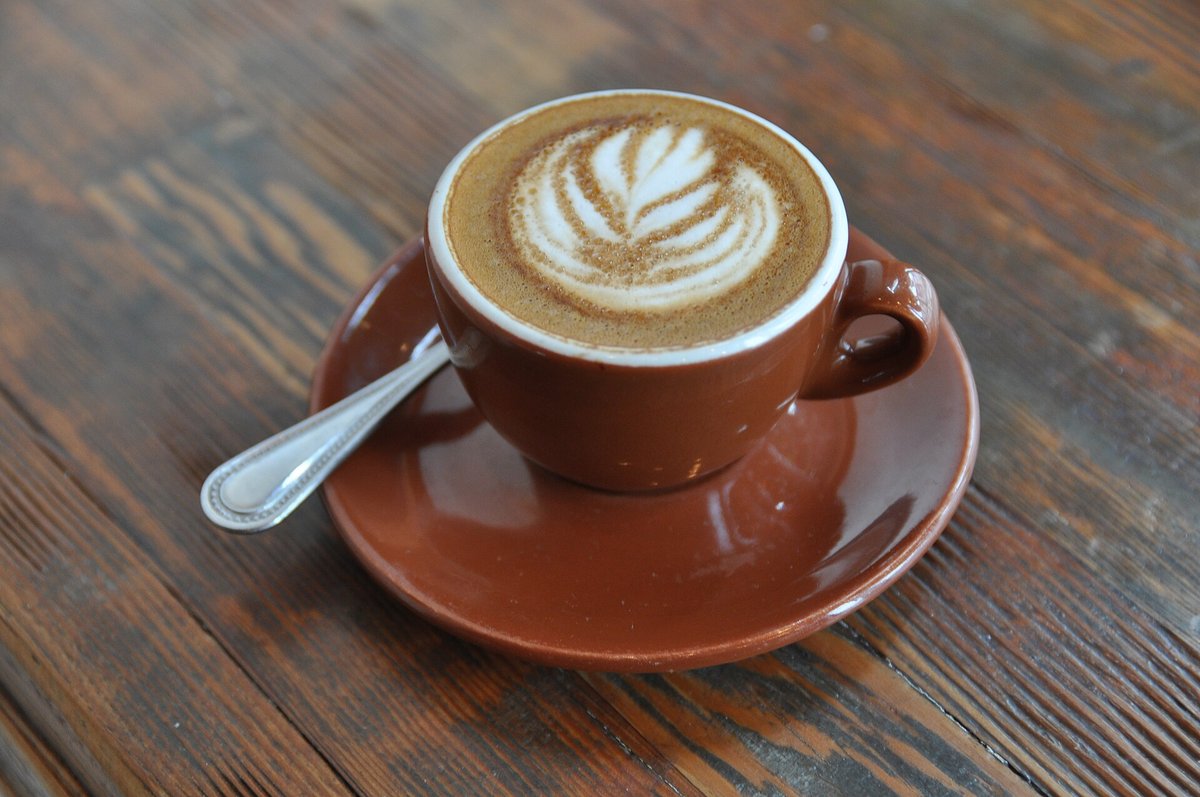
Three meanings of one word.
| Where | Order “macchiato,” get |
|---|---|
| An Italian bar | One shot, a spoonful of foam, in an espresso cup |
| An American specialty café | Often a double shot with an ounce or two of microfoam, poured as latte art; close to a small cortado |
| Starbucks | A caramel macchiato: vanilla syrup, steamed milk, espresso poured on top, caramel drizzle. In structure that is a latte macchiato, milk stained by coffee, sweetened |
| Melbourne | A “long macchiato” can be a double shot in a glass with water and a dash of milk |
The latte macchiato is the older Italian drink that Starbucks’s naming follows: a glass of steamed milk with a shot poured in last, so the coffee sits as a band between milk and foam. The chain’s caramel macchiato is that drink with vanilla syrup in the bottom and caramel on top, served by the 12, 16 and 20 oz cup. So the word “macchiato” names a 40 ml drink in one place and a 16 oz one in another, and both uses are now standard. On a menu board, a small café saves arguments by describing the drink in a few words under its name.
Latte
What it is. One or two shots and a lot of steamed milk, with a thin cap of microfoam, served in a glass in Italy and in a cup almost everywhere else. The Italian standard is around 230 ml. Latte is simply Italian for milk; ordering “a latte” in Italy gets a glass of milk. The full name is caffè e latte or caffellatte, coffee and milk.
The American size. Starbucks’s sizes are the American frame of reference: Short 8 oz, Tall 12, Grande 16 and Venti 20 oz for hot drinks. Its smallest everyday size, the Tall, is half again the Italian glass. A 16 oz latte is mostly a glass of warm milk with two shots in it, which is why it is the drink that carries syrups, chocolate and spice so well (Flavored and Seasonal Drinks), and why the milk, not the coffee, is the larger cost in it.
Older than the machine. The American novelist William Dean Howells described a “cafè latte” served on a steamer between Trieste and Venice in Italian Journeys (1867). The modern drink, with steamed and textured milk, needed the steam wand on the espresso machine, and the history of that machine is on The Espresso Machine.
Café au lait and café con leche are the brewed-coffee cousins: strong drip or press coffee with an equal amount of hot milk, in a bowl in France and a glass in Spain. They are the drinks that need no espresso at all (Café au lait).
Milk: what foams and what does not
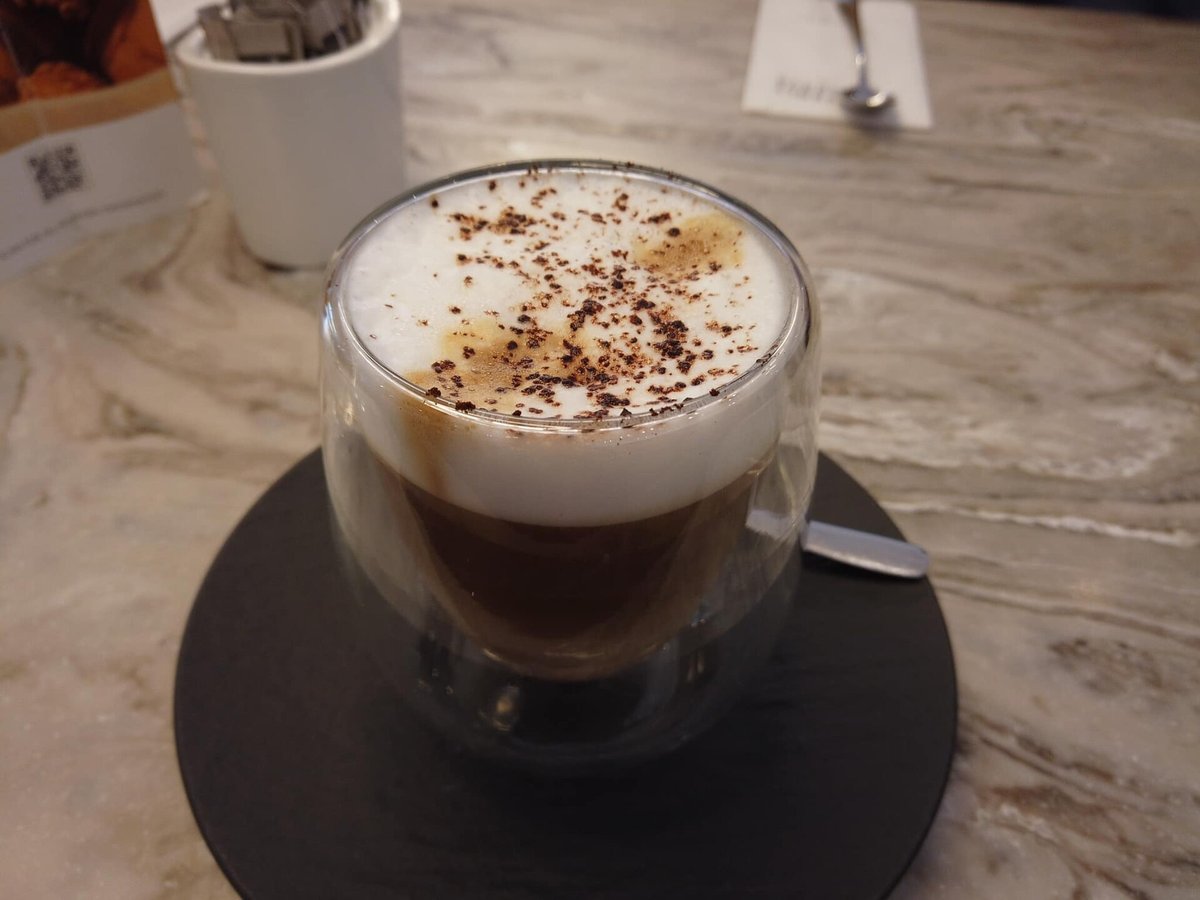
Cow’s milk is about 87.5% water, 4.8% lactose, 3.9% fat and 3.4% protein, according to the Tetra Pak Dairy Processing Handbook. The protein does the foaming, and it comes in two kinds:
| Protein | Share of milk protein | What it does in a milk drink |
|---|---|---|
| Caseins | About 78% | Clustered into micelles. They carry calcium, give milk its body, and curdle if the milk gets acidic enough (milk’s own pH is about 6.6; caseins drop out of solution near pH 4.6) |
| Whey (serum) proteins, chiefly β-lactoglobulin | About 19% | Unfold with heat and coat each air bubble, which is what holds a foam up. Overheated, they unfold too far, bond to each other, and the foam slumps |
| Fat | Not a protein: 3.9% in whole milk | Makes a foam richer and glossier but weaker; it interferes with the protein film around each bubble |
What that means at the jug:
- Cold milk, cold jug. Air goes in while the milk is cold; the rest of the heating folds it in. Starting warm leaves no time to texture it.
- Stop at 55–65 °C (130–150 °F). Lactose tastes sweetest there, and the whey proteins are unfolded enough to hold a fine foam. Past about 70 °C (160 °F) the foam collapses and the milk tastes cooked. This site’s Additions and Espresso pages set that ceiling, with the hand-on-the-jug test.
- Never re-steam. Milk heated once has had its whey proteins unfolded. It will not foam well a second time, and from a food-safety view a jug of warm milk is the thing an inspector looks for (The Michigan Rules).
- Whole milk makes the glossiest microfoam; skim makes tall, stiff, dry foam that suits an old-fashioned cappuccino and little else; half-and-half barely foams at all.
- Ultra-pasteurised (UHT) milk and cream have been heated far higher than ordinary pasteurised milk. Many baristas find they foam less well and taste faintly cooked. No published comparison in coffee drinks settles it; try it before buying a case.
Microfoam versus foam. Microfoam is milk with bubbles too small to see: it looks like wet paint and pours. It is what a flat white, latte and cortado want. Dry foam, with bubbles you can see, is what sits on a traditional cappuccino and stands up to a spoon. The steam wand makes either, by how long its tip stays at the surface drawing in air; the full technique is on Espresso.
Latte art, in one paragraph. A pattern on top exists only when the milk is microfoam and the coffee has crema to contrast with. Pour from a few inches up so the milk dives under the crema, then drop the jug close to the surface so the foam floats and draws. A heart, a tulip and a rosetta are the three every barista learns first. The pattern is a sign the milk was handled right; it adds nothing to the taste.
Making them without a steam wand
A steam wand heats milk and aerates it in one step. Without one, the two jobs are done separately: heat first, then froth, or for iced drinks, froth cold and skip the heat. The tools, and what they cost as of October 2026, are on The Espresso Machine; how each one is used is here.
| Method | How | What it makes | Good for |
|---|---|---|---|
| French press | Heat milk to 55–65 °C on the stove or in the microwave. Fill the press no more than a third. Pump the plunger 15 to 30 times, fast for the first half and slow at the end. Rest 30 seconds; tap the press on the counter to burst big bubbles; swirl | Stiff foam on top, warm milk below. With fewer, slower strokes, something close to microfoam | Cappuccino, latte. A plunger frother is the same tool |
| Battery whisk (a handheld frother wand) | Heat the milk first. Hold the whisk just under the surface for a few seconds, then lower it to spin the milk | Loose foam; the better models make finer bubbles | Lattes and cold foam |
| Jar and microwave | Fill a jar with a lid no more than half with milk. Shake hard for 30 to 60 seconds. Lid off; microwave about 30 seconds so the foam sets on top | A firm, coarse foam | A cappuccino-style cap |
| Electric frother jug | Pour in milk to the line and press the button; it heats and froths together | Consistent warm foam | Anyone making several a day at home |
| Stovetop steam pitcher | A small boiler on a burner, with its own wand | Real steamed milk | The nearest thing to a café without a machine |
A plunger frother doubles the volume of milk in 10 to 20 seconds of pumping, so the jug must have room. I own a French press, and that is the cheapest frother there is: it is already in most kitchens. Whatever the method, the temperature rule is the same, and a thermometer clipped to a pan makes it easy.
Making them without espresso
An espresso machine forces water through fine coffee at high pressure in about half a minute. Nothing else does that, but two methods make a small, strong coffee that will carry milk.
| Method | How | Is it espresso? |
|---|---|---|
| Moka pot | Fill the basket loosely, without tamping; water to just below the valve; medium heat; off the heat as soon as it starts to sputter | No. Steam pressure is far lower than an espresso machine’s, so there is little or no crema. Strong, heavy and slightly bitter, and good with milk |
| AeroPress concentrate | 16 to 18 g of fine-ground coffee, hot water to the first marks, stir, press after about a minute into a small cup | No. The maker describes the result as “rich like an espresso”; it is a strong filter coffee |
| Phin | A dark robusta or blend, a slow drip of about five minutes | No. Strong and heavy, the base of cà phê sữa đá (kah fay shoo-uh dah · [kaː˨˩ fej˧˧ ʂɨə˨˩˦ ʔɗaː˦˥]) (The Drinks) |
| Strong French press or pour-over at double strength | About 1:8 coffee to water instead of 1:16 | No. A respectable café au lait base |
| A manual lever or hand espresso maker | 18 g in, about 36 g out, with hot water from a kettle | Yes, if it reaches true espresso pressure (The Espresso Machine) |
Any of the first four, with 200 g of steamed milk, makes a good milk coffee. Call it what it is. On a menu a “latte” means espresso to most customers; a drink made on a moka pot or an AeroPress is honestly a “moka latte,” a “café au lait” or “phin coffee with milk.” That is a matter of trust more than law, and it avoids the customer who asks for a double shot.
Hot, iced and at the stall
Iced versions of all five are simpler than hot ones: espresso or concentrate over ice, cold milk poured in, no heating at all. Cold foam, milk frothed without heat and spooned on top, is covered on Flavored and Seasonal Drinks.
For a market stall the drinks raise three questions, and the pages that answer them are already written:
| Question | Short answer | Where the detail is |
|---|---|---|
| Is a licence needed? | Yes: any cup made at the stall needs a food service licence, and milk is a food that needs temperature control | The Michigan Rules |
| How is the milk kept safe? | At 41 °F or below in a cooler, or out for up to four hours under a written time procedure the health department approves; warmed to order, a drink at a time | The Michigan Rules |
| Does espresso fit? | A manual lever can pull the shot without power, at 2½ to 4 minutes a drink of one person’s hands | The Espresso Machine |
| What can be sold instead? | A phin concentrate with condensed milk, or honey and half-and-half, makes the stall’s milk drink without espresso | The Drinks and Honey in Coffee |
| What about oat and soy? | Barista-edition cartons are shelf-stable until opened; plain ones may split in hot coffee | Sugar-Free Sweeteners and Plant Milks |
The cheapest milk drink to add at a stall is an iced one. It needs a cooler, a clear cup and bought, bagged ice (Iced Coffee and Ice); no milk is heated, no wand is cleaned, and the coffee can come from the phin or a flash brew already on the table. A hot latte adds a way of heating milk, a thermometer and a jug to rinse between drinks. Elsewhere in the US the same holds: the FDA Food Code, which most states adopt, treats the milk, not the coffee, as the food that needs control.
Price. A latte in the Lansing area costs about $4.00 to $5.00 as of 2026 (Prices and Customers). Whole milk at an assumed supermarket price of $4.00 a gallon is about 3 cents an ounce, so the 8 to 10 oz of milk in a 12 oz latte costs 25 to 31 cents; a barista oat milk is three to five times that. What the rest of a cup costs is on The Numbers.
What is not known
- Who made the first flat white. The record supports early use of the name in England and early café use in both Sydney and Wellington; no document settles it.
- When the cap of steamed foam joined the cappuccino. It came with the espresso machine and steam wand in the 20th century; no first cup is dated.
- How the home methods compare. No published test measures bubble size or foam stability from a French press, a battery whisk and a microwaved jar against a steam wand.
Sources
- Wikipedia: Cappuccino (World Barista Championship definition; Kapuziner and Franziskaner; Caffe Reggio and Caffe Trieste), Flat white (Moldvaer’s proportions; Tourism New Zealand; Bersten; the 1963, 1971, 1983, 1985 and 1989 dates), Cortado (Spanish usage, cortadito, gibraltar, piccolo, galão), Latte (cup sizes; Howells, Italian Journeys), Caffè macchiato (Moldvaer’s 5–10 g at 60–66 °C; Australian variants), Latte macchiato, Starbucks (cup sizes), Milk frother.
- Tetra Pak, Dairy Processing Handbook, chapter 2, “The chemistry of milk” (composition, protein fractions, isoelectric point).
- AeroPress, “How to use” (dose and the maker’s description).
- Anette Moldvaer, Coffee Obsession (Dorling Kindersley, 2014), pp. 150–151, as cited in the Wikipedia articles above.
- On this site: Espresso, What People Put In It, The Espresso Machine, The Michigan Rules, The Drinks, Prices and Customers.
Comments (0)