Coffee · 17 of 64
Coffee Milk and Coffee Syrup: Rhode Island's State Drink
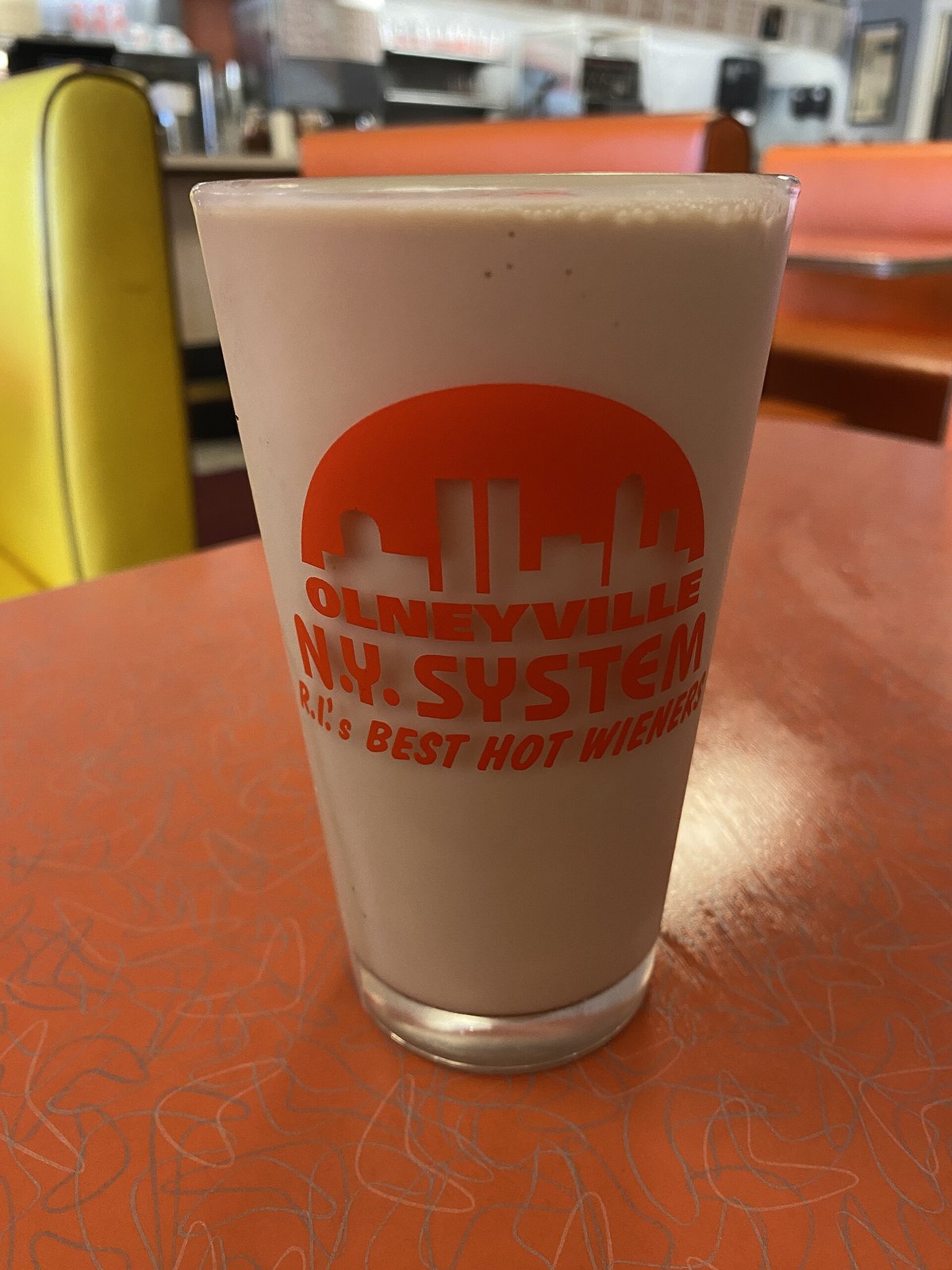
In most of the United States, “coffee syrup” means a bottle of vanilla or caramel that a barista pumps into a latte. In Rhode Island it means something else: coffee boiled down with sugar into a thick, nearly black syrup, stirred into a glass of cold milk the way the rest of the country stirs chocolate syrup. The result is coffee milk, and since 1993 it has been the official state drink of Rhode Island by law.
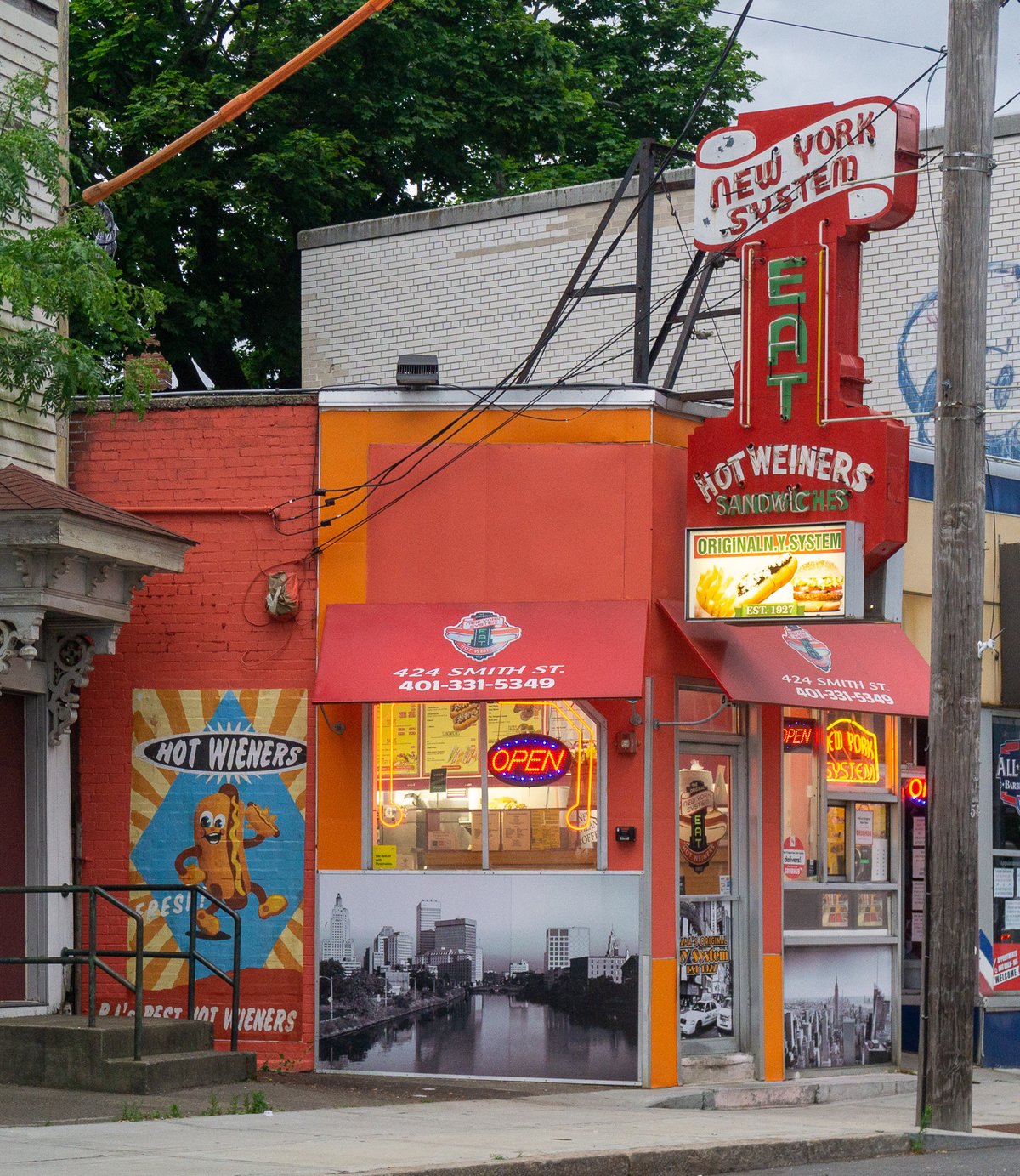
Coffee milk is sweet, mild and milky, closer to chocolate milk than to a latte, and in Rhode Island it is a children’s drink as much as an adult’s. It comes with hot wieners at a New York System counter, from a carton in the supermarket dairy case, and blended with ice cream as a coffee cabinet, the local word for a milkshake. Outside southern New England it is almost unknown.
The cousins at the end are other coffee products and drinks that sit at the edge of ordinary coffee.
The short version
| Question | Answer |
|---|---|
| What is coffee syrup? | Coffee plus sugar, concentrated into a thick syrup. In Rhode Island it is stirred into cold milk. It is coffee made into a syrup, not a syrup that flavours coffee. |
| What is coffee milk? | Cold milk with coffee syrup stirred in: 2 tablespoons to 8 ounces of milk on the Autocrat bottle, about 1 part syrup to 8 of milk. |
| Is it really the state drink? | Yes. R.I. Gen. Laws § 42-4-15: “Coffee milk is hereby designated as the official state drink for the state.” Enacted in 1993 (P.L. 1993, ch. 466), after a contest with Del’s Frozen Lemonade. |
| Who invented it? | Nobody on record. The stories about Italian immigrants and soda-fountain operators sweetening leftover coffee have no named person, place or date. The earliest bottled syrups that can be dated are from the 1920s and 1930s. |
| Which brands? | Autocrat (the best known, founded 1895 in Providence), Eclipse and Coffee Time (both owned by Autocrat since 1991), Dave’s Coffee (cold-brewed coffee and cane sugar, since 2012), Morning Glory, and a revived Silmo. Autocrat is the sweetest; Eclipse and Coffee Time taste more of coffee. Compared below. |
| What is in Autocrat? | High-fructose corn syrup, corn syrup, coffee extract, caramel colour and potassium sorbate. 100 calories and 20 g of added sugar per 2 tablespoons. |
| Caffeine? | Little. Dave’s gives about 20 mg per tablespoon, so a glass of coffee milk carries roughly half the caffeine of a cup of brewed coffee or less. |
| What is a coffee cabinet? | A coffee milkshake: coffee syrup, milk and (usually coffee) ice cream, blended. Called a frappe in the rest of New England. |
| Can I make it at home? | Yes: strong coffee and sugar, reduced by half. Recipe here. Keep it in the refrigerator and use it within about two weeks. There is no tested canning process. |
| Where do I buy it? | New England supermarkets, Walmart, and online. Autocrat 32 oz has listed at about $12–15; Dave’s 16 oz is $18 from the maker (October 2026). |
What coffee syrup is, and what it is not
Coffee syrup is a sugar syrup whose only flavour is coffee. It is sweet enough to be the only sweetener in a glass of milk, and dark enough to turn the milk the colour of a light latte with two tablespoons.
Four different products get called something like “coffee syrup” or “coffee flavouring”, and they are not interchangeable:
| Product | What it is | Sweet? | Used for | Example |
|---|---|---|---|---|
| Rhode Island coffee syrup | Coffee (extract, or brewed coffee) concentrated with sugar or corn syrup | Very | Coffee milk, cabinets, ice cream, glazes | Autocrat, Dave’s |
| Café flavouring syrup | Sugar syrup flavoured with vanilla, caramel, hazelnut and so on (or a coffee flavouring) | Very | Sweetening and flavouring coffee drinks | Torani, Monin (Syrups) |
| Coffee essence | A thin, sweetened liquid of chicory and coffee extract | Yes | British baking (coffee and walnut cake), a cheap “coffee” in hot milk | Camp Coffee, below |
| Coffee extract | Coffee flavour in alcohol, unsweetened, used by the half-teaspoon | No | Flavouring cakes, frostings and ice cream | Supermarket baking aisle |
There is also espresso powder (dried instant espresso, unsweetened), which bakers use the way they use extract.
The easy mistake is the second row. A recipe from Rhode Island that says “2 tablespoons coffee syrup” means the first kind. A bottle of Torani “coffee” or Monin “coffee” syrup is the closest thing most shops stock, but it is a flavouring syrup built on the café model, usually thinner and less intensely coffee-flavoured. It will make a drinkable coffee milk; it will not taste like Autocrat.
Where it came from: the stories and the record
The stories
Every account of coffee milk’s origin is a version of one of three stories:
- Italian immigrants. Providence had a large Italian population by the early twentieth century; families drank strong, heavily sweetened coffee with milk, gave it to the children too, and the habit moved from home kitchens to diners and drugstores in the 1920s and 1930s. Quahog.org, Rhode Island’s long-running local-culture site, gives this version, citing the Providence cookbook writer Nancy Verde Barr. Boston.com’s Wickedpedia adds the Portuguese communities of southern Massachusetts.
- The soda fountain. A soda-fountain operator sweetened leftover coffee grounds with milk and sugar to make a syrup (Wikipedia repeats it). No operator, town or year is ever named.
- Stretching the coffee. Immigrants short of coffee made a little go a long way in a lot of milk (The Takeout).
None of these is documented. They are plausible, and the first fits what is known about who lived in Providence and Fall River and what they drank, but no known recipe, menu, diary or newspaper shows the step from a sweet milky coffee at home to a bottled coffee syrup. Peter Kelly, a culinary professor at Johnson & Wales University in Providence, told NPR’s The Salt in 2016 that the syrup “probably came first”, and added the local dairy industry to the explanation: Rhode Island had produced milk and cheese in quantity since colonial times (NPR, via WUWF). He hedged it, and so should anyone else.
Wikipedia places it by the 1930s at pharmacy and soda-fountain lunch counters, where coffee milk was sold to children as their version of the coffee their parents drank.
The record
| Year | What happened | How solid |
|---|---|---|
| 1895 | Seth H. Brownell and Frank O. Field of the grocers Brownell & Field Co., Providence, found Autocrat as a coffee brand. Motto: “A Swallow Will Tell You.” | Solid (Newport Historical Society) |
| 1914 | Eclipse Food Products founded in Warwick by Alphonse Fiore of Providence. | One source (Quahog.org) |
| 1926–27 | ”Arabian Brand Coffee Syrup”, D. Abelsen & Son, Cumberland, R.I., is advertised in the Ice Cream Trade Journal (1926, as cited by Wikipedia); by 1927 The Milk Dealer shows it in 12 and 16 oz bottles “for home use”, to mix with milk. The earliest coffee syrup on record. | Trade journals |
| 1932 | Silmo Packing Co. of New Bedford, Massachusetts, begins making coffee syrup. The name joins its founders’ surnames, Louis Silva and Carlos Desouza Morais. | Three secondary sources agree |
| 1938 | Eclipse starts selling coffee syrup hard: “You smack your lips if it’s Eclipse.” | Quahog.org; Wikipedia |
| 1930s–40s | Autocrat begins making coffee syrup. Sources say “the 1930s”, “the late 1930s” and “the 1940s”; no dated label or advertisement settles it. | Conflicting |
| 1954 | Autocrat sponsors a television film series to sell its syrup as a way to make milk “more palatable to small fry”. | Television, 1954 |
| 1963 | Globe Extracts of Hauppauge, New York, buys Eclipse. | Quahog.org; Wikipedia |
| 1991 | Autocrat buys Eclipse, ending what the local press called the coffee-syrup wars. Both brands are kept. | Solid (Wikipedia, Yankee, Quahog.org agree) |
| 1993 | Coffee milk becomes the official state drink. | Solid (the statute) |
| c. 2000–2001 | Silmo, renamed MilkMate in 1996, closes. | Sources differ by a year |
| 2012 | Dave’s Coffee of Charlestown, R.I., starts making a cold-brewed, cane-sugar coffee syrup. | Solid (maker) |
| 2013 | Narragansett Beer and Autocrat release Coffee Milk Stout in December; it returns in 2014. | Solid (Beverage Business, 2013) |
| 2014–15 | James Finlay Ltd acquires Autocrat (April 2014); the company is renamed Finlay Extracts & Ingredients USA in 2015. The Autocrat brand continues. | Wikipedia; Quahog.org agrees |
| 2022 | Silmo is revived in New Bedford by Ian Abreu, whose grandfather had owned it. | Boston.com |
Three corrections to what circulates widely. “Eclipse, 1914” is the founding of the company, not of its syrup, which it marketed from 1938. Autocrat was bought by Finlay in 2014, not 2013. And the oldest documented coffee syrups are not from Providence at all: Arabian was made in Cumberland, Rhode Island, and Silmo in New Bedford, Massachusetts. Coffee milk is better described as a drink of the Narragansett Bay region, Rhode Island and the south coast of Massachusetts, than of Rhode Island alone.
The state drink, 1993
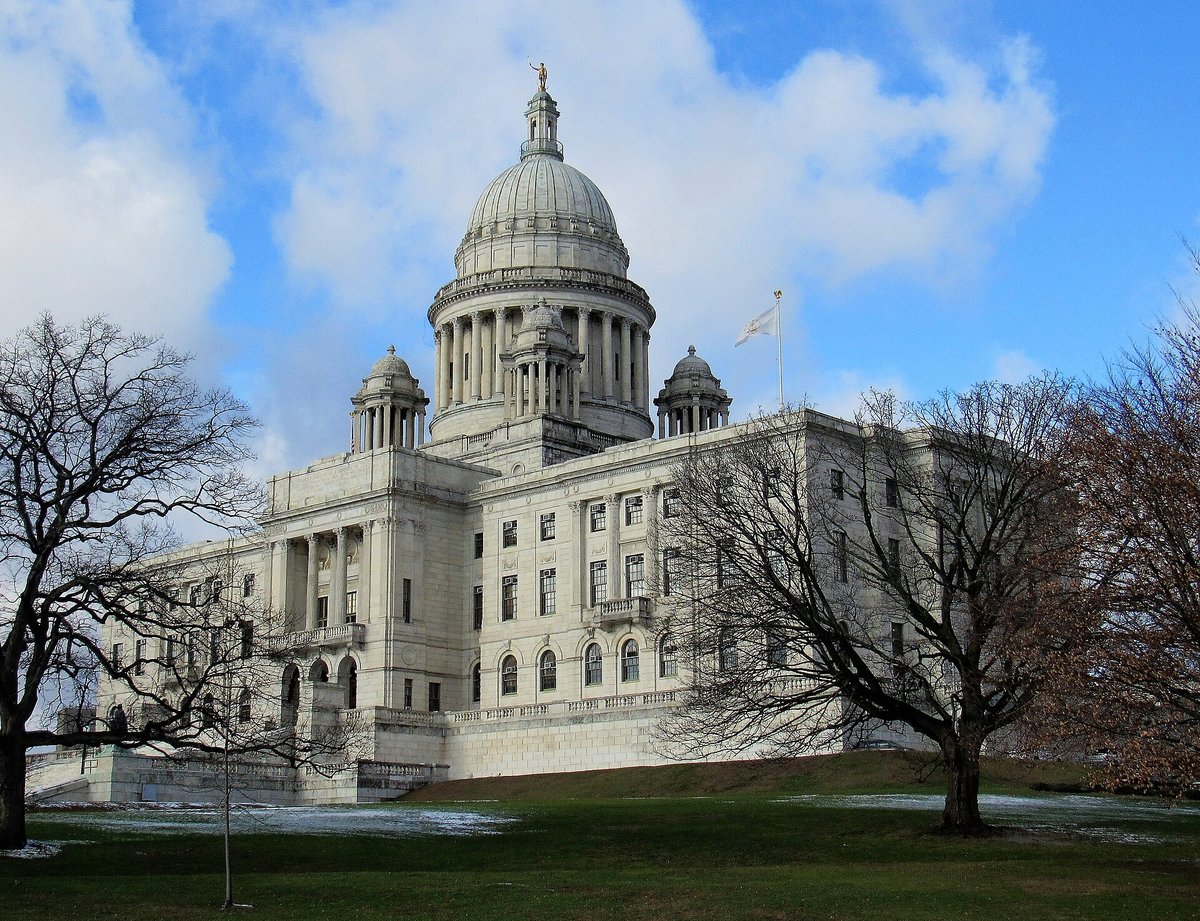
Rhode Island’s General Laws give the whole statute in one sentence. Section 42-4-15 reads, in full: “Coffee milk is hereby designated as the official state drink for the state” (Rhode Island General Assembly). Its history line is P.L. 1993, ch. 466, § 1; the designation is usually dated 29 July 1993.
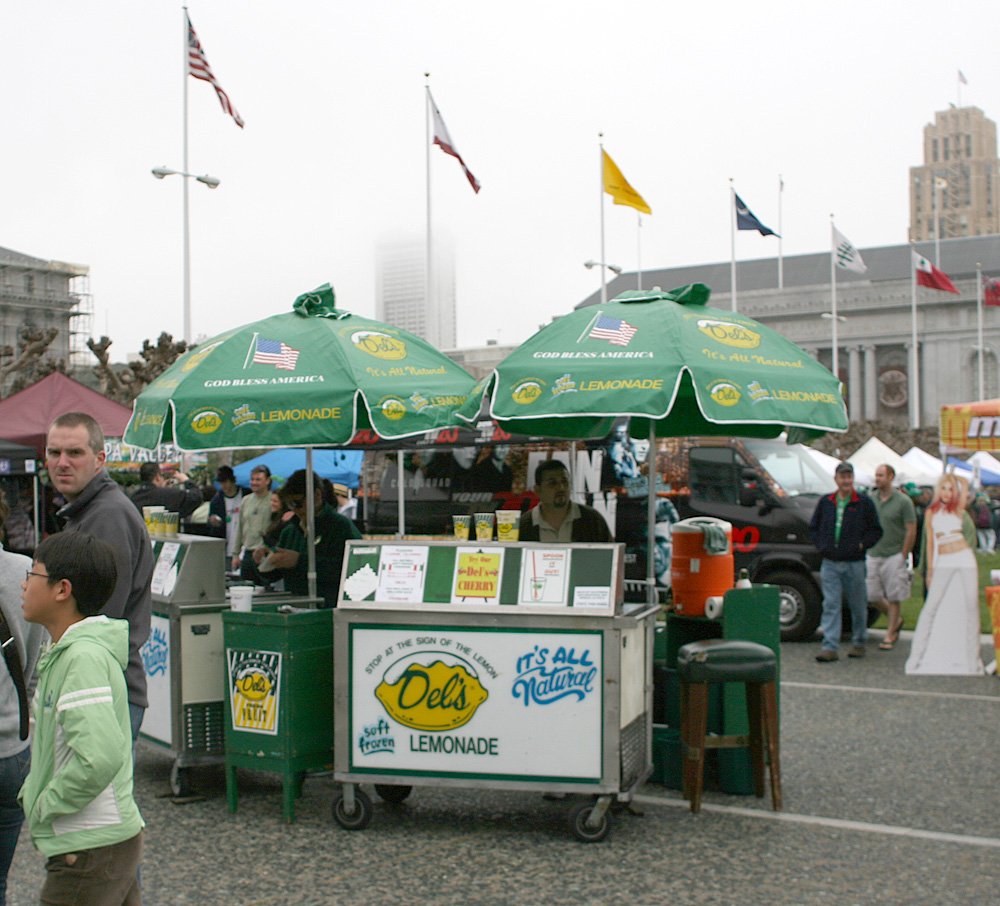
It was not unopposed. The rival was Del’s Frozen Lemonade, the half-frozen lemon slush sold from stands, carts and trucks all over the state. A Federal Reserve Bank of Boston Regional Review “Letter from Providence” recalled four years later that “the debate was loud and passionate. The Providence Journal-Bulletin had a field day” (Boston Fed, 1997).
The legislative detail below is Quahog.org’s and appears to come from the Providence Journal’s coverage at the time, which is not online; treat the specifics as reported:
- The resolution was introduced on 23 March 1993 by Representative John Barr, a Democrat from Lincoln, the town where Autocrat had its plant.
- A Del’s franchisee in the House, Representative Bruce Long of Middletown, asked for the question to be studied and then recused himself.
- The Senate Special Legislation Committee approved it on 1 April with one dissent.
- The House passed it 49 to 36 on 7 May.
- Autocrat held a victory party at its Lincoln headquarters on 27 August.
Quahog.org reports that Representative Barr introduced the resolution “at the behest of Autocrat Coffee” (Quahog.org), and The Takeout says Autocrat campaigned for it. The company’s own records of the campaign are not public.
Rhode Island is not the only New England state with a drink of its own. Maine named Moxie, a bitter gentian-root soda, its official soft drink in 2005 (Wikipedia). Coffee milk remains the only official state drink built on coffee.
The brands, compared
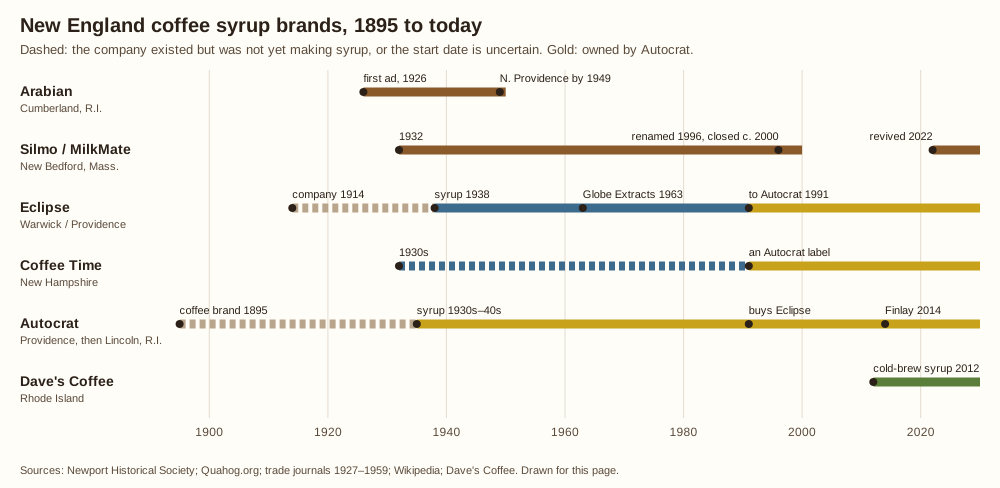
Three of the six brands on sale today are now made by the same company. Autocrat bought Eclipse, and Coffee Time with it, in 1991, so the old rivalry continues as two labels on one production line. The other three, Dave’s, Morning Glory and a revived Silmo, are small makers, and Dave’s and Morning Glory use cane sugar rather than corn syrup.
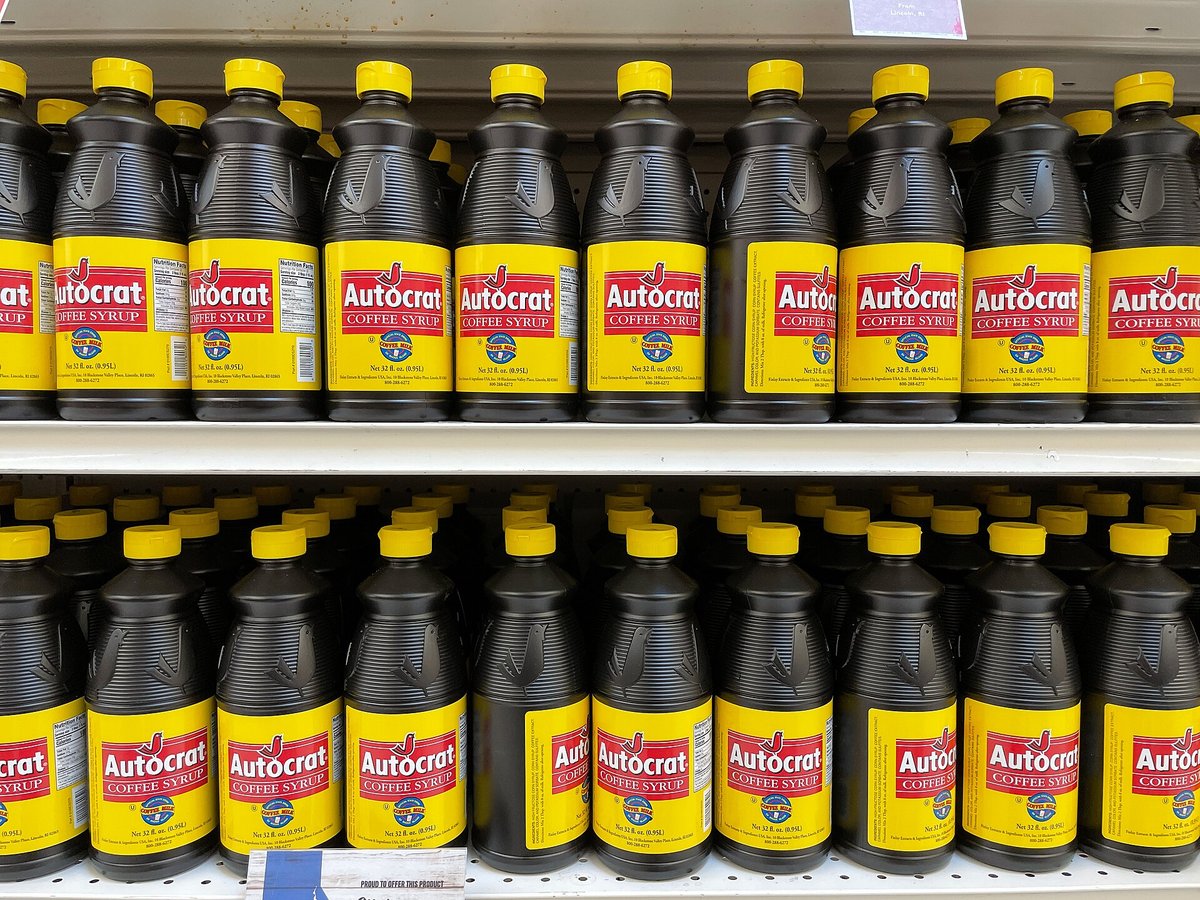
At a glance
| Autocrat | Eclipse | Coffee Time | Dave’s Coffee | Morning Glory | Silmo | |
|---|---|---|---|---|---|---|
| Made in | Lincoln, R.I. | Lincoln, R.I. (by Autocrat) | By Autocrat | Rhode Island (roastery in Narragansett) | Southeastern Massachusetts | New Bedford, Mass. |
| Syrup since | 1930s or 1940s | 1938 | 1930s | 2012 | Not published | 1932 (revived 2022) |
| Owner, October 2026 | Finlays (since 2014) | Finlays, via Autocrat | Finlays, via Autocrat | Dave’s Coffee | Family-owned | Ian Abreu |
| Sweetener | High-fructose corn syrup, corn syrup | High-fructose corn syrup, corn syrup | Corn syrup (label not published online) | Cane sugar | Cane sugar | Not published |
| Coffee | ”Coffee extract" | "Coffee extract” | Not published | Cold-brewed coffee, roasted in-house | Coffee | ”Natural coffee syrup” |
| Colour added | Caramel colour | Caramel colour | Not published | None | None | Not published |
| Per 2 Tbsp | 100 kcal, 20 g added sugar | 101 kcal, 20.3 g sugar | Not published | Not published; about 20 mg caffeine per tablespoon | Not published | Not published |
| How it tastes | The sweetest; a “caramelized note” | Less sweet, more coffee | The most coffee, least like the classic | Lighter, rounder, real-coffee taste; less sweet | ”Damn good syrup” (Gear Patrol) | — |
| Price | About $12–15 for 32 oz | About $11 (2022) | — | $18 for 16 oz (Oct 2026) | About $7 (2022) | — |
The taste row comes from published reviews, not a blind tasting. Sporked (2022) found Autocrat “the sweetest of the bunch”, Eclipse “a stronger coffee flavor with less sweetness” and Coffee Time “the strongest coffee flavor and the least ‘traditional’ coffee milk experience”; Gear Patrol called Eclipse “sweet and vaguely of convenience store coffee”, Morning Glory “damn good syrup” and Dave’s “the most evolved of the coffee syrups”. Finlays’ own head of research described Autocrat to the Boston Globe in 2025 as sweetness first, with “a kind of caramelized note”. Autocrat and Eclipse list exactly the same five ingredients and almost the same nutrition, so whatever difference loyalists taste is in the proportions and the extract, not in what goes into the bottle. No blind tasting of the brands has been published.
Autocrat
Autocrat began as a coffee brand of Brownell & Field Co., Providence grocers, founded in 1895 by Seth H. Brownell and Frank O. Field (Newport Historical Society). Its slogan was “A Swallow Will Tell You.” The Boston Globe reported in 2025 that the name comes from Oliver Wendell Holmes Sr.’s 1858 essays The Autocrat of the Breakfast-Table.
When Autocrat added coffee syrup is not settled: sources say the 1930s, the late 1930s and the 1940s. By the early 1950s it was being sold hard. A 1953 retail trade paper shows a 5-cent-off “Autocrat Coffee Syrup Sale”, and in 1954 the trade magazine Television reported that Brownell & Field had been sponsoring a film series for over a year “for its Autocrat coffee syrup, which is used to make milk more palatable to small fry.” Coffee milk was marketed to parents as a way to get children to drink their milk. New labels for Autocrat coffee, tea and coffee syrup followed in 1954 (Tea & Coffee Trade Journal).
The company moved to Lincoln, Rhode Island. In 2004 it was run by Richard M. Field Jr., the fourth generation, with about 150 staff, and also made coffee extracts for iced cappuccino and ice cream (Providence Business News). In 1991 it bought Eclipse. In April 2014 the British tea and coffee company James Finlay bought Autocrat, and the business became Finlay Extracts & Ingredients USA in 2015 (Wikipedia); since 2025 the parent trades as Finlays Solutions. As of 2025 the syrup was still made in Lincoln (Boston Globe).
In the bottle: high-fructose corn syrup, corn syrup, coffee extract, caramel colour and potassium sorbate, which contains sulfites (Open Food Facts; Stop & Shop). There is no light or sugar-free Autocrat.
Eclipse
Eclipse Food Products was founded in 1914 by Alphonse Fiore of Providence, and began selling coffee syrup in 1938 with the slogan “You smack your lips if it’s Eclipse” (Quahog.org). A 1940 feature in the trade magazine Ice Cream Field showed the Eclipse workroom with “11 coffee percolators, two steam jacketed kettles”: the syrup was brewed from real coffee, in percolators, and boiled down with sugar. In 1951 the company told The Glass Packer that its purity was guaranteed by percolating coffee it roasted and ground itself.
Connecticut’s food inspectors, who tested foods sold in the state, cited Eclipse Coffee Syrup in 1950 as misbranded “because of claim for ‘fresh roasted coffee’”. By 1958–59 the label read “Eclipse Coffee Syrup, Pasteurized, for Milk Shakes, Fortified with Vitamin D.”
Eclipse was bought by Globe Extracts of Hauppauge, New York, in 1963, and by Autocrat in 1991, which ended the local “coffee syrup wars”; Autocrat kept both brands. In the bottle today: the same five ingredients as Autocrat, at 101 calories and 20.3 g of sugar per 2 tablespoons (Open Food Facts). Its fans hold that it is the less sweet, more coffee-tasting of the two, and the reviews above agree.
Coffee Time
Coffee Time was made by a New Hampshire producer from the 1930s (Wikipedia); the maker’s name and town are not on record. It is now a third Autocrat label, sold mostly outside Rhode Island (Yankee), and the reviewer at Sporked found it the most strongly coffee-flavoured of the three Autocrat-family syrups. Its label has not been published online.
Dave’s Coffee
Dave’s Coffee opened as a café in 1998 in the back room of a 1740 farmhouse in Charlestown, Rhode Island, started roasting in Westerly in 2009, and now roasts in a seven-thousand-square-foot roastery in Narragansett, with cafés in Charlestown and Providence (Dave’s story). It has made coffee syrup since 2012. The method, as the company describes it: a Brazilian coffee roasted in-house, rested two days, cold-brewed for 18 hours, combined with cane sugar, simmered about 45 minutes and bottled hot in amber glass (Edible Rhody; Dave’s). The label reads “Cane Sugar, Dave’s Cold Brewed Coffee (Water & Fresh Roasted Coffee)”. Dave’s gives about 20 mg of caffeine per tablespoon. Besides the original it has made vanilla, mocha and decaf versions (Gear Patrol). It won a Yankee Editors’ Choice award in 2013, and it costs more than twice as much per ounce as Autocrat.
Morning Glory
Morning Glory is a small family-owned syrup from southeastern Massachusetts, made from coffee, cane sugar and water. Gear Patrol, the only published source on it, describes it as a stripped-down version of the original Eclipse recipe and found it at Whole Foods for about $7. Its town and founding date are not on record.
Silmo and MilkMate
Silmo Packing Co. of New Bedford, Massachusetts, made coffee syrup from 1932. The name joins its founders’ surnames, Louis Silva and Carlos Desouza Morais. Its bottles appear in packaging trade journals in 1952–53, and it was still listed as a flavouring-syrup maker on Cove Road in the 1980s. It was renamed MilkMate in 1996 (a 1999 food-industry register lists “Silmo MilkMate syrup”) and closed around 2000 (Quahog.org says 2000, Boston.com 2001). At the end of 2022, Ian Abreu, president of the New Bedford City Council, whose grandfather had owned the company, revived it as a natural coffee syrup sold through local food markets. Its ingredients and prices are not published online.
Arabian, the first
D. Abelsen & Son of Grants Mills, in Cumberland, Rhode Island, was selling coffee extract to ice-cream makers by 1919. Its Arabian Brand Coffee Syrup is the earliest bottled coffee syrup on record: Wikipedia cites a 1926 Ice Cream Trade Journal advertisement for “Our New Creation Arabian Brand Coffee Syrup for Ice Cream Topping, Milk Shakes, Iced Coffee, Etc.” By 1927 The Milk Dealer shows it “Sold in 12 oz. and 16 oz. bottles for home use and in one gallon and ten gallon jugs”, described as “fresh roasted coffee, highly concentrated in syrup form. Easy to mix with milk; no equipment necessary.” That is coffee milk, bottled for the home, in 1927.
In 1939 Abelsen offered to make Arabian syrup for dairies and bottlers “under your own brand name”, so some of the dairy and store-brand syrups of that era may have been Arabian in a different bottle. By 1949 the maker was Arabian Syrups & Extracts, Inc., of North Providence. What became of it after that is not on record.
What changed in the bottle
The corn-syrup Autocrat and Eclipse of today are not the syrups of the 1930s. High-fructose corn syrup came into wide use in American food only in the 1970s, and the trade records show the early syrups were brewed from roasted coffee (Eclipse’s percolators, Arabian’s “fresh roasted coffee”) and boiled with sugar. Today’s labels say coffee extract. Yankee says commercial coffee syrup is “commonly made from instant coffee mixed with sugar and corn syrup”; the labels do not say instant coffee, and the makers do not publish how their extract is made. The cane-sugar syrups (Dave’s, Morning Glory) are closer to what a home cook makes, and to what the first syrups were.
The label numbers. Autocrat lists 100 calories, 25 g carbohydrate and 20 g added sugar per 2 tablespoons (Stop & Shop’s listing), and the label says “Refrigerate after opening”, even with its preservative. Twenty grams of added sugar is 40% of the FDA’s daily value for added sugars in one glass of coffee milk. The milk adds about 12 g of its own natural sugar on top.
Ready-made coffee milk
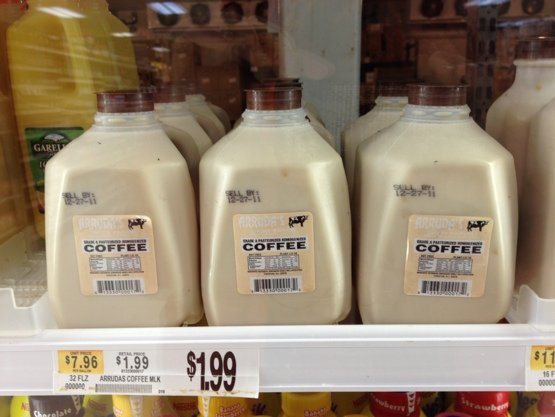
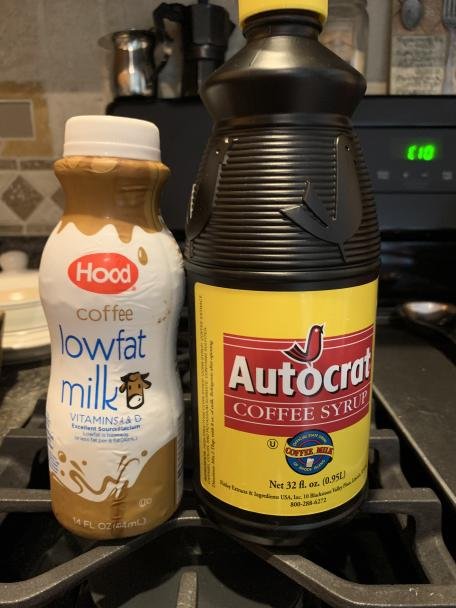
The other way to buy it is already mixed. Hood makes a bottled coffee milk (pictured above); Arruda’s sells it in half-gallon jugs; and in Maine, Oakhurst and Smiling Hill make their own (Yankee).
How to drink it
Coffee milk
Two tablespoons of syrup in 8 ounces of cold milk, stirred. That is the Autocrat label, and Taste of Home’s pitcher version (1 cup of Eclipse to 2 quarts of milk) is the same 1-to-8 ratio. Whole milk is traditional; skim makes a thinner, sharper drink. Recipe: Coffee Milk (Rhode Island).
The coffee cabinet
A cabinet is the Rhode Island and southeastern Massachusetts name for a milkshake: milk, syrup and ice cream, blended thick. The coffee cabinet uses coffee syrup and, most often, coffee ice cream; Yankee describes coffee milk blended with vanilla, and both are made. In Boston and the rest of New England the same drink is a frappe. An old-style New England “milkshake” was milk and syrup shaken without ice cream, which is why the words split.
Why “cabinet” is not known. The theories are that the blender, or the syrup, was kept in a wooden cabinet behind the soda-fountain counter; none is documented (Wikipedia). Eric Delekta, whose family’s Delekta’s Pharmacy in Warren was serving cabinets before the Second World War, offered the blender explanation to NPR in 2016 and called it a guess. Wikipedia cites a 1903 trade journal, The Spatula, for a shaken “coffee syrup, egg, plain cream, ice cream, and shaved ice”; that is a coffee drink of the right kind and the right region, but the page that names it a “cabinet” has not been reproduced. The Newport Creamery chain’s Awful Awful (“Awful Big, Awful Good”) is a cabinet made with ice milk.
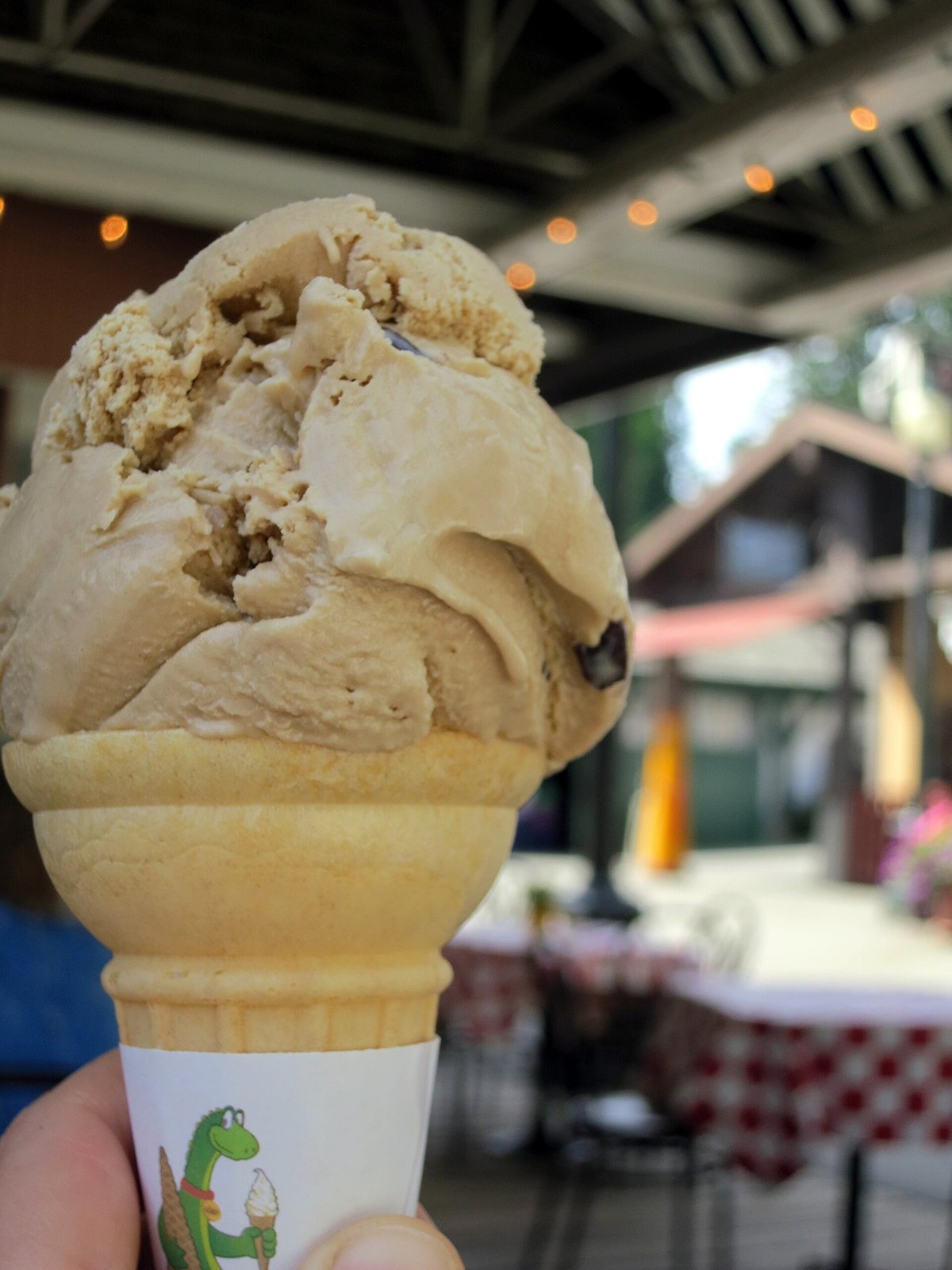
Recipe: Coffee Cabinet (Rhode Island Coffee Milkshake).
Hot, iced and with alcohol
| Drink | How | Source |
|---|---|---|
| Hot coffee milk | 2 Tbsp syrup in a cup of warm (not boiled) milk. Dave’s adds ½ tsp ground ginger, ¼ tsp cinnamon and nutmeg for a gingerbread version. | Dave’s syrup recipes |
| Iced coffee, sweetened | A tablespoon of coffee syrup sweetens an iced coffee without diluting the coffee taste, the one place it beats simple syrup. | — |
| Affogato | Cold syrup over vanilla ice cream. Recipe. | Dave’s |
| ”Dirty” espresso martini | 2 oz coffee syrup, 2 oz vodka, 2 oz strong coffee, shaken a full minute; cocoa rim. | Dave’s |
| The Wired Friar | Equal parts coffee syrup, Frangelico and vodka, a splash of half-and-half. | Dave’s; Edible Rhody |
| Coffee-syrup old fashioned | 1½ oz coffee syrup, 2 oz rye, 3–4 dashes Angostura, a splash of soda, lemon twist. | Dave’s |
| Coffee Milk Stout | Narragansett and Autocrat’s beer, 2013–14. | Beverage Business |
A coffee-syrup cocktail is much sweeter per ounce than one made with a coffee liqueur, which is why the recipes balance it with an equal measure of unsweetened coffee or spirit.
Cooking and baking with coffee syrup
Coffee syrup does two jobs in a kitchen at once: it sweetens, and it adds a roasted, bitter-edged coffee flavour. That makes it a substitute for brown sugar, molasses, honey or maple syrup wherever a dark, slightly bitter sweetness belongs, and for some of the coffee in recipes that would otherwise need brewed coffee and sugar. The Cooking with Coffee page covers coffee as an ingredient in general.
Savoury. Glazes and sauces for pork, chicken and ribs, where the sugar caramelises and the coffee reads as smoke and roast. Brush it on in the last 10 to 15 minutes only; earlier, the sugar burns.
- Coffee Syrup Barbecue Sauce, from Dave’s Coffee’s recipe: 1½ cups of syrup with tomato paste, mustard, hoisin, vinegar and spices.
- Coffee Syrup Jerk Chicken: syrup in place of brown sugar in a jerk marinade, then brushed on as a glaze.
- Glazed carrots: sauté sliced carrots in olive oil, add ⅓ cup syrup and cook about 3 minutes until glossy (Dave’s).
Sweet.
- Coffee Syrup Affogato and Glazed Pecans.
- Roasted pears and baked apples (Dave’s): pears browned in butter, drizzled with ¼ cup syrup and baked 10–15 minutes at 400 °F; apples stuffed with oats, nuts and brown sugar, ⅓ cup syrup poured over, baked 35–40 minutes at 350 °F.
- Ice cream: swirled into vanilla as it comes out of the machine, or as the coffee in a coffee ice cream base. Warwick Ice Cream and Autocrat made a coffee milk ice cream together in 2015 (Wikipedia).
- Frosting and glazes: replace the milk in a buttercream or a powdered-sugar glaze with coffee syrup, a tablespoon at a time. There is no published tested ratio; start with 2 tablespoons per cup of powdered sugar.
- Panna cotta, puddings and custards: a spoon of syrup in the bottom of each glass before the cream sets over it.
- Granola: as part of the binder, in place of some of the honey.
Substituting. One tablespoon of Autocrat carries 10 g of added sugar, about two and a half teaspoons. It swaps most easily for the same volume of maple syrup, honey or molasses. The colour is strong, and it browns fast in an oven or on a grill.
Making coffee syrup at home
Two methods are worth knowing. Both are in the recipe: Coffee Syrup (Rhode Island Style, Homemade).
| Quick (drip and reduce) | Slow (cold brew and reduce) | |
|---|---|---|
| Coffee | ½ cup (about 40 g) finely ground | 1 cup (about 85 g) coarsely ground, dark roast |
| Water | 2 cups, brewed in a drip machine | 3 cups, steeped 12–18 hours, strained |
| Sugar | 1 cup | 1 cup cane sugar (+1 Tbsp corn syrup, optional) |
| Cook | Boil, then simmer until reduced by half, about 30 minutes | Simmer 20–30 minutes to about 1 cup |
| Yield | About 1 cup, 8 glasses of coffee milk | About 1 cup |
| From | Taste of Home, copied by What’s Cooking America | Dave’s Coffee’s description of its own method; ratios are an adaptation for this site, untested by the maker |
| Taste | Stronger roast, more bitter edge | Smoother, rounder, less bitter |
Some practical points:
- It thickens as it cools. A syrup that looks right in the pan will set too stiff in the fridge. Stop when it coats a spoon.
- Do not boil hard at the end. As the syrup thickens it scorches easily on the bottom of the pan, and burnt sugar on top of dark roast tastes harsh. Keep it at a gentle simmer.
- Corn syrup stops crystals. Homemade sugar syrups can crystallise in the fridge; a spoon of corn syrup (mostly glucose, which gets in the way of sucrose crystals) prevents it. Warming the jar in hot water also fixes it.
- Brew strong, not long. Over-extracted coffee (very fine grounds, long steep, hot water) gets bitter, and reducing it concentrates the bitterness along with everything else. See Troubleshooting.
- Decaf works, for a children’s coffee milk with no caffeine to speak of.
Keeping it safely
- Refrigerate it, in a clean, closed jar, and use it within about two weeks. Both published recipes give that figure; it is a sensible limit, not a laboratory-tested shelf life.
- The commercial bottle says the same: Autocrat’s label says “Refrigerate after opening”, and it contains a preservative a homemade syrup lacks.
- Mould and yeast are the realistic risks, not botulism. A syrup of one part sugar reduced into about one part liquid is roughly 55–60% sugar, an estimate, which slows microbes without stopping them (jam needs 65% or more to keep at room temperature). Throw it out if it grows mould, fizzes, or smells sour or alcoholic.
- The cold-brew worry does not carry over. The botulism concern about cold brew, raised by Cornell’s Food Venture Center in 2017, is about unheated, unsweetened coffee sealed in low-oxygen packaging, nitro cans and growlers, at room temperature (Cornell, 2017). A 2023 challenge study for the National Coffee Association found no growth of C. botulinum or other pathogens in black cold brew held at 85 °F for 11 days (Daily Coffee News, NCA). A syrup has been boiled, which pasteurises it, and its sugar ties up the water. Still: make cold brew with clean equipment, and keep the concentrate cold until it goes into the pan. The University of Georgia’s extension note explains why.
- There is no tested home-canning process for coffee syrup. The National Center for Home Food Preservation has none, so a sealed jar on the shelf is untested. Keep it in the fridge, or freeze it in small portions.
Selling homemade coffee syrup is a separate question. In Michigan, MDARD’s cottage-food list says “No simple syrups”; the Michigan Rules and Syrups pages cover what a home kitchen may and may not sell.
Where to buy it (October 2026)
| Where | What | Price seen |
|---|---|---|
| Dave’s Coffee, online | Original Rhode Island Coffee Milk Syrup | $18.00 for 16 oz; $36.00 for four 8 oz bottles (Dave’s) |
| Walmart, online | Autocrat 32 oz | About $15 (Walmart listing, October 2026). A 2023 deal thread put the regular price near $12 (Slickdeals) |
| New England supermarkets | Autocrat, Eclipse, often Dave’s | Stop & Shop, Market Basket, Shaw’s and others in Rhode Island and southeastern Massachusetts stock it beside the chocolate syrup |
| Amazon and eBay | Autocrat, Eclipse, Dave’s | Usually with a heavy shipping markup on 32 oz plastic bottles; a 2023 commenter put eBay at $12–15 shipped |
| Whole Foods, some stores | Morning Glory | About $7 (Gear Patrol, dated) |
| Rhode Island gift and souvenir shops | Autocrat, Dave’s, often in gift sets with mugs | — |
Outside New England, the easiest routes are a maker’s own online shop or a homemade batch.
What is not known
- Who made the first coffee syrup, and when. The 1926 Arabian brand in the Ice Cream Trade Journal is the earliest reported; nothing earlier has been documented.
- When Autocrat began making syrup. Sources say the 1930s, the late 1930s and the 1940s.
- The full recipes of the early syrups. Trade papers show they were brewed from roasted coffee; no complete pre-1970s ingredient list is known.
- Why a milkshake is a “cabinet”. Undocumented.
- How long homemade coffee syrup really keeps. No shelf-life study exists; the two-week figure is a published recipe’s, not a laboratory’s.
- How much coffee is in the commercial syrups. The labels list “coffee extract” without a strength, so there is no published figure for Autocrat’s caffeine.
The cousins: coffee at the edge of coffee
Coffee syrup belongs to a family of coffee products and drinks that sit just outside the cup most people make: concentrates, substitutes, stretched or sweetened coffees, and coffee made into food. Nine have their own pages: Camp Coffee, Manhattan Special and Coffee Sodas, Mazagran, Postum and Coffee Substitutes, Café HAG, Sanka and the Story of Decaf, Kaffeost, Kopi Joss, Qishr and Coffee Liqueurs, Irish Coffee and Coffee Cocktails.
Camp Coffee and British coffee essence
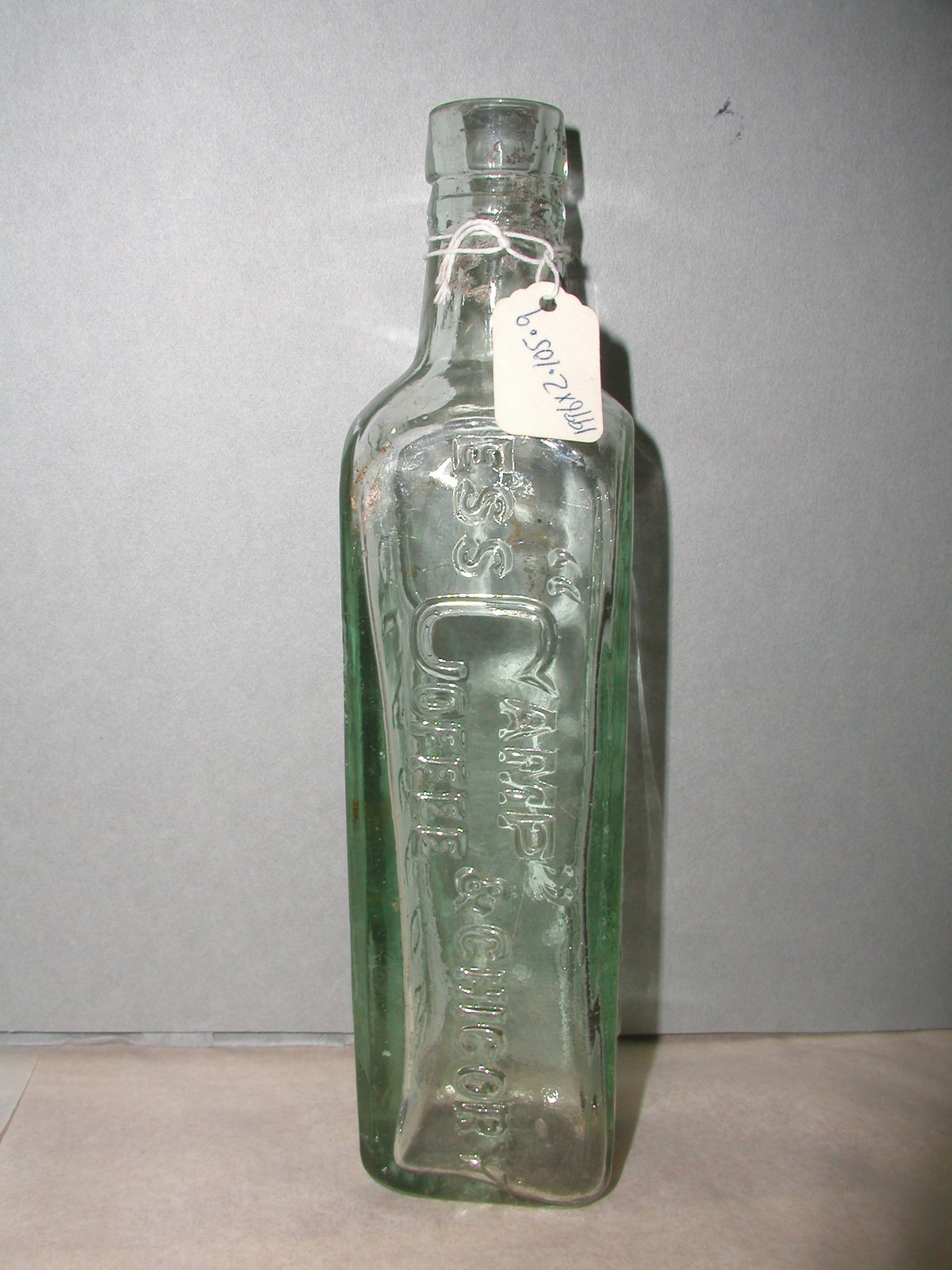
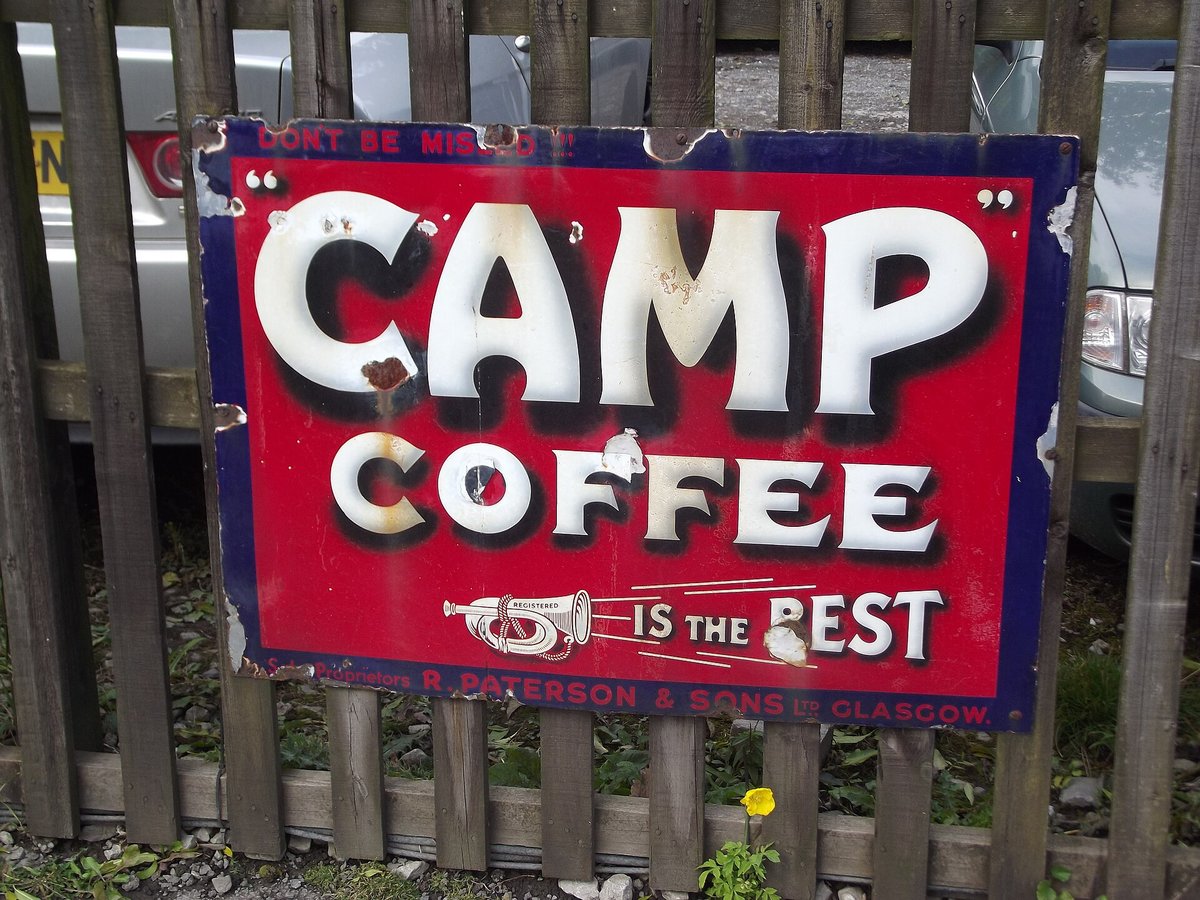
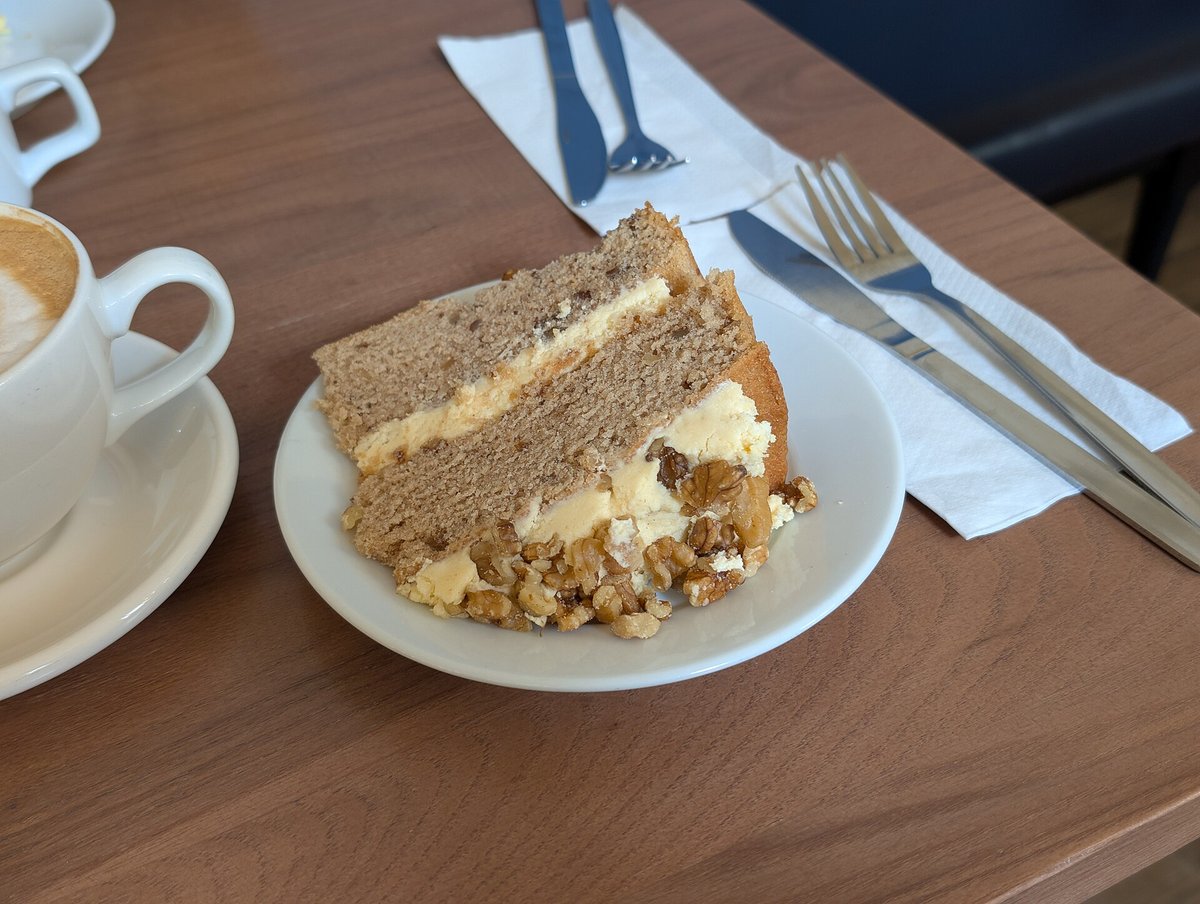
Camp Coffee is Britain’s nearest thing to coffee syrup: a dark, sweet liquid of sugar, water, chicory extract (25%) and coffee extract (4%), made in Glasgow by R. Paterson & Sons since at least the 1880s (the company says 1885; other accounts say 1876) (Wikipedia). It was sold as instant coffee for soldiers and households before instant coffee existed, stirred into hot milk or water. Today it is mostly a baking ingredient: British cooks reach for it to flavour coffee icing and the coffee and walnut cake. Its label, a seated Gordon Highlander served by a Sikh servant, was redrawn in 2006 to seat the two men as equals. With a quarter chicory and one part in twenty-five coffee, it is closer to chicory coffee than to Rhode Island syrup. The whole story is on Camp Coffee.
More cousins
| Item | What it is | On this site |
|---|---|---|
| Manhattan Special | A sweet espresso soda, made in Brooklyn since 1895 from espresso, seltzer and sugar (Wikipedia). | Manhattan Special and Coffee Sodas |
| Mazagran | Coffee served in a glass, named after an 1840 siege in Algeria: black coffee and water in France, iced with lemon in Portugal, with rum in Austria. Starbucks and Pepsi tested a fizzy bottled one in 1995. | Mazagran |
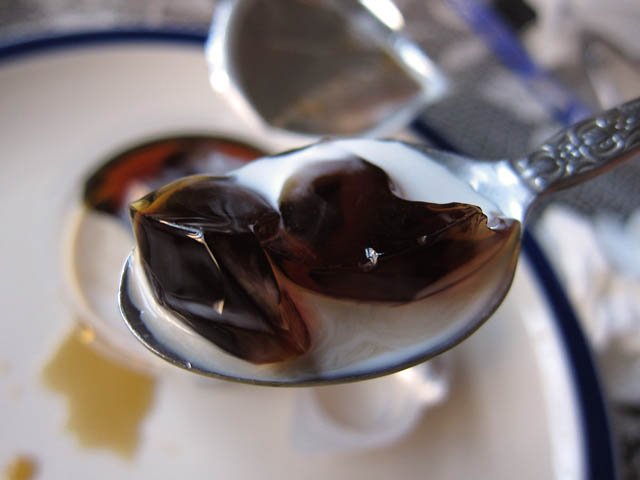
| Coffee jelly | Sweetened coffee set with gelatin, a nineteenth-century British dessert that became a Japanese café staple from the 1910s–20s (Wikipedia). | Cooking with Coffee; a 1944 Army recipe, Coffee Jelly |
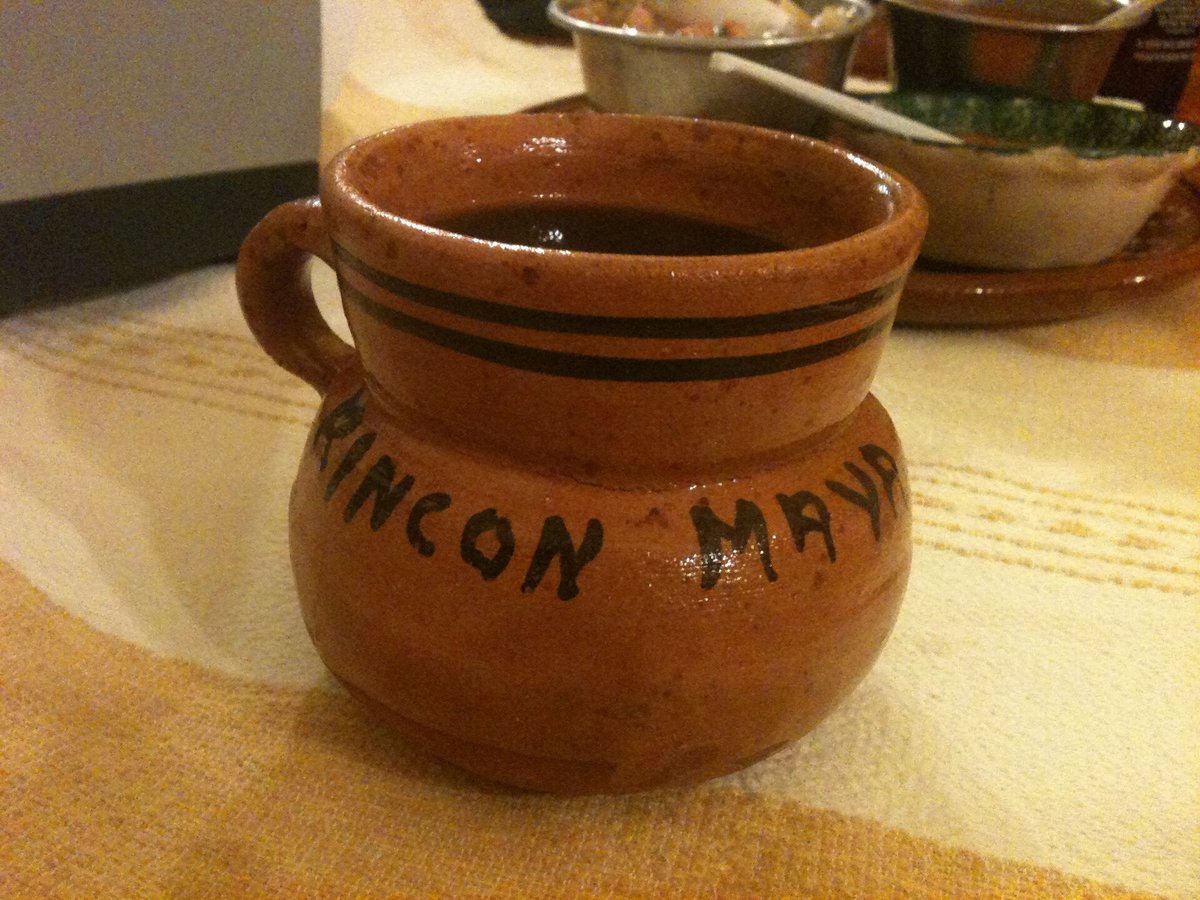
| Café de olla | Mexican coffee boiled in a clay pot with cinnamon and piloncillo. | Additions |
| Yuenyeung | Hong Kong’s coffee mixed with milk tea. | Additions |
| Egg coffee | Two unrelated drinks: Hanoi’s cà phê trứng (egg yolk whipped with sugar and condensed milk, from the late 1940s) and the American Midwest’s “Scandinavian” egg coffee (a raw egg stirred into the grounds to clarify a boiled pot). | Mentioned in Additions |
| Salt coffee (cà phê muối) | Coffee under a salted cream, from Huế, 2010. | Additions |
| Kaffeost | Baked bread cheese (leipäjuusto) cut into hot coffee in northern Finland and Sweden, eaten with a spoon. | Kaffeost |
| Postum and coffee substitutes | C. W. Post’s wheat-bran-and-molasses drink from Battle Creek, 1895; German malt coffee and Muckefuck; Italian barley coffee; dandelion root coffee. | Postum and Coffee Substitutes |
| Café HAG | The first commercial decaf, Ludwig Roselius, Bremen, 1906; sold in France and the US as Sanka. | Café HAG, Sanka and the Story of Decaf |
| Coffee leaf tea and cascara | Teas from the coffee plant’s leaves and from the dried cherry. | Beans (cascara) |
| Kopi luwak | Coffee passed through a civet. | Myths and Corrections |
Sources
- Rhode Island General Assembly, R.I. Gen. Laws § 42-4-15, Official state drink.
- Federal Reserve Bank of Boston, Regional Review, “Letter from Providence, Rhode Island”, Winter 1997.
- Newport Historical Society, Autocrat and Brownell & Field Co. (2012).
- Quahog.org, Coffee Milk.
- Wikipedia, Coffee milk, Coffee cabinet, Autocrat, LLC, Camp Coffee.
- Yankee / New England Today, Coffee Milk.
- Boston.com Wickedpedia, Coffee milk.
- NPR The Salt, via WUWF, What’s in that coffee cabinet? A delicious taste of Rhode Island history (2016).
- Providence Business News, Local flavor (2004).
- Beverage Business, Narragansett and Autocrat Coffee Milk Stout (2013).
- Edible Rhody, Local elixir turns mixer.
- Dave’s Coffee, coffee syrup and syrup recipes.
- Gear Patrol, The best coffee syrups.
- Open Food Facts, Autocrat Coffee Syrup.
- Sporked, What is coffee milk? (2022).
- Boston Globe, Autocrat coffee syrup (2025).
- Dave’s Coffee, Dave’s story.
- Trade journals, via Google Books: Ice Cream Trade Journal (1919, 1930), The Milk Dealer (1927), National Bottlers’ Gazette (1939), Ice Cream Field (1940), Connecticut Agricultural Experiment Station food reports (1949–59), The Glass Packer (1951–52), Television (1954), Tea & Coffee Trade Journal (1954), Thomas Food Industry Register (1999).
- Taste of Home, Coffee Syrup; What’s Cooking America, Coffee Milk.
- Cornell Food Venture Center, Cold brew coffee (2017).
- Daily Coffee News, NCA white paper builds a case for in-store cold brew safety (2023); National Coffee Association, Cold Brew White Paper.
- University of Georgia CAES, Can cold brew coffee make you sick? (2024).
- The Takeout, What is coffee milk?.
- Wikipedia, Manhattan Special, Mazagran, Coffee jelly, Postum, Coffee substitute, Café HAG, Moxie.
Comments (0)