Somalia & South Africa
I ate breakfast in Mogadishu (don’t ask why I have been there) and in South Africa.
Two countries, and two completely different kinds of honesty required.
Somalia’s kitchen records two different kinds of arrival — a thousand years of Indian Ocean trade, and forty years of Italian colonialism — and those are not the same thing. Blurring them into a generic “influences” mush would be lazy and it would be wrong.
South Africa’s street food carries origin stories that are politically loaded, universally retold, and almost entirely undocumented. The most famous one is anachronistic — the dates don’t work. But swinging the other way and dismissing segregation’s role would be its own distortion.
The defensible position, and I’ll hold it on both: these are foods of constrained communities, and the specific origin anecdotes are undocumented. Both halves of that sentence matter.
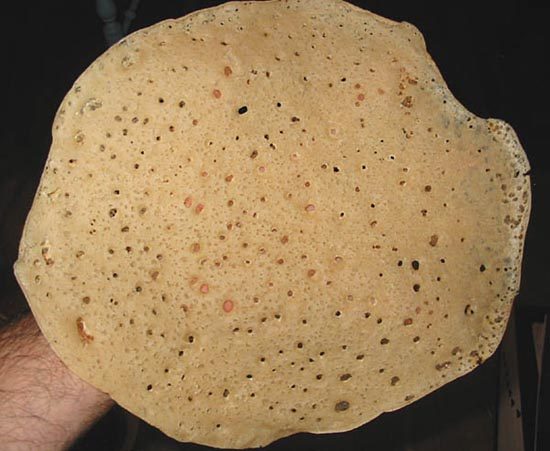
Canjeero: the actual Somali breakfast, and the one almost every English-language list leaves out in favour of the samosa.
Mogadishu
⚠ First, a correction to my own plan
My original list for this page didn’t include canjeero. That was the mistake, because canjeero is the actual Somali breakfast.
Sambuus, sabaayad and baasto are all real and all eaten. But canjeero is what Somalis actually eat in the morning — daily, the way injera is eaten in Ethiopia. Leaving it out and leading with the samosa is like writing about English breakfast and leading with the mushroom.
So it leads.
And there’s a clean spine running through this whole section, worth stating openly: three of these four dishes are foreign in origin, and all four are now unambiguously Somali.
Canjeero / laxoox / lahoh
(The c is silent.)
What it is: a fermented pancake — spongy, holed, tangy. Essentially a sourdough crêpe. The everyday Somali breakfast.
The name splits regionally: canjeero in the south, Mogadishu included; laxoox / lahoh elsewhere. Eaten across Somalia, Djibouti, Yemen, and parts of Ethiopia and Kenya — which is itself a map of the region’s connections.
Related to injera, and distinctly different:
| Canjeero | Injera | |
|---|---|---|
| Size | Smaller | Larger |
| Thickness | Thinner and softer | Thicker, spongier |
| Ferment | ~1 day | Usually a couple of days |
| Sourness | Less sour | More sour |
| Grain | Sorghum, corn/white cornmeal, wheat | Teff |
So: a cousin. Fermented briefly, milder, and eaten as a personal-sized pancake rather than a shared tablecloth. That last difference is bigger than it looks — it changes the whole social shape of the meal.
How it’s actually eaten: for breakfast with subag (Somali ghee) and sugar or honey — that’s the everyday one. Or with sesame oil. Or savory, with beer (liver and onions), suqaar (diced stir-fried meat), or odkac/muqmad (dried preserved meat). Tea alongside.
I run a sourdough starter, so I’ll say the obvious thing: this is a wild ferment doing what my starter does, on a one-day clock — and the tang is the point rather than a side effect.
RECIPE — Canjeero (makes ~12)
- 150 g sorghum flour (the preferred flour for laxoox)
- 100 g white cornmeal / corn flour
- 100 g all-purpose flour
- 1 tsp instant yeast
- ½ tsp salt
- ~700 ml warm water
- (A few tablespoons of batter saved from a previous batch — the traditional starter — gives a better, more sour result than yeast alone. Same principle as any back-slopped ferment.)
- Whisk the flours, yeast and salt; whisk in the warm water to a thin, smooth, pourable batter — thinner than pancake batter, about like heavy cream.
- Cover and ferment somewhere warm for 8–12 hours. Overnight is best. It’s ready when it’s bubbly with a mild sour aroma. ⚠ Don’t rush this. The holes and the tang are the whole point — a fast canjeero is just a thin pancake.
- Stir gently, add salt if needed. If it’s very thick, loosen with warm water.
- Non-stick or well-seasoned pan over medium, ungreased or barely greased.
- Pour ~80 ml in the center and swirl outward in a spiral.
- Cook ONE SIDE ONLY, ~1.5–2 min — until the top is set, dry, and covered in fine holes. Do not flip. The holed top surface is the finished face; it’s what you’re making.
- Stack under a towel.
Serve hot, with subag or ghee and a spoon of sugar or honey. Or roll it around suqaar.
→ Full recipe: Canjeero
Sambuus — and the Indian Ocean trade route
What it is: the Somali samosa — a triangular pastry of spiced minced meat, usually beef or goat, with onion and chili, deep-fried. A Ramadan fixture for iftar, and a breakfast and snack food year-round.
The history here is genuinely well-documented — unusually so for this dossier, and I want to spend the space on it because it’s the good stuff:
- The samosa family is Middle Eastern / Persian in origin, not Indian. Start there, because most people don’t.
- The earliest ancestor is the sanbusaj — praised by the Abbasid-era poet Ishaq al-Mawsili (d. 850), which is the earliest known mention. Recipes appear in 10th–13th-century Arab cookery books as sanbusak / sanbusaq / sanbusaj, all from the Persian sanbosag.
- The medieval precursor was baked, not deep-fried.
- From there it spread along trade routes in every direction: to India (as the samosa), and along the Indian Ocean coast, making a permanent home in Somalia, Ethiopia and Yemen.
- Somalia specifically: through Indian Ocean trade from the 13th to 16th centuries, Somali cuisine took on curry-like seasonings and precursors to samosas, known locally as sambuus.
And the name is the evidence. You don’t need a document — you can hear it:
sanbosag → sanbusaj → sambuus → samosa
All the same word. The trade route is in the vocabulary.
Why this matters for how I’m writing it: Somalia’s coast was a node in a maritime commercial network running from the Persian Gulf to India to the Swahili coast for over a thousand years — a relationship of trade and exchange, in which Somali merchants were participants, not recipients.
Sambuus isn’t a foreign thing that landed in Somalia. It’s a shared possession of the whole Indian Ocean world, and Somalia is one of its homes.
Hold onto that, because it is the exact opposite of the baasto story below, and the contrast is the entire point of this section.
RECIPE — Sambuus (makes ~24)
Wrappers: ⚠ practical truth — almost everyone uses spring-roll pastry (or samosa patti), and Somali cooks in the diaspora certainly do. Use it. If you want to make your own: 300 g flour, 1 tsp salt, 2 Tbsp oil, ~150 ml water — knead, rest 30 min, roll paper-thin, cut into 8 × 20 cm strips.
Filling
- 500 g ground beef or goat
- 1 large onion, minced fine
- 3 cloves garlic, minced
- 1–2 green chilies, minced
- 2 tsp xawaash (below)
- 1 tsp ground cumin
- ½ tsp turmeric
- Handful cilantro, chopped
- Salt, black pepper
- 2 Tbsp oil
Xawaash (خواش) — the Somali spice blend. Make it. It’s the flavor of the whole cuisine.
Toast whole, then grind: 4 Tbsp cumin seed, 4 Tbsp coriander seed, 1 Tbsp black peppercorns, 1 Tbsp cardamom seeds, 1 tsp cloves. Then add, after grinding: 2 Tbsp ground turmeric and 1 Tbsp ground cinnamon. Keeps in a jar 6 months.
Sealing paste: 3 Tbsp flour + 3 Tbsp water, whisked to a glue.
Method
- Brown the meat hard in oil over high heat, breaking it up. Add the onion, garlic and chili; cook 5 min.
- Add the xawaash, cumin, turmeric, salt and pepper. Cook 5 min more, until completely dry. ⚠ Wet filling will burst the pastry in the fryer. Off heat, fold in the cilantro. Cool completely.
- Fold: take a strip, fold up a corner to form a triangular pocket, keep folding along the strip to build the cone, spoon in ~1 Tbsp filling, continue folding to the end, seal the tail with the flour paste.
- Deep-fry at 175 °C / 350 °F, ~3–4 min, turning, until deep golden.
- Drain. Serve with basbaas — Somali hot sauce: blend 4 green chilies, 1 clove garlic, a handful of cilantro, the juice of 1 lime, ½ tsp salt, 2 Tbsp water.
Sabaayad
What it is: the Somali flaky layered flatbread — rolled, oiled, folded, flattened, and pan-fried so it separates into buttery leaves. Very similar to the paratha, and not by accident.
The history — the trade route again, plus a second, later layer:
Sabaayad’s flakiness reflects paratha-like techniques introduced via Indian, Arab and Swahili traders along the Somali coast, adapted to East African staples. Then a more recent layer: during the colonial era, Indian laborers brought to East Africa introduced roti and chapati more widely.
And Somalis call it sabaayad — and also, revealingly, Somali chapati. The second name carries its own history. A food can be fully yours and still say where it came from, out loud, every time you order it.
RECIPE — Sabaayad (makes 8)
From Xawaash, the standard Somali source.
- 3 cups (~375 g) all-purpose flour
- 1 cup (~120 g) whole wheat flour, sifted
- 2 Tbsp canola oil
- 1 tsp baking powder
- 2 Tbsp sugar
- 1 tsp salt
- 2 cups hot milk ← the distinguishing move. Hot, not warm.
- ~1¼ cups oil for cooking
- Sift the whole wheat flour; combine all the dry ingredients, then the oil and the hot milk. Knead 5 min by mixer, or 15 min by hand.
- Smear 1 Tbsp oil over the dough, put it in a plastic bag, and rest 30–45 min.
- Divide into 8. Roll each into a rectangle, spread 1 Tbsp oil over the surface, then fold to create layers — fold in thirds like a letter, then in thirds again, or roll it into a rope and coil it. Rest briefly, then roll out again to ~18 cm.
- Preheated skillet on medium. Lay it on; ~1 minute until bubbles form; flip and add 1 Tbsp oil underneath.
- Reduce heat to low. Press the edges down with a spatula or a folded towel. Flip again with more oil, then flip 4–5 more times without adding oil.
- Total cooking time: 4–5 minutes.
- Store in a covered container — the trapped steam keeps them warm and tender. (Leave them uncovered and they stiffen.)
Serve with tea, honey, ghee, or suqaar.
→ Full recipe: Sabaayad
Baasto — the Italian colonial legacy
What it is: pasta. Baasto is simply the Somali word for it — usually spaghetti, served with suugo, a thick spiced tomato-and-meat sauce. It is described as a de facto national dish of Somalia.
The history, stated plainly
- Italy held colonial territory in the Horn of Africa from the late 19th century to the 1940s — from present-day Eritrea, down the Red Sea coast to Somalia, and inland to Ethiopia. These territories were seized, ruled or occupied.
- Italian Somaliland ran from 1889 to 1941, ending in military defeat by the British, followed by a UN trusteeship under Italian administration until Somali independence in 1960.
- Pasta arrived with that colonization. That’s uncontested, and there’s no reason to soften it.
I’m not going to erase this. Baasto is not a coincidence or a culinary curiosity. Pasta is in Mogadishu because Italy colonized Somalia. Saying “Italian influence,” as though it were a cultural exchange between equals, would be false. It should be named: this is a colonial inheritance.
And I’m not going to dwell on it either, because what Somalis did with it is the more interesting half, and it’s a story of agency, not victimhood. Somali cooks took the pasta and made it thoroughly their own:
- Suugo is spiced with xawaash — cumin, cardamom, coriander, cinnamon, cloves, turmeric. That is not an Italian sauce.
- The additions are “decidedly non-Italian”: cilantro, tamarind, and xawaash’s sweet-spicy profile.
- It’s eaten with a banana. A whole ripe banana on the side of the plate, eaten in alternating bites with the pasta. Universal in Somalia and utterly unrelated to anything Italian.
- And it’s eaten with the right hand, often alongside canjeero, in a Somali meal structure.
The line I’d land it on:
Italy brought the noodle. Somalia made the dish.
Baasto is what a colonized people did with what was imposed on them: they took it, spiced it with their own masala, put a banana next to it, and made it a national dish on their own terms. That’s neither an erasure of the colonialism nor a wallow in it. It’s what actually happened.
And now put it next to sambuus. Two foreign foods, both fully Somali. One arrived through a thousand years of trade in which Somali merchants were participants. The other arrived at the point of a gun. Both are on the same breakfast table, and the difference between how they got there is not a detail — it’s the whole history of the Horn of Africa, on a plate.
RECIPE — Baasto iyo suugo (serves 4)
- 500 g spaghetti
- 500 g ground beef or diced goat
- 1 large onion, diced
- 4 cloves garlic, minced
- 2 Tbsp xawaash (recipe above)
- 1 tsp ground cumin
- 400 g tinned crushed tomatoes
- 2 Tbsp tomato paste
- 1 tsp tamarind paste (the non-Italian move — do not skip)
- 1 green chili, minced
- 500 ml stock or water
- 3 Tbsp oil
- Large handful cilantro, chopped
- Salt, pepper
- 4 ripe bananas, to serve ← not a garnish. Not optional. Part of the dish.
- Brown the meat hard in oil. Add the onion, cook 8 min until soft and golden. Add the garlic and chili, 2 min.
- Add the xawaash and cumin; fry 2 min until fragrant — bloom the spice in fat, don’t just stir it into liquid.
- Add the tomato paste, cook 2 min; then the crushed tomatoes, tamarind and stock.
- Simmer 40–50 min, uncovered, until thick and the oil separates and pools at the edges. That separation is the doneness signal. Season.
- Fold in most of the cilantro off the heat.
- Boil the spaghetti in well-salted water to al dente. Drain.
- Plate the pasta, ladle the suugo over, remaining cilantro on top, and a whole peeled banana alongside. Eat them together — the sweetness against the spice is the entire reason it’s there. If you leave the banana off because it seems strange, you’ve made a different, worse dish and you don’t get to have an opinion about it.
South Africa
⚠ Read this before the recipes
South African street food’s origin stories are politically loaded, widely retold, and poorly documented. The apartheid narrative attached to bunny chow and kota is repeated everywhere, almost always without a source, and in its most common form it is anachronistic.
Two failure modes here, and I’m trying to avoid both:
- Don’t repeat the unsourced version.
- Don’t swing the other way and dismiss segregation’s role. That would be its own distortion. Segregation in South Africa long predates the 1948 apartheid state, and its role in shaping these foods is real even where the specific stories aren’t documented.
Bunny chow — the most careful writing on this page
What it is: a hollowed-out loaf of white bread — quarter, half or full — filled with curry (bean, mutton, chicken), with the excised bread — “the virgin” — on top for dipping. Durban.
What’s actually documented:
- ✅ It originated among Indian South Africans in Durban.
- ✅ Its creation is dated to the 1940s.
- ✅ “The precise origins of the food are disputed” — that’s Wikipedia’s own framing, and it’s correct.
- ✅ It was sold in Gwelo, Rhodesia (now Gweru, Zimbabwe) during World War II. A striking, underused fact, and it does real work below.
The competing accounts — there are at least four, and no source picks a winner
-
The Banias / Kapitan’s etymology. A Durban restaurant run by Banias — an Indian merchant caste — called Kapitan’s, on the corner of Victoria and Albert streets, is said to have created it. The name follows the caste: bania is from the Sanskrit for merchant, and “from the bania man shop came the bunny man shop, and from bunny man shop came the bunny chow.” This is the most linguistically satisfying account, and it means “bunny” has nothing to do with rabbits — which is worth stating outright, because every reader assumes it does.
-
The golf caddies. Indian golf caddies couldn’t get from the course back to Grey Street for lunch, so friends brought food out to them; lacking containers, a restaurant owner poured the curry into a loaf. A variant ties it to caddies not being allowed to carry sharp cutlery in public.
-
The sugar plantation workers. Migrant Indian laborers on the KwaZulu-Natal sugar cane plantations needed a fast portable meal in short breaks, and hollowed out bread as a container.
-
The beggars / leftovers. At day’s end, beggars asked for leftover food; cooks without time to make sandwiches dug out bread and filled it with curry.
⚠ The apartheid story — here is the careful version
The widely-told claim: bunny chow was invented as a way to sell food to Black customers who weren’t allowed inside restaurants under apartheid; the bread was the plate, so nothing had to be returned.
Why this is wrong as usually stated — and it’s the dates that do it:
- Bunny chow is dated to the 1940s. Apartheid was formalized in 1948.
- And it was already being sold in Gwelo, Rhodesia — a different country — during WWII (1939–45).
A dish that had already crossed an international border before 1948 cannot have been caused by a 1948 South African law.
- The Daily Maverick’s 2024 piece on exactly this question is worth citing for its honesty: it is an opinion piece that concedes Googling the origins produces “interesting history and stories (but not verified).” A national outlet, writing directly about the origin question, could not find documentation. That’s the finding. Not a failure of their reporting — a fact about the record.
But here’s what I must not do: overcorrect. Segregation is not the same as apartheid, and it did not begin in 1948.
- Indians in Durban were subject to ghettoization and legal restriction long before the National Party took power — the Natal Indian community had been fighting discriminatory legislation since the 1890s.
- Wikipedia’s careful phrasing, worth quoting in full: “There are competing theories as to the development of bunny chow in the mid-20th Century, though the ghettoization of Indians in Durban and the restrictions placed upon them by the dictates of apartheid feature heavily in each.”
So the precise statement is this: segregation is the context of all four accounts. The 1948 apartheid statute is not the documented cause of any of them. And the dish’s subsequent life — becoming a food that crossed South Africa’s racial lines when little else did — genuinely does belong to the apartheid era.
If I had to compress the whole thing into one paragraph:
Bunny chow comes from Durban’s Indian community in the 1940s — everything past that is contested. You’ll read that it was invented so Black customers who couldn’t enter restaurants could be served through a window, the bread standing in for a plate. It’s the most-told version and there’s no source for it; it also sits awkwardly with the dates, since the dish was already being sold in Rhodesia during the Second World War, before apartheid was law in 1948. What’s not in doubt is the setting: Durban’s Indian community was ghettoized and legally restricted for decades before 1948, and every competing origin story — the Bania merchants’ café, the golf caddies, the cane workers, the beggars at closing time — is a story about people improvising around constraint. The bread bowl is what that constraint produced. And “bunny” isn’t a rabbit: it’s most likely a corruption of bania, the merchant caste who ran the shop.
⚠ NOT FOUND: documentation for any of the four origin accounts, or for the apartheid-causation story. If you want to go deeper, the scholarly references Wikipedia cites are Jaffrey (2003), Kraig & Sen (2013) and Hajratwala (2009) — print, and the only real route to documentation.
RECIPE — Bunny chow (mutton), serves 4
Durban mutton curry
- 1 kg mutton or lamb, bone-in, cut into chunks (bone-in matters — it’s a long braise)
- 3 Tbsp oil
- 2 large onions, sliced
- 1 cinnamon stick, 4 cardamom pods, 4 cloves, 2 bay leaves, 1 star anise
- 1 Tbsp ginger-garlic paste
- 3 Tbsp Durban masala (a hot, fiercely red, chili-forward blend — this is the specific spice of the dish. Substitute 2 Tbsp Kashmiri chili powder + 1 Tbsp garam masala + 1 tsp cumin + 1 tsp coriander.)
- 1 tsp turmeric
- 2 tomatoes, grated
- 3 medium potatoes, halved
- 1 tsp salt
- 400 ml water
- A sprig of curry leaves
- Cilantro to finish
Plus: 2 unsliced white loaves; grated carrot salad or sambals (tomato + onion + chili) to serve
- Heat the oil; fry the whole spices 30 sec until they crackle. Add the onions; cook 10–12 min to deep golden. Take your time here — it’s the base.
- Add the ginger-garlic paste, 1 min. Add the Durban masala and turmeric; fry 1 min in the oil to bloom it.
- Add the mutton; brown and coat, 5 min. Add the grated tomato and salt; cook 5 min until the oil separates.
- Add the water and curry leaves. Cover; simmer 1 hr 15 min.
- Add the potatoes; simmer 30–40 min more, uncovered toward the end, until the mutton is falling off the bone and the gravy is thick. ⚠ It must be thick, or it will destroy the bread. This is the single most important instruction in the recipe — every structural failure of a bunny chow is a gravy that was too loose.
- Cut the loaf into quarters (or halves). Hollow each out, leaving ~2 cm walls. Keep the removed bread — that’s the “virgin” — and sit it on top.
- Fill with curry right to the top. Cap with the virgin. Serve with carrot salad or sambals.
Eating it: no cutlery. Tear the virgin, dip, then eat inward, tearing off curry-soaked walls as you go. The bottom corner — maximum saturation — is the prize.
→ Full recipe: Bunny chow
Kota — Soweto’s township food
What it is: a quarter loaf of white bread, hollowed out, filled with slap chips (soft vinegary fries), polony, Russian sausage, cheese, atchar (Indian-style mango pickle), sometimes beef mince or mashed potato, plus an egg. Gauteng — Soweto and Johannesburg.
The name: kota is a township approximation of “quarter”* — a quarter loaf. Also spelled spatlo / sphatlho / s’phatlo; skhambane is another term. In Cape Town the analogous item is the Gatsby; in Pretoria, the s’phatlo.
The history:
- The relationship to bunny chow is the interesting part: “it was probably by way of Zulu men who came to work on the mines that the basic idea of the bunny was transported to Gauteng and reimagined as the kota.” Migrant labor carried the concept inland from Durban, where Black workers adapted it — swapping Indian curry for the fillings of the township corner shop.
- ⚠ “Probably.” That’s the sources’ own hedge and I’m keeping it. This is a plausible reconstruction, not documentation. NOT FOUND: any confirmation of the mine-worker transmission.
- The Daily Maverick’s “Bunny Chow vs Kota — who owns it, Soweto or Durban?” (2 Aug 2024) covers this dispute directly. ⚠ Read it for what it is: the author openly declares a bias toward Soweto’s claim, offers no dates or documentation, and admits searching turned up “interesting history and stories (but not verified).” It’s evidence that the dispute exists and is unresolved — not evidence for either side.
And the genuinely useful observation, from sandwich expert Jim Behymer, quoted there: the kota combines “elements of the polyglot cuisine of South Africa” — South Asian pickles (atchar), Russian sausages, Dutch braai traditions, Western European fried potatoes.
A kota is a map of everyone who ever came to South Africa, in one loaf.
That’s the thesis worth writing, and it’s better than any origin anecdote.
⚠ On the apartheid framing, same caution as bunny chow. You’ll read that kota, bunny chow, the Gatsby and the s’phatlo are “one of the last vestiges of apartheid — served in bread because it was more transportable, because it was illegal for Black people to eat in a restaurant or use cutlery.” Widely repeated, not documented. The “illegal to use cutlery” claim in particular is asserted without any citation and I am not going to repeat it as fact.
What is solid: these are foods of segregated, under-resourced communities, engineered for cheapness, portability and calories. That’s a true statement about apartheid-era South Africa, and it doesn’t need an invented statute to hold it up.
RECIPE — Kota (makes 4)
- 2 unsliced white loaves, quartered and hollowed
- Slap chips: 800 g potatoes, cut thick (~1.5 cm)
- Atchar: 4 Tbsp mango atchar
- 8 slices polony (South African bologna)
- 2 Russian sausages, halved lengthwise and griddled
- 4 slices processed cheese
- 4 eggs, fried
- Optional: 200 g beef mince, fried with onion and curry powder
- Tomato sauce (ketchup), mustard, chili sauce
- Optional: shredded lettuce, sliced tomato, atchar-brine drizzle
Slap chips — and “slap” (Afrikaans) means limp, which is the goal, not a failure:
- First fry: 140 °C / 285 °F, 6–8 min. They should be cooked through and pale — no color at all. Drain.
- Optional second fry: 180 °C, 1–2 min — only if you want a little structure. The authentic kota chip is soft, not crisp.
- Drain and douse with white vinegar and salt while hot. Non-negotiable.
Assembly — the order matters, it’s structural:
- Hollow the quarter loaf, leaving ~2 cm walls.
- Butter or atchar the inside walls. This waterproofs the bread. Skip it and the whole thing collapses.
- Chips first, packed to the bottom.
- Polony, Russian sausage, mince if using.
- Cheese on top of the hot filling so it melts.
- Fried egg on top of everything.
- Atchar, tomato sauce, mustard, chili.
- Cap with the bread lid. Wrap tightly in paper. Press.
Eat immediately, wrapped, from the paper.
Vetkoek — “fat cake”
What it is: deep-fried yeast dough — golden, hollow-ish, chewy. Split and filled with curried mince, or torn and eaten with syrup, honey, jam or cheese. Sweet or savory, and both are traditional. Eaten across South Africa by everyone; a genuine breakfast and anytime food.
The name is Afrikaans and transparent: vet = fat, koek = cake. Named for how it’s cooked, which is refreshingly honest of it.
The history:
- ✅ Solid: it traces to Dutch settlers at the Cape of Good Hope in the 17th century, who brought a tradition of fried dough breads similar to Dutch oliebollen. That lineage is straightforward and well-attested — vetkoek is recognizably an oliebol’s descendant.
- ⚠ Hedged: it’s “thought to have originated with the Voortrekkers” — the Dutch settlers who moved into the interior in the 1830s — who needed portable, durable food for long journeys. Note the hedge: “thought to.” The Voortrekker attribution is traditional, not documented — the same species of folklore as the rest of this page. NOT FOUND: documentation. The 17th-century Dutch fried-dough lineage is the solid part; the Great Trek story is the decorative part.
- And one more honest note: vetkoek is claimed and eaten across South Africa’s communities, and near-identical fried breads — magwinya, amagwinya, “fat cakes” — are staples in Black townships too. Framing it as exclusively Afrikaner would be inaccurate.
RECIPE — Vetkoek (makes 8)
- 500 g all-purpose flour
- 7 g instant yeast
- 1 tsp salt
- 1 Tbsp sugar (most recipes add sugar to speed the rise)
- ~300 ml lukewarm water
- Neutral oil for deep-frying
- Mix the flour, yeast, salt and sugar. Add the water; knead 8–10 min to a soft, smooth, slightly sticky dough.
- Cover; rise 1–1.5 hr, doubled.
- Knock back; divide into 8 balls of ~100–105 g. Flatten slightly into thick discs. Prove 20–30 min on a floured tray.
- Heat the oil to 170 °C / 340 °F. ⚠ The temperature is the whole recipe. 170 °C is “hot enough to crisp the outside quickly, cool enough that the inside cooks through before burning.” Hotter and you get a raw doughy center in a dark shell — the classic vetkoek failure.
- Fry in batches, 3–4 min per side, until deep golden brown. They’ll float and puff. Don’t crowd the pot.
- Drain on a rack — not paper. Paper steams the bottom soft.
To serve:
- Savory: split while hot, fill with curried mince — 500 g beef mince browned with 1 onion, 2 Tbsp curry powder, 1 grated tomato, 1 Tbsp chutney, 100 g peas, simmered 20 min.
- Sweet: tear it open and eat with butter and golden syrup, honey, apricot jam, or a slab of cheddar.
→ Full recipe: Vetkoek
What both countries have in common
A hollowed loaf in Durban. A pancake in Mogadishu. A samosa whose name is a thousand-year-old receipt.
Every dish on this page was made by people working around a constraint — a short break on a cane plantation, a colonial import you didn’t ask for, a corner shop with no plates. None of them were designed. All of them work.
And the honest version, in both countries, is the same: the setting is documented, the anecdote isn’t. I’d rather hand you a solid context and an admitted gap than a good story with nothing under it.
More at Breakfast Favorites and Why breakfast?. For the other end of the bread spectrum — a breakfast whose every component has been documented to death — see the Irish breakfast; and the tea that goes with the sabaayad is the same argument I make over in coffee.
Sources & further reading
Somalia
- Wikipedia — Lahoh — the sorghum batter and the regional names.
- Wikipedia — Somali cuisine
- Wikipedia — Samosa — Ishaq al-Mawsili, sanbusaj, the Persian sanbosag etymology, and the baked-not-fried precursor.
- Xawaash — Somali Chapati (Sabaayad) — the recipe used above; the standard Somali source.
- Travel Food Atlas — Canjeero (Anjero/Lahoh/Laxoox)
- Somebody Feed Seb — Somalian Canjeero (Lahoh) Flatbreads — the injera comparison.
- KQED — How Colonialism Brought a New Evolution of Pasta to East Africa — the best source on baasto, and the colonial framing done well.
- TasteAtlas — Baasto iyo suugo — the cilantro/tamarind/xawaash “decidedly non-Italian” note.
- Tastes from the Road — Baasto from Somalia
- Wikipedia — Somali maritime history
South Africa
- Wikipedia — Bunny chow — the 1940s dating, “precise origins disputed,” Gwelo/Rhodesia in WWII, Kapitan’s, the bania etymology, the caddies and plantation accounts. Cites Jaffrey (2003), Kraig & Sen (2013), Hajratwala (2009).
- NPR (The Salt) — Bunny Chow: South Africa’s Sweet-Sounding Dish Has A Not-So-Sweet Past — ⚠ listed but not read. The fetch timed out during research and I have not quoted it. It’s likely the best journalism on the question and should be read directly before anyone leans on this section further.
- Daily Maverick — Bunny Chow vs Kota: who owns it, Soweto or Durban? (2 Aug 2024) — ⚠ an opinion piece with a self-declared bias and no documentation, which admits its own stories are “not verified.” Cited for the dispute’s existence only. Jim Behymer’s polyglot-cuisine quote is here.
- Food52 — The Origins of Bunny Chow
- Culture Trip — The Mystery of Durban’s Signature Dish Bunny Chow — the “mystery” framing is itself the honest signal.
- Sandwich Tribunal — Durban Curry and Bunny Chow
- Sunday Times — Spathlo, bunny chow, skhambane: This is SA street food, Soweto style — national outlet, the terminology.
- Wikipedia — Vetkoek
- Sandwich Tribunal — South African Fry Bread: Vetkoek — the 100–105 g portioning, the simple dough, the sugar-for-speed note.
- Basecamp — Vetkoek History and Origins — the 17th-century Dutch / oliebollen lineage and the Voortrekker attribution.
Comments (0)