Shrimp and Grits
Yes, it’s breakfast. It was breakfast long before it was anything else, and the people who made it that way called it “breakfast shrimp.”
I’ve eaten it in Charleston and in New Orleans, and I went into this assuming that made me a tourist in one city and a heretic in the other — that Charleston owns it and New Orleans borrowed it. That turns out to be almost exactly backwards from what the printed record says, and the real story is better than either city’s version.
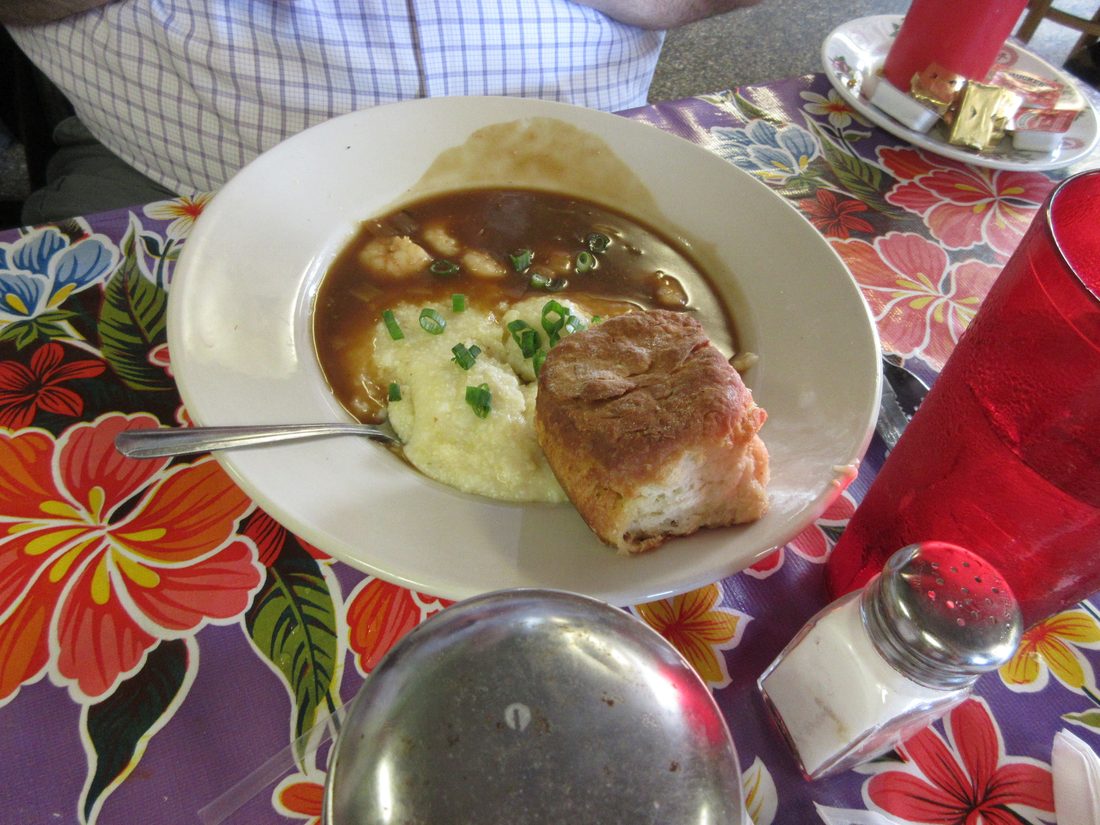
The 1930 original was four things: shrimp, butter, grits, salt. Everything else you see is an accretion — and the cream gravy is younger than Bill Neal.
It’s Gullah Geechee. That goes first.
The Gullah Geechee — descendants of West and Central Africans enslaved to grow rice in the Lowcountry of coastal South Carolina and Georgia — developed this dish. The earliest versions were fried shrimp, coated in flour, salt and pepper, served with a roux over a cereal grain: rice, millet, or corn.
And Michael Twitty, in The Cooking Gene, identifies the part that reframes it entirely. As corn travelled from the Americas to Africa, it was absorbed into the diets of the very populations later carried to the American South. In central and southeastern Africa, that corn was eaten as porridge — alongside shrimp.
The pairing of corn porridge and shrimp arrived already formed.
Twitty puts it more bluntly than I would dare to: “I don’t care what anyone says; shrimp and grits came from Mozambique.”
So the dish sits at a three-way confluence: Indigenous American corn (the Muskogee ground it in stone mills — that’s where the “gritty” comes from), African technique and taste, and Lowcountry shrimp.
“Breakfast shrimp” was a seasonal fisherman’s and home breakfast — eaten during shrimp season, with small creek shrimp caught free with a cast net. Not restaurant food. Something you ate because the creek was full and the corn was in the cupboard.
The 1930 recipe, and what it doesn’t contain
The famous printed version is “Shrimps and Hominy” in Two Hundred Years of Charleston Cooking, compiled by Blanche S. Rhett, 1930. It’s attributed to William Deas, Rhett’s African-American butler — the same man reputed to have created she-crab soup.
Here is the entire original, in spirit: shrimp, butter, grits, salt.
That’s it. No cheese. No mushrooms. No cream gravy. No andouille. No bacon. Today’s ubiquitous “shrimp and grits with cream gravy” is a 1990s invention — which makes it newer than Bill Neal’s restaurant version, not older. Everyone thinks they’re eating the old way. Almost nobody is.
⚠ Two source conflicts I’ll report rather than resolve. The book gets dated 1930 by most sources and the publisher, 1931 by Wikipedia (minor — I’m using 1930). And the number 78 gets garbled: one source says Deas was 78 years old; another says he ate the dish every morning in shrimp season for 78 years. Those are different claims and one is a transmission error — the “78 years old” reading looks like the original. I couldn’t check the 1930 book itself, so I’m giving you both. Either way the implication survives: the dish was routine in Charleston well before the Civil War.
The complication nobody mentions — and it’s your New Orleans plate
Here’s what I didn’t expect, and it’s why eating it in both cities isn’t the contradiction I thought.
New Orleans got there first in print — by about forty years:
- 1891 — a shrimp-and-grits recipe in a syndicated column in the Louisiana Review.
- 8 May 1895 — “Fried Lake Shrimp. Grillade. Hominy” on a menu in the New Orleans Times-Democrat.
Both predate the 1930 Charleston book by roughly four decades.
Handle that carefully, because it does not overturn the Gullah Geechee origin. Print lags practice by decades or centuries — especially for food cooked by people who were never published. The Charleston oral testimony reaches back further than either clipping.
But it does puncture the tidy “Charleston 1930 is the origin point” story, and it shows what was probably true all along: shrimp and corn porridge was a general Gulf-and-Lowcountry coastal Southern thing, not one city’s invention that another city copied.
Which means my two plates weren’t the original and the knockoff. They were two branches of the same tree, and the tree is older than both.
Bill Neal, honestly
Bill Neal put shrimp and grits on the menu at Crook’s Corner in Chapel Hill and it went national from there — after Craig Claiborne wrote it up in the New York Times. (⚠ Sources give the Claiborne piece as 1984 or 1985 and I couldn’t settle it; the NYT blocks automated access. Flagging rather than picking.)
Now the framing, which matters:
Do not write “Bill Neal invented shrimp and grits.” Don’t even write “Bill Neal elevated a humble dish” — that’s the same claim wearing a nicer coat.
The Levine Museum of the New South says it exactly right: “Despite the many hands — black, brown, and white — that prepared the dish over time, it was Bill Neal, a white chef raised in Grover, North Carolina, who… created a version of the dish that became cemented in the cuisine of the American South.”
That sentence does two jobs at once. It credits Neal accurately — he did make the version that stuck — and it names the asymmetry without flinching.
The dish already existed and was already good. What changed in 1985 was who was allowed to be paid for it, and who got written about.
Neal took it national. He didn’t invent it. And the people who did weren’t asked.
Charleston vs New Orleans — the real distinction
Since I’ve had both, and since the print record says they’re siblings rather than parent and child:
| Charleston / Lowcountry | New Orleans / Cajun-Creole | |
|---|---|---|
| The fat | Bacon, butter | Bacon, andouille, tasso |
| The liquid | Shrimp stock, sometimes cream | Stock, tomato, BBQ-shrimp butter |
| The seasoning | Restrained; lemon, scallion, pepper | Assertive; cayenne, paprika, the trinity |
| The intent | Let the shrimp be the shrimp | Let the sauce be the point |
The honest read: Charleston points at the shrimp, New Orleans points at the gravy. Both are right. If you only ever eat one, you’ll think the other is doing it wrong, which is how I ended up eating it in both cities and being confused about which one I preferred. (It’s the tasso. I’m sorry, Charleston.)
The recipes
The collection is already deep here — eight of them, including Charleston Shrimp and Grits with Tasso Gravy (which, note, is Charleston with the New Orleans move in it — the branches have been cross-pollinating for a century), Cajun Shrimp and Grits, Creamy Lowcountry Shrimp and Grits, and Kardea’s Charleston Shrimp and Grits.
What was missing is the one that started it, so I’ve added it:
Shrimps and Hominy, 1930 (Charleston) — shrimp, butter, grits, salt. Make it once before you make any of the others. It is startlingly plain and it is the point: everything else on this page is an accretion on top of four ingredients.
And read the S.O.S. page for what “hominy” in that 1930 title actually meant — because it isn’t what you think, and the word changing is why the 1976 edition quietly retitled the recipe “Breakfast Shrimp and Grits.”
Next: cornmeal — johnny cake the way I actually eat it, which I’ve never seen written down anywhere.
Sources & further reading
- Michael Twitty, The Cooking Gene (2017) — the Mozambique argument. Via The Local Palate.
- Blanche S. Rhett, Two Hundred Years of Charleston Cooking (1930) — “Shrimps and Hominy,” attributed to William Deas. Retitled “Breakfast Shrimp and Grits” in the 1976 edition.
- Levine Museum of the New South, “Shrimp and Grits” — the best single sentence written on the Neal question.
- The Local Palate, “The History of Shrimp and Grits” — Erin Byers Murray, and the source for the 1891/1895 New Orleans references.
- Deep South Magazine, “Shrimp and Grits: A History” — the Muskogee stone-mill connection.
- Shrimp and grits — Rachel Wharton on the earliest Gullah Geechee versions.
Comments (0)